Test your voice agent
Voice Agent Evaluation: The Complete 2026 Guide
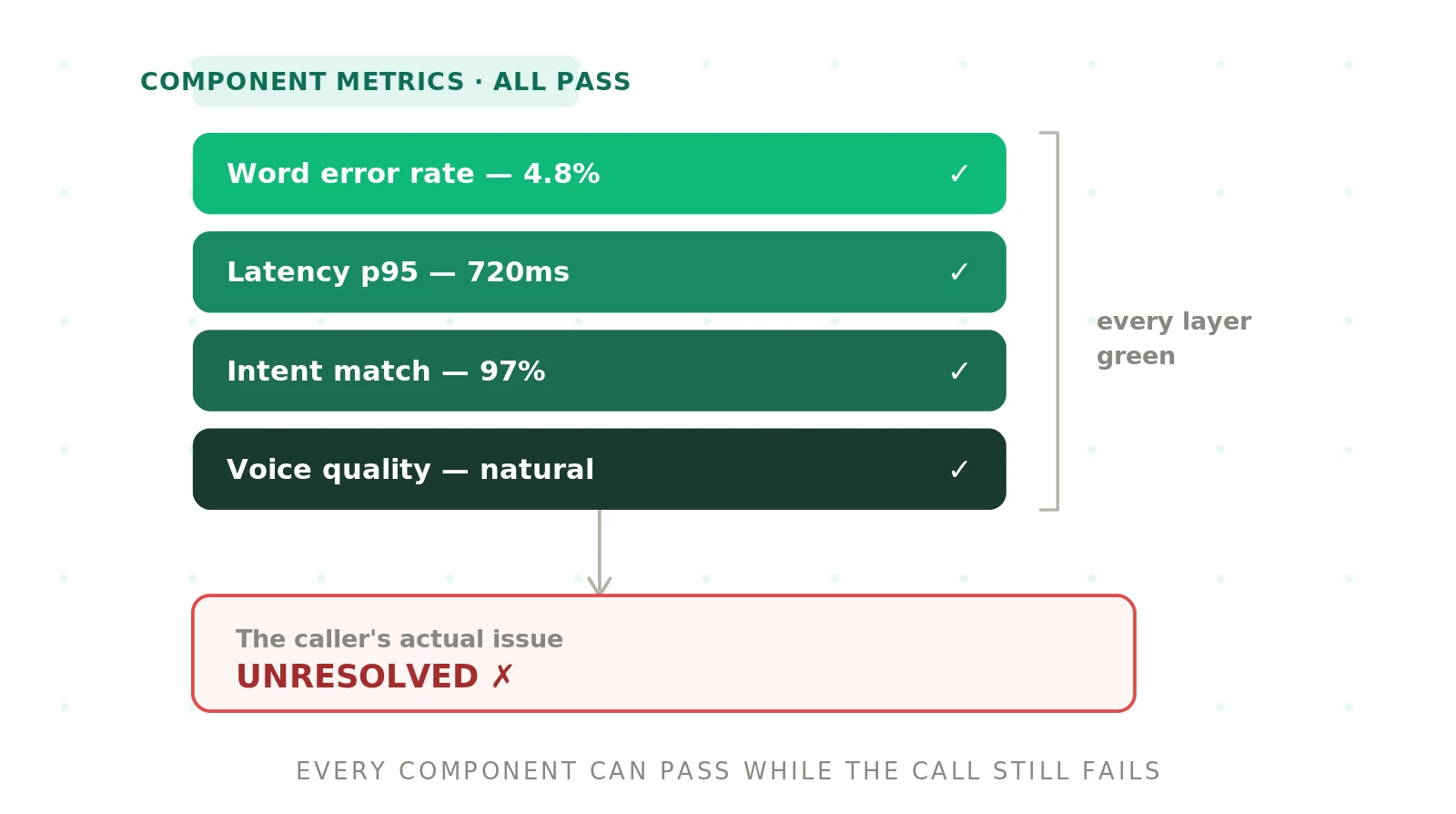
Most teams building voice agents in 2026 can tell you their agent's word error rate and its average latency. Far fewer can tell you whether it actually resolved the caller's problem, escalated when it should have, or held up when someone talked over it in a noisy car. That gap is the whole problem with voice agent evaluation. The numbers that are easy to measure are not the numbers that decide whether the agent is good. The ones that matter are spread across a stack of components that each fail in their own way.
This guide is the complete picture. What voice agent evaluation is, and why it differs fundamentally from evaluating a text chatbot or a bare language model. The layers you have to measure, the metrics that actually predict success, and a step-by-step framework for an evaluation pipeline you can trust before you ship. It is the foundation the rest of our AI voice agent testing work builds on.
What is voice agent evaluation?
Voice agent evaluation is the practice of measuring, systematically and repeatably, whether an AI voice agent does what it is supposed to do. It answers a deceptively simple question: is this agent good enough to put in front of callers? It gets there by breaking that question into measurable parts — did it hear the caller correctly, understand the intent, take the right action, respond quickly enough, sound natural, and resolve the issue.
It is worth separating evaluation from testing, because the terms get used loosely. Testing is the act of running the agent against scenarios; evaluation is the judgment of the results against a standard. In practice they interlock — you test in order to evaluate — and our testing vs evaluation guide draws the line in detail. The important thing is that evaluation is about a verdict, not just activity: a pass/fail, a score, a comparison against the previous version.
Why voice agent evaluation is different
If you have evaluated a text LLM or a chatbot, some of this transfers — but the parts that do not are the parts that break voice agents in production. Three differences matter most.
First, the input is audio, not text. Before the language model sees anything, speech has to be transcribed, and that transcription is lossy. A misheard word, a dropped digit, an accent the recognizer struggles with — all of it corrupts the input before reasoning even begins. Evaluating only the text layer hides this entirely, which is why why voice agents fail in production so often comes down to acoustic conditions a demo never reproduced.
Second, conversation is real-time and full-duplex. A caller can interrupt, pause, talk over the agent, or fall silent. The agent has to decide when the caller is done (endpointing), when to yield the floor, and how fast to start replying. None of these exist in a turn-based text interface, and each is a distinct failure mode that text evaluation cannot see.
Third, latency is part of correctness. A textually perfect answer that arrives two seconds late feels broken, because callers experience the pause, not the total reply — the distinction our latency vs response time guide unpacks. Human sensitivity to conversational delay is well established: the ITU-T G.114 telephony standard puts the comfortable one-way limit at 150ms. For a voice agent, timing is not a performance footnote; it is a quality dimension you must evaluate directly.
The voice agent evaluation stack
A voice agent is a pipeline, and evaluation has to cover every layer, because a failure in any one sinks the call. Measuring the whole and calling it "accuracy" hides where the problem actually is.
Speech recognition (STT/ASR). The transcription layer. Measured primarily with word error rate and its cousins — see STT evaluation and the WER vs CER guide — but raw WER understates the impact of errors on critical entities like names, dates, and dollar amounts, so weight those separately. Vendor benchmark numbers are measured on clean audio, so treat them as a ceiling, not the accuracy you will see on real calls.
Understanding. Whether the agent correctly extracted the caller's intent and the entities inside it. An agent can transcribe a sentence perfectly and still route the wrong intent.
Dialogue and task success. The layer that actually matters to the business: did the agent take the right actions, follow policy, call the right tools, and resolve the issue. This is where "no human involved" gets confused with "problem solved" — the trap our containment vs deflection guide warns about.
Voice output (TTS). Whether the agent's speech is natural, correctly pronounced, and appropriately paced. Covered in depth in TTS evaluation.
Latency and timing. Time to first audio, turn duration, and interruption handling, all measured at percentiles rather than averages.
Safety and guardrails. Whether the agent refuses out-of-scope requests, resists prompt injection, and escalates appropriately — the difference between guardrails and evaluation is drawn in our guardrails vs evals guide.
Offline evaluation vs online evaluation
Voice agent evaluation happens in two distinct modes, and you need both.
Offline (pre-production) evaluation runs the agent against a fixed set of scenarios in a controlled environment, before any real caller is exposed. This is where regression testing lives: a suite of scenarios and caller profiles you run on every change, so you catch breakage before it ships. You cannot wait for thousands of real callers to hit every edge case. So offline evaluation depends on synthetic callers — simulated voices with varied accents, pace, and behaviour — and on stress testing the agent against difficult, adversarial, and high-concurrency conditions.
Online (production) evaluation measures the agent against real traffic once it is live. This is the domain of observability, borrowing the discipline of production monitoring: sampling real calls, scoring them, tracking metric drift, and catching the failures your scenario suite never imagined. Offline evaluation tells you whether a change is safe to ship; online evaluation tells you whether reality agrees. Teams that skip either one ship blind in one direction — and the A/B testing that compares two live versions sits squarely in the online half.
| Mode | When it runs | Catches | Depends on |
|---|---|---|---|
| Offline | Before release, on every change | Regressions before they ship | Scenario suite, synthetic callers |
| Online | Continuously, in production | Failures the suite never imagined | Live sampling, scoring, drift alerts |
Metrics that actually matter
The metrics worth gating on are the ones that predict a good caller experience, not the ones that are easiest to compute.
Task success rate — the share of calls where the caller's actual goal was accomplished — is the headline number, because everything else is a means to it. Resolution rate and escalation accuracy keep containment honest, so a high automation rate does not hide trapped callers. Word error rate, especially on critical entities, gates the input quality. Latency at p90 and p95 gates responsiveness, since the tail is what callers feel. And safety pass rate — refusals, injection resistance, policy adherence — gates the failures that make headlines.
Notice what is missing: vanity metrics like total calls handled or average handle time, which move in the wrong direction just as easily when an agent is failing. Evaluate outcomes, not activity.
The role — and limits — of LLM-as-judge
Much of 2026 voice agent evaluation leans on LLM-as-judge: using a language model to score whether a response was correct, helpful, or on-policy. It scales in a way human review never could, and for many subjective dimensions it is genuinely useful.
But it has real limits, and treating its scores as ground truth is a mistake. An LLM judge evaluating a transcript never hears the audio, so it misses mispronunciation, awkward pacing, and the pause that made the call feel broken. Research on the approach documents position bias, verbosity bias, and inconsistency — it can be gameable and confidently wrong on exactly the edge cases you most need to catch. Our LLM-as-judge limits piece covers this in full. The honest approach uses LLM judges for scale on subjective dimensions, deterministic checks for anything you can assert directly, and human review for the calls that matter most — not any one of the three alone.
How to build a voice agent evaluation pipeline
A dependable evaluation setup follows the same shape whatever your stack. Here is the framework.
1. Define what success means — Write down the outcomes that count: task resolved, correct action taken, policy followed. Evaluation is meaningless until you have named the standard you are judging against.
2. Build a scenario suite — Assemble representative calls, including the hard ones: edge cases, angry callers, noisy lines, out-of-scope requests. Cover the situations real callers create, not just the happy path.
3. Vary caller profiles — Run each scenario across accents, speaking pace, and background noise, so you evaluate the agent your real callers will meet, not an idealized one.
4. Measure every layer — Capture STT accuracy, intent, task success, latency, and voice quality separately, so a failure points to the component that caused it.
5. Combine judge types — Use deterministic checks for hard assertions, LLM-as-judge for subjective scoring, and human review for high-stakes calls. No single judge covers everything.
6. Run it in CI, gate on it — Make the suite run on every change and block releases that regress, so evaluation catches breakage before callers do — the same discipline our LLM update regression work depends on.
7. Close the loop with production — Feed real failures back into the scenario suite, so online evaluation continuously sharpens offline coverage.
Common voice agent evaluation mistakes
The failures repeat across teams. Evaluating only the text layer and never the audio, so acoustic problems ship undetected. Reporting average latency instead of the tail, which hides the calls that felt broken. Treating containment as success without checking resolution. Trusting an LLM judge's score as if it were ground truth. Testing only the happy path, so the first angry caller finds the edge case in production. And running evaluation once before launch rather than on every change, so the tenth model update quietly regresses what the first one got right. Each one is avoidable, and each one is common.
What's new in voice agent evaluation in 2026
Two shifts stand out this year. First, speech-to-speech models — agents that skip the separate transcription step — have moved evaluation away from pure WER toward end-to-end task and conversational measures, because there is no clean transcript to score in the middle. Second, real-time online evaluation has become standard rather than aspirational, part of the broader move toward evaluation-driven development: teams now score a sample of live calls continuously and alert on drift, instead of relying on a pre-launch suite alone. Industry surveys like Deepgram's State of Voice AI report track how fast production deployments — and the evaluation demands on them — are growing. The through-line is that evaluation has moved closer to production and closer to outcomes, and away from component metrics measured once in a lab.
The voice agent evaluation tooling landscape
The tooling splits into two camps, and the split matters. General LLM-evaluation platforms score text traces well, but they were built for chat and stop at the transcript, so they miss the acoustic, timing, and turn-taking layers a phone call introduces. Voice-specific platforms run the actual call and evaluate what the caller hears. The deciding question for a voice agent is simple: does the platform hear the audio, or only read the transcript? Evaluation that stops at text cannot catch the failures that live in sound.
Voice agent evaluation with Evalgent
Evalgent is a voice agent evaluation platform built for the acoustic and behavioural layers that text-only tools skip. It runs realistic conversations against your agent, over real audio, and measures what the caller actually experiences. Five primitives carry the workflow.
- Scenarios define real-world test conversations, from happy paths to hostile and out-of-scope callers.
- Profiles vary caller persona, accent, pace, and line quality, so a clean-audio pass cannot hide the cohorts that struggle.
- Metrics measure every layer — transcription accuracy, task success, escalation, latency at percentiles, voice quality — against custom, per-scenario thresholds instead of one collapsed number.
- Evaluations run the whole suite as automated batches of synthetic callers, at concurrency, on every change.
- Reviews let your team replay any call with audio, transcript, and metrics side by side, to hear what a score is really measuring.
Together they turn voice agent evaluation into a repeatable release gate: you define the calls that scare you, run them on every change, gate on the outcome, and ship only when the agent passes. Judges combine deterministic checks, LLM scoring, and human review, so no single method's blind spot decides the verdict. Outcomes measured directly, every layer visible, the same suite guarding every release.
The bottom line
Voice agent evaluation is the systematic measurement of whether a voice agent works — across speech recognition, understanding, dialogue, task success, latency, and voice quality. It is different from text or LLM evaluation because the input is lossy audio, the conversation is real-time, and timing is part of correctness.
Do it across the whole stack, in both offline and online modes, gating on outcomes rather than vanity metrics, and combining judge types rather than trusting any one. The teams that ship reliable voice agents in 2026 are not the ones with the best demo — they are the ones whose evaluation catches the failure before the caller does.
Frequently asked questions
What is voice agent evaluation?
Voice agent evaluation is the systematic measurement of whether an AI voice agent performs correctly across its full pipeline: speech recognition, understanding, dialogue, task completion, latency, and voice quality. It produces a verdict — a score, a pass/fail, or a comparison against a previous version — rather than just running the agent, and it spans both pre-production testing and live production monitoring.
How is voice agent evaluation different from LLM evaluation?
LLM evaluation judges text in and text out. Voice agent evaluation adds three things text lacks: lossy audio input that must be transcribed before reasoning, real-time full-duplex conversation with interruptions and turn-taking, and latency as a correctness dimension. A textually perfect answer can still fail if the agent misheard the caller, talked over them, or replied too slowly.
What metrics matter most for voice agents?
Task success rate is the headline metric, since everything else serves it. Pair it with resolution rate and escalation accuracy to keep automation honest, word error rate on critical entities to gate input quality, latency at p90 and p95 to gate responsiveness, and safety pass rate for refusals and policy adherence. Avoid vanity metrics like total calls handled.
What is the difference between offline and online evaluation?
Offline evaluation runs the agent against a fixed scenario suite before production, catching regressions before they ship. Online evaluation scores real calls in production, catching failures the suite never imagined and tracking metric drift. You need both: offline tells you a change is safe to ship, online tells you whether reality agrees. Skipping either ships you blind in one direction.
Can you use LLM-as-judge to evaluate voice agents?
Yes, but not alone. LLM-as-judge scales subjective scoring in a way human review cannot, and it is useful for judging helpfulness or policy adherence. But it never hears the audio, so it misses pronunciation and pacing, and it can be inconsistent or gameable. Combine it with deterministic checks for hard assertions and human review for high-stakes calls.
How do you test a voice agent before production?
Build a scenario suite covering realistic and difficult calls, run it across varied caller profiles for accent, pace, and noise, and measure every layer separately — transcription, intent, task success, latency, and voice quality. Use synthetic callers to reach edge cases at scale, run the suite in CI, and gate releases on the results so regressions are caught before callers meet them.
Why is latency part of voice agent evaluation?
Because callers experience timing as quality. A pause before the agent replies feels like the agent froze, even if the eventual answer is perfect. Latency — specifically time to first audio, measured at the tail percentiles rather than the average — is therefore a correctness dimension you must evaluate directly, not a performance detail you can defer until after functional testing.
How often should you evaluate a voice agent?
Continuously, in two ways. Run the offline scenario suite on every change — every prompt edit, model swap, or config update — and gate releases on it, since regressions creep in with each update. In production, score a sample of live calls on an ongoing basis and alert on drift. Evaluating once before launch leaves you blind to everything that changes afterward.
Related Articles
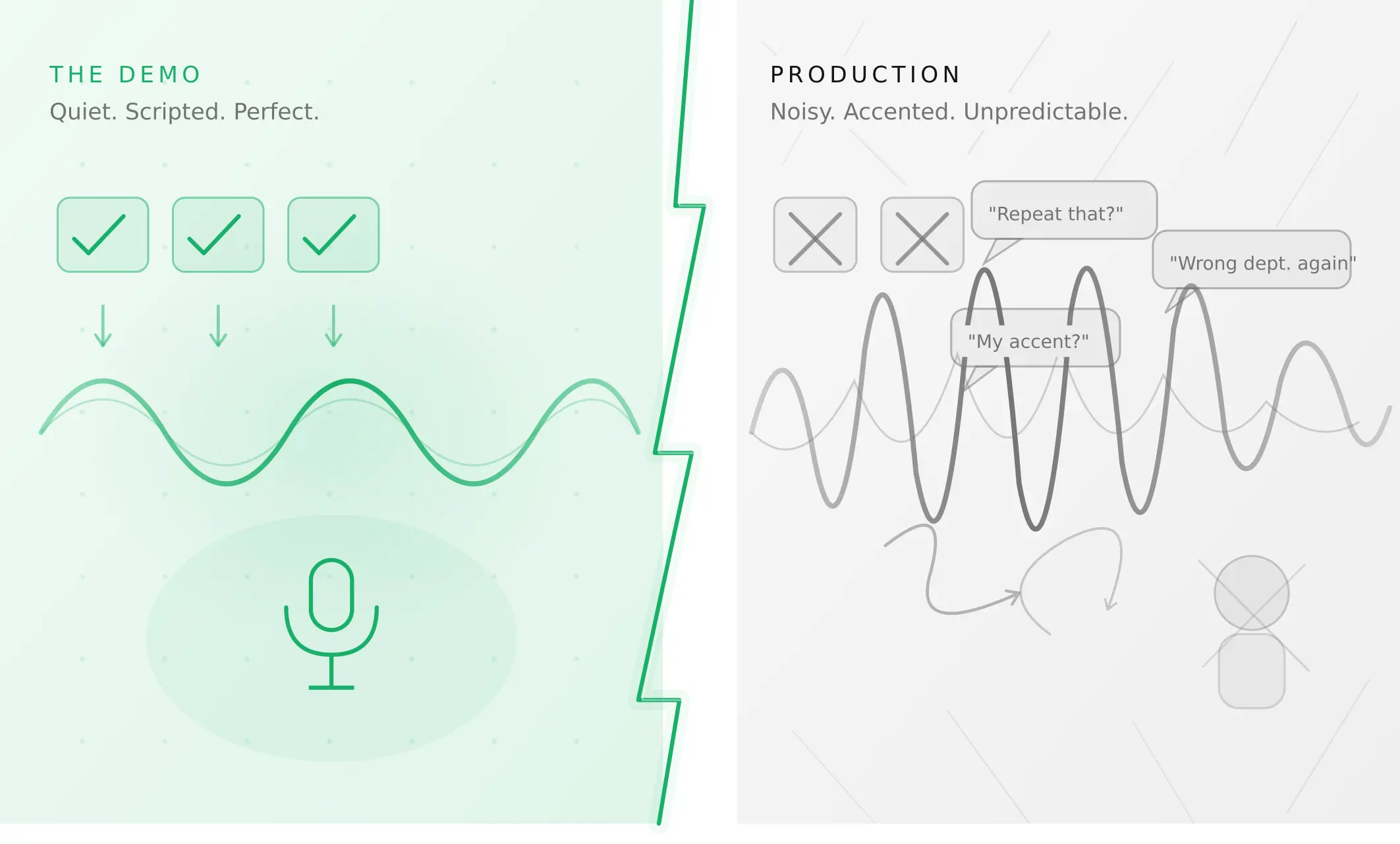
Why AI voice agents fail in production (and how to prevent it)
AI voice agents that ace demos still break in production. Learn the 5 root causes, how to test for each, and what production readiness actually means.
Read more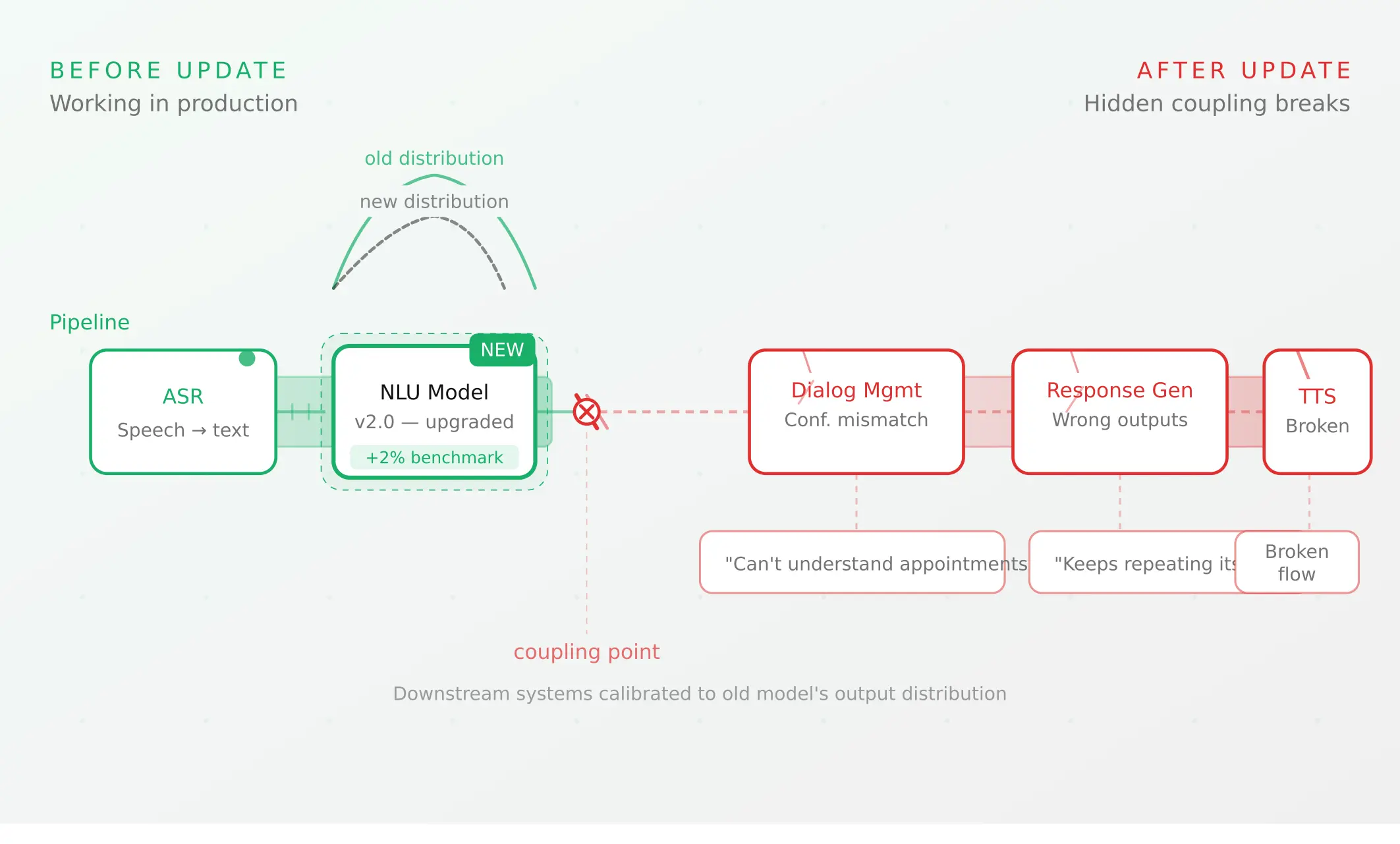
Voice agent regression testing: why LLM updates break production
LLM updates improve benchmarks but break voice agents in 5 predictable ways. How to detect and prevent regressions after every model or prompt change.
Read more