Test your voice agent
Transcript vs Audio Evaluation for Voice Agents (2026)
# Transcript vs audio evaluation for voice agents
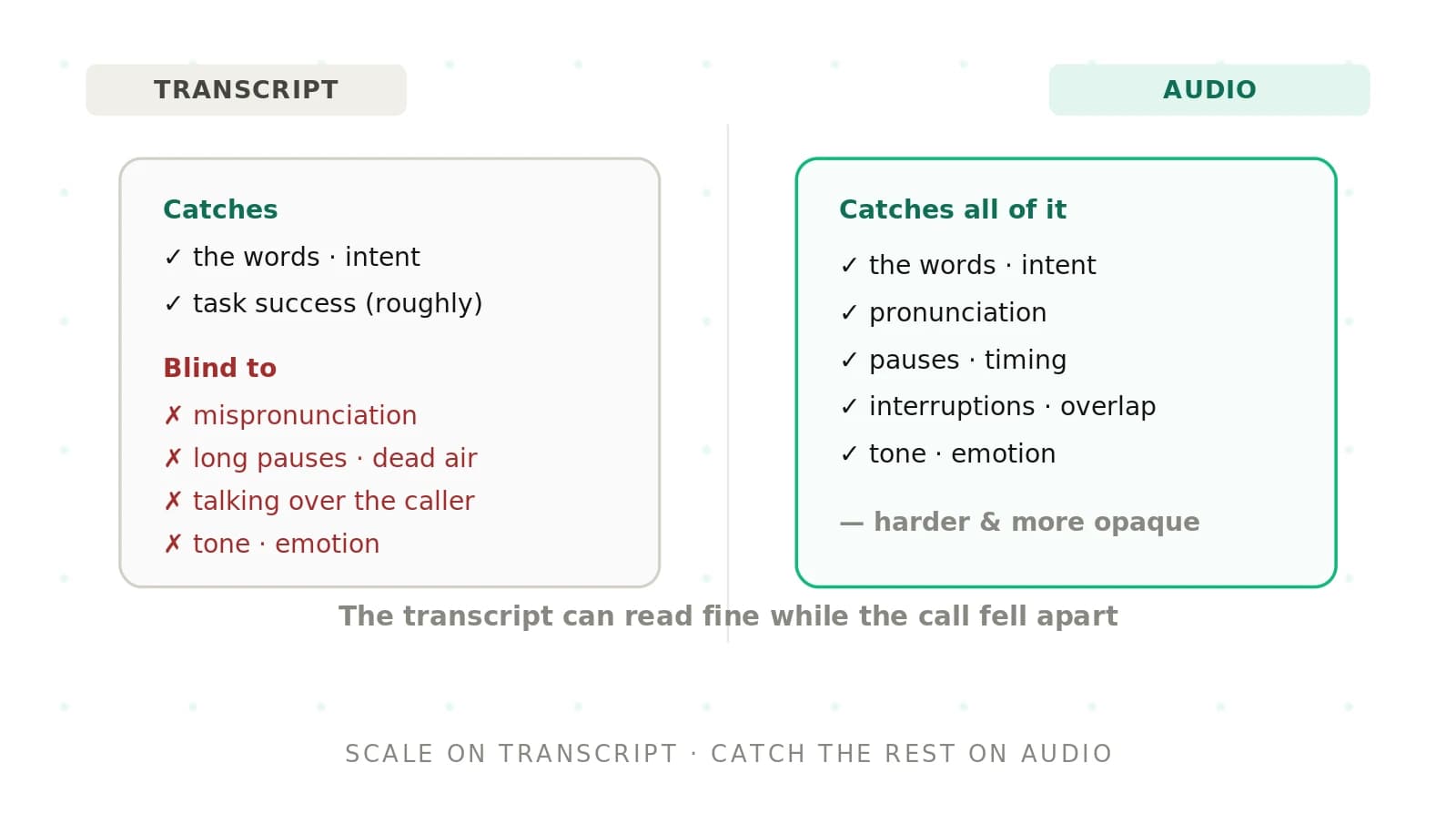
Every voice agent produces two artifacts you can grade. There is the transcript, a clean line of text, and there is the audio, the actual sound the caller heard. Grading the transcript is fast, cheap, and easy to automate. Grading the audio is slower, harder, and more opaque. Most teams reach for the transcript because it is right there. Then a caller complains about something the transcript never showed.
That gap is the whole subject of this article. A transcript and its audio can tell two different stories about the same call. The words can be correct while the delivery falls apart. This piece compares transcript versus audio voice agent evaluation head to head. What each catches, what each misses, when to use which, and how to combine them. It builds on our broader voice agent evaluation guide and narrows in on one decision.
What transcript evaluation actually measures
Transcript evaluation grades the text of a call. You take the words the agent said and the words the caller said, then score them. Did the agent answer the question? Did it follow policy? Did it call the right tool? These are real, important questions, and text answers them well.
The appeal is obvious. Text is small, structured, and trivial to store. You can run thousands of transcripts through automated checks in seconds. You can search them, diff them, and feed them to a language model to judge at scale. This is why transcript evaluation dominates. It fits the tools teams already own.
Most transcript scoring leans on either deterministic rules or an LLM judge. Rules check for exact strings, required disclosures, or forbidden phrases. A judge reads the transcript and rates helpfulness or tone. Both are useful. Both share one blind spot: the transcript is not the call.
What the transcript quietly throws away
A transcript is a lossy compression of a conversation. The moment speech becomes text, a lot of signal disappears. Some of what it drops decides whether the call felt good or broken.
Pronunciation. The transcript says "Dr. Nguyen." It cannot tell you the agent mangled the name. A mispronounced word reads as correct text while sounding wrong to the caller.
Pacing and timing. The transcript shows the reply. It does not show the two-second pause before it. The comfortable one-way delay limit is around 150ms per the ITU-T G.114 standard. A perfect answer delivered late still feels like the agent froze. Our latency versus response time guide unpacks why the pause, not the total, is what callers feel.
Tone and prosody. Prosody) — the rhythm, stress, and intonation of speech — carries meaning text cannot. "Sure, I can help with that" can sound warm or robotic. The transcript is identical either way.
Paralanguage. The wider layer of paralanguage — sighs, filler, hesitation, emphasis — shapes how the caller reads intent. A transcript flattens all of it into neutral words.
Overlap and turn-taking. When the agent and caller talk at once, the transcript often serializes them into tidy turns. The actual collision, and who yielded, is lost.
Failed barge-in. A caller interrupts to correct the agent. The agent should stop and listen. If it plows on, the transcript may still show both lines in order, hiding the fact that the agent ignored the interruption entirely.
None of these are edge cases. They are the exact failures that make a technically correct agent feel unusable on a real phone line.
What audio evaluation catches that transcript cannot
Audio evaluation grades the recorded call itself. Instead of reading words, you assess sound. This is the only way to catch the paralinguistic and timing failures the transcript hides.
Audio scoring can measure perceived quality directly. The mean opinion score is the classic method: listeners rate how natural and clear speech sounds. It can flag mispronunciation, because you hear the name. It can measure real latency, because the silence is in the waveform. It can detect overlap, because two voices are physically present in the signal.
Crucially, audio evaluation catches failed barge-in. You can hear the caller interrupt and hear whether the agent stopped. That single behavior separates an agent that feels conversational from one that feels like a menu tree. No transcript check reaches it.
Audio also grounds the transcript itself. Transcription is imperfect, and its accuracy is measured with word error rate. If you only ever evaluate the transcript, you inherit its errors silently. Listening to the audio is how you learn the transcript was wrong in the first place.
Why audio evaluation is harder and more opaque
If audio catches so much, why not always use it? Because it is genuinely harder to work with, and the cost shows up in several places.
Audio files are large. Storing, moving, and processing them costs far more than text. You cannot grep a waveform. You cannot diff two calls by eye. Automated audio scoring exists, but it is less mature and more expensive to run than a text check.
Audio is also more opaque to reason about. A transcript gives you a clear artifact to point at in a bug report. An audio judgment like "the pacing felt off" is harder to pin to a line and harder to reproduce. Human review of audio is slow and does not scale to thousands of calls per release.
So the trade is real. Transcript evaluation is cheap, scalable, and blind to delivery. Audio evaluation is expensive, hard to scale, and the only thing that hears the call. Neither wins outright.
Transcript vs audio evaluation, side by side
Here is the comparison in one view. Read it as a division of labor, not a contest.
| Dimension | Transcript evaluation | Audio evaluation |
|---|---|---|
| Catches | Content correctness, policy adherence, tool calls, required disclosures, intent | Pronunciation, pacing, latency, tone, prosody, overlap, failed barge-in, real audio quality |
| Misses | Pronunciation, timing, tone, overlap, barge-in, transcription errors | Nothing acoustic; content checks still need transcript alignment |
| Cost | Low — small files, fast, easy to automate at scale | High — large files, slower processing, harder to scale |
| Opacity | Transparent — a clear text artifact to point at | Opaque — judgments harder to reproduce and pin down |
| Best for | High-volume regression, content and policy gating | High-stakes calls, delivery quality, launch sign-off |
When to use transcript evaluation
Reach for transcript evaluation when the question is about content, and volume is high. It is the right default for the bulk of your suite.
Use it for regression testing on every change. When you swap a model or edit a prompt, you want fast feedback across many scenarios. Transcript checks give you that in seconds. Use it to gate policy and compliance: required disclosures, forbidden claims, correct tool calls. These are text facts, and text checks them cleanly.
Transcript evaluation is also where deterministic rules shine. Anything you can assert exactly — a confirmation number was read back, a disclaimer appeared — belongs in a rule on the transcript. It is cheap enough to run on every call, every release.
When to use audio evaluation
Reach for audio evaluation when delivery is the question, or when the stakes are high enough to justify the cost. It is not for every call, but it is essential for some.
Use it before launch, on the calls you cannot afford to get wrong. Use it whenever a metric depends on sound: pronunciation of names and drugs, latency at the tail, whether the agent handles interruption. Use it for regression checks specifically on barge-in and turn-taking, because those failures are invisible to text.
Audio is also how you audit your transcript pipeline. Periodically listen to a sample of calls your transcript checks passed. If the audio tells a different story, your transcript layer is missing something, and you have just found it.
The hybrid approach most teams should run
The honest answer is not transcript or audio. It is both, layered by cost and stakes. This mirrors the logic in our testing versus evaluation guide: use the cheap, broad method for coverage and the expensive, deep method where it counts.
The pattern is a funnel. Run transcript checks on everything, on every change, as your fast regression gate. Then run audio evaluation on a targeted subset: the high-stakes scenarios, a random sample for drift, and any call a transcript check flagged as borderline. Cheap and wide at the base, expensive and deep at the tip.
This is distinct from the narrower question of whether an LLM judge reading a transcript is trustworthy. That judge inherits every transcript blind spot and adds its own biases. Our LLM-as-judge limits piece covers that specific failure mode in depth. The transcript-versus-audio decision is the layer above it: which artifact you grade at all.
Governance frameworks push in the same direction. The NIST AI Risk Management Framework treats measurement as continuous and multi-method, not a single pre-launch check. A hybrid transcript-plus-audio setup is how that principle looks for a voice agent.
How to build a hybrid transcript and audio evaluation setup
You can stand this up in a defined sequence. Here is the framework, ordered by dependency.
1. List failures by artifact — Write down every failure you care about, then tag each as text-visible or audio-only. Pronunciation and barge-in go audio. Policy and tool calls go text. This split drives everything after it.
2. Automate transcript checks first — Build deterministic rules for hard assertions and an LLM judge for subjective content. Run these on every call, every change, as your fast base layer.
3. Define the audio subset — Decide which scenarios always get audio scoring: high-stakes flows, name and number handling, interruption tests. Keep the set small and deliberate.
4. Add a random audio sample — On top of the fixed set, pull a random slice of production calls for audio review. This catches drift your fixed scenarios never imagined.
5. Escalate borderline transcripts — When a transcript check is uncertain or flags a call, route that call to audio. The cheap layer feeds the expensive one.
6. Score audio on delivery metrics — Measure pronunciation, latency at percentiles, overlap, and barge-in success on the audio subset. Track them per scenario, not as one number, following the pattern in our voice agent metrics scorecard.
7. Close the loop — Feed audio failures back into your transcript rules where possible, and back into the fixed audio set where not. Coverage sharpens every release.
Common mistakes teams make
The failures repeat. Grading only the transcript and shipping delivery bugs is the most common. The words pass, the call sounds broken, and nobody hears it until a caller does.
The opposite mistake is rarer but real: trying to audio-review everything and drowning. Audio does not scale to thousands of calls per release, and teams that try either slow to a crawl or quietly stop. The point of the hybrid is to spend audio budget where it earns its cost.
Two more recur. Trusting the transcript as ground truth when it is itself a lossy, error-prone artifact. And measuring latency from the transcript's turn order rather than the audio's real timing, which hides the pauses callers actually feel. Both come from forgetting that the transcript is a compression, not the call. When you evaluate vendors, the same trap appears: our voice agent vendor evaluation guide shows why a text-only demo hides the acoustic failures.
Transcript vs audio evaluation with Evalgent
Evalgent is a voice agent evaluation platform built for the acoustic layer that text-only tools skip. It runs realistic conversations against your agent over real audio, then scores both the transcript and the sound the caller heard. That is the whole point: you never have to choose blind between the two artifacts. Five primitives carry the workflow.
- Scenarios define real-world test conversations, from happy paths to interruptions, hostile callers, and out-of-scope requests.
- Profiles vary caller persona, accent, pace, and line quality, so a clean-transcript pass cannot hide the cohorts that struggle.
- Metrics measure both layers — content and policy from the transcript, pronunciation, latency, overlap, and barge-in from the audio — against per-scenario thresholds.
- Evaluations run the whole suite as automated batches of synthetic callers, at concurrency, on every change, with audio scoring on the subset you choose.
- Reviews let your team replay any call with audio, transcript, and metrics side by side, to hear what a score is really measuring.
Together they turn the transcript-versus-audio decision into a single funnel: transcript checks on everything for scale, audio scoring where delivery and stakes demand it. You define the calls that scare you, run them on every change, and gate on the outcome. Judges combine deterministic checks, LLM scoring, and human review, so no single blind spot decides the verdict. To see it on your own agent, book a demo.
The bottom line
Transcript evaluation is cheap and scalable but blind to how the call sounds. Audio evaluation hears the delivery but costs more, so run transcript for scale and audio where the stakes are high.
Frequently asked questions
What is the difference between transcript and audio evaluation?
Transcript evaluation scores a voice agent from the text of the call, checking content, policy, and tool calls. Audio evaluation scores the recorded sound the caller actually heard. Transcript is cheap and scalable but blind to delivery. Audio catches pronunciation, pacing, tone, and interruption, at higher cost and lower scale.
Why is transcript-only evaluation risky for voice agents?
Because a transcript is a lossy compression of the call. It can show perfectly correct words while the audio was mispronounced, badly paced, or spoken over an interruption the agent ignored. Text checks pass, the call sounds broken, and nobody notices until a real caller complains about something the transcript never recorded.
What can audio evaluation catch that transcripts miss?
Audio catches everything that lives in sound rather than words: pronunciation of names and numbers, real latency and pauses, tone and prosody, overlapping speech, and failed barge-in. It also grounds the transcript itself, revealing transcription errors you would otherwise inherit silently by never listening to the underlying recording.
Is transcript or audio evaluation cheaper?
Transcript evaluation is far cheaper. Text files are small, fast to process, and easy to automate at scale, so you can run thousands of checks in seconds. Audio files are large, slower to process, and harder to scale. That cost gap is the main reason a hybrid funnel exists at all.
When should I use audio evaluation instead of the transcript?
Use audio when delivery is the question or the stakes are high. That means launch sign-off, pronunciation of critical entities, latency at the tail, and interruption handling. Also use it to audit a sample of transcript-passed calls, since that is how you discover what your text-only layer has been quietly missing.
What is the hybrid approach to voice agent evaluation?
Run transcript checks on every call and every change as a fast, wide regression gate. Then run audio evaluation on a targeted subset: high-stakes scenarios, a random production sample, and any call a transcript check flagged. Cheap and broad at the base, expensive and deep at the tip, spending audio budget where it counts.
How is this different from the LLM-as-judge question?
The LLM-as-judge question is narrower: whether a language model reading a transcript can be trusted to score it. That judge inherits every transcript blind spot plus its own biases. Transcript versus audio is the layer above it — which artifact you grade at all — and it determines whether the judge ever hears the call.
Can I measure latency from the transcript?
Not accurately. A transcript may show turns in order, but it does not encode the real silence between them. Measuring latency from turn order hides the pauses callers actually feel. True response timing lives in the audio waveform, which is why latency belongs to the audio side of a hybrid evaluation setup.
Related Articles
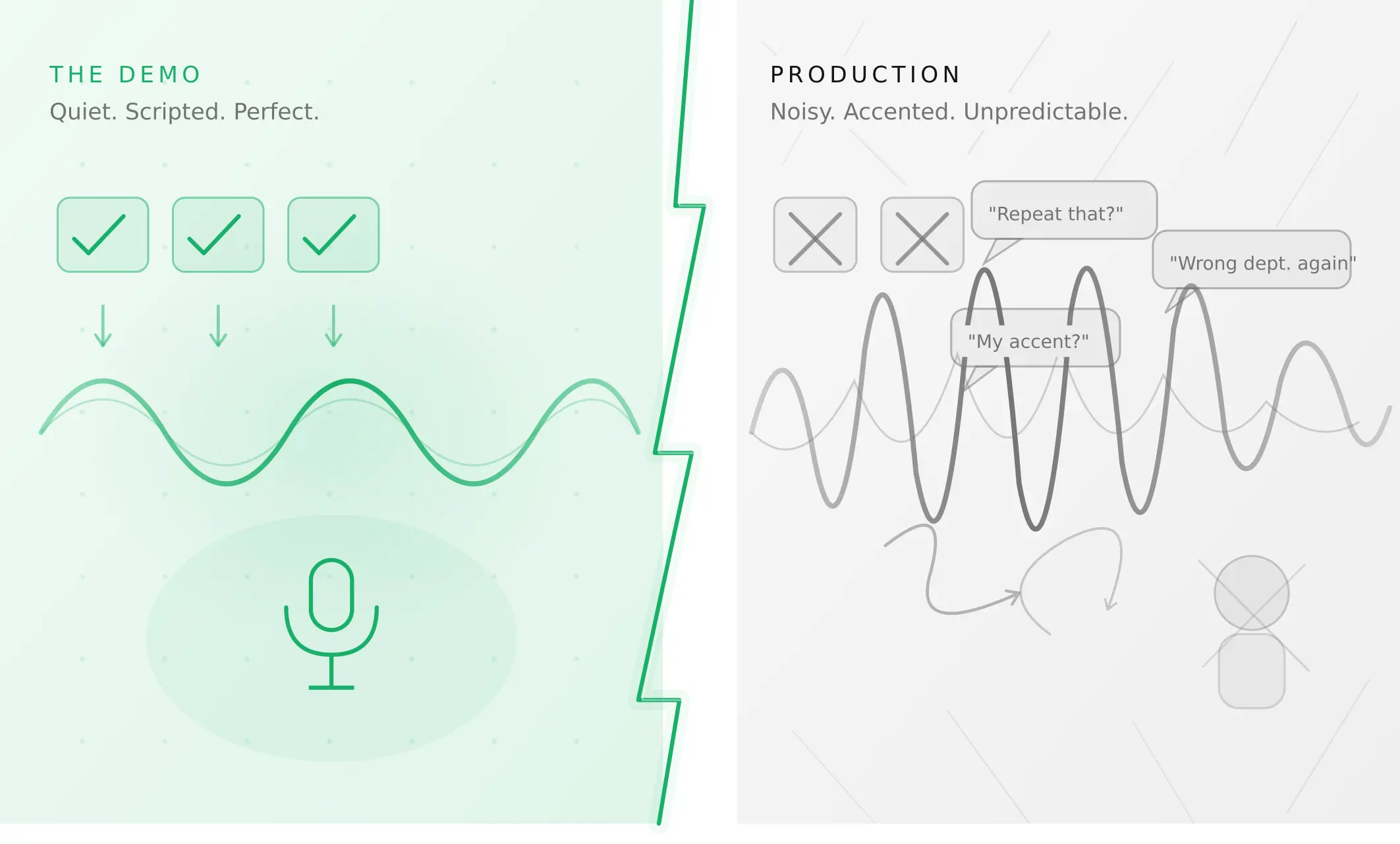
Why AI voice agents fail in production (and how to prevent it)
AI voice agents that ace demos still break in production. Learn the 5 root causes, how to test for each, and what production readiness actually means.
Read more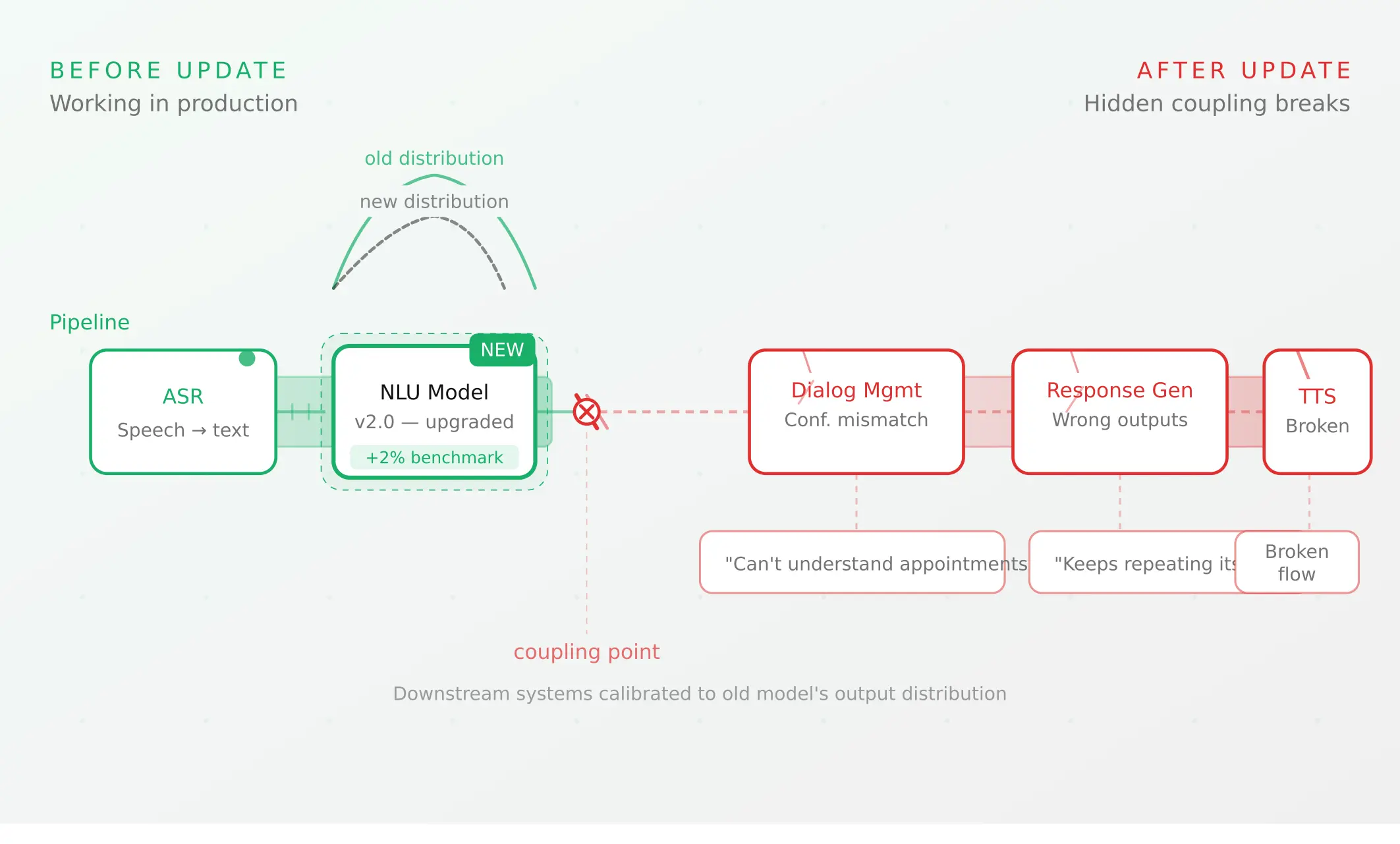
Voice agent regression testing: why LLM updates break production
LLM updates improve benchmarks but break voice agents in 5 predictable ways. How to detect and prevent regressions after every model or prompt change.
Read more