Test your voice agent
Escalation Accuracy: Measuring Good Handoffs
# Escalation accuracy: measuring good handoffs
Quick answer
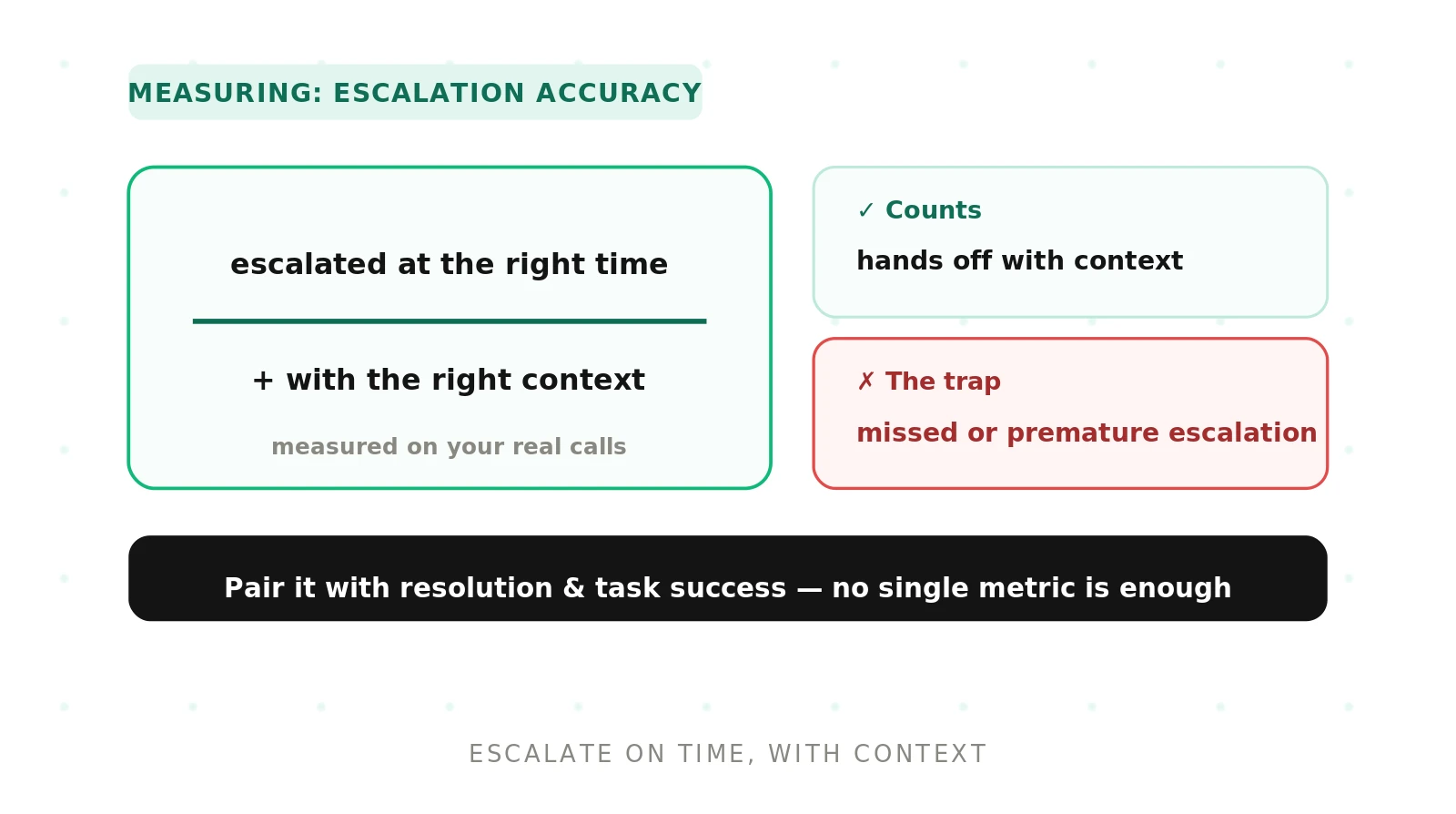
> Quick answer: Escalation accuracy for voice agents measures whether the agent handed off to a human at the right time, only when it should have, and with the right context. Frame it as precision and recall on the "should escalate" decision, score timing separately, and check that the handoff carried enough context that the human did not restart the call.
Most teams track an escalation rate. That number tells you how often the agent transfers a call. It tells you nothing about whether those transfers were correct.
A voice agent can post a healthy escalation rate while trapping frustrated callers in loops and dumping easy calls on humans. Escalation accuracy is the metric that separates a good handoff from a bad one. This post is about measuring it.
This is the metric, not the mechanism. Our escalation and handoff testing guide covers how to build the escalation paths and test the transfer itself. Here we focus on the measurement: did the agent make the right call, at the right time, with the right context.
Evalgent is an independent evaluator. We score escalation accuracy on your own call data, using labels you can defend to operations and compliance.
What escalation accuracy actually measures
> Escalation accuracy: the degree to which a voice agent escalates to a human only when it should, at the right moment, and with enough context that the human does not have to start over. It combines a decision score, a timing score, and a context score.
The word escalation hides three separate judgments. Each one fails in its own way.
The first is the decision. Should this call have gone to a human at all? The second is timing. If it should have, did the agent act before the caller gave up or the damage was done? The third is context. When the handover happened, did the human inherit what they needed?
A single "escalation rate" collapses all three into one figure. That is why it misleads. You need three lenses, not one.
We call this the escalation accuracy triad: right call, right time, right context. Score each separately, then read them together. A number that looks fine on decision can still fail on timing.
The escalate decision as precision and recall
The cleanest way to measure the decision is to treat "should escalate" as a binary classification. Every call either warranted a human or did not. The agent either escalated or did not. That gives you the four cells of a confusion matrix.
A true positive is a call that needed a human and got one. A true negative is a call the agent correctly kept and handled. The two failures are the ones that matter.
A false negative is a missed escalation. The call needed a human, and the agent kept it. The caller is trapped. A false positive is an over-escalation. The agent transferred a call it could have finished. Containment drops and human cost rises. These are the classic false positive and false negative errors, sometimes called type I and type II errors.
Now apply precision and recall to the escalate decision.
- Recall answers: of all calls that needed a human, how many did the agent escalate? Low recall means missed escalations. Callers are being trapped.
- Precision answers: of all calls the agent escalated, how many actually needed a human? Low precision means over-escalation. The agent is dumping solvable calls.
You cannot judge an agent on one alone. An agent that escalates everything has perfect recall and terrible precision. An agent that escalates nothing has perfect precision on the calls it never sent and zero recall. Report both, and pair them with an F-score if you want a single balance number.
Precision and recall trade off against each other. Where you set the balance depends on the stakes. A billing dispute that goes wrong is recoverable. A missed safety or fraud signal is not. Weight recall higher when a missed escalation causes real harm.
Timing: a late escalation is a failed one
A correct escalation decision made too late is still a failure. The caller has already repeated themselves four times. They are angry before the human even picks up. The decision cell says true positive. The experience says loss.
Timing is why escalation accuracy cannot be a pure classification score. You have to measure when the agent gave up, not just whether it did.
Two failure shapes matter here. The first is the late escalation: the agent kept trying long after it was clearly stuck, then transferred a burned caller. The second is the premature escalation: the agent bailed on the first sign of friction, before it had a fair chance to resolve the call. Premature handoffs look like over-escalation and quietly destroy containment.
Measure timing with concrete signals from the transcript and event log. Count the turns before escalation. Count how many times the caller repeated the same request. Flag repeated failed tool calls or repeated clarification prompts. An escalation that fires after the third identical caller utterance is late, whatever the decision score says.
Set a threshold per intent. A password reset that stalls for six turns is a different problem from a complex claim that reasonably takes longer. Judging timing without an intent-specific budget produces noise. The conversation scoring approach we use assigns these budgets per scenario so timing is graded against a fair bar.
Context completeness: the handoff the human inherits
The third lens is the one teams forget. A handoff can be correct and timely and still fail if the human has to start the call over.
Picture a warm transfer where the human agent opens with "Hi, how can I help you today?" The caller has already spent three minutes with the agent. They just explained their whole problem. Now they explain it again. That is a no-context handoff, and it is one of the loudest complaints callers have about automated systems.
Context completeness measures what the handoff carried. Score it against a checklist for the scenario:
- Caller identity and verification status. Did the human inherit who this is and whether they were authenticated?
- The reason for the call. Was the intent passed, or does the human start from zero?
- What the agent already tried. Failed steps, tools called, information gathered.
- The reason for escalation. Why the agent gave up, so the human does not repeat the same dead end.
Score each field as present, partial, or missing, then roll up to a context completeness rate per handoff. A transfer that carried identity but dropped the reason for escalation is a partial handoff, and the human wastes time rediscovering it.
Distinguish a warm handoff from a cold one when you score. A cold transfer that drops the caller into a queue with no context is the worst case. A warm transfer with a full context summary is the target. Both can be counted as "escalated" by a naive rate, which is exactly why the rate hides the problem.
Escalation outcomes, their cost, and how to detect them
Every escalation lands in one of four outcomes. Each carries a different cost and needs a different detection method. This table is the core of an escalation accuracy audit.
| Escalation outcome | What happened | Business cost | How to detect it |
|---|---|---|---|
| Correct escalation | Call needed a human and got one, in time, with full context | The intended cost of a warranted transfer | True positive on the decision, timing within the intent budget, context checklist complete |
| Missed escalation | Call needed a human but the agent kept it | Trapped caller, abandonment, complaints, safety or compliance risk | False negative: label calls that warranted a human, check whether the agent escalated |
| Premature or over-escalation | Agent transferred a call it could have finished | Lost containment, higher human cost, longer wait for the caller | False positive: label solvable calls, check for transfers before a fair resolution attempt |
| No-context handoff | Agent escalated correctly but passed little or no context | Caller repeats everything, longer handle time, lower satisfaction | Score the handoff payload against the context checklist; flag partial and missing fields |
Read the table as a whole. An agent can be strong on the first two rows and still fail the last one. That is why escalation accuracy is a set of scores, not a single rate.
How to measure escalation accuracy step by step
Follow these steps to produce a defensible escalation accuracy score for a voice agent.
1. Define the escalate rule per intent. Write down, for each scenario, what conditions warrant a human. Get operations and compliance to sign off. This is your ground truth for the decision.
2. Build a labeled test set with both classes. Include calls that should escalate and calls that should not. Without negative cases you can measure recall but never precision, and over-escalation goes undetected.
3. Run the calls through the live agent. Use realistic audio, not text. Capture the full transcript, the event log, the escalation event, and the handoff payload passed to the human.
4. Label the decision against ground truth. Mark each call true positive, true negative, false positive, or false negative. Compute precision, recall, and an F-score for the escalate decision.
5. Score timing separately. For each correct escalation, measure turns to escalation and caller repeats against the intent budget. Flag late and premature transfers even when the decision was right.
6. Score context completeness. Check the handoff payload against the scenario checklist: identity, reason, prior attempts, reason for escalation. Rate each field present, partial, or missing, then roll up.
7. Have humans review a sample. Double-label a subset to check your labels agree. Measure agreement with a statistic like Cohen's kappa so the ground truth itself is trustworthy.
8. Report the three scores together. Publish decision precision and recall, timing pass rate, and context completeness side by side. Never collapse them into one headline number.
Where escalation accuracy fits in your evaluation program
Escalation accuracy is not a standalone dashboard tile. It is one axis of a broader evaluation. It sits next to containment, resolution, and task success on a full voice agent metrics scorecard.
It also has a direct tension with containment. Every over-escalation you cut raises containment. Every missed escalation you fix lowers it. If you optimize containment alone, you push the agent toward keeping calls it should hand off. Our containment versus deflection guide explains why chasing containment in isolation backfires, and escalation accuracy is the guardrail that keeps it honest.
Measure it the way you measure any capability: as part of a structured voice agent evaluation, on real scenarios, repeatedly. A single sample is a snapshot. Escalation behavior drifts as prompts, models, and tools change, so re-score on a schedule.
Who should own the labels matters too. The team that built the agent has an incentive to define the escalate rule generously, so missed escalations look like judgment calls. This is the case for independent voice AI evaluation: a third party writes the escalate rule with operations, labels the calls without a stake in the score, and reports the failures plainly. Escalation accuracy is only as good as the ground truth behind it.
Start with the highest-stakes intents. Fraud, safety, and disputes are where a missed escalation does the most damage, so their recall deserves the tightest bar. Lower-stakes intents can tolerate more over-escalation while you tune. Set the balance deliberately, per intent, and write it down.
Frequently asked questions
How do you measure escalation accuracy for voice agents?
Measure it in three parts. Score the escalate decision as precision and recall against a labeled ground truth of calls that should and should not escalate. Score timing by counting turns and caller repeats before the handoff against an intent budget. Score context completeness against a handoff checklist. Report all three together rather than as one number.
What is a missed escalation in a voice agent?
A missed escalation is a call that warranted a human, but the agent kept handling it. In classification terms it is a false negative on the "should escalate" decision. The caller is trapped, often repeating themselves or abandoning the call. Missed escalations are the most damaging failure because they hide inside a healthy-looking containment rate.
How do you detect over-escalation?
Detect over-escalation by labeling calls the agent could have finished, then checking which ones it transferred anyway. Each unnecessary transfer is a false positive on the escalate decision, which lowers precision. Over-escalation also shows up as premature handoffs that fire on the first sign of friction. Without negative test cases you cannot measure it at all.
Why did my voice agent escalate too late?
Late escalation usually comes from an agent that keeps retrying a failing path instead of recognizing it is stuck. The decision was right, but the timing was wrong. Detect it by counting turns to escalation and repeated caller utterances against an intent-specific budget. An escalation after the third identical request is late, whatever the decision score says.
How do you measure handoff context completeness?
Score the handoff payload against a scenario checklist: caller identity and verification status, the reason for the call, what the agent already tried, and why it escalated. Rate each field present, partial, or missing, then roll up to a context completeness rate. A handoff that forces the human to ask "how can I help?" again scores poorly.
Is escalation accuracy the same as escalation rate?
No. Escalation rate is how often the agent transfers a call. Escalation accuracy is whether those transfers were correct, timely, and context-complete. A high escalation rate can hide both missed escalations and over-escalations. Rate is a volume metric; accuracy is a quality metric. You need accuracy to know whether the rate is good or bad.
How do precision and recall apply to escalation?
Treat "should escalate" as a binary decision. Recall is the share of calls that needed a human that the agent actually escalated; low recall means missed escalations. Precision is the share of escalated calls that truly needed a human; low precision means over-escalation. Report both, since an agent can max one by sacrificing the other, plus an F-score for balance.
What is a warm handoff versus a cold handoff?
A warm handoff transfers the caller to a human along with context: identity, intent, prior attempts, and the reason for escalation. A cold handoff drops the caller into a queue with none of that. A naive escalation rate counts both as the same event. Context completeness scoring separates them, which is why cold transfers score as no-context handoffs.
The bottom line
Escalation accuracy measures whether a voice agent handed off at the right time, only when it should, and with the right context. Score the decision with precision and recall, grade timing and context separately, and never trust a raw escalation rate to tell you any of it.
Ready to see where your agent traps callers or dumps easy calls? Book a demo and Evalgent will audit your escalation accuracy as an independent third party.
Related Articles
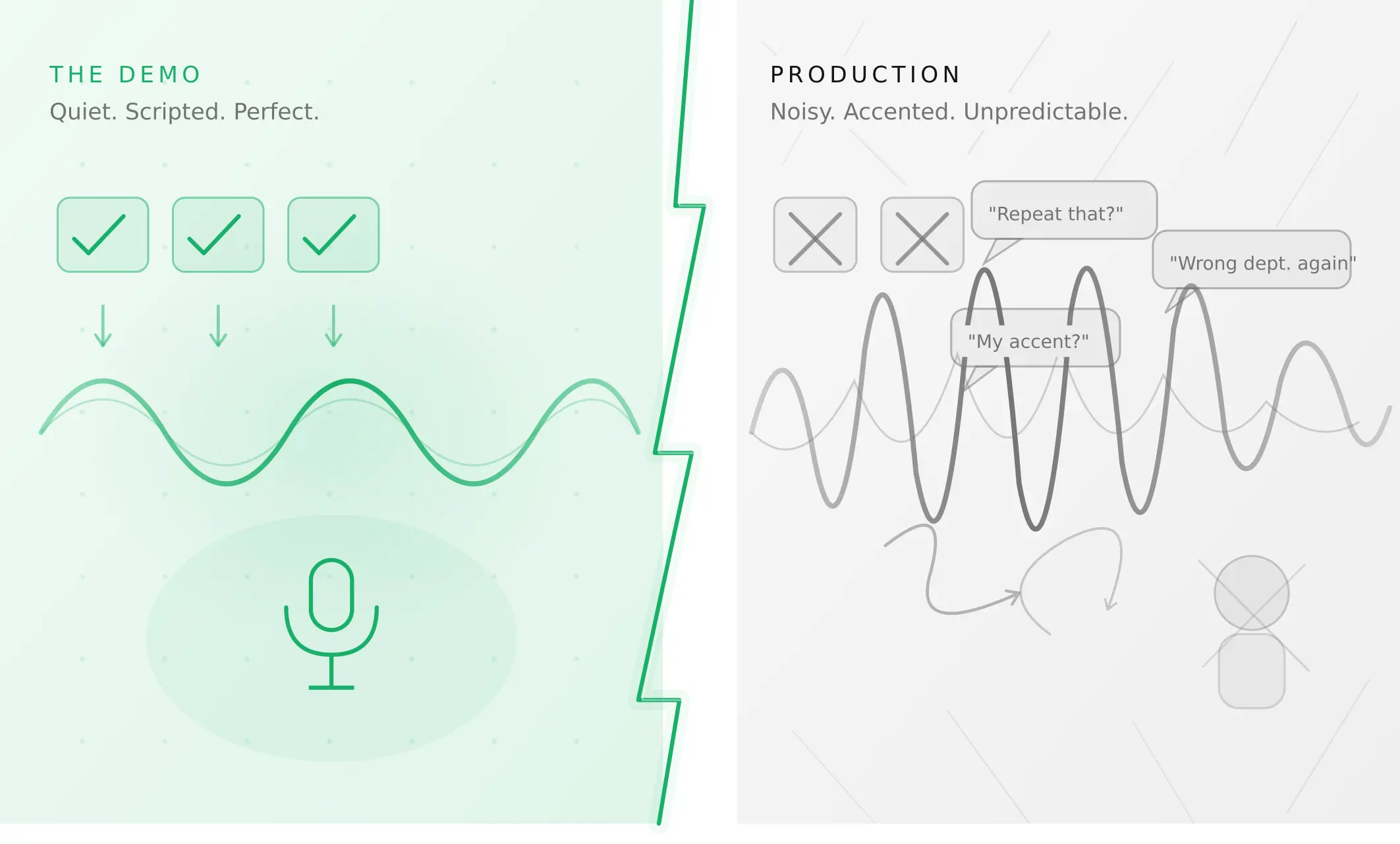
Why AI voice agents fail in production (and how to prevent it)
AI voice agents that ace demos still break in production. Learn the 5 root causes, how to test for each, and what production readiness actually means.
Read more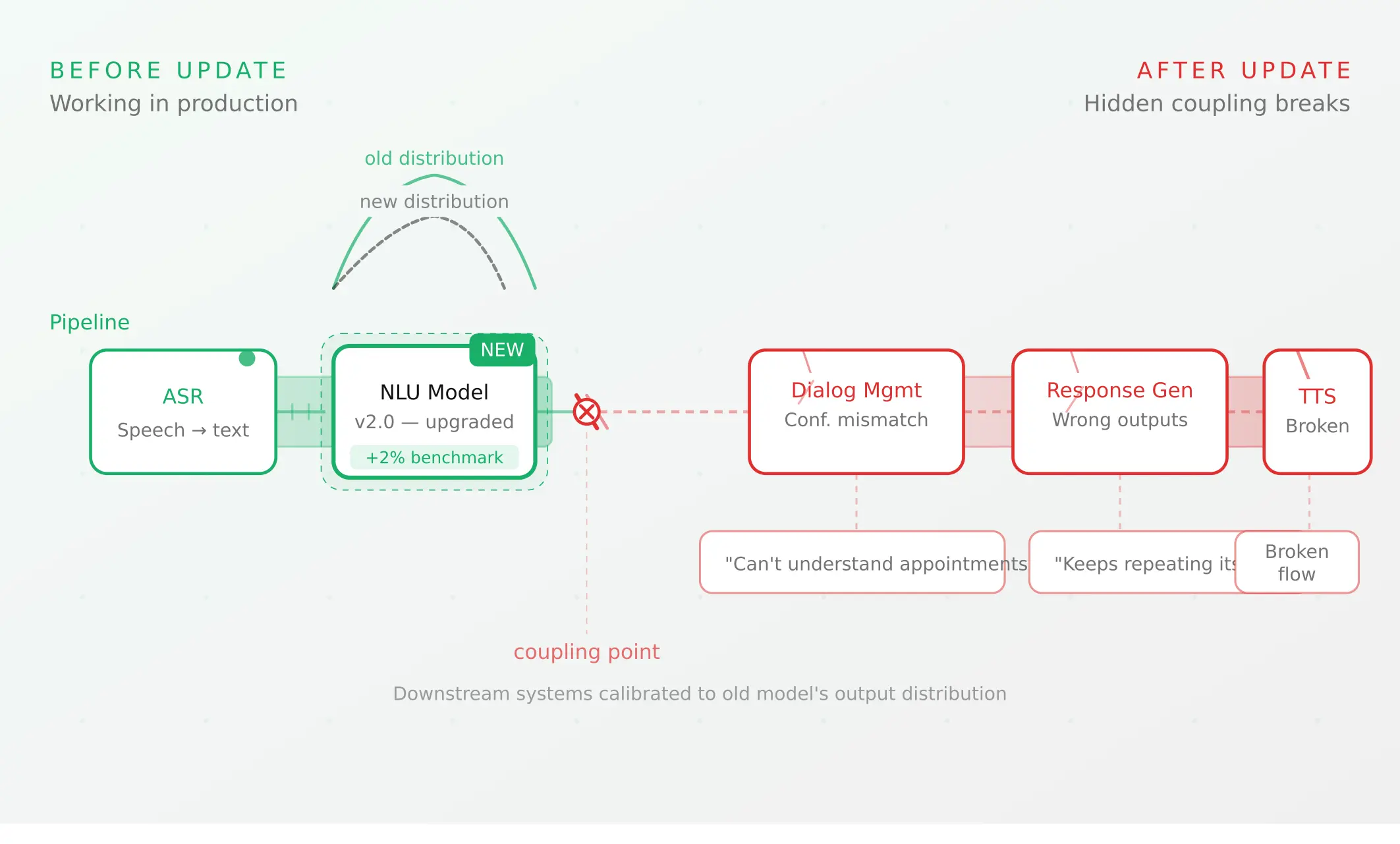
Voice agent regression testing: why LLM updates break production
LLM updates improve benchmarks but break voice agents in 5 predictable ways. How to detect and prevent regressions after every model or prompt change.
Read more