Test your voice agent
Jev for Voice Agent Evaluation: Calibrated Scoring at Scale
# Jev for voice agent evaluation: calibrated scoring at scale
Quick answer
Jev voice agent evaluation turns each call transcript into a state, then asks many scoring questions in one call. It returns typed, calibrated decisions in 70–500ms. Its killer feature is calibrated confidence, which tells you which scores to trust and routes the rest to humans. Jev is a scorer, not independent evidence.
Most teams still grade voice agents with an LLM-as-judge on a thin sample of calls. It is slow, expensive, and noisy. Jev changes the math on all three.
Jev launched on September 15, 2026, in early access. TypeSafe AI calls it the first "System One Model." It does not write text. You send it a state and questions, and it returns decisions. This post shows how to use jev for voice agent evaluation as a fast, calibrated scoring engine, where it wins, and where it must not stand in for independent audit.
What Jev actually does in an evaluation
Jev is not an LLM. It does not generate explanations or freeform critique. Instead, it takes a state and returns typed, probabilistic answers with calibrated confidence.
> Jev: a System One model that maps a state plus questions to typed probabilistic decisions with calibrated confidence. It classifies and scores; it does not generate language.
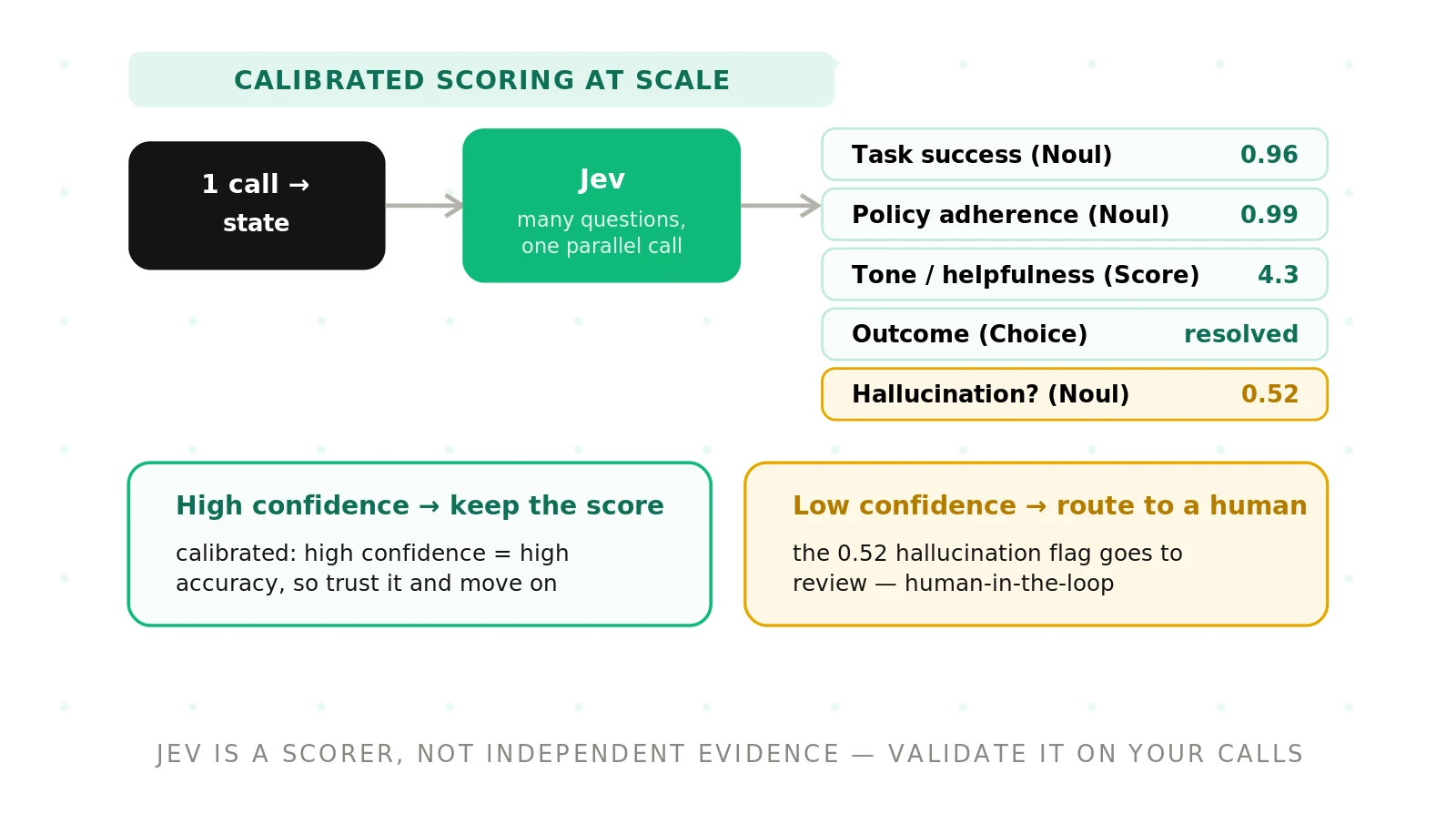
For evaluation, the state is one call. That means the transcript, plus any structured data you attach, such as the intent, tools called, or CRM outcome. You then ask questions about that state.
Jev answers three question types. Each maps to a common evaluation need.
- Choice picks one of up to 255 options. It returns a probability per option plus a confidence score. Use it for outcome labels like resolved, escalated, or abandoned.
- Score returns an ordered rating, such as low, medium, or high. It gives a continuous score, a distribution, and confidence. Use it for tone, helpfulness, or clarity.
- Noul returns a yes-or-no probability. Use it for pass/fail rules like task success or a specific disclosure.
The important part for scale: you can ask many questions about one state in a single parallel call. Grading a call on twelve dimensions costs barely more latency than grading it on one. This is what makes full-coverage scoring practical.
Turn one call into many scores
Here is the mental model. Each call becomes a state. Each rubric line becomes a question. One request returns the whole scorecard.
Say your rubric has these dimensions for a support agent:
- Task success — did the agent resolve the caller's stated goal? (Noul)
- Disclosure adherence — did it read the recording notice? (Noul, one per required rule)
- Tone and helpfulness — how warm and useful was the agent? (Score)
- Outcome — resolved, escalated, or abandoned? (Choice)
- Hallucination present — did it state an unsupported fact? (Noul)
- Compliance risk — did it promise something out of policy? (Noul)
You send the transcript once with all six questions attached. Jev returns six typed answers, each with its own confidence. On our test runs this lands in well under a second. Because Jev cannot hallucinate and produces 0% type errors, a Noul is always a valid probability and a Choice always lands inside your option set.
This structure suits scoring a voice agent conversation far better than a free-text judge. You get machine-readable fields you can aggregate, chart, and alert on. You do not get a paragraph you then have to parse.
Why calibrated confidence is the killer feature
Speed and cost get the headlines. Calibration is what makes Jev useful as an evaluator.
> Calibrated confidence: when the model reports 0.9 confidence, it is right about 90% of the time. Higher confidence means higher accuracy.
TypeSafe reports that Jev is calibrated and that higher confidence maps to higher accuracy. See the definition of calibration in statistics) for the formal idea. The practical payoff is a triage signal built into every score.
A raw LLM judge gives you a label with no honest sense of its own reliability. Jev gives you a label and a trustworthy confidence number. So you can split every judgment into two buckets. High-confidence scores you accept automatically. Low-confidence scores you route to a person.
That is confidence-gated review, and it is the heart of good calibrated scoring for voice agents. You spend human attention only where the model is unsure. The human-in-the-loop pattern stops being a cost center and becomes a targeted safety net.
Calibration is not a guarantee per call. A 0.95 score can still be wrong. But across thousands of calls, a calibrated model lets you set a threshold and know roughly how much you are catching.
What the independent testing found
LangChain published independent testing of Jev as an evaluator, titled "Can Jev Be a Better Agent Evaluator?" The full write-up is here. The numbers are notable.
As a judge, Jev's quality-score variance was 92–913x lower than GPT-5.6 Luna and Terra and Claude Sonnet 4.6. Lower variance means more consistent scores across repeated runs. That consistency matters for inter-rater reliability: a scorer that disagrees with itself cannot agree with anyone.
The cost and speed gap was just as wide. Jev averaged 0.44 seconds and $0.00035 per call. LangChain's total for the run was $0.34 with Jev versus $28.17 with Claude. Attribute these figures to LangChain, not to us.
Cheap, fast, consistent scoring is exactly what full-coverage evaluation needs. It is why you can move from a sample to scoring every call, not a sample. When judgment costs a fraction of a cent, grading 100% of calls stops being a budget question.
The eval dimension to question-type map
Every evaluation dimension maps to a Jev question type and a validation method. Pick the type by the shape of the answer, then decide how you will check Jev against ground truth.
| Evaluation dimension | Jev question type | How to validate it |
|---|---|---|
| Task success (goal met) | Noul (yes/no probability) | Compare to human-labeled outcomes on a held-out set |
| Disclosure / policy adherence | Noul, one per rule | Deterministic keyword or regex check as ground truth |
| Tone and helpfulness | Score (ordered levels) | Human ratings on a sample; check rank correlation |
| Call outcome | Choice (resolved / escalated / abandoned) | Reconcile with CRM disposition and human labels |
| Hallucination present | Noul (yes/no probability) | Human review of flagged turns against source facts |
| Acoustic issues (tone, pace, overlap) | Not Jev — transcript only | Audio-based checks on the raw waveform |
Note the last row. Jev reads the transcript, not the audio. Acoustic problems like talk-over, clipped speech, or a robotic cadence do not live in the text. For those, pair Jev with audio-based signals. Our guide on transcript versus audio evaluation covers where each layer catches different failures.
How to build a Jev-based scoring pipeline
Follow this order to stand up jev for voice agent evaluation without over-trusting it. Start offline, prove calibration on your data, then gate humans on low confidence.
1. Define your rubric as typed questions. Write each evaluation dimension as a Choice, Score, or Noul. Keep the wording specific. "Did the agent read the recording disclosure?" beats "Was the call compliant?"
2. Convert each call into a state. Assemble the transcript plus structured fields you already have, such as intent, tools called, and CRM outcome. This is Jev's input.
3. Send all questions in one parallel call. Ask every rubric question about the state at once. You get the full scorecard back in well under a second per call.
4. Log the confidence with every score. Store the probability and confidence for each answer, not just the label. The confidence is the routing signal you will use next.
5. Set a confidence threshold for human review. Below the threshold, route the judgment to a person. Above it, accept the score automatically. Tune the threshold against how much human capacity you have.
6. Validate against ground truth. Hold out a labeled sample. Confirm a reported 0.9 confidence maps to roughly 90% accuracy on your calls. Check statistical classification metrics like precision and recall per dimension.
7. Add deterministic and audio checks alongside Jev. Use exact-match rules for disclosures and audio analysis for acoustic issues. Jev is one layer, not the whole stack.
8. Monitor drift and recalibrate. Re-check calibration as your agent, prompts, and callers change. A threshold that held last quarter may not hold today.
The TypeSafe docs cover the request format and question schemas in detail. Build the pipeline offline first, where a wrong score costs nothing on a live call.
The honest limits you must design around
Jev is a strong scorer. It is not a complete evaluation program. Four limits shape how you should use it.
First, Jev classifies and scores only. It does not produce open-ended reasoning or explanations. When you need a narrative critique of why a call went wrong, you still need an LLM or a human. Jev tells you what, not why.
Second, Jev works on the transcript, not raw audio. Tone, pace, and overlapping speech are acoustic. They need audio-based checks. Do not assume a clean transcript score means a clean-sounding call.
Third, calibrated does not mean guaranteed. Confidence is reliable in aggregate, not on any single call. Treat it as a routing signal, not a certificate.
Fourth, and most important: using Jev as your scorer is still an automated judge. It is not independent third-party evidence. A vendor grading its own agent with any scorer, however good, is not the same as an outside audit.
Where Evalgent fits
Jev can be your scoring engine. Evalgent is your independent evaluator. Those are different jobs.
You can run Jev in-house as a fast, calibrated judge, and you should. But the LangChain result is a finding about Jev as a scorer, not a stamp of independence for your own program. If you grade your agent with your own Jev calls, you are still marking your own homework.
Evalgent runs independent voice AI evaluation on your real calls and your own test cases. We use calibrated scorers like Jev where they help, alongside deterministic verifiable rewards and human review on the judgments that matter. We validate every scorer against ground truth before we trust its numbers, and we benchmark on your own data, not a generic set. The model background lives in our Jev for voice agents pillar. Jev is in early access, so treat every published figure as a starting point to verify, not a settled benchmark.
Frequently asked questions
How do you use Jev for voice agent evaluation?
You turn each call transcript into a state, then attach scoring questions as Choice, Score, or Noul types. Jev returns typed answers with calibrated confidence in 70–500ms, all in one parallel call. Store the confidence with every score, accept high-confidence judgments automatically, and route low-confidence ones to human review.
Can Jev replace an LLM judge for voice agents?
Jev can replace an LLM judge for anything that maps to a Choice, Score, or Noul. LangChain's testing found Jev's quality-score variance was 92–913x lower than GPT-5.6 and Claude judges, at 0.44s and $0.00035 per call. It cannot write freeform critique, so keep an LLM for narrative feedback and root-cause analysis.
Why is calibrated confidence useful for scoring voice agents?
Calibrated confidence means a reported 0.9 maps to roughly 90% accuracy. That gives you a built-in triage signal. You accept high-confidence scores automatically and route low-confidence ones to a person. This confidence-gated review spends human attention only where the model is unsure, instead of on every call.
Is Jev-based scoring independent evaluation evidence?
No. Using Jev as your scorer is still an automated judge, run by you on your own agent. It is not independent third-party evidence. Jev can make your in-house scoring faster and more consistent, but an outside audit on your real calls is what holds up under procurement scrutiny or a customer's questions.
What Jev question type should I use for each dimension?
Match the type to the answer shape. Use Noul for yes/no rules like task success, disclosures, and hallucination flags. Use Score for ordered ratings like tone and helpfulness. Use Choice for a fixed label set like resolved, escalated, or abandoned. Choice returns a probability per option plus confidence.
Does Jev evaluate audio quality in voice agents?
No. Jev reads the transcript and structured state, not the raw waveform. Acoustic issues like tone, pace, clipping, and overlapping speech do not appear in text. You must pair Jev with audio-based checks to catch them. Treat transcript scoring and acoustic analysis as two separate layers of your evaluation stack.
How do I validate Jev scores against ground truth?
Hold out a human-labeled sample of calls. Score them with Jev and compare. Confirm that a reported 0.9 confidence lands near 90% accuracy on your data. Check precision and recall per dimension, and use deterministic rules for disclosures. Recheck calibration whenever your agent, prompts, or caller mix changes.
How much does it cost to score every call with Jev?
Jev input costs $0.042 per million tokens and output is free, roughly 400x cheaper than an LLM judge. LangChain reported $0.00035 per call and $0.34 for a full run versus $28.17 with Claude. At that price, grading 100% of calls becomes practical instead of sampling. Attribute the figures to LangChain.
The bottom line
Jev turns voice agent scoring into fast, calibrated, machine-readable decisions you can run on every call. Use its confidence to route uncertain judgments to humans, but keep independent evaluation separate, because your own scorer grading your own agent is not third-party evidence.
Want to see calibrated scoring and independent audit working together on your real calls? Book a demo and we will score a sample of your actual traffic.
Related Articles
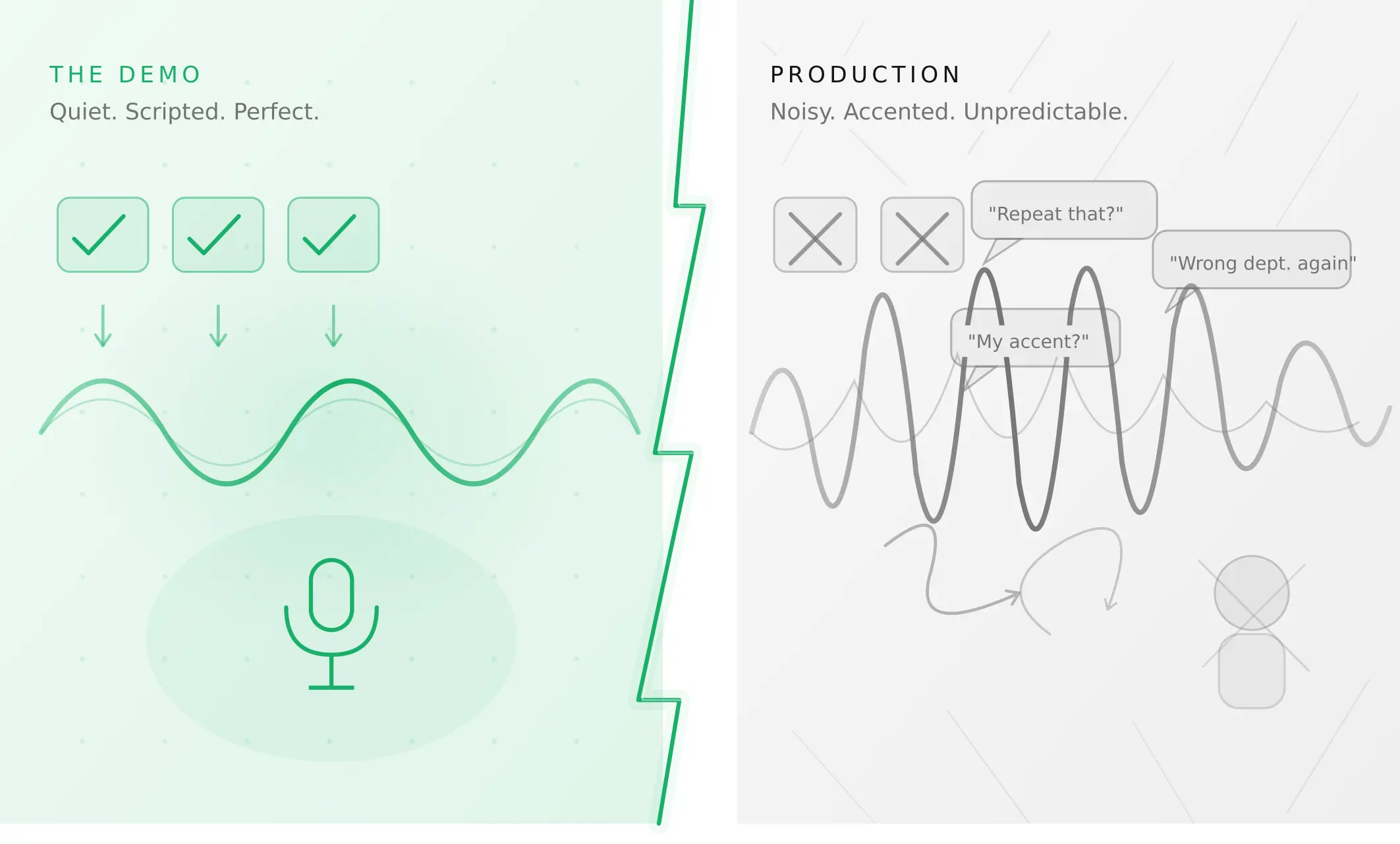
Why AI voice agents fail in production (and how to prevent it)
AI voice agents that ace demos still break in production. Learn the 5 root causes, how to test for each, and what production readiness actually means.
Read more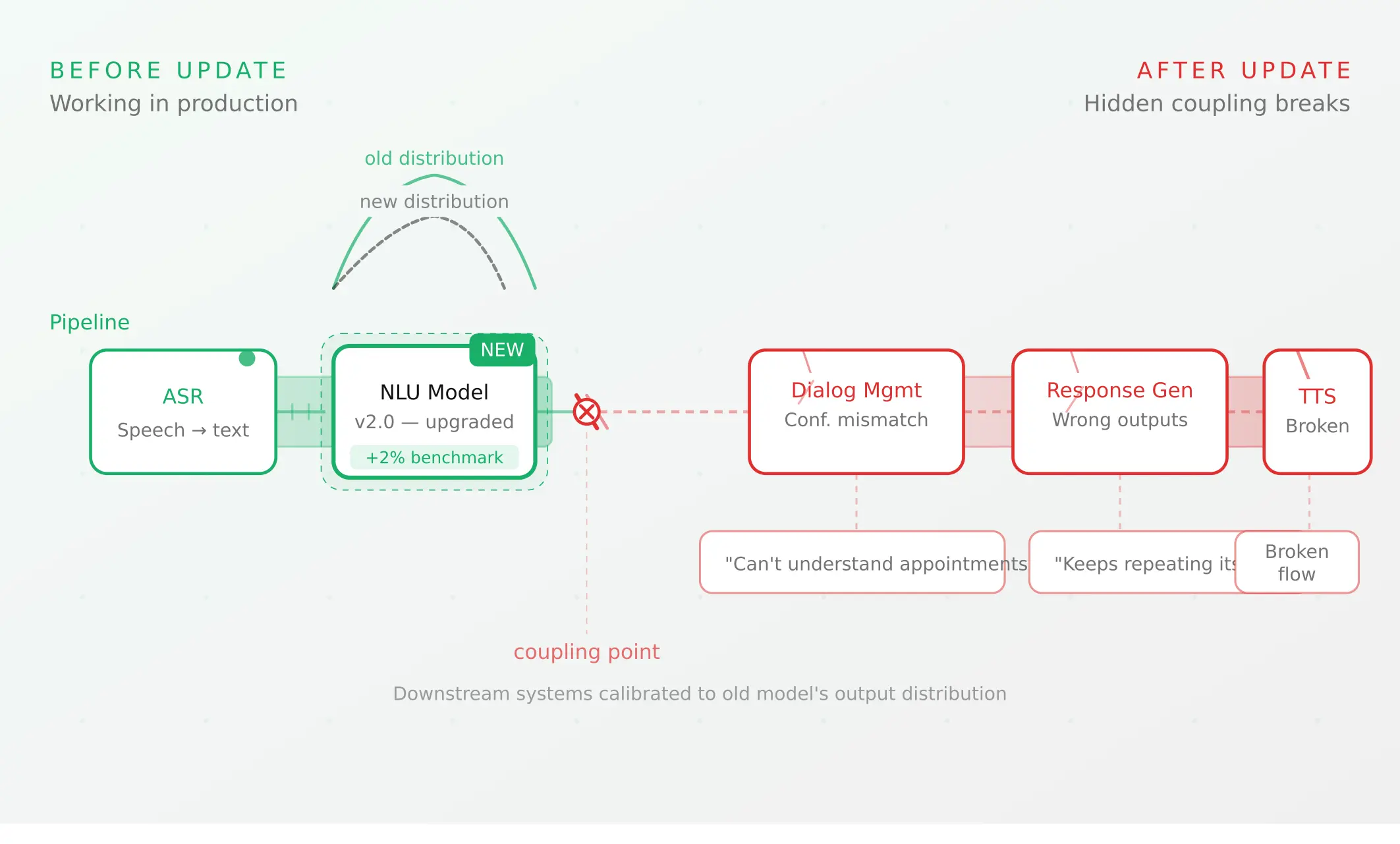
Voice agent regression testing: why LLM updates break production
LLM updates improve benchmarks but break voice agents in 5 predictable ways. How to detect and prevent regressions after every model or prompt change.
Read more