Test your voice agent
How to Measure Time to First Audio for Voice Agents
# How to measure time to first audio for voice agents
Quick answer
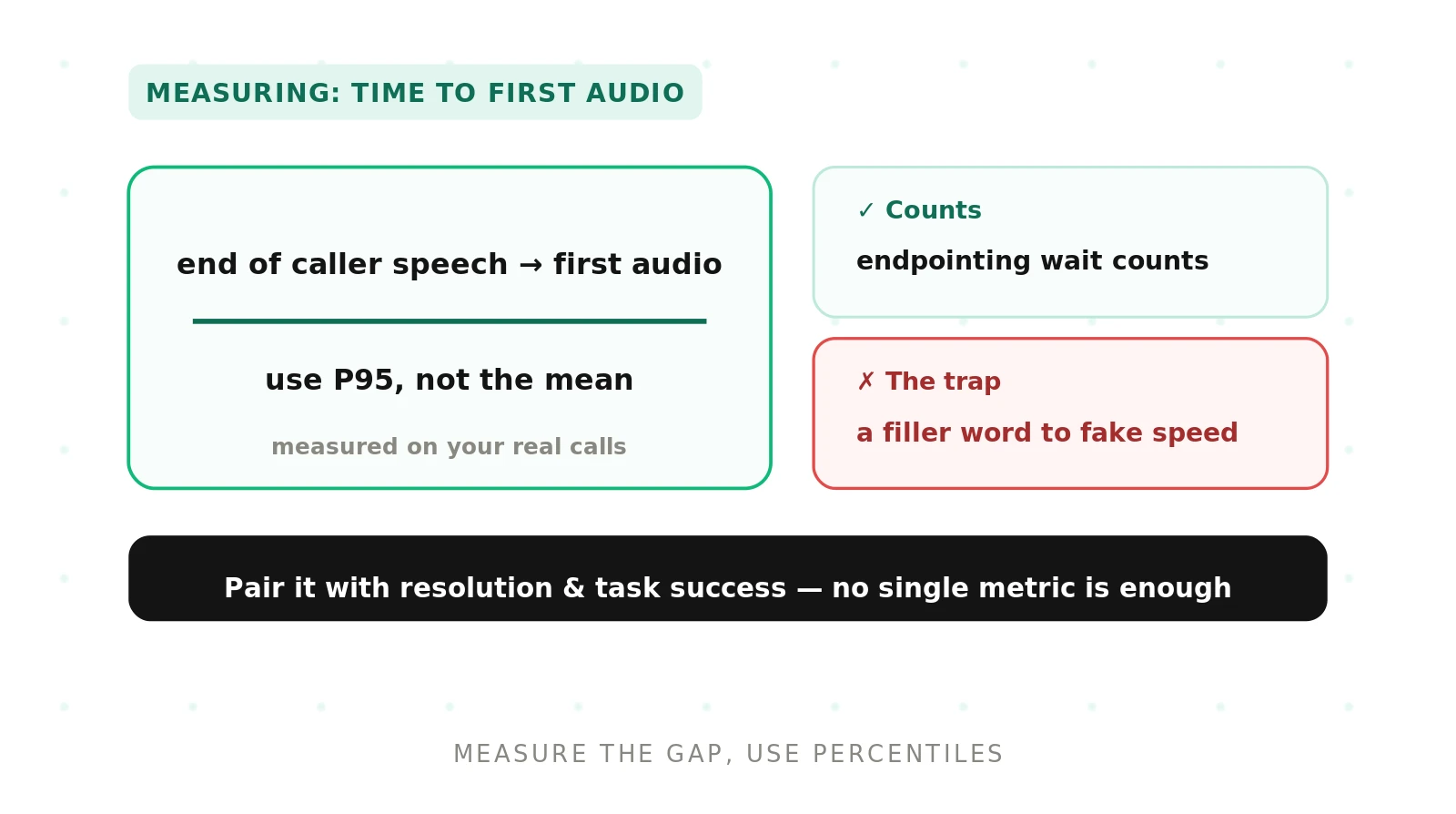
Time to first audio for voice agents is the gap from when the caller stops speaking to the first sound the agent makes back. Measure it per call, from end of caller speech to first audio byte out. Report P50, P95, and P99, never the mean. Keep it separate from total response latency.
Callers do not judge your agent by a spec sheet. They judge it by one thing: how long the line stays silent after they stop talking. That silence is time to first audio, and it is the single clearest signal of whether an agent feels fast or feels broken.
Most teams never measure it cleanly. They quote an average latency number that blends several stages and hides the pauses callers actually feel. This post fixes that. It defines time to first audio for voice agents, shows how to measure it precisely, and explains why percentiles beat the mean every time.
Evalgent is an independent, third-party evaluator of voice agents. We measure time to first audio on your own calls, with a fixed definition and no incentive to flatter the result. The method below is the one we use.
What time to first audio means for a voice agent
Let us pin down the term before we measure it.
> Time to first audio (TTFA): the elapsed time from the end of the caller's speech to the first audible sound produced by the agent. It measures how fast the agent starts speaking, not how long its full reply takes.
The name is often shortened to TTFA. Some teams call it time to first byte of audio, or first-token audio latency. The label matters less than the two endpoints. The clock starts when the caller finishes talking. The clock stops when the caller hears the first sound back.
This is a latency) measurement in the strict engineering sense. It is the delay between a cause and its first observable effect. The cause is the caller going quiet. The effect is the agent's first audible response.
TTFA is not the whole reply. It ends the instant audio begins, whether that audio is a word, a greeting, or a short acknowledgment. What comes after belongs to a different measurement, covered later in this post.
Why time to first audio drives perceived responsiveness
A voice conversation runs on tight timing. Humans expect a reply within a fraction of a second of finishing a sentence. When that reply is late, the caller notices the gap before they notice anything else.
This is why TTFA maps so directly onto perceived responsiveness. A voice agent is a soft real-time system. It has a deadline set by human conversational habit, not by a server. Miss that deadline and the interaction feels wrong, even when the eventual answer is perfect.
The standards world has measured this for decades. In telephony, the ITU-T G.114 recommendation sets guidance on one-way delay that keeps a call feeling natural. The same principle underlies round-trip delay work in networking. Human ears are strict about timing on a voice channel.
Silence carries meaning on a phone call. A short pause reads as thinking. A long pause reads as a dropped line. Callers who hit a long pause often start talking again, which collides with the agent's reply and restarts the turn. Long TTFA does not just feel slow. It actively breaks turn-taking.
Because TTFA is what the caller feels first, it deserves its own number. Our latency for voice agents guide covers the full latency budget across a call. This post zooms in on the one metric that shapes the first impression of every turn.
Time to first audio versus total response latency
TTFA is easy to confuse with total response latency. Keeping them apart is the most important distinction in this post.
> Total response latency: the time from end of caller speech to the end of the agent's complete spoken reply. It includes everything TTFA measures, plus the full duration of the agent speaking.
TTFA measures when the agent starts. Total response latency measures when the agent finishes. An agent can start speaking quickly and still take a long time to say everything. So the two numbers move independently, and they answer different questions.
TTFA answers the responsiveness question: does the line feel alive? Total response latency answers the throughput question: how long is the whole turn? A caller forgives a longer reply if it begins promptly. They rarely forgive a long silence, even before a short reply.
There is a related distinction between raw latency and what the caller actually experiences. Our latency versus response time guide unpacks that difference in full. For measurement, the rule is simple: report TTFA on its own, and never fold it into a blended latency average.
The latency segments that add up to time to first audio
TTFA is not one delay. It is a chain of stages, each with its own clock. To measure and improve it, you have to see the parts. The table below breaks the chain into its four main segments.
| Latency segment | What it adds to time to first audio | How to measure it |
|---|---|---|
| Endpointing wait | The pause before the agent decides the caller has actually stopped talking | Time from the last caller speech energy to the endpointing decision |
| Speech-to-text | Time to turn the captured audio into a final transcript the model can read | Time from the endpointing decision to the final transcript token |
| Language model | Time for the model to read the prompt and begin generating a reply | Time from prompt sent to the first response token returned |
| Text-to-speech first byte | Time to synthesize the reply and stream the first chunk of sound | Time from the first response token to the first audio byte out |
Two of these segments deserve extra attention. The endpointing wait is the most overlooked, and it belongs inside TTFA. The agent cannot respond until it believes the caller is done, and that decision takes time. Our endpointing for voice agents guide explains how that judgment is tuned.
The speech-to-text stage is a frequent culprit when TTFA runs long. Slow transcription pushes back every downstream stage. For ways to trim that segment specifically, see our guide on how to reduce STT latency. Note that streaming changes the picture: with streaming transcription and synthesis, stages overlap instead of running strictly in sequence, so the first audio byte can leave before later stages finish.
How to measure time to first audio for a voice agent
Here is the step-by-step method. Follow it in order. The aim is a TTFA number you can trust, defend, and compare across versions.
1. Fix the start point. Define the clock start as the end of caller speech, not the start of the caller's last word. Use the same definition on every call, so results stay comparable.
2. Fix the stop point. Define the clock stop as the first audio byte the caller can hear, not the moment the reply text is ready. The caller hears sound, not tokens.
3. Include the endpointing wait. Count the pause the agent takes to decide the caller stopped. This wait is part of what the caller feels, so it belongs inside TTFA.
4. Timestamp every stage. Log a timestamp at end of speech, endpointing decision, final transcript, first model token, and first audio byte. These raw times are your source of truth.
5. Compute TTFA per call. Subtract the start timestamp from the first-audio timestamp for each individual call. Store one TTFA value per call, not a running average.
6. Aggregate with percentiles. Compute P50, P95, and P99 across your calls. The spread matters more than any single center value, because the tail is where callers suffer.
7. Segment by scenario and condition. Split TTFA by intent, caller accent, background noise, and network path. A quiet test line and a noisy mobile call produce very different numbers.
8. Re-run on every change. Treat the measurement as a regression suite. Run it on each model swap, prompt edit, or provider change, so a slowdown shows up before callers find it.
This method runs on your own call logs. For a walkthrough on scoring metrics against your real traffic, see benchmarking voice agents on your own data.
Use P50, P95, and P99, not the mean
The mean is a poor summary for TTFA. It hides the pauses that actually hurt.
Picture a set of calls where most first-audio times land near half a second, but one call in twenty stalls for three seconds. The mean still looks healthy. Yet that slow slice is where callers talk over the agent, repeat themselves, or hang up. A single average cannot show you this.
This is why you report the distribution. The percentile view tells the real story. P50 is the median call, the typical experience. P95 shows how the slower calls behave. P99 exposes the worst tail, the calls that generate complaints.
Latency-shaped metrics are not evenly distributed. The tail runs long and thin, and the mean gets dragged around by it. So a falling mean can hide a rising P99. Watch the high percentiles closely, because a few very slow first responses do more damage to trust than many slightly slow ones.
Set targets at the percentile level, not the average. A goal like "P95 under one second" is honest and testable. A goal like "average under one second" can be met while one call in twenty feels broken.
Watch out for filler words and other TTFA tricks
Here is a trap that fools naive TTFA measurement. An agent can make its first-audio number look great without being any faster.
The common trick is a filler word. The agent plays a quick "okay" or "let me check" the instant the caller stops, while the real answer is still being computed. The first-audio clock stops early, so TTFA looks excellent. But the useful reply arrives just as late as before.
Filler words are not always bad. A short acknowledgment can reassure a caller during a genuine wait, and it can prevent the caller from talking over the agent. The problem is measurement, not the technique. If your TTFA counts filler audio, the metric no longer reflects when the caller gets a real response.
The fix is to measure two things. Track time to first audio of any kind, and separately track time to first substantive audio, meaning the first sound that carries the actual answer. When the two diverge sharply, filler is masking a slow pipeline. An honest evaluation reports both, so a fast filler cannot hide a slow answer.
This is one reason measurement should sit outside the vendor. A team optimizing its own dashboard has an incentive to let filler flatter the TTFA number. An independent evaluator uses one fixed definition and reports the gap. Our post on independent voice AI evaluation explains why that separation matters.
How Evalgent measures time to first audio
Evalgent is an independent, third-party evaluator for voice agents. It measures time to first audio the way this post describes: per call, from a fixed start point, with percentiles, and split by first audio versus first substantive audio.
For every call, Evalgent timestamps the endpointing decision, the final transcript, the first model token, and the first audio byte. It attributes the TTFA to its segments, so you can see whether transcription, the model, or synthesis is the bottleneck. Then it reports P50, P95, and P99 across scenarios, not a single blended average.
Because the scoring sits outside the vendor, the numbers are ones you can put in front of a buyer or a board. TTFA is one metric among many; we cover the full set in our voice agent metrics scorecard, and the wider approach in our voice agent evaluation overview.
The bottom line
Time to first audio is the gap the caller feels before the agent speaks, so measure it from end of caller speech to first audio byte, and report percentiles. Keep it separate from total response latency, and split real audio from filler, or the number will lie to you.
Frequently asked questions
What is time to first audio for a voice agent?
Time to first audio for a voice agent is the elapsed time from the moment the caller stops speaking to the first sound the agent produces. It measures how fast the agent starts responding, not how long the whole reply takes. Often shortened to TTFA, it is the clearest single signal of perceived responsiveness on a call.
How do you measure time to first audio?
Fix the start point at the end of caller speech and the stop point at the first audio byte the caller can hear. Include the endpointing wait. Timestamp each stage, subtract start from first audio for each call, and store one value per call. Then aggregate with P50, P95, and P99, segmented by scenario and condition.
Where does the time to first audio clock start?
The time to first audio clock starts at the end of the caller's speech, meaning the moment they finish their turn. It does not start when the agent decides they finished, because the endpointing wait is part of what the caller experiences. Using end of speech as the fixed start keeps results comparable across every call and version.
How is time to first audio different from response latency?
Time to first audio measures when the agent starts speaking. Total response latency measures when the agent finishes its complete reply. TTFA answers whether the line feels alive; response latency answers how long the whole turn takes. An agent can start fast but finish slow, so the two numbers move independently and should be reported separately.
Why does time to first audio matter for voice agents?
Time to first audio matters because callers judge responsiveness by the silence after they stop talking. A voice call is a soft real-time system with a deadline set by human habit. A long first-audio gap reads as a dropped line, prompts callers to repeat themselves, and breaks turn-taking, even when the eventual answer is correct.
Should you use the mean or percentiles for time to first audio?
Use percentiles, not the mean. The mean hides the slow tail where callers suffer, because latency is not evenly distributed. Report P50 for the typical call, P95 for the slower calls, and P99 for the worst tail. Set targets at the percentile level, such as P95 under one second, so a few slow first responses cannot hide.
Do filler words reduce time to first audio?
Filler words can make time to first audio look lower without making the agent faster. The agent plays a quick acknowledgment while the real answer is still computing, so the clock stops early. Fillers can reassure callers, but if TTFA counts them, the metric misleads. Measure first audio and first substantive audio separately to catch this.
What is a good time to first audio for a voice agent?
There is no universal target, because it depends on the task and the channel. As a working guide, keep P95 low enough that the caller never mistakes the pause for a dropped line. Judge TTFA against realistic conditions, not a quiet test line.
Ready to see your time to first audio measured cleanly, by an independent party? Book a demo with Evalgent.
Related Articles
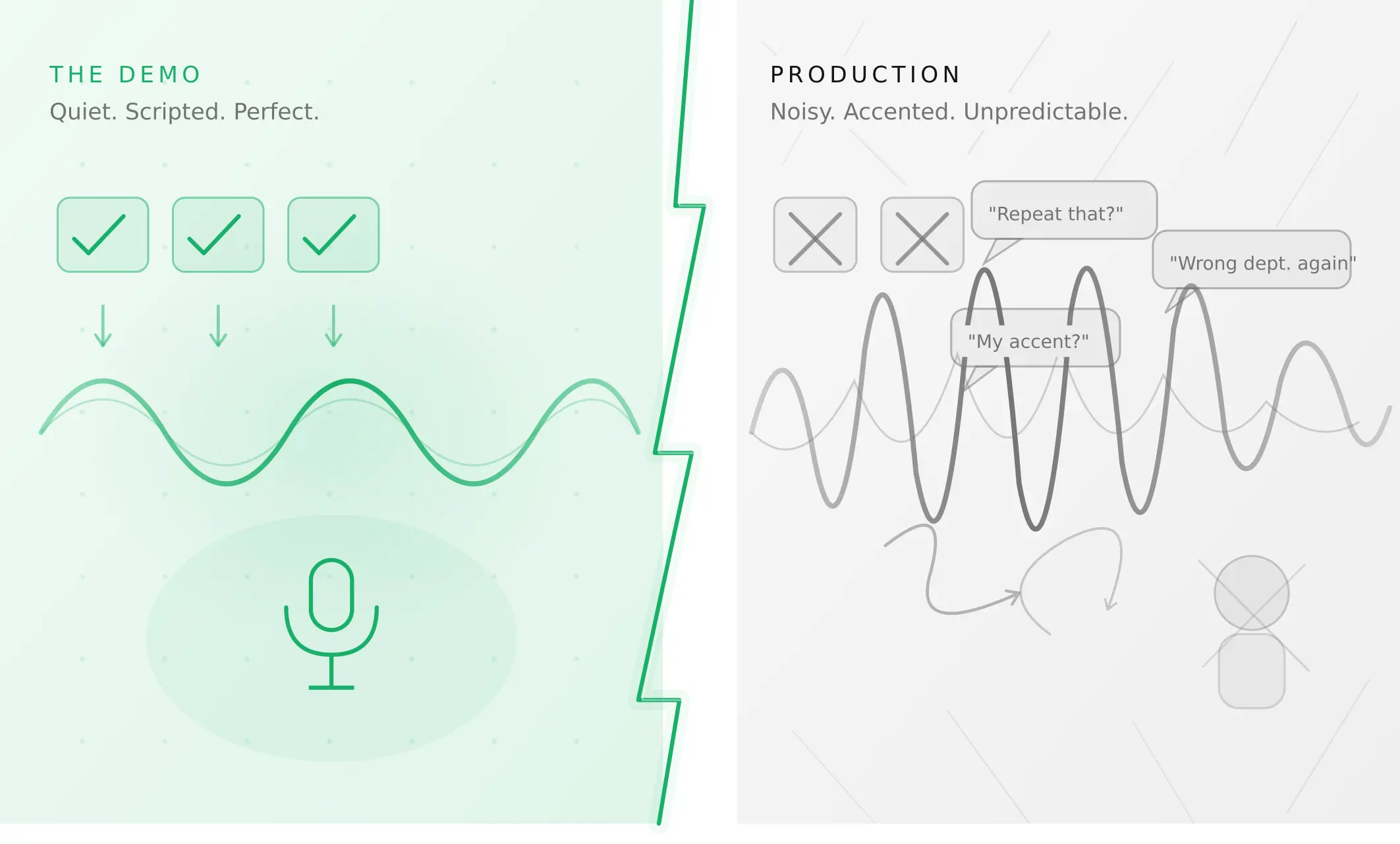
Why AI voice agents fail in production (and how to prevent it)
AI voice agents that ace demos still break in production. Learn the 5 root causes, how to test for each, and what production readiness actually means.
Read more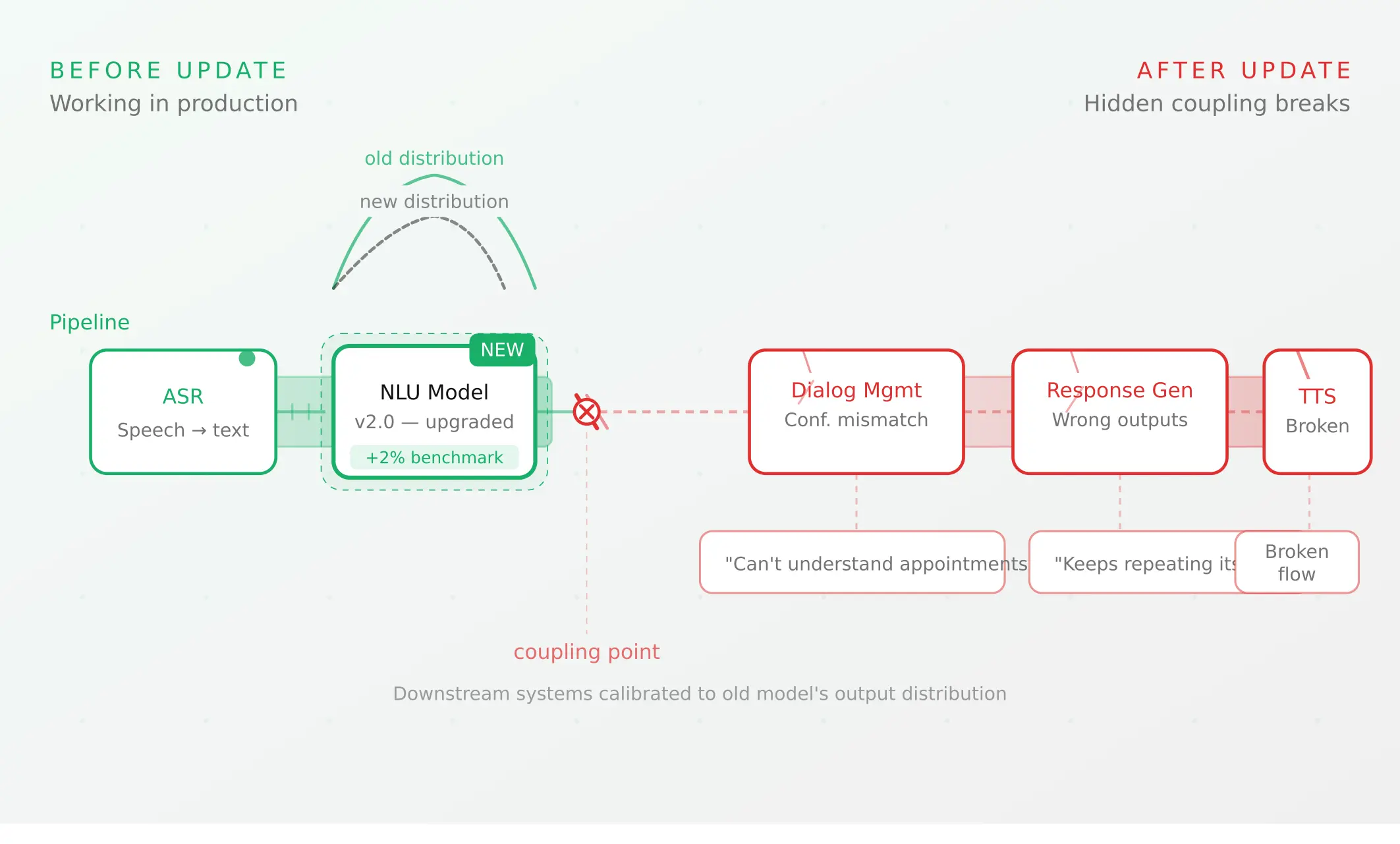
Voice agent regression testing: why LLM updates break production
LLM updates improve benchmarks but break voice agents in 5 predictable ways. How to detect and prevent regressions after every model or prompt change.
Read more