How to automate voice agent testing: synthetic callers vs manual QA
On this page
Your QA engineer puts on a headset, dials into the voice agent, and runs through the test script. Appointment booking. Balance inquiry. A handful of edge cases — speaking quickly, mumbling slightly, asking two questions at once. An hour later: thirty scenarios tested, two bugs found. Ship it.
The next morning, a user with a regional accent calls from a noisy open-plan office. Another speaks at nearly twice the average rate. A third asks to "cancel the thing I set up last week." None of them complete the interaction. None of them were in the test script.
This is the structural failure of manual QA for voice agents at scale — and it is not fixable by hiring more testers. The gap between what a human QA team can cover and what production traffic actually looks like is fundamental, not operational. Understanding how to automate voice agent testing, and where ai test automation cannot replace human judgment, is the discipline that separates teams that scale reliably from teams that discover failures through user complaints.
What manual QA for voice agents is actually good at
The case for ai test automation is not a case against human testers. Manual QA does things that no automated system can replicate well, and ignoring those strengths produces gaps just as damaging as ignoring automation's strengths.
Exploratory testing
A skilled QA engineer does not follow the script — they deviate from it. They probe the edges of the conversation design, improvise responses the agent has never encountered, and surface failure modes that no written scenario anticipates. This exploratory instinct is genuinely irreplaceable. Synthetic callers are better at exploiting known failure modes at scale. Humans are better at discovering unknown ones first.
Tone and conversational quality evaluation
Does the agent feel warm or robotic? Is the pacing natural? A synthetic caller measures whether the agent responded within 400ms. It cannot assess whether the exchange felt human. Evaluating TTS voice quality and emotional register requires human perception.
Compliance and language auditing
Verifying that required disclosures appear correctly, that prohibited language is absent, and that regulatory language meets jurisdiction-specific requirements — these benefit from human accountability. A synthetic caller can verify that a phrase appears in a transcript. It cannot verify that a disclosure was stated in the correct context or that a caller understood it.
Initial edge case discovery
The first time you encounter a failure mode, a human usually finds it. Discovering that your agent fails when users say "the thing I scheduled last week" instead of "my appointment" is inherently human work. Once that failure mode is known, synthetic callers test it systematically at scale — but the discovery itself requires a person.
The problem is not that manual testing is weak. The problem is that it can only ever cover a small fraction of what your agent encounters in production — and that fraction is almost never the one that breaks.
Five ways manual QA fails at production scale
1. Coverage is structurally impossible
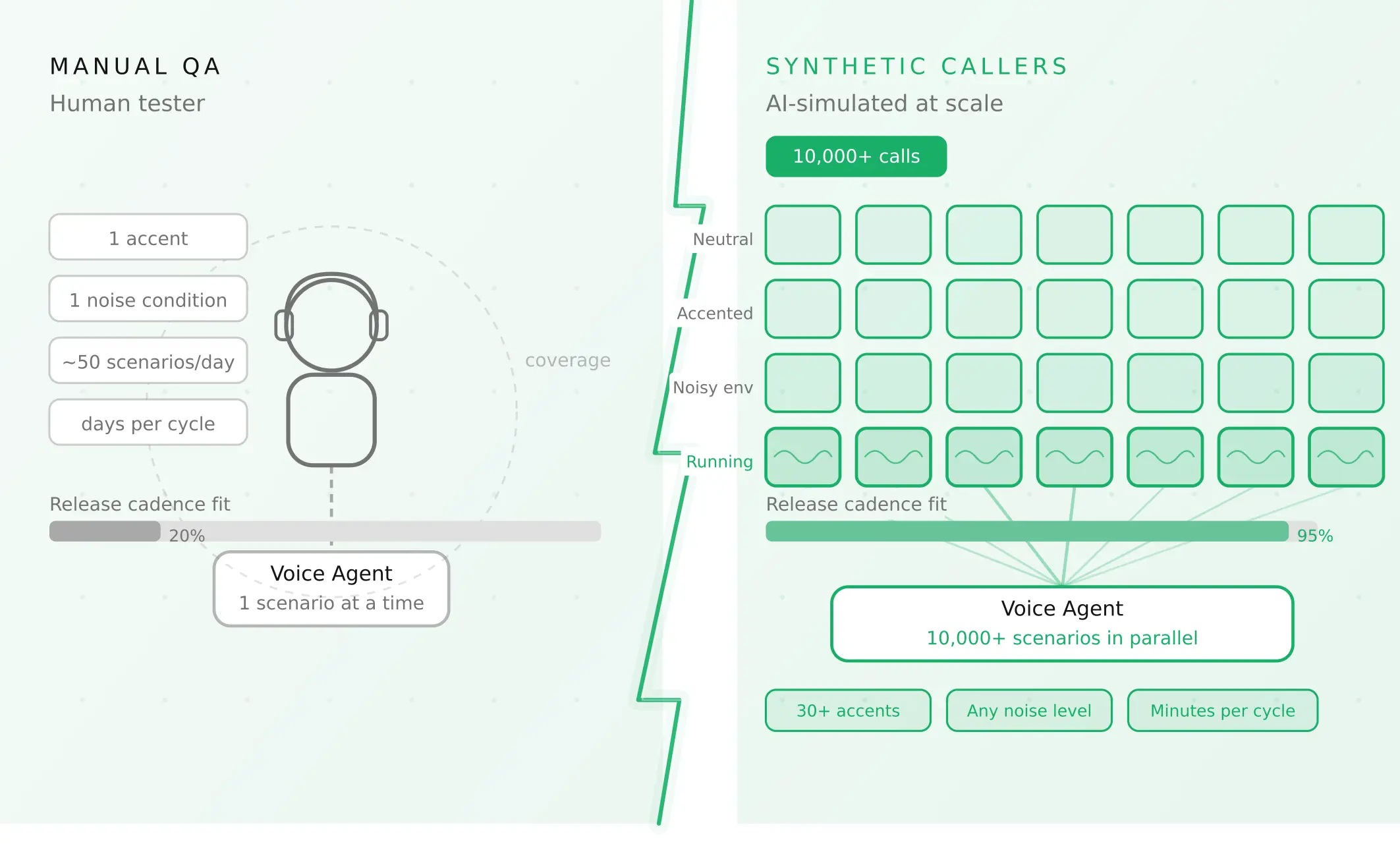
A thorough manual QA cycle covers 50 to 200 test scenarios. A voice agent handling 10,000 daily conversations encounters an effectively infinite input space — accents, speaking rates, noise levels, phrasings, emotional states, multi-intent utterances, mid-sentence corrections, and every combination.
Human reviewers across all analyses typically sample fewer than 2% of total interactions. At that coverage level, systematic failure modes persist for weeks before they accumulate enough support complaints to be noticed. A well-designed synthetic caller suite covers hundreds of accent variations, dozens of noise profiles, and thousands of conversational paths — automatically on every deployment.
Manual QA vs automated testing voice ai is not quality versus speed. It is a question of which problems each approach can structurally reach.
2. Manual testing bottlenecks release velocity
Voice AI development moves fast. Prompt changes, model updates, and integration changes can ship multiple times per week. Each is a potential regression that needs catching before it reaches users.
Manual testing creates a hard bottleneck. If thorough manual QA takes two days and you are shipping three times a week, you are either skipping tests or blocking releases. Voice agent ci/cd pipeline testing with automated synthetic callers removes this constraint: a regression suite that would take a human team two days runs overnight and delivers results before the morning standup. The regression testing framework for model updates describes this integration in detail.
3. Acoustic diversity cannot be simulated by one person
Your QA engineer has one voice, one accent, one speaking rate, and one microphone — calling from one environment. They can try speaking quietly or quickly. They cannot systematically represent thousands of users calling from office environments, moving vehicles, busy streets, factory floors, and international locations — all at once, repeatably, and with precise measurement.
This matters because voice AI is acoustic at its core. Deepgram's published benchmarks show that background noise at typical contact-centre levels (55–65 dB SNR) reduces ASR transcription accuracy by 15–30% depending on the model and codec. A 5% word error rate (WER) increase from background noise compounds through every downstream decision in the pipeline.
Ai test automation with parameterised caller profiles injects specific noise conditions at defined dB levels, applies accent and dialect profiles, simulates packet loss and codec degradation, and measures WER at every variation point. Platforms like Bluejay test across 500+ behavioral variables including acoustic conditions. That coverage is structurally impossible without automation.
4. Timing failures are invisible to human perception
Voice is a real-time medium. A 3-second delay that is invisible in a transcript log is agonising in a live conversation. Barge-in detection, interruption handling, and turn-taking all depend on timing that human testers experience subjectively and measure imprecisely.
When a QA engineer notes "it felt a bit slow," that is a useful signal — but not a quantified one. It does not tell you whether latency is originating in ASR, LLM inference, TTS synthesis, or a downstream API call. According to ITU-T G.114, one-way audio delay above 150ms begins to affect conversation quality. Cascading STT→LLM→TTS architectures routinely produce P95 response times of 3 seconds or more under real conditions — invisible in subjective manual testing.
Automated voice testing measures timing at every stage of every conversation with millisecond precision. A 400ms latency regression — imperceptible to a human tester — is immediately visible in P95 latency tracking and statistically correlates with higher call abandonment rates.
5. You cannot test for failure modes you have not anticipated
The most dangerous failures are the ones you do not know to look for. When your NLU confidence score distribution shifts after a model update, no QA engineer will think to test "conversations where confidence scores sit between 0.73 and 0.81." When a downstream API begins responding 200ms slower under load, no manual test catches the cascading effect on turn-taking behaviour.
Synthetic callers can run continuously in production shadow mode — testing your agent against real traffic patterns without exposing real users to failures. They replay production conversations against new model versions and detect divergences before they reach users. This is the stress-testing practice taken from periodic activity to continuous infrastructure.
Manual QA vs automated testing voice AI: full comparison
| Dimension | Manual QA | Ai test automation (synthetic callers) |
|---|---|---|
| Scenarios per day | 50–200 | 10,000+ |
| Accent coverage | 1 (the tester's) | Parameterised across dozens |
| Background noise conditions | 1–3 staged | Programmatic injection at any dB level |
| Latency measurement | Subjective | Millisecond precision at every stage |
| Release cadence support | Days per cycle | Minutes per cycle |
| Regression detection | Manual, memory-dependent | Automated and systematic |
| Cost per test | High (human time) | Marginal at scale |
| Unknown failure discovery | Strong | Limited |
| Tone and experience judgment | Strong | Limited |
| Compliance auditing | Strong | Limited |
| Coverage of production distribution | <2% | Near-complete with good scenario design |
What are synthetic callers for voice agents?
Synthetic callers are AI-simulated callers that execute realistic voice conversations programmatically, without a human on the line. Each synthetic caller is a configurable software agent that dials your voice agent, speaks using synthesised speech, responds to the agent's outputs following a defined conversation path, and records every measurable output — transcript accuracy, intent classification, task completion, timing at each stage, and error events.
What makes synthetic callers powerful for ai test automation is parameterisation. A single scenario — "user wants to book an appointment" — can be tested simultaneously across dozens of configurations: different accent profiles, different noise conditions, different speaking rates, different phrasings of the same intent, different points at which the user interrupts. Each configuration produces an independent data point. Together they map the reliability surface of that scenario across the realistic range of human behaviour.
This is qualitatively different from running one-off simulations or replaying recordings. Ai test automation through synthetic callers produces systematic, repeatable, comparable measurements across a parameter space — which is what voice agent qa actually requires.
The leading voice ai platforms in this space approach ai test automation differently. Hamming AI has analysed 4M+ production voice agent calls and focuses on regression detection and CI/CD integration. Bluejay tests across 500+ behavioural variables for ai agent evaluation with explicit stress testing. Cekura generates test cases automatically from agent instructions and runs live monitoring. Coval applies autonomous vehicle-style regression methodology with native CI/CD gates. The profiles feature in Evalgent lets you configure 8 behavioral parameters per caller — accent, noise level, speech pace, latency simulation, and more — and run them in combination across your scenario library.
What synthetic callers cannot do
Intellectual honesty requires acknowledging the limits of ai quality assurance through automation.
Genuine unpredictability. Synthetic callers simulate variation within parameterised bounds. Real users are more emotionally unpredictable and genuinely surprising than any simulation. The first time a user asks your agent something entirely outside its intended domain, a human tester is more likely to surface it.
Subjective conversational quality. A synthetic caller measures whether the agent responded within 400ms. It cannot assess whether the exchange felt natural or frustrating. Human judgment remains irreplaceable for evaluating TTS voice quality and conversational register.
Setup quality dependency. A synthetic caller suite testing the wrong scenarios, with unrepresentative acoustic profiles, or incorrect success criteria gives you false confidence. Transcript analysis falls short for the same reason — automated measurement is only as good as what you choose to measure.
Domain expertise. Understanding which failure thresholds are acceptable, and what good first-call resolution looks like in your specific context, requires human judgment from people who understand your users and business.
The complementary model: how to combine both
Teams shipping reliable voice agents are not choosing between manual testing and automated voice testing. They are using each approach for what it can structurally reach.
The workflow that works at scale:
1. Discovery phase. Human testers explore the agent freely, find failure modes, and define the scenarios that matter. Do not skip this phase — the scenarios your synthetic callers will test are only as good as the discovery work that preceded them.
2. Systematisation phase. Every discovered failure mode becomes a parameterised test case in the synthetic caller suite. A QA engineer who found that the agent fails at 1.4x average speech speed has created a scenario that now runs automatically — across every speed from 0.8x to 1.6x — on every subsequent deployment.
3. Continuous automated validation. Synthetic callers run the full suite on every code change, prompt edit, model update, and integration change. They catch regressions before users do and feed directly into the voice agent CI/CD pipeline. Deployments that fail the regression suite are blocked automatically.
4. Periodic human review. QA engineers review a rotating sample of production calls and synthetic test results, looking for patterns that suggest new failure modes. This feeds discovery back into Phase 1. The loop is continuous, not cyclical.
This model scales in a way that pure manual testing cannot. A team of three QA engineers with a well-designed synthetic caller suite covers more ground than thirty engineers running manual tests — faster, more systematically, and more reproducibly.
How to scale voice agent QA without hiring: a 5-step checklist
This voice agent qa checklist applies from initial deployment through high-volume production scale. Each step represents a layer of ai test automation maturity — skip a step and you will discover its gaps through production incidents rather than evaluation results.
1. Build a golden call set before launch. Maintain a curated library of at least 50 production conversations with known expected outcomes — core flows, non-linear paths, and the failure modes your discovery phase found. Run this set before every deployment. Alert when task completion rate, escalation rate, WER, or P95 latency deviates more than 5% from baseline.
2. Inject acoustic diversity from day one. Do not wait for an accent-related production failure before testing accents. Parameterise your synthetic caller suite across at minimum three profiles: quiet (~45 dB), moderate (~65 dB), and high noise (~75 dB). Cover the accent groups most represented in your user base. Testing only with clean studio audio means testing a demo, not a production system.
3. Integrate ai test automation into your CI/CD pipeline. Every prompt change is a deployment risk. Connect your synthetic caller suite so every code or prompt change triggers an automated regression run. Define pass/fail thresholds — task completion must not drop more than 3%, P95 latency must not increase more than 20%, WER must not increase more than 2 percentage points — and block deployments that fail any threshold.
4. Convert every production failure into a permanent test case. When a real user has a bad experience, convert that call into a regression test case with the original audio, timing, and behaviour preserved. Over time, your golden call set evolves from imagined scenarios into a library built from actual production failures.
5. Monitor P95 and P99 latency, not just averages. A 500ms average masks 10% of calls spiking to 3 seconds or more. Set alerts on: P95 latency exceeding 50% above baseline; task completion falling below 75%; escalation rate increasing more than 25%; WER exceeding 18%; error rate exceeding 10%.
How many test scenarios do you actually need?
A common question in voice agent qa — and one the qa automation ai conversation rarely answers with specifics — is how many test scenarios for voice agent coverage are actually required. Here is a practical framework by deployment stage.
| Stage | Minimum scenarios | Coverage priority |
|---|---|---|
| Pre-launch | 100–200 | Core flows × 3 acoustic profiles × primary accents |
| Post-launch (30 days) | 200–500 | Add edge cases from first production traffic |
| Growth (10K+ daily calls) | 500–1,000 | Domain terminology, regional accents, multi-intent paths |
| Scale (100K+ daily calls) | 1,000+ | Full distribution — rare inputs become statistically frequent |
The minimum is the floor below which your ai test automation suite cannot catch failure modes that will appear at the corresponding call volume. Teams running ai test automation through tools like Hamming run suites of thousands of scenarios per deployment for high-volume agents. For agents built on Vapi or Retell, this connects via webhook to your deployment workflow with minimal integration overhead. For teams on LiveKit or Pipecat, the synthetic caller suite points at any SIP or WebRTC endpoint.
The real cost of not automating voice agent testing
Manual testing bottlenecks do not just introduce delays. They allow failures to reach production because the test suite could not structurally cover them. Every production failure is a support ticket, a potential churn event, and a data point against the credibility of your AI programme.
The economics of ai production quality are straightforward. Moving from manual-only QA to a hybrid model — combining human testers with ai test automation through synthetic callers — reduces production bugs reaching users by up to 80%. This result is driven by the shift from reactive firefighting to systematic, proactive coverage across the full production distribution. When teams compare automated voice testing vs human testers, they consistently find that the right question is not which to choose, but how to combine them so each covers what the other cannot reach.
Tracking the right ai metrics makes this measurable. The Hamming team's analysis of 4M+ production voice agent calls shows that teams at testing maturity level 4 — full ai test automation with synthetic callers, CI/CD integration, and continuous production monitoring — experience significantly fewer post-launch incidents than teams at lower maturity levels.
Voice AI at ai production scale rewards the teams that find failures before users do. Manual QA is where a quality practice starts. Ai test automation is how it grows to match the scale of real traffic.
Summary
Automated testing ai for voice agents is not a replacement for human testers — it is the infrastructure that makes human testing effort compound over time. Human testers discover failure modes; synthetic callers exploit them at scale across every acoustic condition, accent profile, and conversation path, automatically on every deployment. Neither ai test automation nor human testing works without the other.
The teams shipping reliable voice agents at scale have built this complementary practice: discovery through human testing, systematisation through scenario design, continuous validation through ai test automation, and periodic human review to feed new findings back into the loop.
The five root causes of why voice agents fail in production explains in detail what each testing layer is designed to catch.
Frequently asked questions
What is ai test automation for voice agents?
Ai test automation for voice agents uses synthetic callers — AI-simulated callers that execute realistic voice conversations programmatically — to run thousands of test scenarios automatically on every deployment. It replaces manual QA for coverage, regression detection, acoustic diversity, and latency measurement, while humans retain exploratory testing, tone evaluation, and compliance auditing.
What are synthetic callers for voice agents?
Synthetic callers are software agents that simulate real users in voice conversations with your AI agent. They execute parameterised conversation flows across defined accent profiles, noise conditions, speaking rates, and latency profiles — producing measurable data on task completion, WER, and timing at every stage. They enable coverage that is structurally impossible through human testing alone.
How do I scale voice agent QA without hiring more testers?
Build a synthetic caller suite that runs automatically on every deployment. Start with a golden call set of 100+ scenarios covering your core flows and edge cases. Parameterise across your primary acoustic and accent profiles. Integrate into your CI/CD pipeline with defined pass/fail thresholds. Reserve human testers for exploratory discovery and qualitative review — the work that requires judgment, not coverage.
What is the difference between manual QA and automated voice testing?
Manual QA provides exploratory discovery, qualitative judgment, and compliance auditing. Automated voice testing provides systematic coverage at scale, regression detection, acoustic diversity simulation, and millisecond-precision latency measurement. Manual QA covers fewer than 2% of production interactions. Automated testing can approach near-complete coverage of the production distribution with good scenario design.
How many test scenarios do I need for a voice agent?
A minimum of 100–200 scenarios before launch, covering core flows across at least three acoustic profiles and your primary accent groups. Grow to 500+ in the first 30 days as production traffic reveals real edge cases. At 10K+ daily calls, 500–1,000 is the practical floor. Below that threshold, specific failure modes become statistically certain to reach real users.
How does voice agent ci/cd pipeline testing work?
Connect your synthetic caller suite to your CI/CD pipeline using webhooks or a native integration. Every deployment event — code change, prompt edit, model update, or integration change — triggers the full scenario suite automatically. The suite runs against defined pass/fail thresholds on task completion rate, P95 latency, WER, and escalation rate. Deployments that fail any threshold are blocked before reaching users.
Can synthetic callers replace human testers entirely?
No. Synthetic callers cannot evaluate subjective conversational quality, discover genuinely novel failure modes outside their parameterised bounds, or apply domain expertise. Human testers remain essential for exploratory testing, tone and experience evaluation, and compliance auditing. The effective model combines both — humans for discovery, synthetic callers for systematic exploitation at scale.
What metrics should I track in an automated voice agent QA practice?
Track word error rate (WER) per acoustic and accent profile, task completion rate by scenario category, first-call resolution rate, latency at P50/P90/P95/P99, escalation rate, and error type distribution. Set automated alerts when any metric deviates more than 5% from baseline. Monitor averages and percentiles separately — average latency hides the worst user experiences in the P95 tail.
Related Articles
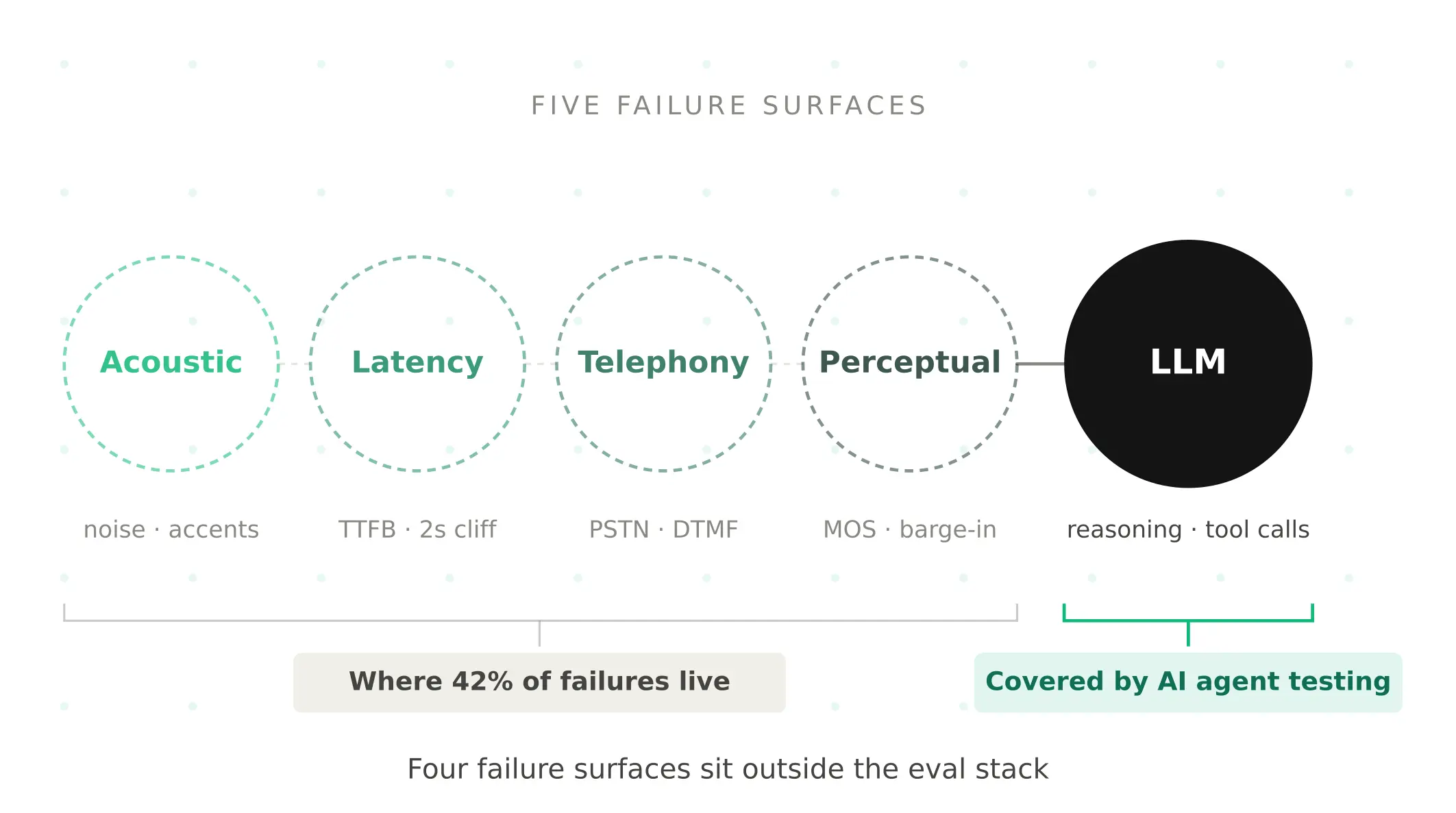
AI Agent Testing vs Voice Agent Testing: What General Tools Miss for Voice
AI agent testing measures text outputs. Voice agent testing measures behaviour through an acoustic pipeline. Five failure categories general tools miss.
Read more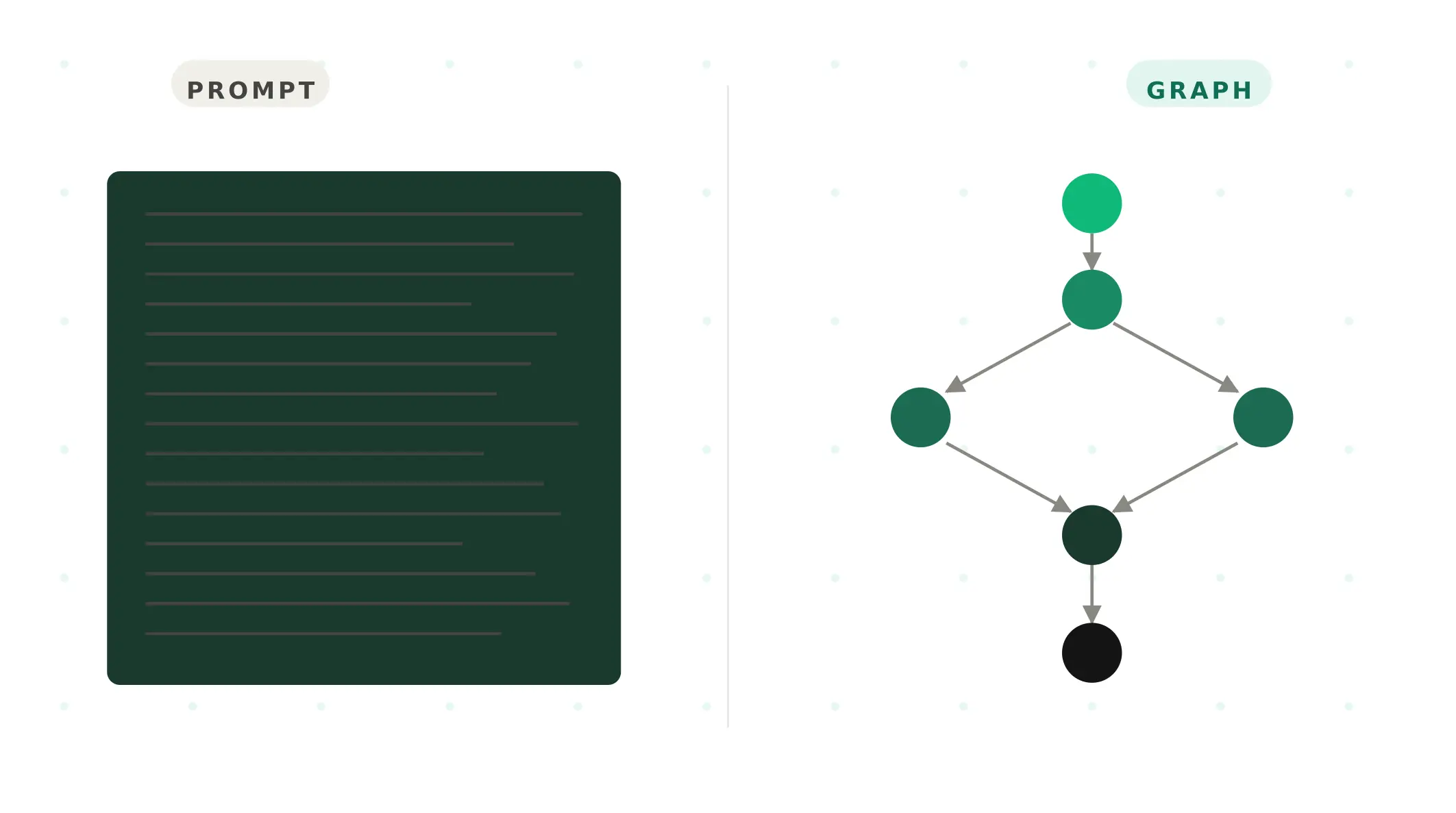
Why Production Voice Agents Are Becoming Graphs, Not Prompts
Graph-based voice agents externalise control flow that prompt-based agents trust the LLM to handle. Why this is the architecture winning production deployments.
Read more