Test your voice agent
Offline vs Online Voice Agent Evaluation
# Offline vs online voice agent evaluation
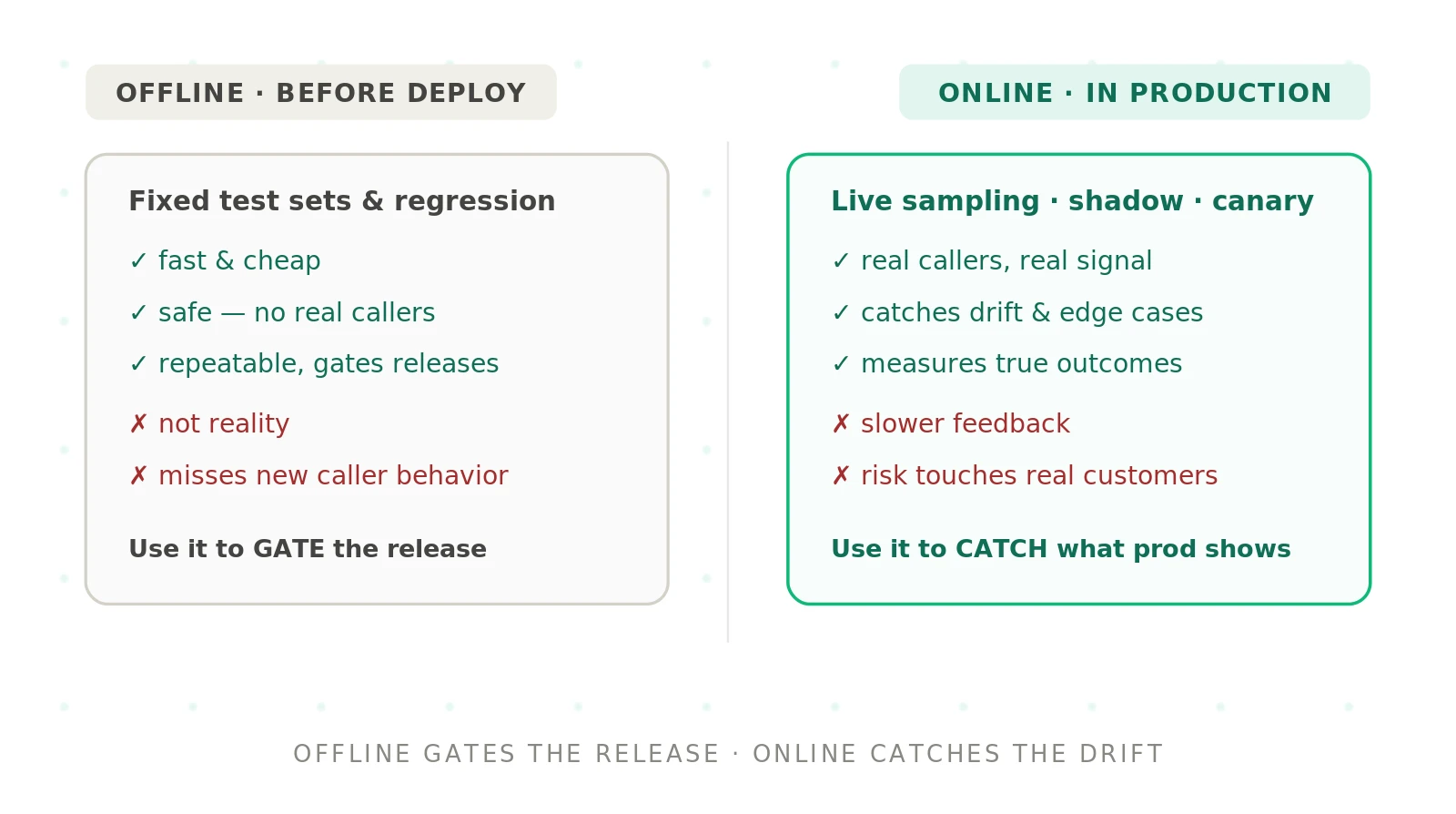
> Quick answer: Offline vs online voice agent evaluation is the split between testing on fixed recorded cases before release and measuring live production calls after. Offline is fast, safe, and repeatable but not real. Online is real but slow and risky. Mature teams use both.
Every voice agent that reaches production passes through two very different kinds of scrutiny. One happens in a lab, against saved calls and scripted scenarios, before a single real customer is exposed. The other happens in the wild, against live callers, once the agent is answering phones. Both are called evaluation. They measure different things, catch different failures, and carry different costs.
Teams that only do the first ship agents that pass every test and still frustrate real callers. Teams that only do the second discover regressions the expensive way, one angry caller at a time. This guide explains what each half measures and what it misses. It then shows how to wire the two together, so offline evaluation gates your releases and online evaluation catches the drift no lab can predict.
What offline evaluation actually measures
Offline evaluation runs your voice agent against a fixed set of inputs you control. You assemble a test set: recorded calls, synthetic scenarios, edge cases pulled from past incidents, and adversarial prompts. You run the agent against every case, score the outputs against a known standard, and compare the score to the last run.
> Offline evaluation: testing a voice agent against a fixed, recorded, or scripted dataset before deployment, where inputs and correct answers are known in advance. Results are repeatable because the inputs never change.
The defining trait is repeatability. The same test set produces a comparable score every time, so you can tell whether a change made the agent better or worse. This is the mechanism behind regression testing: you lock in the behavior you want, then flag any future change that breaks it. When you swap a model, edit a prompt, or update a policy, the offline suite tells you what moved before customers feel it.
Offline evaluation covers three main jobs. Regression suites protect behavior you have already validated. Fixed test sets check accuracy on scenarios you care about, like refund requests or appointment changes. Bake-offs pit candidate configurations against each other on identical cases. That is the only fair way to compare voice agents on the same test cases. It lets you pick a winner on evidence rather than a demo.
What offline evaluation catches
Offline testing is strongest on anything you can define in advance. It catches broken intent recognition, wrong tool calls, policy violations, prompt regressions, and accuracy drops on known scenarios. Because you own the ground truth, scoring is precise and disagreements are settled by the transcript, not opinion.
It also catches the failures that are dangerous to find in production. A misconfigured refund flow, an agent that leaks its system prompt, a handoff that never fires: you want these surfaced against recorded calls, not live customers. Offline is where you run the tests that would be reckless to run on real people.
What offline evaluation misses
The weakness is baked into the strength. A fixed test set only measures the situations you thought to include. Real callers interrupt, mumble, change their minds mid-sentence, and speak over background noise no scripted case anticipated. Offline evaluation cannot measure how the agent handles the call you never imagined.
It also cannot detect drift. The model behind your agent updates, caller behavior shifts with the season, and a phrase that worked in March fails in September. Your offline suite keeps passing because the inputs never changed. The lab score stays green while real quality quietly slides. This blind spot is exactly what online evaluation exists to close.
What online evaluation actually measures
Online evaluation measures the agent as it runs against real callers in production. Instead of a fixed dataset, the inputs are whatever your customers actually say, in whatever conditions they actually call from. You sample live calls, score a representative slice, and watch metrics over time.
> Online evaluation: measuring a voice agent's quality on live production traffic using real callers, sampled and scored after the fact or in near real time. Inputs are uncontrolled and reflect true conditions.
The signal is real because the conditions are real. There is no gap between the test and reality because the test is reality. Online evaluation is how you learn your true containment rate and your real latency under load. It also shows how the agent behaves with accents, noise, and impatience that no synthetic set captures cleanly.
Online evaluation uses a few core techniques. Live sampling scores a percentage of real calls against a rubric. Shadow deployment runs a new agent version silently alongside the live one. It receives the same traffic without affecting callers, so you compare candidates on real input at zero customer risk. A canary release routes a small slice of traffic to the new version. It watches for trouble before a full rollout. An A/B test splits live traffic between versions to measure which performs better on real outcomes.
What online evaluation catches
Online evaluation catches everything the lab cannot imagine. It surfaces drift as it happens, exposes the long tail of weird calls, and reveals how latency and reliability behave under real concurrency. It measures outcomes that only exist in production: did the caller get their problem solved, did they escalate, did they hang up in frustration.
It also catches the slow degradations. A gradual rise in escalations, a creeping increase in dead air, a dip in containment after an upstream model update. These trends only appear against a stream of real traffic, tracked through telemetry over days and weeks. The lab shows you a snapshot. Production shows you the trend.
What online evaluation misses
The cost of realism is speed and safety. Online evaluation is slow: you need enough real calls to reach a conclusion, and rare scenarios may take weeks to appear in the sample. You cannot force the edge case you want to test; you wait for it to occur.
It is also risky. By definition, a problem measured online has already reached a real caller. If a new version degrades quality, some customers experience that degradation before your metrics flag it. Techniques like shadow deployment reduce this risk, but pure online evaluation always trades some customer exposure for real signal. And because inputs are uncontrolled, isolating the cause of a metric shift is harder than in a clean offline run.
Offline vs online voice agent evaluation compared
The two approaches are not competitors. They are two halves of one system, each covering the other's blind spot. This table lays out the trade-offs side by side.
| Dimension | Offline evaluation | Online evaluation |
|---|---|---|
| Speed | Fast; runs in minutes on demand against a fixed set | Slow; needs enough live calls to reach a conclusion |
| Realism | Low; only measures scenarios you scripted in advance | High; measures true caller behavior and conditions |
| Risk | None; no real customers are exposed to failures | Real; problems surface only after callers hit them |
| What it catches | Regressions, policy breaks, accuracy on known cases | Drift, long-tail failures, real latency and outcomes |
| Best use | Release gate before deploy; safe adversarial testing | Continuous monitoring; catching drift and rare cases |
Read the table as a division of labor. Offline owns the pre-deploy gate because it is fast, safe, and repeatable. Online owns continuous monitoring because it is the only place real quality lives. Neither replaces the other. A team that leans only on offline ships confidently and drifts blindly. A team that leans only on online catches problems late and expensively.
How to combine offline and online evaluation
The goal is a loop: offline gates every release, online watches production, and production findings feed back into the offline suite. Here is how to build that loop step by step.
1. Build a versioned offline test set. Collect real scenarios, edge cases, and past incidents into a fixed dataset with known correct answers. Version it so every change is tracked, the same way you version code.
2. Make the offline suite a release gate. No agent version ships until it passes the regression suite and meets your accuracy bar on the fixed set. A failed offline run blocks the deploy automatically.
3. Shadow-test new versions before rollout. Run the candidate version silently against live traffic alongside production. Compare its scored outputs to the current version on identical real calls, with no customer exposure.
4. Canary the release to a small slice. Route a small percentage of live traffic to the new version. Watch containment, latency, and escalation for a defined window before widening the rollout.
5. Sample and score live calls continuously. Pull a representative slice of production calls on a schedule and score them against the same rubric your offline suite uses. Track the metrics over time to expose drift.
6. Feed production failures back into the offline set. Every real failure you find online becomes a new offline test case. The next release that would repeat that failure is caught in the lab, before it ships.
7. Re-baseline on a fixed cadence. Because models and callers drift, refresh your offline ground truth and re-score periodically. A stale test set slowly stops representing reality.
This loop turns two static activities into one system that improves itself. Offline stays honest because production keeps donating fresh cases. Online stays cheap because most known failures are caught before they ever reach a caller. The full mechanics of the pre-deploy half are covered in our guide to AI voice agent testing, and the boundary between the two halves is drawn in detail in the testing vs monitoring guide.
Where an independent evaluator fits
Both halves share one hidden dependency: the scoring standard. If your offline rubric and your online rubric disagree, the loop breaks, because a passing lab score no longer predicts a passing production score. The two evaluations only reinforce each other when they measure quality the same way.
This is the case for a single, neutral standard applied across both. Evalgent is an independent, third-party evaluator that scores your voice agent against your own rubric on both recorded test sets and sampled live calls, so the gate and the monitor speak the same language. Because the scoring is independent of the team that built the agent, a green offline run and a green production week mean the same thing to everyone reading the report. That neutrality also matters when you benchmark voice agents on your own data, since the result is not shaped by the vendor whose agent is under test. For a wider view of how these pieces assemble into a program, start with the overview of voice agent evaluation. Frameworks like the NIST AI Risk Management Framework reinforce the same principle: measurement should be consistent, documented, and independent of the party being measured.
Choosing where to spend first
For a team just starting, offline evaluation is the higher-leverage first investment. It is cheap to run, catches the failures that are dangerous to find in production, and gives you a gate you can trust from day one. Build the fixed test set and the regression suite before you ship anything you care about.
Online evaluation earns its place the moment you have real traffic. A pilot with ten calls a day cannot support meaningful live sampling; a production line with thousands of daily calls cannot survive without it. The right sequence is offline first as the safety net, then online layered on as volume grows and drift becomes the dominant risk. Neither is optional at scale, but the order of adoption follows the traffic.
Frequently asked questions
What is offline voice agent evaluation?
Offline voice agent evaluation tests an agent against a fixed, recorded, or scripted dataset before deployment. Inputs and correct answers are known in advance, so results are repeatable and comparable across runs. It powers regression suites, accuracy checks on known scenarios, and bake-offs. Its strength is speed and safety; its limit is that it only measures cases you scripted.
What is online voice agent evaluation?
Online voice agent evaluation measures an agent on live production traffic from real callers. You sample and score a representative slice of real calls, either after the fact or in near real time. It captures true conditions, real outcomes, and drift that no lab predicts. The trade-off is speed and risk, since problems surface only after callers experience them.
When should I use offline versus online evaluation?
Use offline evaluation as your pre-deploy gate: it is fast, safe, and repeatable, ideal for regression testing and adversarial cases you cannot run on real people. Use online evaluation once you have live traffic, to catch drift and long-tail failures the lab misses. Mature teams run both, with offline gating releases and online monitoring production continuously.
Does offline evaluation catch production drift?
Offline evaluation does not catch drift on its own. Its inputs never change, so the score stays stable even as models update and caller behavior shifts. That is precisely why online evaluation exists. To surface drift, sample and score live calls over time, then feed new failures back into the offline set and re-baseline it on a fixed cadence.
How do I sample live voice agent calls for evaluation?
Pull a representative slice of production calls on a schedule, not just the ones that already look broken. Score each sampled call against the same rubric your offline suite uses, so the two halves agree. Track the metrics over days and weeks to expose trends. Raise the sampling rate around any risky release, such as a model swap or a canary rollout.
What is the difference between regression testing and production monitoring for voice agents?
Regression testing is offline: it runs a fixed suite before release to confirm a change did not break behavior you already validated. Production monitoring is online: it watches live traffic to catch drift, outages, and real-world failures after release. Regression testing prevents known problems from shipping. Monitoring surfaces unknown problems as they emerge. Both are needed.
Can shadow deployment replace offline testing?
Shadow deployment does not replace offline testing. It runs a new version silently against real traffic, which gives realistic signal at low customer risk, but it is still slow and cannot force rare scenarios. Offline testing runs those cases instantly and safely before any deploy. Use shadow deployment as a bridge between the offline gate and a full production rollout.
How often should I re-run offline evaluation?
Re-run offline evaluation on every release as a gate, so no version ships without passing the regression suite. Beyond that, re-baseline the ground truth on a fixed cadence, since models and caller behavior drift over time. Add a new offline test case every time production surfaces a failure, so the suite grows to cover the reality it once missed.
See both halves scored on one standard
A green lab result and a quiet production week should mean the same thing. They only do when one neutral standard scores both. Ready to close the gap between your test set and your real calls? Book a demo and let Evalgent evaluate your voice agent offline and online against your own rubric.
The bottom line
Offline evaluation is fast, safe, and repeatable but blind to reality, while online evaluation is real but slow and risky. Use offline to gate every release and online to catch the drift no lab can predict, scored on one standard so both halves agree.
Related Articles
Why AI voice agents fail in production (and how to prevent it)
AI voice agents that ace demos still break in production. Learn the 5 root causes, how to test for each, and what production readiness actually means.
Read more
Voice agent regression testing: why LLM updates break production
LLM updates improve benchmarks but break voice agents in 5 predictable ways. How to detect and prevent regressions after every model or prompt change.
Read more