Test your voice agent
How to test policy adherence in voice agents
# How to test policy adherence in voice agents
A voice agent can sound helpful and still break the rules. It can promise a refund it cannot authorize. It can skip a required disclosure. It can quote a rate that violates policy. None of these show up as bad audio or slow responses. They show up as compliance exposure. Policy adherence testing exists to catch them before a real caller does.
This guide explains how to test that a voice agent follows both company policy and regulatory rules. It covers what to assert, how to score it, and why a missed disclosure fails the whole call.
What policy adherence testing actually checks
Policy adherence is about rules, not quality. It asks a narrow question. On this call, did the agent do what your policy requires and avoid what it forbids? The answer is binary for each rule. There is no partial credit for a disclosure that almost fired.
The rules come from two sources. Company policy defines what the agent may say, may do, and may promise. Regulatory rules define what the law requires in your vertical. Both reduce to business rules the agent must honor. Testing turns each rule into an explicit check that either passes or fails.
Five rule types cover most policy tests:
- Mandatory disclosures. Statements the agent must say, such as a recording notice or a debt-collection disclosure.
- Allowed actions. Steps the agent is authorized to take, like scheduling or quoting an approved price.
- Forbidden actions and promises. Things the agent must never do, like guaranteeing an outcome or waiving a fee.
- Script and process adherence. The required order of steps, such as verifying identity before sharing account details.
- Escalation rules. When the agent must hand off to a human instead of continuing.
Policy adherence versus guardrails testing
Policy adherence is easy to confuse with guardrails testing. They overlap, but they answer different questions. Getting the split right keeps both test suites focused.
Guardrails testing targets safety and abuse. It checks that the agent resists jailbreaks, refuses harmful requests, and does not leak data under pressure. Our guide to testing voice agent guardrails covers that work in depth. Policy adherence testing targets business and regulatory compliance. It checks that the agent follows the rules your business and your regulators impose.
| Dimension | Guardrails testing | Policy adherence testing |
|---|---|---|
| Core question | Is the agent safe and abuse-resistant? | Does the agent follow business and regulatory rules? |
| Trigger | Adversarial or harmful input | Normal, everyday calls |
| Example failure | Agent leaks data after a jailbreak | Agent skips the recording disclosure |
| Rule source | Safety standards and abuse policy | Company policy and vertical regulation |
| Scoring | Pass/fail on safety | Pass/fail on each rule |
| Owner | Trust and safety | Compliance and operations |
The line is simple. Guardrails ask whether the agent misbehaves under attack. Policy adherence asks whether it follows the rules on an ordinary, cooperative call. You need both, and they rarely share test cases.
Why a missed disclosure is a hard failure
Most voice agent metrics are graded on a curve. A slightly slow response or an awkward phrasing lowers a quality score. Policy adherence does not work that way. A mandatory disclosure either fired or it did not. There is no middle.
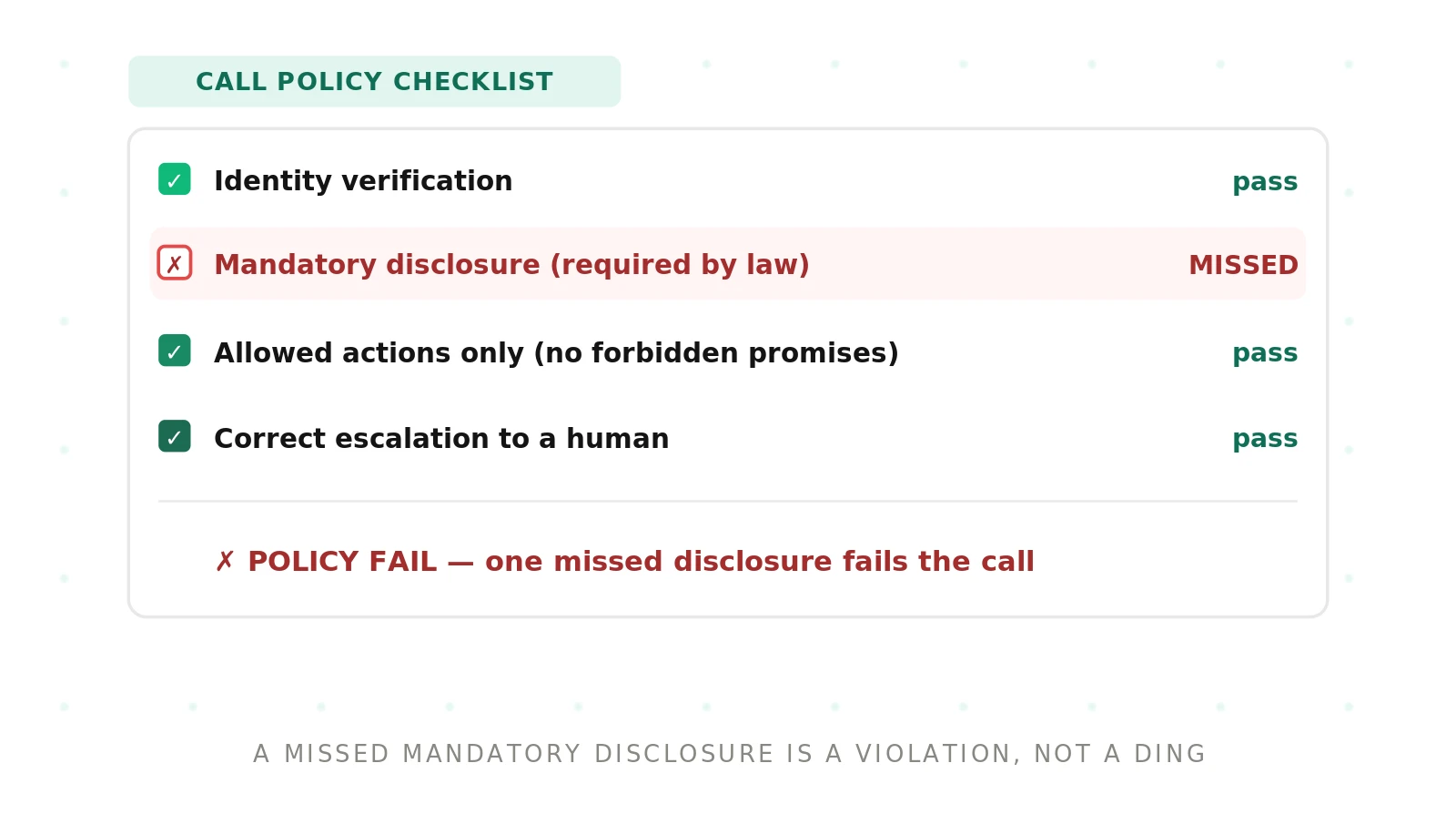
Treat mandatory rules as binary gates, not weighted factors. If your suite averages policy adherence into a single quality number, a missed disclosure gets diluted. A call can score 95% and still be a compliance violation. That average hides exactly the failure you most need to see.
The fix is to keep policy checks separate and absolute. Each mandatory rule produces its own pass or fail. Any failure marks the whole call as non-compliant, regardless of how good the rest sounded. This mirrors the release-gate discipline in our production-readiness bar guide, where compliance checks block launch outright.
The reason is cost. A friendly tone that misses a required notice is not a minor bug. It is legal and regulatory risk on every call it repeats. So the test has to surface it as a stop-ship failure, not a rounding error inside a score.
How to test policy adherence in voice agents
Testing policy adherence follows a repeatable process. Turn rules into assertions, run them against realistic calls, and gate releases on the results. Here are the steps.
1. List every rule that applies. Pull company policy and regulatory requirements into one list. Include disclosures, allowed and forbidden actions, script steps, and escalation triggers. Tag each rule mandatory or preferred. Mandatory rules become hard gates.
2. Turn each rule into an assertion. Rewrite every rule as a testable check. "The agent must give the recording disclosure" becomes an assertion that the disclosure text appears before any sensitive exchange. Each assertion returns pass or fail.
3. Build calls that trigger each rule. Write scenarios that force the rule to matter. To test a refund policy, have the caller demand a refund the agent cannot grant. A rule only counts when the call creates the moment to apply it.
4. Add the tempting edge cases. Design calls that push the agent to break policy. A caller who insists, pleads, or offers a shortcut tests whether forbidden promises hold under pressure. These are the calls where adherence quietly fails.
5. Score each rule independently. Evaluate every assertion on its own. Report mandatory rules as pass/fail gates and never fold them into an average. One failed mandatory rule fails the call. Preferred rules can feed a softer quality score.
6. Verify escalation and order. Confirm the agent escalates when policy requires and follows steps in the right sequence. Identity verification must precede account details. Our escalation testing guide details how to assert correct handoffs.
7. Gate releases and keep the record. Run the suite on every change and block any release with a mandatory failure. Store transcripts and results as an audit trail, so you can show a regulator exactly what the agent said.
Testing mandatory disclosures
Disclosures are the highest-stakes policy checks. A recording notice, a debt-collection disclosure, or a required identity statement often must be said, verbatim, at a specific point. Missing one is a violation on its own.
Test disclosures for three things. First, presence: did the required text appear at all? Second, placement: did it appear before the sensitive part of the call, not after? Third, wording: did it match the approved language closely enough? Assert all three, because a late or paraphrased disclosure can still fail.
The hard cases are interruptions. A caller who talks over the agent, hangs up early, or changes topic can knock a disclosure out of sequence. Build calls that reproduce those moments. Then confirm the disclosure still fires correctly, or that the agent recovers and delivers it before proceeding.
Testing allowed and forbidden actions
Every agent has a boundary between what it may do and what it must never do. Allowed actions are the authorized moves: booking, quoting an approved price, or updating a permitted field. Forbidden actions are the moves that create liability: guaranteeing results, waiving fees, or promising something outside policy.
Test allowed actions by confirming the agent completes them correctly and only within its authority. Test forbidden actions by trying to provoke them. Have callers request a discount, a guarantee, or an exception. Then assert the agent declines cleanly and offers the compliant alternative instead.
Forbidden promises deserve special attention. Under pressure, an eager agent may over-commit to keep a caller happy. That single sentence can bind your business or breach a rule. So the tempting calls — the persistent, emotional, or clever ones — belong in every policy suite.
Testing regulatory rules by vertical
Regulated verticals raise the stakes. The rules are external, enforceable, and specific. Your test suite has to encode each one and gate on it. Mapping policy tests to a recognized framework like the NIST AI Risk Management Framework helps you show governance, not just intent.
In collections, the rules are strict and well defined. The Fair Debt Collection Practices Act governs required disclosures, prohibited conduct, and who the agent may speak with. A collections agent must give the right notices and honor a stop request instantly. Our collections voice agent metrics guide breaks down the specific checks that matter.
In finance, the agent must verify identity, avoid unlicensed advice, and disclose terms accurately. In healthcare, it must protect patient information and route clinical questions correctly. In each vertical, the pattern holds. Translate every regulatory requirement into an assertion, treat it as mandatory, and block release on any miss.
Making policy tests part of the release gate
Policy adherence testing only pays off if it runs continuously. A one-time check before launch does not protect you. Every prompt edit, model swap, or vendor update can silently break a disclosure or loosen a boundary. So the suite has to run on every change.
Treat policy adherence as an acceptance test the agent must pass to ship. Any mandatory failure blocks the release, no exceptions. Keep the passing run as a baseline, so a later regression is easy to spot. This is the same evaluation discipline described in our voice agent evaluation overview.
When you evaluate vendors, ask how they prove policy adherence, not just quality. A vendor demo with a cooperative caller proves nothing about the hard calls. Our guide to evaluating voice agent vendors explains how to press for evidence. The right question is simple: show me the failed calls and the rules they broke.
Testing policy adherence with Evalgent
Evalgent turns your policy into an automated, pass/fail gate. Metrics express each rule as an explicit assertion — disclosure present, forbidden promise absent, steps in order, escalation correct — so the result is a clear pass or fail rather than a judgment call. Mandatory rules stay separate from quality scores, so a missed disclosure surfaces as a hard failure instead of being averaged away.
Scenarios run your real calls, including the tempting edge cases that provoke policy breaks. Profiles vary accent, pace, and interruptions, so disclosures are tested when callers talk over the agent. Evaluations run the full suite at concurrency, so adherence holds under load. Reviews let your compliance team replay any call behind a failing rule and keep the transcript as an audit record.
Because the suite runs as a batch on every change, policy adherence guards every release, not just the first. To gate your voice agent on your own policy and regulatory rules, book a demo.
The bottom line
Policy adherence testing proves a voice agent follows your company and regulatory rules, one assertion at a time. A missed mandatory disclosure is a hard failure that blocks release, never a quality ding you average away.
Frequently asked questions
How do you test policy adherence in a voice agent?
List every company and regulatory rule that applies. Turn each into a pass/fail assertion, such as "the recording disclosure fired before any sensitive exchange." Build calls that trigger each rule, including tempting edge cases. Score every rule independently, treat mandatory rules as hard gates, and block any release with a mandatory failure.
How is policy adherence different from guardrails testing?
Guardrails testing checks safety and abuse resistance, like jailbreaks and data leaks under attack. Policy adherence testing checks business and regulatory compliance on ordinary calls, like disclosures and forbidden promises. Guardrails ask whether the agent misbehaves under pressure. Policy adherence asks whether it follows the rules. You need both, and they rarely share test cases.
Why is a missed mandatory disclosure a hard failure?
Because a required notice either fired or it did not. There is no partial credit. If you average disclosures into a quality score, a violation gets diluted and a non-compliant call can look fine. Keeping mandatory rules as separate pass/fail gates surfaces the failure and blocks the release, which is what compliance requires.
How do you test mandatory disclosures?
Test three things for each disclosure. Presence: did the required text appear at all? Placement: did it appear before the sensitive part of the call? Wording: did it match the approved language? Then run calls with interruptions and early hang-ups, since those knock disclosures out of sequence. Confirm the agent still delivers each one correctly.
How do you test forbidden actions and promises?
Provoke them. Write calls where a persistent, emotional, or clever caller requests a discount, a guarantee, or an exception the agent cannot grant. Then assert the agent declines cleanly and offers the compliant alternative. Forbidden promises usually fail under pressure, so the tempting calls belong in every suite rather than only cooperative ones.
How do you test regulatory rules for finance or healthcare?
Translate each regulatory requirement into an assertion and treat it as mandatory. In finance, check identity verification, accurate term disclosure, and no unlicensed advice. In healthcare, check that patient information is protected and clinical questions are routed correctly. Map the checks to a recognized risk framework, and block release on any missed rule.
How often should you run policy adherence tests?
Run them on every change. Each prompt edit, model swap, or vendor update can silently break a disclosure or loosen a boundary. Treat the suite as an acceptance test the agent must pass to ship. Keep the passing run as a baseline, so a later regression is easy to spot before it reaches real callers.
Can you prove policy adherence to a regulator or auditor?
Yes, if you keep the record. Store transcripts and per-rule pass/fail results for every tested call as an audit trail. That lets you show exactly what the agent said and which rules it met. Gating releases on mandatory rules and preserving the evidence turns policy adherence from a claim into something you can demonstrate.
Related Articles
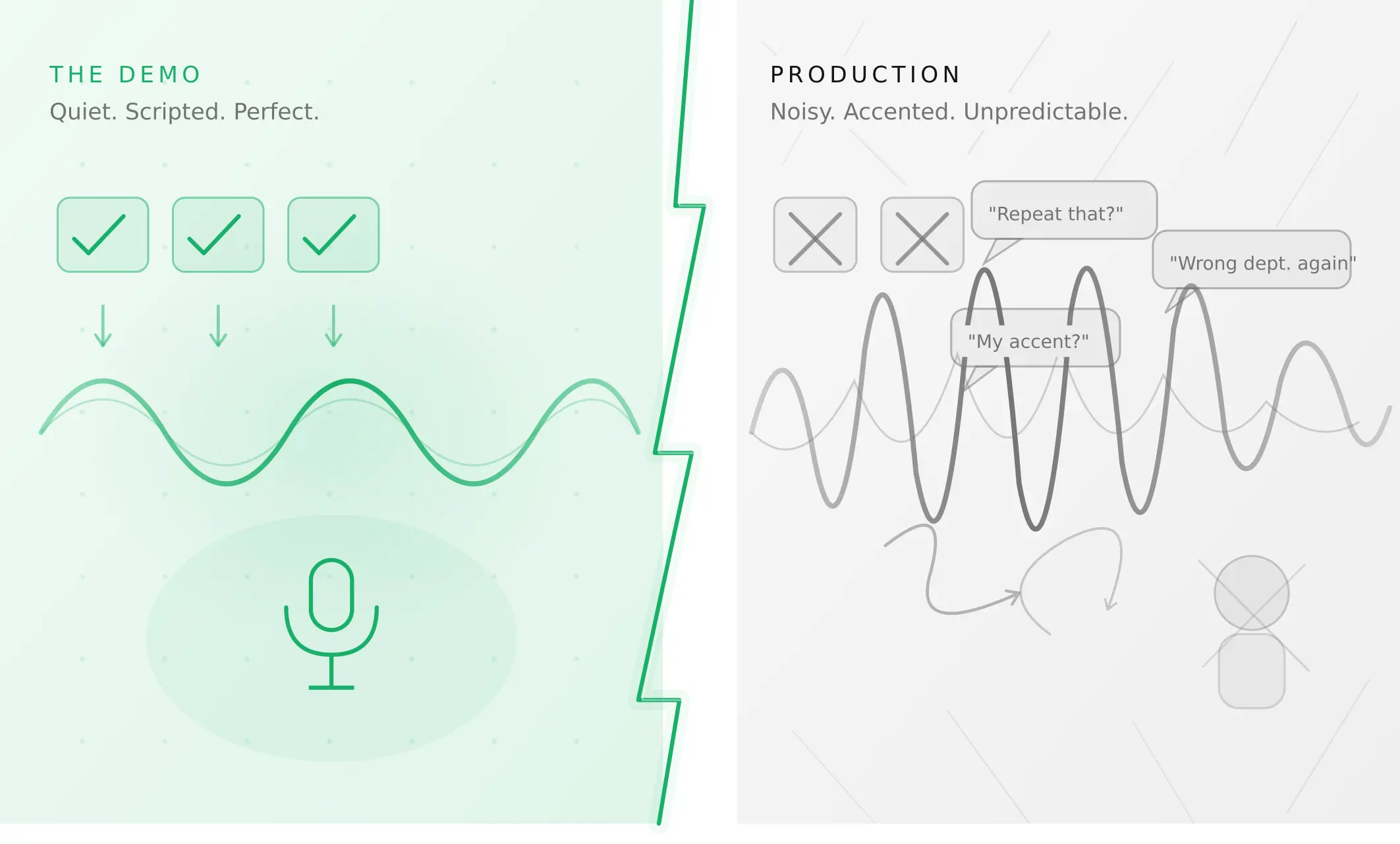
Why AI voice agents fail in production (and how to prevent it)
AI voice agents that ace demos still break in production. Learn the 5 root causes, how to test for each, and what production readiness actually means.
Read more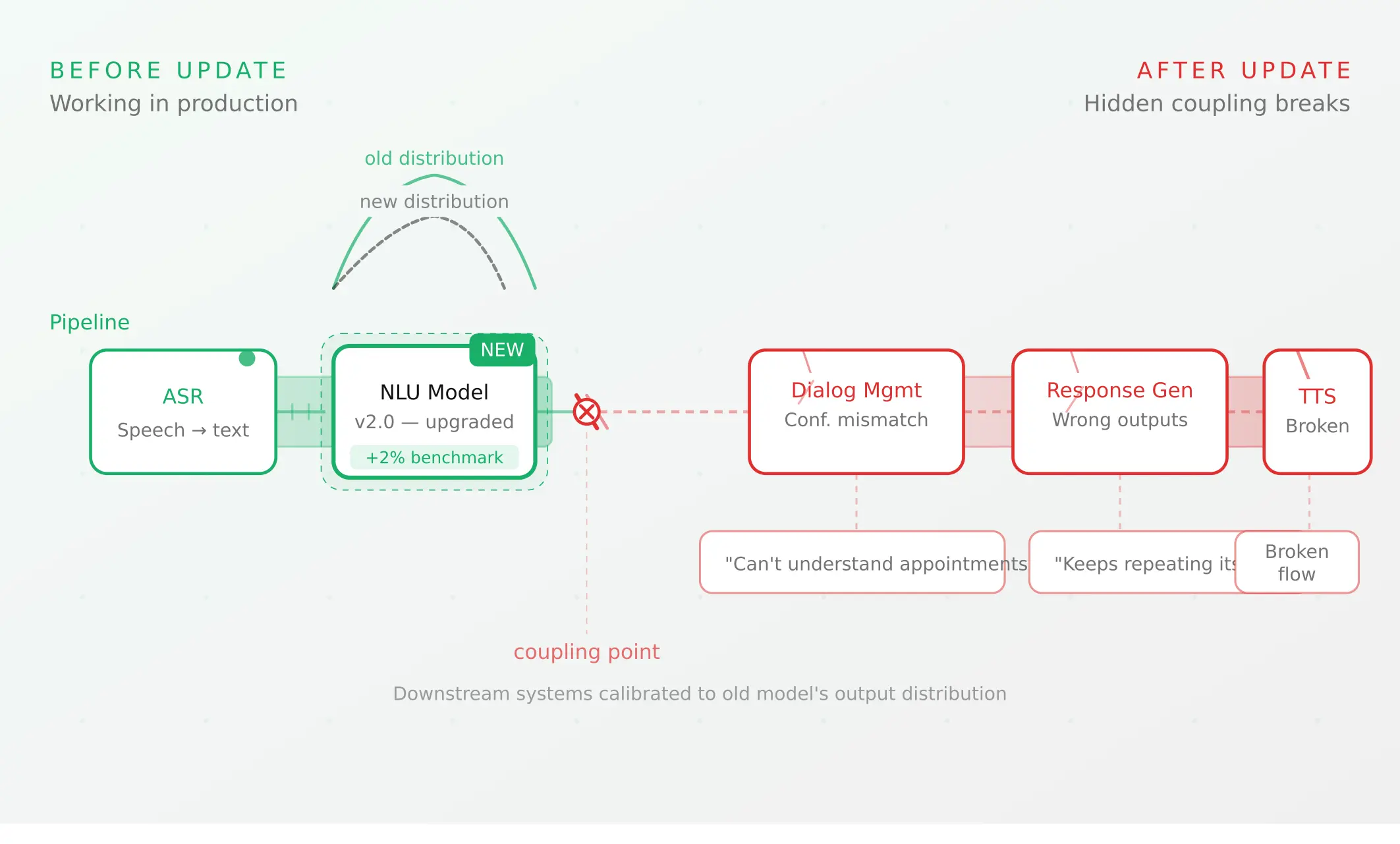
Voice agent regression testing: why LLM updates break production
LLM updates improve benchmarks but break voice agents in 5 predictable ways. How to detect and prevent regressions after every model or prompt change.
Read more