Test your voice agent
Human-in-the-Loop Evaluation for Voice Agents
# Human-in-the-loop evaluation for voice agents
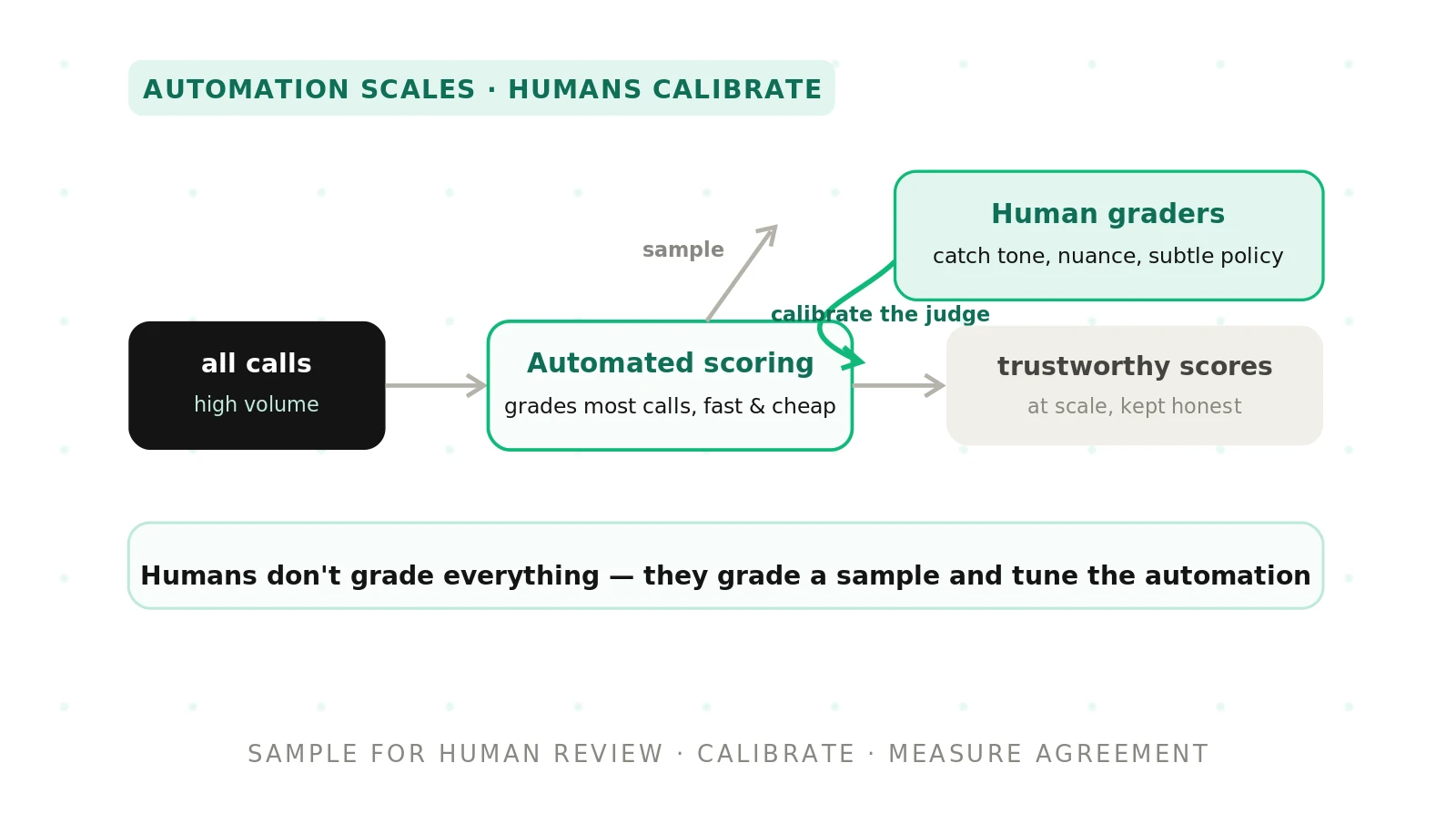
> Quick answer: Human in the loop voice agent evaluation puts trained people in the scoring loop to judge what machines miss. Humans catch tone, nuance, and subtle policy breaks. Automated scoring handles volume. The strongest programs combine both, then use human labels to calibrate the automated layer.
Most teams treat evaluation as a machine problem. They point an automated scorer at every transcript and trust the number that comes back. That works until a caller is condescended to, a refund policy is bent, or a scripted apology lands as sarcasm. Machines miss these. People do not.
Human-in-the-loop evaluation is the discipline of placing trained reviewers inside the scoring loop on purpose. Not everywhere. Not on every call. In the specific places where human judgment beats a model, and where a wrong score costs you real money or real trust. This post shows where those places are, and how to build a loop that scales without hiring an army.
What only humans reliably catch
Automated scoring is good at surface facts. Did the agent verify identity? Did it read the disclosure? Did it hit the latency target? These map to rules, and rules are easy to check at scale.
Human reviewers earn their place on the harder layer. That layer is judgment.
Human-in-the-loop evaluation: a review process where trained people score agent behavior that automated tools cannot judge reliably, then feed those labels back to improve both the agent and the automated scorer. See the concept of a human-in-the-loop system for the general pattern.
Four things humans catch that machines routinely miss:
- Tone and warmth. A transcript can be word-perfect and still feel cold or rushed. Tone lives in pacing, word choice, and repair moves. Humans hear it.
- Nuance in intent. Callers hedge, backtrack, and imply. A model often scores the literal words. A person reads what the caller actually meant.
- Subtle policy breaks. The dangerous violations are not the obvious ones. They are the near-misses where the agent almost followed the rule, and a compliance reviewer knows the difference.
- Context that spans the call. A promise made in minute one that is quietly broken in minute nine is invisible to turn-level scoring. Humans track the whole arc.
None of this means humans are better at everything. They are slower, more expensive, and less consistent than a well-tuned scorer. The goal is not to choose. It is to place each judge where it is strongest.
Where humans belong in the evaluation stack
Think of evaluation as a stack with three layers. Each layer answers a different question, and each has a natural owner.
The first layer is deterministic checks. Did required steps happen? These are rules, and machines own them completely.
The second layer is automated quality scoring. This is where a model judges softer attributes at volume. It is fast and cheap, but it drifts and it guesses. We cover its limits in depth in our post on the limits of LLM-as-judge evaluation.
The third layer is human judgment. This is the smallest layer by volume and the highest by authority. Humans do not review everything. They review the calls that matter most, and they set the standard the other layers are measured against.
A common mistake is treating these as competing options. They are not. The right question is which task belongs to which judge, and where the same task benefits from more than one.
Evaluation task: human, automated, or hybrid
The table below maps common evaluation tasks to the judge that fits. Use it to decide where to spend human hours and where to let automation run.
| Evaluation task | Human review | Automated scoring | Hybrid approach |
|---|---|---|---|
| Compliance disclosure present | Slow and costly at scale | Reliable on exact-match rules | Automate, human audits a sample |
| Tone, empathy, warmth | Strong, the gold standard | Weak and inconsistent | Human labels calibrate the model |
| Task completion or containment | Accurate but expensive | Good with clear success rules | Automate, humans adjudicate disputes |
| Subtle policy or ethics breach | Essential, hard to replace | Misses near-misses | Human review on flagged high-risk calls |
| Transcription accuracy on names | Precise but slow | Fast, weak on rare words | Automate, humans check flagged spans |
| Latency and interruption timing | Not needed | Precise and cheap | Fully automated |
| Sentiment shift across a call | Reads nuance well | Approximate | Model flags, human confirms edge cases |
The pattern is consistent. Automation carries volume. Humans carry judgment and set the ground truth. Hybrid is where most high-stakes tasks land, because you get scale from the machine and trust from the person.
Calibrating your human graders
Here is the uncomfortable truth. Two humans scoring the same call often disagree. If your reviewers are not calibrated, their scores are noise dressed as signal. You cannot fix a model with labels you cannot trust.
Calibration is the work of making reviewers agree for the right reasons. It rests on three things.
Write a rubric that removes guesswork
A rubric is the scoring standard in writing. It defines each dimension, the scale, and what each score means with concrete examples. Vague rubrics produce vague agreement.
Good rubric dimensions are observable and anchored. Instead of "rate empathy 1 to 5," define what a 2 looks like versus a 4, with a real quoted example for each. The reviewer matches behavior to an anchor rather than trusting a gut feeling.
Measure inter-rater agreement, do not assume it
Once reviewers score the same set of calls, measure how often they agree. This is inter-rater reliability, and it is not optional. Raw percent agreement overstates the truth because some agreement happens by chance.
Use a chance-corrected statistic instead. Cohen's kappa works for two raters. Fleiss' kappa extends it to more than two. A kappa near 1 means strong agreement beyond chance. A low kappa means your rubric is unclear or your reviewers are untrained. Fix the rubric before you trust the scores.
Adjudicate disagreements, then feed the lesson back
When two reviewers disagree, a third person, usually a senior reviewer, decides. This is adjudication. The adjudicated answer becomes the ground truth for that call.
Adjudication is not just tie-breaking. Every disagreement is a lesson about a weak rubric line. Log why the split happened. Update the rubric. Re-train. Over time, disagreements fall and agreement rises for the right reasons, not because reviewers learned to shrug and pick the middle score.
This whole discipline is quality control applied to human judgment. The same rigor a factory uses on parts, you apply to labels.
Using humans to validate and tune automated scoring
Once your human labels are trustworthy, they become the most valuable asset in your program. They are the ground truth that tells you whether your automated scorer is any good.
The workflow is simple to state.
First, have calibrated humans score a representative set of calls. Second, run your automated scorer on the same calls. Third, compare. Where the machine agrees with humans, you can trust it to run alone. Where it diverges, you have found its blind spots.
This comparison is not a one-time gate. Automated scorers drift as call patterns change and as prompts get tuned. A scorer that matched humans in the spring can quietly rot by the fall. Re-validating against fresh human labels catches the drift before it corrupts a quarter of reporting.
Human labels also tune the scorer directly. When you find a class of calls the model mishandles, those adjudicated examples become the correction set. You refine the scoring prompt or the rubric it follows, then re-test against held-out human labels. The machine gets better because people taught it, on your data, not a vendor's benchmark. Our guide on how to benchmark voice agents on your own data covers why your data beats generic scores.
One caution. A judge that grades itself is not a judge. If the same model that runs your agent also scores it, you have a conflict baked into the loop. This is the core case for independent voice AI evaluation, where the evaluator has no stake in the result.
Sampling for human review to control cost
Humans cannot review every call. A mid-size deployment handles tens of thousands of calls a week. Reviewing all of them by hand is impossible and unnecessary. The answer is sampling).
Sampling means reviewing a subset chosen so that what you learn generalizes to the whole. Done well, a few hundred calls tell you what matters across a hundred thousand. Done badly, you review the easy calls and miss every fire.
Three sampling strategies cover most needs, and the strongest programs blend them.
Random sampling gives you an unbiased read on overall quality. Pull calls at random, score them, and you get a defensible estimate of how the agent performs in general.
Stratified sampling splits calls into groups first, then samples each group. Sample by intent, by outcome, by language, or by time of day. This ensures rare but important call types get eyes on them, even though they are a small share of volume.
Targeted sampling sends the riskiest calls to humans. Route calls the automated scorer flagged as low-confidence, low-score, or high-risk. This is a form of active learning), where human effort goes exactly where the model is least sure. It is the highest-value review hour you can buy.
A practical mix might be a small random layer for baseline trust, a stratified layer so no call type hides, and a targeted layer that chases the model's uncertainty. The random layer keeps you honest. The targeted layer keeps you safe.
How to design a human-in-the-loop voice agent evaluation
Here is a concrete build sequence. Follow it in order. Each step depends on the one before it.
1. Define what only humans should score. List the dimensions where judgment beats rules, such as tone, nuance, and subtle policy. Everything else defaults to automation.
2. Write an anchored rubric. For each human dimension, define the scale and give a quoted example at every score. Remove words like "good" that mean different things to different people.
3. Train reviewers on the rubric. Walk a shared set of calls together. Discuss disagreements. Do not start scoring for real until reviewers understand the anchors.
4. Measure inter-rater agreement. Have reviewers independently score an overlap set. Compute kappa. If agreement is low, fix the rubric and retrain before proceeding.
5. Set up adjudication. Assign a senior reviewer to resolve splits. Log every adjudication reason and fold it back into the rubric.
6. Build your sampling plan. Combine random, stratified, and targeted sampling. Size the sample to the risk of each call type, not to a flat percentage.
7. Validate the automated scorer against human labels. Run both on the same calls. Trust the machine only where it agrees with calibrated humans.
8. Feed labels back and re-test. Use adjudicated examples to tune scoring, then re-check against held-out human labels on a schedule.
9. Monitor drift and re-calibrate. Re-run agreement checks and scorer validation regularly. Treat calibration as ongoing, not a one-time launch task.
This loop is deliberately small at the human layer and large at the automated layer. That balance is what makes it scale.
Common pitfalls that break the loop
Even well-intentioned programs fail in predictable ways. Watch for these.
Scoring everything by hand burns your reviewers out and produces less, not more. Reserve humans for judgment and high-risk samples.
Skipping agreement measurement is the quiet killer. Teams assume their reviewers agree, ship a model tuned on noisy labels, and wonder why production scores feel wrong.
Letting the agent's own model grade its own work hides the failures you most need to see. Keep the evaluator separate from the thing evaluated.
Treating calibration as a launch task rather than a habit lets drift accumulate. Rubrics rot, reviewers change, and call patterns shift. Re-calibrate on a schedule.
Choosing between transcript and audio review without thinking also costs you. Tone lives in audio, and some issues are inaudible in text alone. Our post on transcript versus audio evaluation covers the trade-off.
How this fits the wider evaluation picture
Human-in-the-loop scoring is one piece of a larger program. It sits alongside metric design, test-case coverage, and clear outcome definitions.
If you are earlier in the journey, start with the fundamentals in our voice agent evaluation hub. It frames how evaluation, testing, and monitoring fit together. The distinction between the first two matters more than most teams expect, and our guide on testing versus evaluation for voice agents draws the line clearly.
You will also need metrics worth scoring against. A human can tell you a call felt wrong, but you still need a defensible number to report. Our voice agent metrics scorecard lays out the four buckets that matter and the vanity traps to avoid. And when you argue about outcomes like containment, the definitions themselves matter, which is why we separate containment from deflection.
Frequently asked questions
What is human in the loop voice agent evaluation?
Human in the loop voice agent evaluation places trained reviewers inside the scoring process to judge what automated tools cannot. People score tone, nuance, and subtle policy breaks. Machines handle volume and clear rules. Human labels also calibrate the automated scorer, so the two layers work together rather than competing.
What can humans catch that automated scoring misses?
Humans catch tone, warmth, and pacing that read fine in text but land poorly in a call. They catch implied intent when callers hedge or backtrack. They catch near-miss policy breaks where the agent almost followed a rule. They also track promises across a whole call that turn-level automated scoring cannot connect.
How do you calibrate human graders for voice agent evaluation?
Write an anchored rubric that defines each score with real quoted examples. Train reviewers on a shared set of calls before scoring for real. Measure inter-rater agreement with a chance-corrected statistic like Cohen's kappa. When reviewers disagree, a senior reviewer adjudicates, and every disagreement becomes a lesson that sharpens the rubric.
What is inter-rater reliability and why does it matter here?
Inter-rater reliability measures how often independent reviewers assign the same score for the right reasons. It matters because uncalibrated labels are noise, and you cannot tune an automated scorer with untrustworthy ground truth. Chance-corrected metrics like Cohen's kappa or Fleiss' kappa are the standard, because raw percent agreement overstates the truth.
How can humans validate and tune LLM-judge scoring?
Have calibrated humans score a representative set of calls, then run the automated scorer on the same calls. Where they agree, the machine can run alone. Where they diverge, you have found blind spots. Feed adjudicated examples back to refine the scorer, then re-test against held-out human labels on a regular schedule.
How much human review do you actually need?
You do not need to review every call. A blended sample usually suffices: a small random layer for an unbiased baseline, a stratified layer so rare call types get seen, and a targeted layer on flagged high-risk calls. A few hundred well-chosen calls can reliably represent tens of thousands.
How do you sample calls for human review to control cost?
Combine three strategies. Random sampling gives an unbiased read on overall quality. Stratified sampling ensures rare intents and outcomes get reviewed. Targeted sampling routes low-confidence and high-risk calls to humans, a form of active learning that spends effort where the model is least sure. Size samples by risk, not a flat percentage.
Can automated scoring ever replace human review entirely?
Not for judgment-heavy tasks. Automation is reliable for deterministic checks and clear success rules, so those can run unattended. Tone, subtle policy, and ambiguous intent still need people. Even automated scorers you trust require periodic human re-validation, because scoring drifts as prompts change and call patterns shift over time.
The bottom line
Humans and machines evaluate best as a team, not as rivals. Put people on judgment and high-risk samples, let automation carry volume, and use human labels to keep the automated layer honest.
Ready to build a human-in-the-loop program that scales? Book a demo and see how an independent evaluator combines calibrated human review with automated scoring on your own calls.
Related Articles
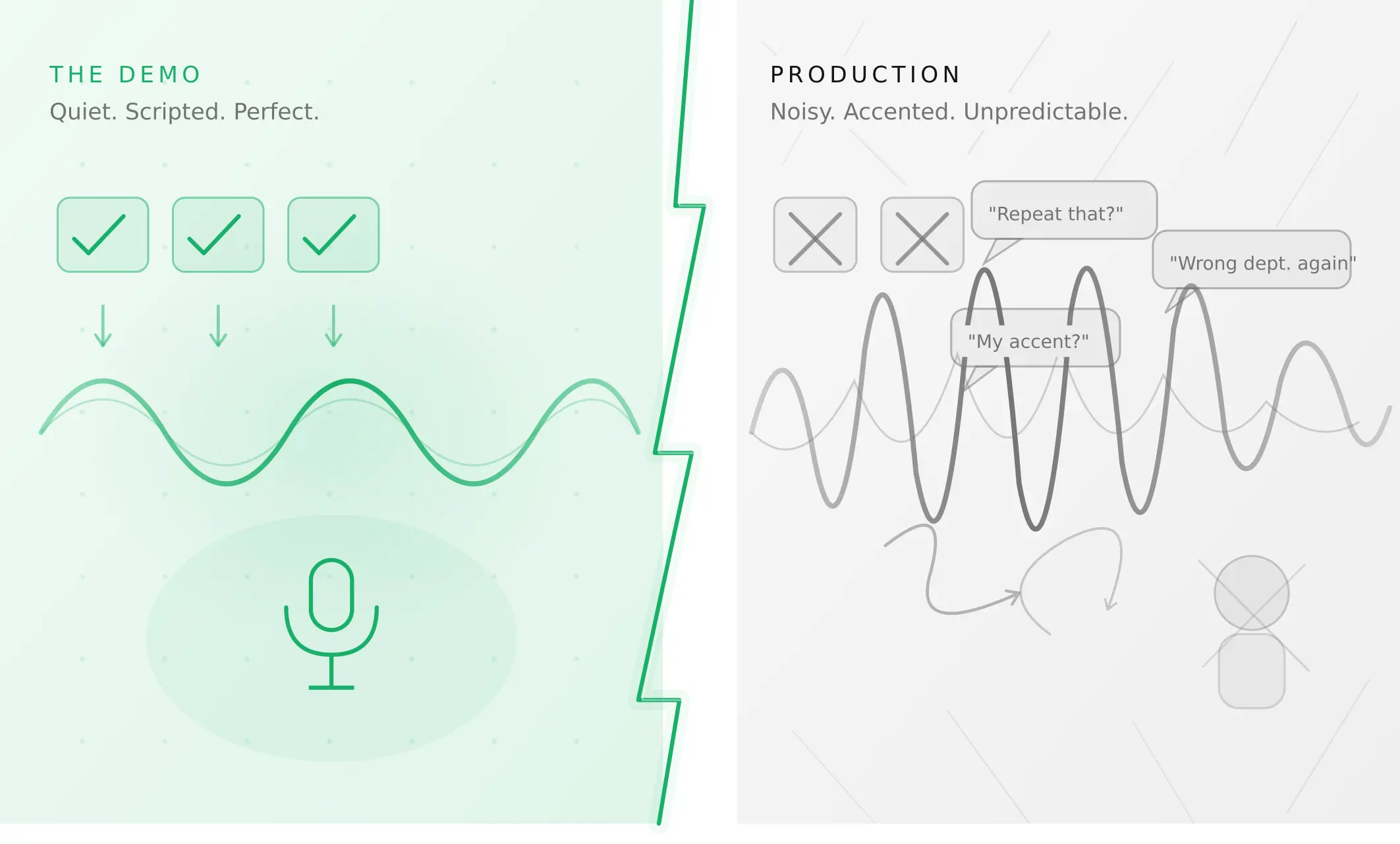
Why AI voice agents fail in production (and how to prevent it)
AI voice agents that ace demos still break in production. Learn the 5 root causes, how to test for each, and what production readiness actually means.
Read more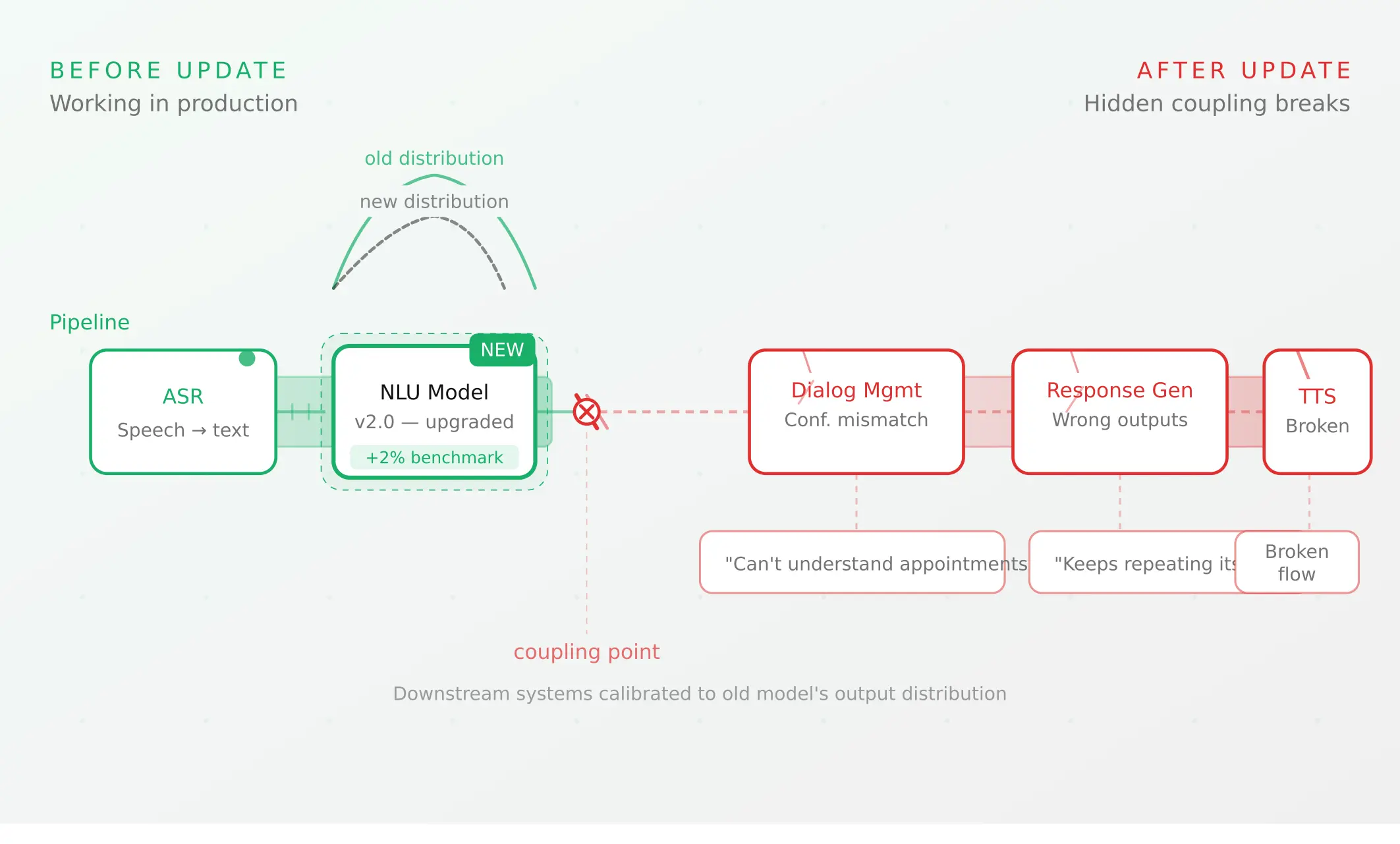
Voice agent regression testing: why LLM updates break production
LLM updates improve benchmarks but break voice agents in 5 predictable ways. How to detect and prevent regressions after every model or prompt change.
Read more