Test your voice agent
How to Sample Live Calls for Evaluation
# How to sample live calls for evaluation
Quick answer
> Quick answer: Sampling live calls voice agents teams cannot grade in full means drawing a small, representative set of production calls to review instead of all of them. Use random sampling for an unbiased baseline, stratified sampling to cover outcomes and flows fairly, and targeted sampling to study failures. Size for a reliable estimate, and refresh as traffic shifts.
You cannot listen to every call your voice agent takes. A busy line handles thousands of calls a day. Human review does not scale to that. So you review a sample. The question is how to pick that sample well.
Sampling live calls voice agents run in production is the difference between a score you trust and a number that flatters you. A bad sample hides your worst calls. A good sample gives you an honest read on quality, at a fraction of the effort. This guide covers the three main methods, how big a sample you need, how to avoid bias, and how to handle real audio safely.
It builds on our voice agent evaluation guide and the case for independent, third-party evaluation. Evalgent runs this sampling work as the independent evaluator, so the scores are not marked by the team that shipped the agent.
Why you cannot grade every call
Full census review is a fantasy for most teams. The math is simple. If each call takes six minutes to review, one reviewer covers about eighty calls a day. A line doing three thousand calls a day would need dozens of reviewers just to keep up. That cost is not worth paying.
Sampling solves this. You review a subset and infer the quality of the whole. The inference is only valid when the subset resembles the whole. A well-drawn sample of 400 calls can estimate your success rate more reliably than a lazy scan of 4,000. Size is not the point. Representativeness is.
There is a second reason to sample deliberately. Automated scoring drifts. Even if you grade every transcript with a model, you still need a human-reviewed sample to check that the automated grader is right. Sampling is the audit layer under the automation.
> Representative sample: A representative sample is a subset of calls whose mix of outcomes, flows, and callers matches the full population. It supports valid conclusions about the whole. A skewed sample supports only conclusions about itself.
Random, stratified, and targeted sampling
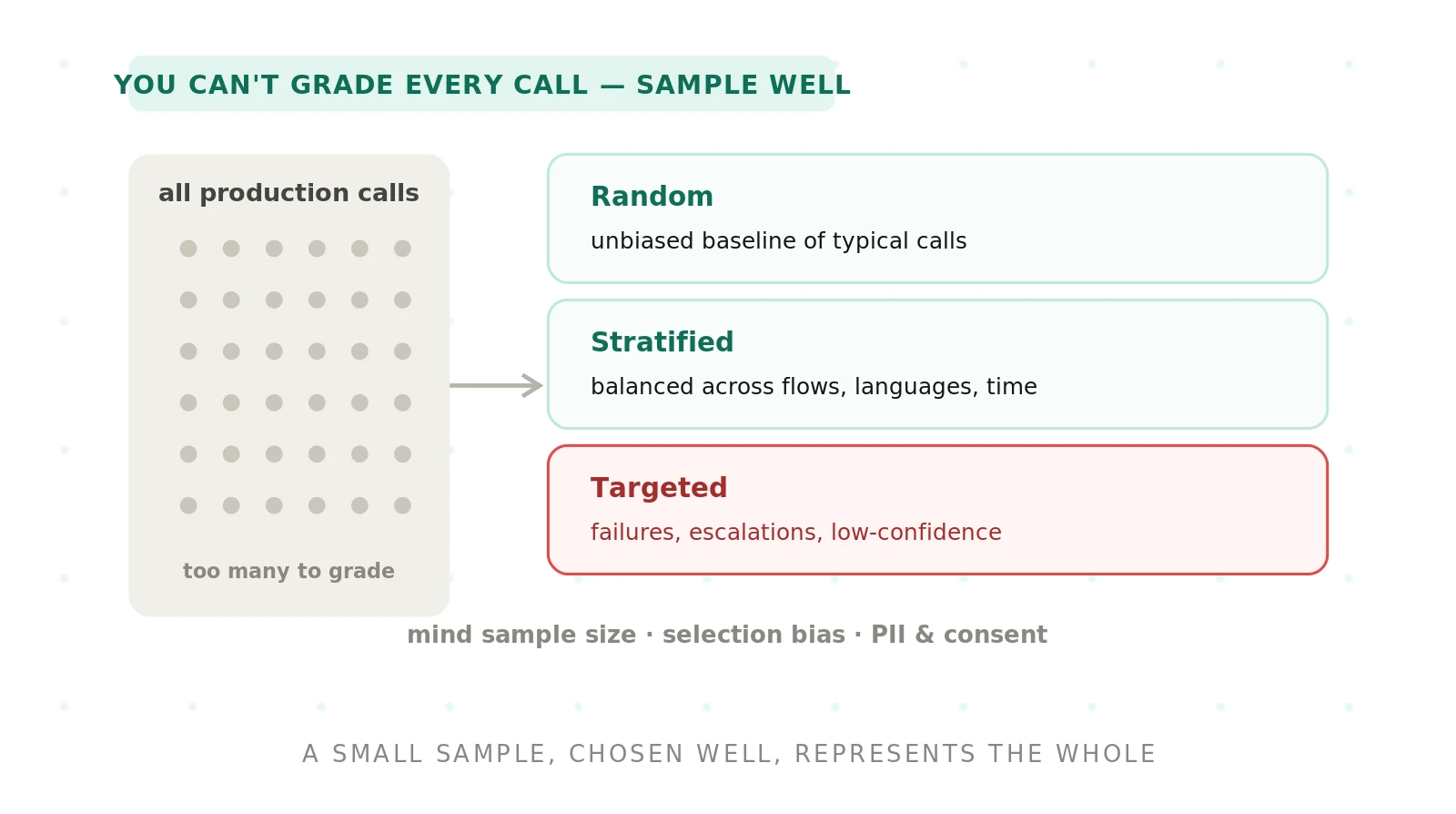
Three sampling methods cover almost every case. Each has a job. Most mature programs run all three at once, for different questions.
A simple random sample gives every call an equal chance of selection. It is unbiased by design. Use it for your baseline quality number, the one you report to leadership. Its weakness is rare events. If escalations are two percent of traffic, a random sample of 200 calls holds about four of them. That is too few to study.
Stratified sampling fixes that. You split traffic into groups, or strata, and sample each group on purpose. Strata can be outcome, flow, language, or time of day. You can oversample the rare strata, then weight the results back to true proportions. This gives you enough failures to study without distorting the headline number.
Targeted sampling ignores proportions entirely. You pull calls that match a signal: failures, escalations, low confidence scores, long durations, or repeated caller attempts. This is closest to importance sampling, where you draw more from the region you care about. It is a debugging tool, not a measurement tool. Never report a targeted sample as your overall quality.
| Sampling method | When to use it | Caveat |
|---|---|---|
| Random | Baseline quality number, unbiased trend tracking, checking an automated grader | Under-covers rare events like escalations and edge-case flows |
| Stratified | Fair coverage across outcomes, flows, languages, and time; comparing segments | Needs correct weights to recombine, or the headline number skews |
| Targeted | Debugging failures, escalations, low-confidence turns, and long calls | Not representative; never quote as your overall pass rate |
Stratifying by outcome, flow, language, and time
Strata are the groups you sample within. Choosing them well is most of the work. Four dimensions matter for voice agents.
Outcome. Split by resolved, escalated, abandoned, and error. Each outcome fails in a different way. An abandoned call and a clean resolution deserve equal scrutiny, even though one is rare.
Flow. Split by the reason people call: billing, scheduling, support, or sales. A billing flow that leaks numbers is a different risk than a scheduling flow that books the wrong day. Sample each flow so no path goes unwatched.
Language and accent. If your agent serves more than one language, stratify by it. Accuracy often drops for the smaller language groups. A random sample buries that drop under the majority. Treat each language as its own stratum.
Time. Split by hour, day, and shift. Late-night traffic differs from midday traffic. Model updates and prompt changes land on a date, so time strata let you see a regression the moment it appears.
How to design a live-call sampling plan
Here is a repeatable plan. Follow it in order, and you get a sample you can defend.
1. Define the population. State exactly which calls count: date range, lines, languages, and any filters. Write it down. The population is the thing your score describes.
2. Pick the question. Decide whether you want a headline number, a segment comparison, or a failure study. The question picks the method.
3. Choose the method. Use random for the baseline, stratified for fair coverage, targeted for debugging. Run more than one if you have more than one question.
4. Set the strata. List outcomes, flows, languages, and time buckets. Decide how many calls each stratum needs.
5. Compute the size. Use the sizing rule below to hit a reliable estimate at your chosen margin of error.
6. Draw the sample. Pull call IDs programmatically, using a seeded random function so the draw is reproducible and auditable.
7. Strip and gate PII. Redact sensitive data and confirm consent before any audio reaches a reviewer.
8. Score and weight. Grade each call on your rubric. Then weight stratified results back to true proportions for the headline number.
9. Log the draw. Record the seed, filters, date, and counts, so anyone can reproduce the exact sample later.
Choosing a sample size you can trust
Bigger is not always better. Past a point, extra calls barely move the estimate. Sample size determination tells you where that point sits.
For a single proportion, like your pass rate, size depends on three things: the margin of error you accept, the confidence you want, and the rate itself. A common target is a five percent margin at ninety-five percent confidence. That needs roughly 380 to 400 randomly drawn calls, almost regardless of how large your traffic is. Reviewers are often surprised the number is so small. It is small because a confidence interval narrows with the square root of sample size, not linearly.
Rare strata need their own budget. To estimate the escalation-handling rate within escalations, you size that stratum on its own. You might need 150 escalated calls, even though escalations are two percent of traffic. Oversample them, review them, then weight them back down.
Tighter margins cost more. Halving the margin of error roughly quadruples the sample. So pick a margin you can act on, not the smallest one imaginable. A three-point margin rarely changes a decision that a five-point margin would not.
Avoiding selection bias
Selection bias is the quiet killer of call audits. It happens when the calls you review differ systematically from the calls you do not. The score then describes your sample, not your service.
The most common trap is reviewing only what is easy. Short calls transcribe cleanly, so reviewers gravitate to them. Long, messy calls hold most of the failures. A convenience sample of tidy calls reports a quality level you do not actually deliver.
Another trap is silent filtering. Your pipeline may drop calls that failed to record, or calls where the agent crashed. If so, you have excluded your worst outcomes. Those dropped calls are data. Count them as failures rather than deleting them from the population.
Timing bias is subtle. Sampling only business hours misses the overnight degradation. Sampling only the week after a launch misses the slow drift that follows. Randomize within your strata, and cover the full time window your population claims.
The fix is discipline. Draw the sample by a machine, from the whole population, with a recorded seed. Do not let a human hand-pick calls. A transcript-only review can add its own bias, since transcripts hide tone and overlap. Decide up front whether audio is required for each stratum.
Refreshing the sample over time
A sample is a snapshot. Traffic changes, so the sample goes stale. A set drawn in January does not describe a March that added a new flow and a new language.
Refresh on a schedule and on events. On a schedule, draw a fresh random baseline every review cycle, weekly or monthly, so trends stay honest. On events, draw a new sample whenever something changes the population: a prompt update, a model swap, a new market, or a seasonal spike.
Keep the old draws. A history of dated samples lets you compare like with like and spot regressions. This is the backbone of benchmarking on your own call data, where the goal is a moving picture, not a one-time grade. Tie each sample to the config version that produced the calls, so a score always maps to a known build.
Do not reuse the same call IDs each cycle. Fresh draws catch new failure modes. A frozen sample slowly turns into a regression suite, which is useful but answers a different question.
Handling PII and consent when pulling audio
Real calls carry real personal data. Names, card numbers, health details, and addresses all show up in production audio. Pulling that audio into a review tool is a privacy event, not a neutral copy.
Redact before review. Strip or mask sensitive fields in the transcript, and bleep them in the audio, before a reviewer ever opens the call. Automated redaction runs at the point the sample is drawn, not after. Our PII handling guide covers the specific fields to catch.
Confirm the legal basis. Recording and reviewing calls is governed by consent and retention rules that vary by state and sector. Two-party-consent states require disclosure to the caller. Sampled audio should inherit the same retention limits as the source recording, and be deleted on the same clock.
Limit access. Only named reviewers should touch raw audio, and every access should be logged. An independent evaluator works inside these controls, so the sample stays auditable without widening who can hear customer calls. Score against a rubric that never asks a reviewer to write sensitive data back down. See our metrics scorecard for a rubric shape that keeps PII out of the results.
Frequently asked questions
How do I sample live calls for voice agent evaluation?
Define the population, pick your question, and choose a method. Use random sampling for a baseline pass rate, stratified sampling to cover outcomes and flows fairly, and targeted sampling to study failures. Draw call IDs with a seeded random function, redact PII, then score against a rubric and weight stratified results back to true proportions.
What is the difference between random and stratified sampling for voice agents?
Random sampling gives every call an equal chance, so it is unbiased but under-covers rare events. Stratified sampling splits traffic into groups like outcome, flow, or language, then samples each group on purpose. Stratified sampling lets you study rare failures and compare segments, as long as you weight the groups back to their true proportions.
How many calls should I review?
For a headline pass rate at a five percent margin and ninety-five percent confidence, roughly 380 to 400 randomly drawn calls suffice, almost regardless of total volume. Rare strata need their own budget, often 100 to 150 calls each. Tighter margins cost far more, since halving the margin roughly quadruples the sample.
How do I avoid selection bias in call sampling?
Draw the sample by machine from the whole population, with a recorded random seed. Never let reviewers hand-pick calls, since easy, short calls hide most failures. Count dropped or crashed calls as failures rather than deleting them. Cover the full time window and every language, so no segment is quietly excluded from the score.
When should I use targeted sampling?
Use targeted sampling to debug, not to measure. Pull calls that match a signal: failures, escalations, low confidence scores, long durations, or repeat callers. This concentrates your review on the calls most likely to teach you something. Never report a targeted sample as your overall quality, because it deliberately over-represents the calls you care about most.
How often should I refresh a call sample?
Refresh on a schedule and on events. Draw a fresh random baseline every review cycle, weekly or monthly, to keep trends honest. Draw a new sample whenever the population changes: a prompt update, a model swap, a new market, or a seasonal spike. Keep old dated draws so you can compare like with like and catch regressions.
How do I handle PII when pulling call audio?
Redact before review. Mask sensitive fields in transcripts and bleep them in audio at the moment the sample is drawn, not after. Confirm consent and follow state recording rules, and apply the source recording's retention clock to the sample. Limit raw audio to named reviewers, log every access, and use a rubric that never records sensitive data.
Can I score every transcript automatically instead of sampling?
Automated scoring helps, but it does not remove the need for a sample. Model graders drift and miss tone, overlap, and timing that only audio reveals. Keep a human-reviewed sample as the audit layer that checks the automated grader. Sampling and automation work together: automation covers volume, sampling verifies the automation stays correct over time.
The bottom line
Good sampling makes a small, well-drawn set of calls speak for your whole line. Choose random for the baseline, stratified for fair coverage, and targeted for debugging, then size for a reliable estimate and refresh as traffic shifts.
Ready to put an honest sampling plan behind your voice agent? Book a demo and let Evalgent run the sampling and scoring as your independent evaluator.
Related Articles
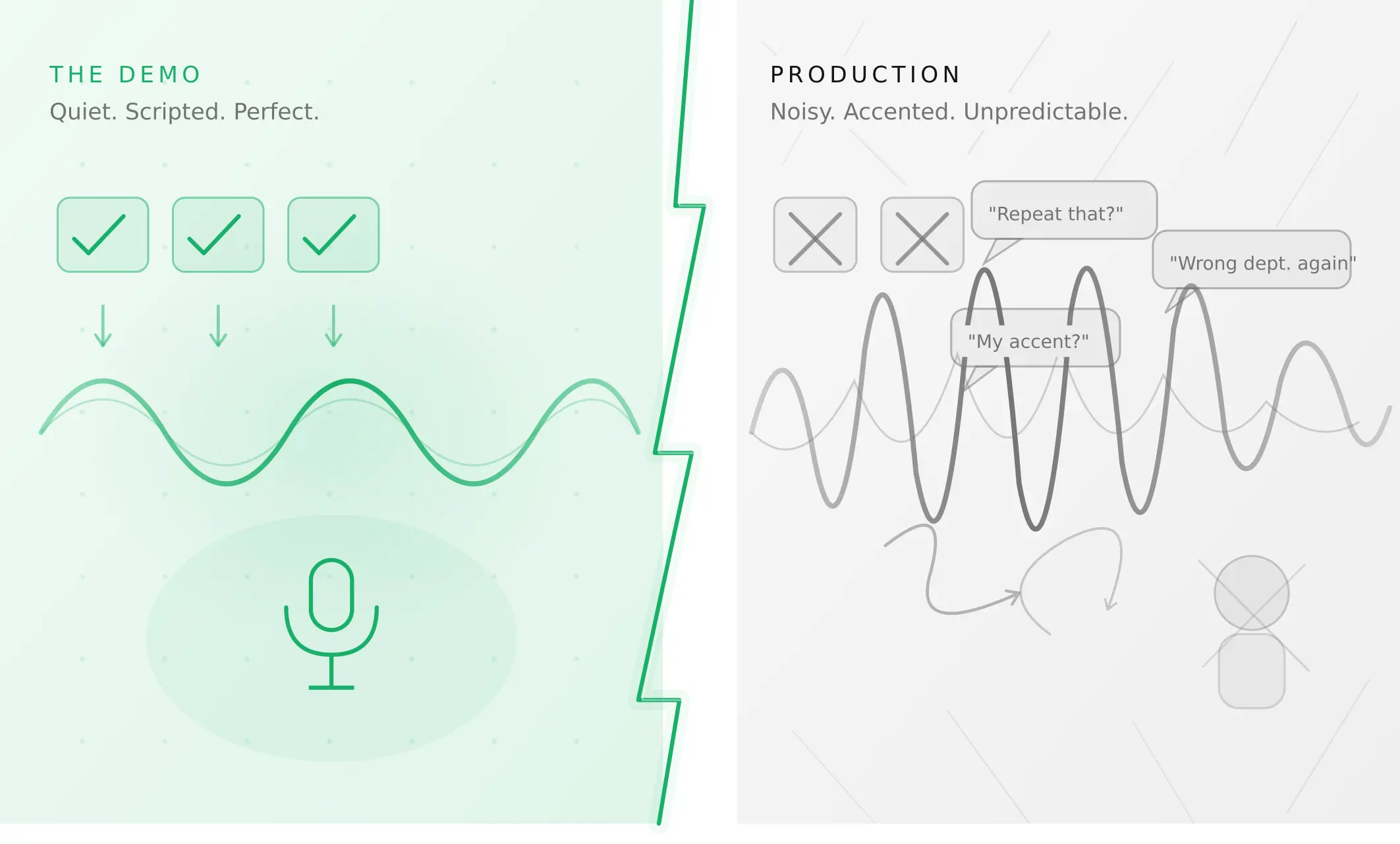
Why AI voice agents fail in production (and how to prevent it)
AI voice agents that ace demos still break in production. Learn the 5 root causes, how to test for each, and what production readiness actually means.
Read more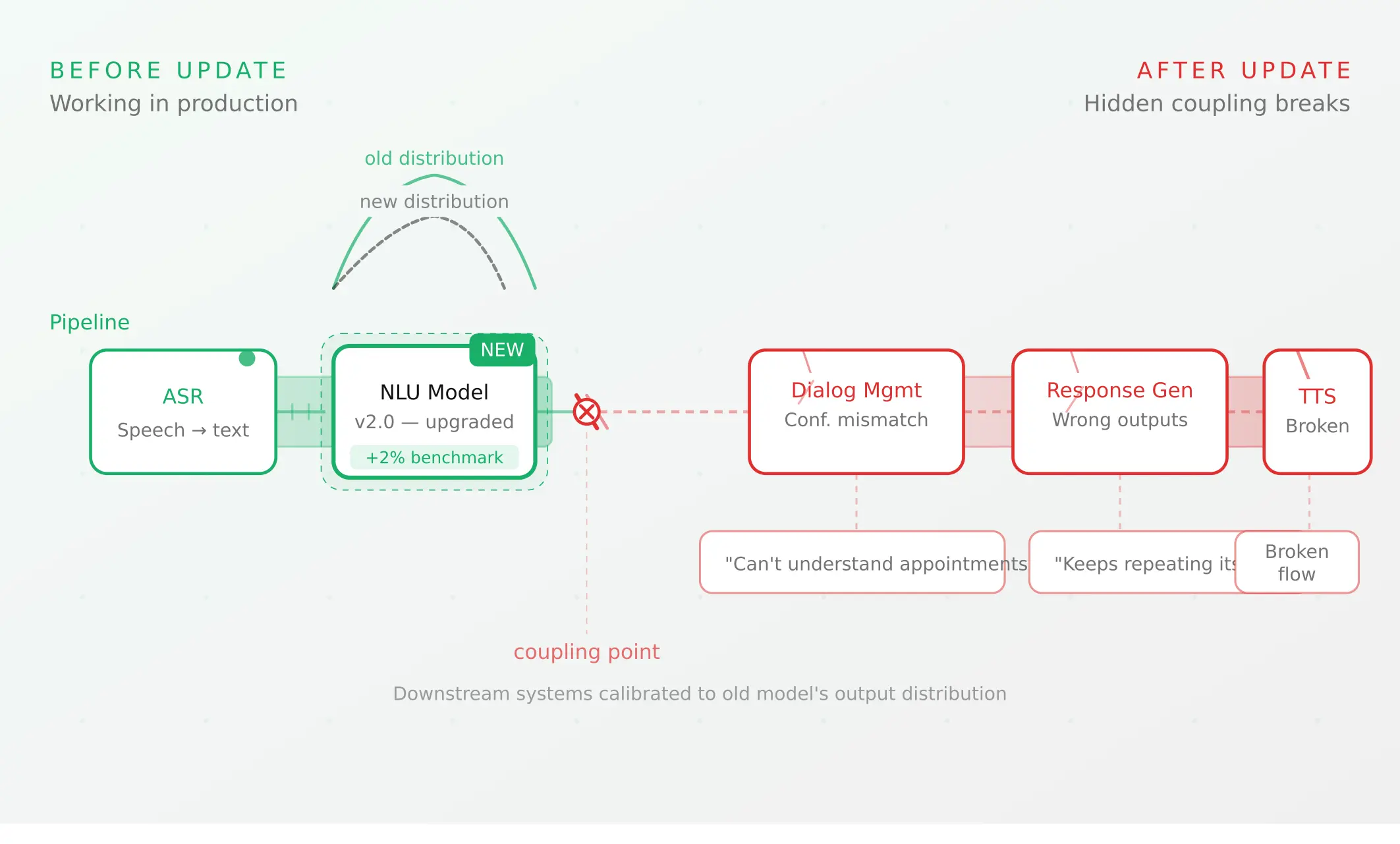
Voice agent regression testing: why LLM updates break production
LLM updates improve benchmarks but break voice agents in 5 predictable ways. How to detect and prevent regressions after every model or prompt change.
Read more