Test your voice agent
Turn Voice Agent Production Failures into Tests
# Turn voice agent production failures into tests
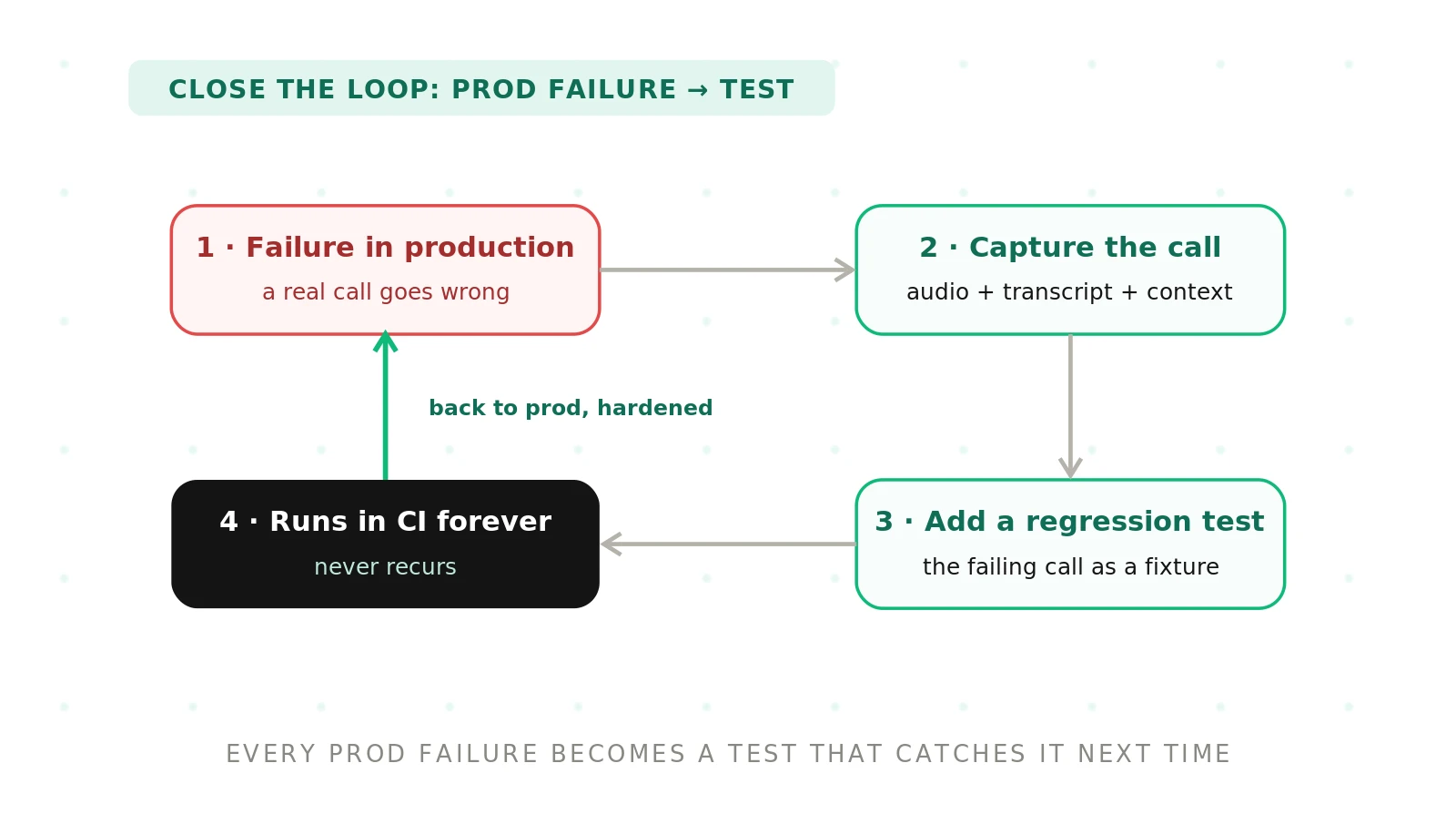
> Quick answer: A voice agent production feedback loop captures real failed calls, root-causes them, and converts each into a permanent regression test with the failing call as a fixture. Re-running that test on every change means the same failure never ships twice.
Every voice agent fails in production. The question is whether those failures teach the system anything. Most teams patch the prompt, close the ticket, and move on. The fix works today. Then a model update or a prompt edit quietly reintroduces the same bug three weeks later.
A production feedback loop breaks that cycle. It treats each real failure as a specimen, not a fire. You capture the call, find the cause, and lock the behavior into a test that runs forever. The failure becomes a guardrail against its own return.
This is the difference between a test suite that decays and one that compounds. This piece explains how to build the loop, what to capture at each stage, and why the resulting suite is your strongest defense against drift. If you are still setting up basic coverage, start with our guide to voice agent evaluation, then come back for the production half.
Why production is your best test source
Synthetic test cases are essential, but they share a blind spot. You can only test for problems you already imagined. Production has no such limit. Real callers do things no test author would think to script.
They interrupt mid-sentence. They give a ZIP code as five separate digits. They switch languages halfway through. They ask two questions in one breath. Each of these is a test case you did not write, delivered free by a live caller.
> Feedback loop: a system where outputs are fed back as inputs to shape future behavior. In software, production signals flow back into the test suite so the system improves with use. See feedback for the general concept.
The gap between lab and field is where voice agents break. A benchmark score from launch day says little about the agent callers reach this morning. Continuous monitoring of production voice agents surfaces the failures, but monitoring alone does not prevent recurrence. You need a mechanism that turns each caught failure into a standing check.
That mechanism is the loop. Monitoring finds the problem once. The regression test finds it every time after.
What a production-to-test feedback loop is
The loop has a simple shape. Signals come out of production. Tests go back in. The suite grows with every incident, and each incident can only cost you once.
Contrast this with the common pattern. A caller complains. An engineer listens to the audio. They spot a bad prompt instruction. They edit it. The ticket closes. Nothing stops that same edit from being reverted, or the model beneath it from changing. The knowledge lived in one engineer's head and one closed ticket. It is gone.
In a real loop, that same incident produces an artifact. The failing call becomes a fixture. The expected behavior becomes an assertion. The pair joins the suite. Now the fix is defended. Anyone can run the suite and confirm the behavior still holds.
> Regression test: a test that checks previously working behavior still works after a change. It exists to catch the reintroduction of an old bug. See regression testing.
This is why independent evaluation matters here. The team that wrote the prompt is not the best judge of whether the fix holds under a model swap. As the independent evaluator, Evalgent re-runs your accumulated production failures on every change, so the suite is enforced by someone with no stake in the last patch. Our piece on independent voice AI evaluation covers why outside checks catch what internal teams miss.
Where failures come from and what test each becomes
Not all failures arrive the same way. Some show up in metrics. Some hide in transcripts. Some are only audible in the raw audio. The signal you capture determines the test you can build. The table below maps each source to the signal it gives you and the test it becomes.
| Failure source | Captured signal | Test you add |
|---|---|---|
| Live metrics and alerts | Spike in escalations, drop in task success, latency breach | Threshold assertion on the failing scenario, re-run on every deploy |
| Call transcripts | Wrong answer, missed intent, policy violation in text | Input-output test: same caller utterance must produce the corrected response |
| Raw call audio | Barge-in mishandled, silence, talk-over, accent misheard | Audio fixture replayed through the agent, asserting correct turn-taking and transcription |
| Caller or agent survey feedback | Reported confusion, repeated question, abandoned call | Scenario test reproducing the confusing path, asserting a clear resolution |
| Escalation and handoff logs | Agent failed to transfer, transferred wrongly, looped | Escalation test asserting the correct handoff trigger and destination |
Two lessons come out of this table. First, transcript review and audio review catch different classes of failure, so you need both. A transcript hides a talk-over that ruined the call. The audio hides nothing but is slower to review.
Second, the richest fixture is the raw call itself. A transcript is a lossy summary. The audio preserves timing, overlap, and tone. When you save a failing call as a fixture, save the audio, not just the text.
How to run the production-to-test feedback loop
The loop is a repeatable process, not a one-time project. Run it on a fixed cadence and on every incident. Here is the sequence from a caught failure to a defended fix.
1. Capture the failing call. Pull the full record: audio, transcript, metadata, and any metric that flagged it. Store it with a stable ID so you can reference it later. The raw call is your fixture, so preserve it losslessly.
2. Triage by severity and frequency. Not every failure earns a test today. Rank by caller impact and how often the pattern appears. A rare cosmetic glitch waits. A frequent policy violation jumps the queue.
3. Find the root cause. Trace the failure to its origin: prompt, model, retrieval, or logic. Do not stop at the symptom. Use structured root cause analysis so the fix addresses the cause, not the surface.
4. Write the failing test first. Turn the call into a test that fails against the current agent. This proves the test actually detects the bug. A test that passes before the fix proves nothing.
5. Fix, then confirm the test passes. Apply the change. Re-run the new test. It must now pass. Re-run the full suite to confirm the fix broke nothing else.
6. Add the test to the permanent suite. Commit the fixture and assertion. It now runs on every future change. The failure is defended for good.
7. Write a short postmortem. Record what failed, why, and what test now guards it. Keep the postmortem blameless. See the Google SRE postmortem culture for a model that focuses on systems, not people.
8. Re-run on every change. Model updates, prompt edits, and data changes all trigger the suite. The loop only pays off if the tests run continuously, not once.
Follow this and the suite becomes self-reinforcing. Each pass through the loop leaves the agent measurably harder to break in the same way again.
Why the suite compounds against drift
A voice agent drifts. The model provider ships an update. Someone edits a prompt to fix one edge case. A knowledge-base document changes. None of these show up as a code change you would think to test. Each can silently undo a past fix.
This is where the accumulated suite earns its keep. A one-time benchmark cannot catch a regression introduced after the benchmark ran. A growing library of real-failure tests can. Every past incident stands guard against its own return, no matter what changed underneath.
The economics favor the loop over time. Writing a test after an incident costs an hour. Shipping the same failure to callers a second time costs trust, escalations, and rework. The suite converts a one-time cost into permanent protection. This is continual improvement applied to a voice agent: small, steady gains that never regress.
The compounding effect is the whole point. A team that runs the loop for a year holds hundreds of tests drawn from real calls. A team that patches and forgets holds the same bugs it started with, plus new ones. Continuous auditing of the production agent keeps the suite honest as the system moves.
There is a coverage benefit too. Production failures cluster around the paths callers actually use. A suite built from real calls weights its coverage toward what matters, not toward paths a test author guessed at. You end up testing the agent your callers meet, not the one you imagined.
Who should own the loop, and when to start
The loop suits any team running a voice agent that real people call. It matters most when the stakes of a repeat failure are high. A collections agent that misstates a balance, a healthcare intake agent that mishears a symptom, a support agent that leaks a policy: these are failures you cannot afford twice.
Start the loop the day you go live, not after the first crisis. Early calls are noisy and full of signal. The failures you capture in week one often recur for months if left undefended. A small suite built early beats a large one built in a panic.
Teams with limited QA capacity should still start, just narrower. Pick your highest-impact scenario. Capture its failures. Build tests for that path only. Widen coverage as the loop proves its value. For a deeper split of what testing and evaluation each contribute, see our guide on testing versus evaluation for voice agents.
One caution on escalation paths. A failure to hand off correctly is easy to miss in metrics and painful for callers. Treat every mishandled transfer as a first-class fixture. Our guide on escalation in voice agents covers the handoff triggers worth asserting.
Independent enforcement closes the last gap. A suite the building team owns can be quietly weakened when a deadline looms. As the independent evaluator, Evalgent holds the production-failure suite outside the build team and re-runs it on every change, so no fix silently disappears.
Frequently asked questions
What is a voice agent production feedback loop?
A voice agent production feedback loop is a process that captures real failed calls, root-causes them, and converts each into a permanent regression test. The failing call becomes a fixture, and the test runs on every change. This ensures a failure that reached callers once cannot silently return.
How do I turn a failed call into a regression test?
Capture the full call, including audio and transcript, as a fixture with a stable ID. Root-cause the failure to prompt, model, retrieval, or logic. Write a test that fails against the current agent, apply the fix, then confirm the test passes. Commit it to the permanent suite so it re-runs on every change.
Why capture the audio and not just the transcript?
A transcript is a lossy summary of a call. It hides timing, overlap, talk-over, and tone. Barge-in and turn-taking failures are often invisible in text but obvious in audio. Saving the raw call as a fixture preserves everything, so your regression test can replay the exact conditions that caused the original failure.
How is this different from a one-time benchmark?
A one-time benchmark scores the agent on a fixed test set on one date. It cannot catch a regression introduced after it ran. A production feedback loop grows a suite from real failures that re-runs continuously. Each past incident stands guard against its own return, no matter what changes in the model, prompt, or data.
How often should I run the production failure suite?
Run the production failure suite on every change to the agent: model updates, prompt edits, and knowledge-base changes. Also run it on a fixed schedule, such as daily or weekly, to catch drift from provider-side updates you did not trigger. Continuous re-runs are what make the loop pay off over time.
Which production failures should become tests first?
Triage by caller impact and frequency. Failures that harm callers or violate policy jump the queue. Frequent patterns matter more than rare cosmetic glitches. Escalation and handoff failures deserve priority because they are easy to miss in metrics and costly for callers. Start with your highest-impact scenario and widen coverage from there.
Why use an independent evaluator for this loop?
The team that wrote a fix is not the best judge of whether it holds under a model swap. A suite the build team owns can be quietly weakened near a deadline. An independent evaluator holds the production-failure suite outside the build team and re-runs it on every change, so no past fix silently disappears under pressure.
Can synthetic testing replace a production feedback loop?
Synthetic testing and a production feedback loop are complementary, not interchangeable. Synthetic tests cover problems you can imagine in advance. Production supplies failures no test author would script. Using synthetic callers for voice agent testing alongside real-failure fixtures gives you both proactive coverage and defense against surprises live callers deliver.
The bottom line
A production feedback loop turns every real failure into a permanent test. That is the only way to stop the same bug from shipping twice.
Pair this loop with systematic voice agent testing and a benchmark on your own call data for broader coverage. Ready to see the loop enforced independently? Book a demo and we will show you how Evalgent turns your production failures into a compounding regression suite.
Related Articles
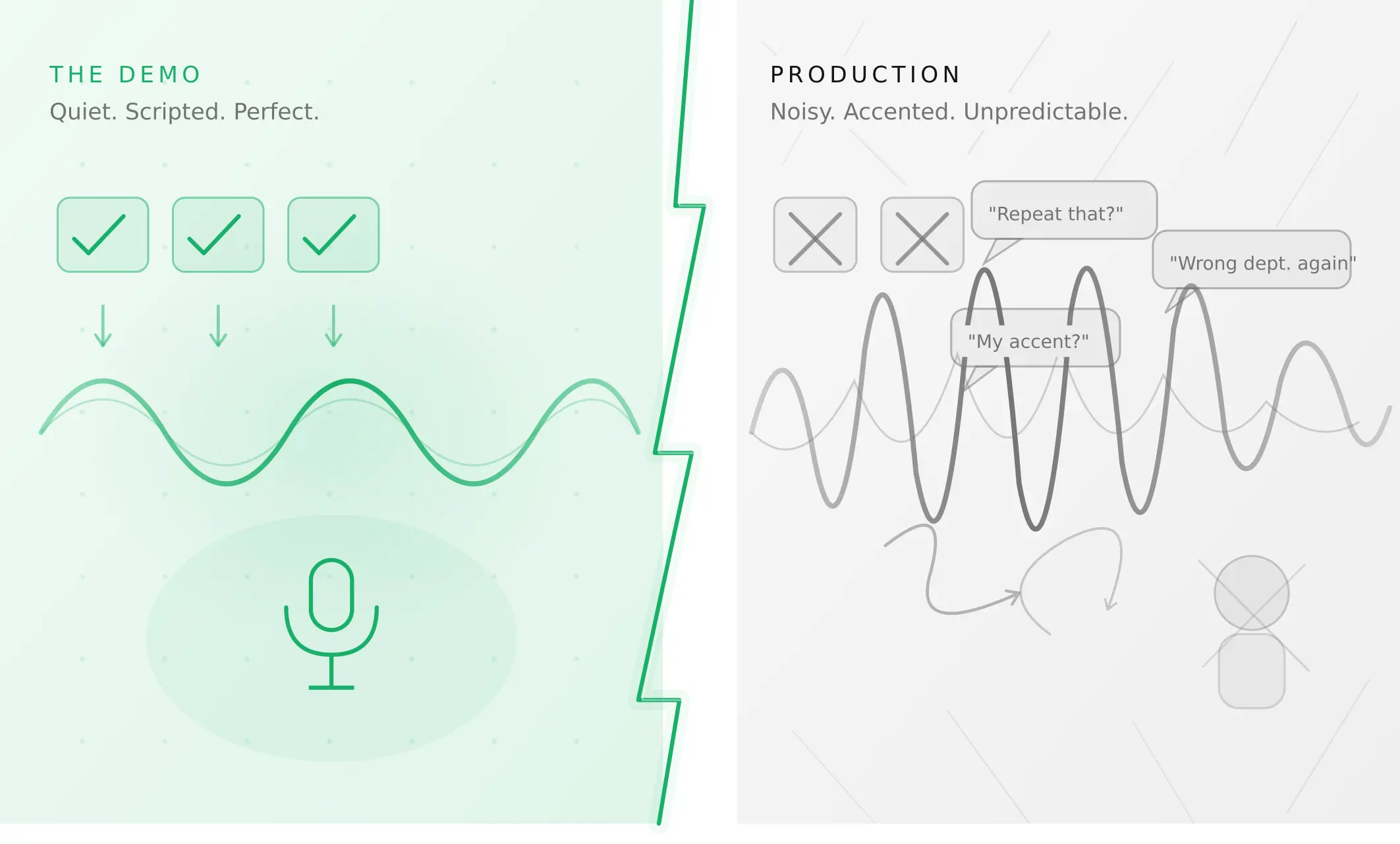
Why AI voice agents fail in production (and how to prevent it)
AI voice agents that ace demos still break in production. Learn the 5 root causes, how to test for each, and what production readiness actually means.
Read more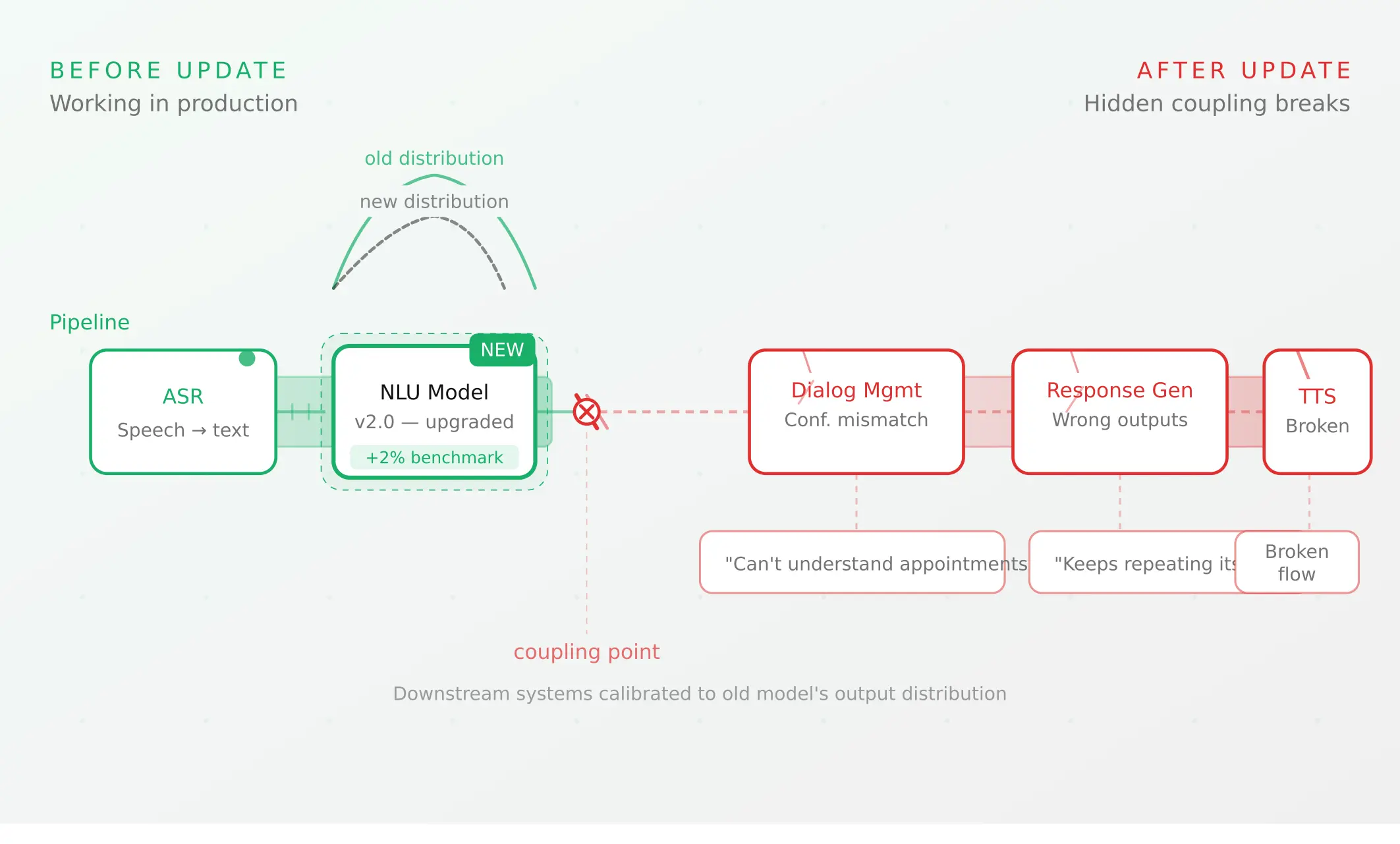
Voice agent regression testing: why LLM updates break production
LLM updates improve benchmarks but break voice agents in 5 predictable ways. How to detect and prevent regressions after every model or prompt change.
Read more