Test your voice agent
Independent Voice AI Evaluation: What It Is and Why It Matters
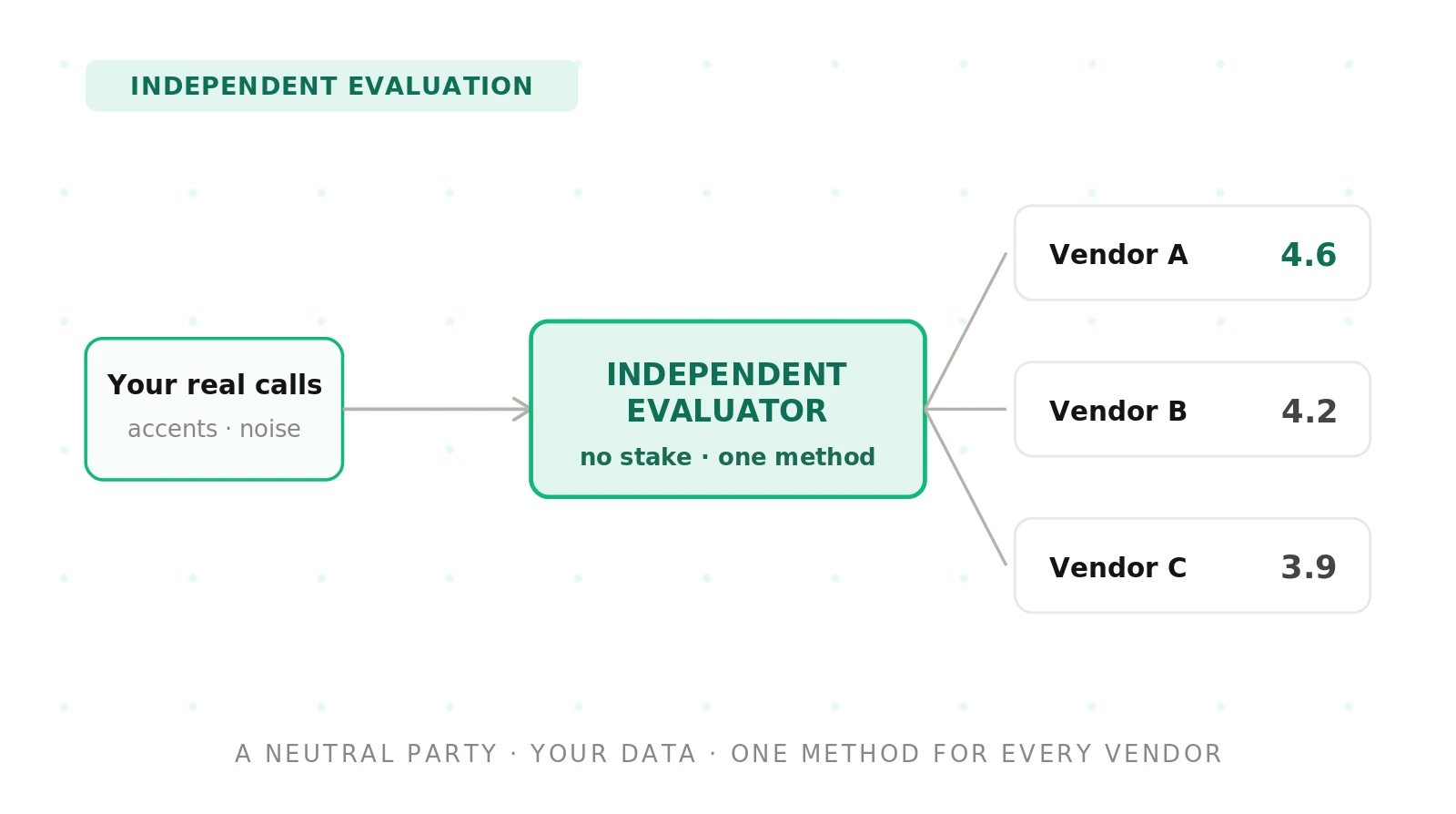
When a voice agent is graded by the company that built it, the grade is marketing. That is fine for a landing page and useless for a purchase decision. As enterprises run more voice agents — often four or five vendors at once — the question "which one is actually better, and is it good enough to ship?" needs an answer no vendor can credibly give about itself. Independent voice AI evaluation is that answer: a neutral assessment, on your calls, scored the same way for everyone.
This guide defines the category. What "independent" actually means, why it matters more as deployments scale, what a real evaluation covers, and how to run one. It is the hub for our work on the vendor scorecard and on why vendor-reported metrics can't decide a purchase.
What "independent" means
Independent evaluation borrows a principle from software assurance called independent verification and validation: the party checking the system is not the party that built or sells it. Applied to voice AI, "independent" has three concrete requirements.
First, no stake in the outcome. The evaluator does not win if a particular vendor is chosen, which removes the conflict of interest that makes vendor-reported numbers unreliable. Second, your data, not theirs. The evaluation runs on your real calls — your callers, accents, noise, and tasks — rather than a vendor's curated dataset. Third, one method for everyone. Every vendor or version is scored with a single, fixed definition, so the results are comparable. Remove any of the three and the "evaluation" collapses back into marketing.
Why independent evaluation matters
The case is straightforward once you see the incentives. A vendor measures its own agent, on data it chose, with definitions it controls, and publishes the flattering result — not dishonesty, but selection. The deeper problem is that independent, production-scale benchmarks barely exist in voice AI, so most cited numbers trace back to the seller. Even the choice of evaluator changes the verdict: the same calls scored two ways can rank agents differently, a limitation our LLM-as-judge piece details.
Three forces make independence non-optional in 2026. Enterprises run multiple vendors to hedge risk, and comparing them requires one neutral yardstick. Procurement and security increasingly demand evidence, not vendor assurances, before a contract or a go-live. And agents change — a model update can silently regress a vendor that passed at selection — so someone with no stake has to keep checking. A great demo settles none of this, because a demo is the same curated success in live form, and the gap between it and production is why voice agents fail.
What an independent evaluation covers
A real evaluation measures the whole agent, not a single headline number. It scores speech recognition accuracy on your audio — weighted for critical entities, not a clean-audio word error rate — plus latency at the tail, task success, escalation and recovery, safety and compliance, and behavior under load. Timing is judged against real thresholds; the comfortable one-way limit in the ITU-T G.114 telephony standard is 150ms, and the tail is what callers feel. For regulated buyers, the safety and compliance checks map to a recognized framework such as the NIST AI Risk Management Framework, so the result stands up to a security review. The full layer-by-layer picture is in our voice agent evaluation guide.
Independent vs vendor vs internal evaluation
Three parties can evaluate a voice agent, and they are not equivalent.
| Vendor self-testing | Internal (your team) | Independent evaluation | |
|---|---|---|---|
| Stake in outcome | High — wants the sale | Low | None |
| Data | Vendor's clean audio | Your calls | Your calls |
| Cross-vendor comparability | None | Varies | Built in — one method |
| Rigor / methodology | Undisclosed | Depends on time | Fixed and disclosed |
| Credible to procurement | No | Sometimes | Yes |
Internal testing is valuable and closer to the truth than vendor claims, but teams rarely have the time or tooling to score every vendor identically at scale, and their results still need a defensible methodology. Independent evaluation supplies both the neutrality and the shared method.
How to run an independent voice AI evaluation
The process is the same whether you run it yourself with neutral tooling or bring in a third party.
1. Define success on your terms — Write down the calls the agent must handle and what "resolved" means, before looking at any vendor.
2. Build one shared test set — Assemble scenarios and caller profiles from your real traffic, including edge cases, noise, and adversarial callers.
3. Score every vendor identically — Run the same calls against each vendor or version, with one fixed definition per metric, so the comparison is fair.
4. Measure on your own data — Produce the numbers yourself rather than accepting vendor-reported figures.
5. Test at production scale — Re-run the critical checks under expected peak concurrency, since accuracy and latency degrade under load.
6. Document the evidence — Keep the scored results and methodology, so procurement and security can see how the decision was made.
7. Re-evaluate on a cadence — Repeat after model updates and on a schedule, because today's winner can regress tomorrow.
When you need an independent evaluation
A few moments make independence non-negotiable rather than nice-to-have. When you are choosing between vendors and every vendor's own chart says it wins, one neutral comparison is what breaks the tie. When procurement or security asks for evidence before signing, a vendor's marketing page will not clear the bar, but a documented, neutral audit trail will. When you move from a pilot to production, an independent gate tells you whether the agent is ready for the callers you cannot control. And when a vendor ships a model update, a fresh evaluation catches the regressions a one-time approval would miss.
The common thread is a decision with real consequences and a number you cannot afford to take on faith. If the stakes are low and easily reversed, internal spot-checks may be enough. If they are high — a multi-year contract, a regulated workflow, a customer-facing launch — the measurement should be neutral, on your data, and documented well enough to defend later.
Who needs independent evaluation
The buyers change, the need does not. An engineering leader choosing a vendor needs a comparison that is not the vendor's own chart. A QA team needs a repeatable gate that does not depend on a demo. Procurement and security need documented evidence for a contract or an audit. And a customer experience owner running several vendors needs to know which one actually resolves calls, not which one markets best. Independent evaluation serves all of them from the same principle: measure it yourself, neutrally, on the calls you get. The buyer's title and the use case change what gets weighted most, but not the need for a neutral number, produced the same way for every option on the table.
Independent voice AI evaluation with Evalgent
Evalgent is built to be the neutral evaluator. Scenarios reproduce your real calls — happy paths, edge cases, interruptions, and adversarial callers — and run identically against every vendor or version you compare. Profiles vary caller accent, pace, and line quality, so no vendor wins on clean audio alone. Metrics measure each dimension on your own data, with one fixed definition applied to everyone, so results are finally comparable across vendors. Evaluations run the suite at concurrency, and Reviews let your team replay any call to hear why one option scored higher than another. Because Evalgent has no stake in which vendor you pick, the number it produces is one you can put in front of procurement and security.
The result is a decision you can defend: not the vendor's best-case claim, but your own measurement on the calls you actually get. To run an independent evaluation of the vendors or versions you are weighing, book a demo.
The bottom line
Independent voice AI evaluation is a neutral assessment of a voice agent, on your own calls, scored the same way for everyone, by a party with no stake in the result. It exists because vendor-reported metrics can't be compared and can't be trusted to predict production.
Use it to choose between vendors, to satisfy procurement and security, and to keep agents honest as they change. The vendor's grade tells you what it wanted to show; an independent evaluation tells you what you will actually get.
Frequently asked questions
What is independent voice AI evaluation?
Independent voice AI evaluation is the assessment of a voice agent by a neutral party — one with no stake in which vendor is chosen — on your own real calls, scored with a single fixed method for every vendor or version. It replaces vendor-reported metrics with numbers you can trust, so you can compare options fairly and prove a decision to procurement and security.
Why can't a vendor evaluate its own voice agent credibly?
Because the vendor has a stake in the outcome. It selects the test data, the conditions, and the definitions, then publishes the flattering result — legitimate marketing, but not neutral evidence. That conflict of interest means vendor numbers can't be compared across vendors or trusted to predict production. Credible evaluation requires a party with nothing to gain from the answer.
How is independent evaluation different from internal testing?
Internal testing, run by your own team, is closer to the truth than vendor claims because it uses your data. But teams rarely have the tooling to score every vendor identically at scale, and their results still need a documented, defensible methodology. Independent evaluation adds neutrality and a fixed, shared method, producing comparisons that hold up to procurement and security review.
What does an independent voice AI evaluation measure?
It measures the whole agent on your own calls: speech recognition accuracy weighted for critical entities, latency at the tail, task success, escalation and recovery, safety and compliance, and behavior under load. Each metric uses one fixed definition applied to every vendor, so the results compare directly. For regulated buyers, safety checks map to a recognized framework so the evaluation withstands a security review.
Do you need independent evaluation if you only use one vendor?
Yes. Even with a single vendor, you need a neutral, repeatable measurement to know the agent is production-ready, to satisfy procurement and security, and to catch regressions after model updates. A vendor's own metrics can't confirm readiness, and a demo can't either. Independent evaluation gives you a gate you own, rather than trusting the seller's best-case number.
How often should you run an independent evaluation?
Run it at selection, before go-live, and then on a regular cadence plus after any known vendor change. Voice agents shift when their underlying models update, so a single passing result at procurement time does not guarantee ongoing performance. Continuous or periodic re-evaluation keeps vendors honest across the life of the contract rather than only at the start.
Is independent evaluation the same as an audit?
They overlap. An audit is a formal, documented review against defined criteria, and an independent evaluation produces exactly that kind of evidence for a voice agent. The key shared property is neutrality — the reviewer has no stake in the outcome. You can think of an independent evaluation as the measurement engine that a voice AI audit is built on.
Can you run an independent evaluation yourself?
Yes, if you use neutral tooling and a disciplined method: one shared test set from your real traffic, identical scoring for every vendor, measurement on your own data, and documented results. The independence comes from the method and the absence of a stake in the outcome, not from who clicks run. The point is a fair, reproducible comparison you can defend.
Related Articles
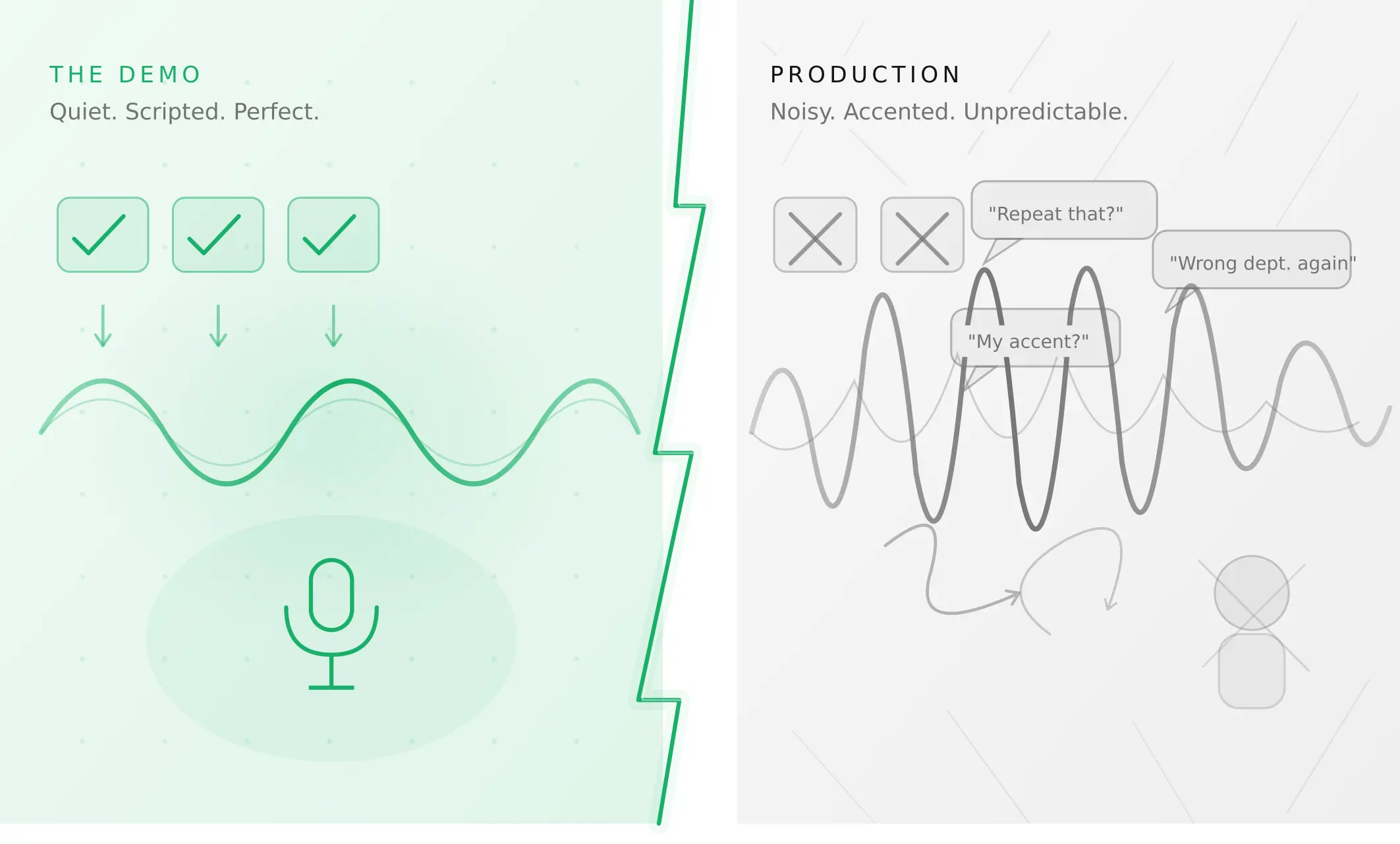
Why AI voice agents fail in production (and how to prevent it)
AI voice agents that ace demos still break in production. Learn the 5 root causes, how to test for each, and what production readiness actually means.
Read more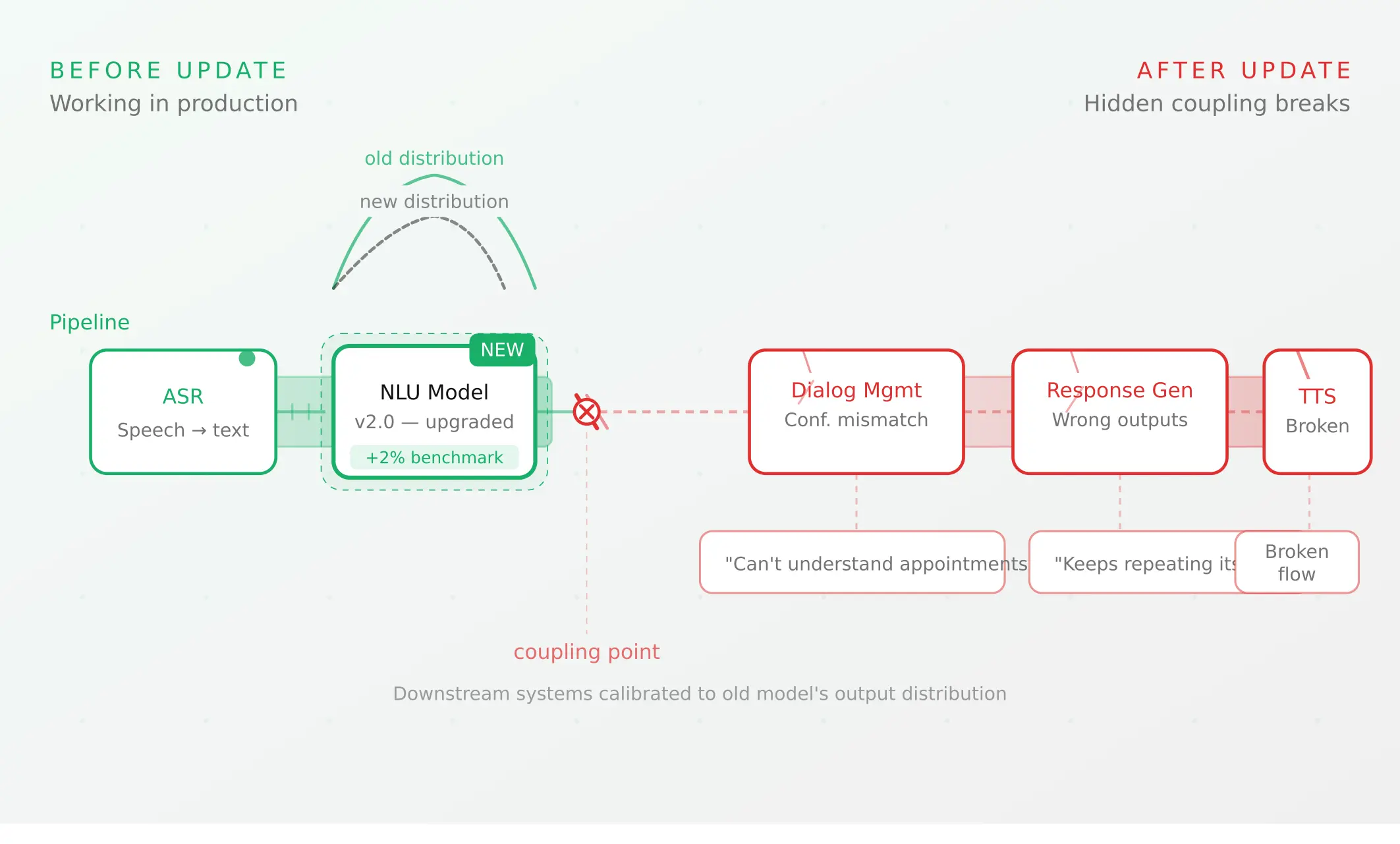
Voice agent regression testing: why LLM updates break production
LLM updates improve benchmarks but break voice agents in 5 predictable ways. How to detect and prevent regressions after every model or prompt change.
Read more