Test your voice agent
Jev for Real-Time Routing and Escalation in Voice Agents
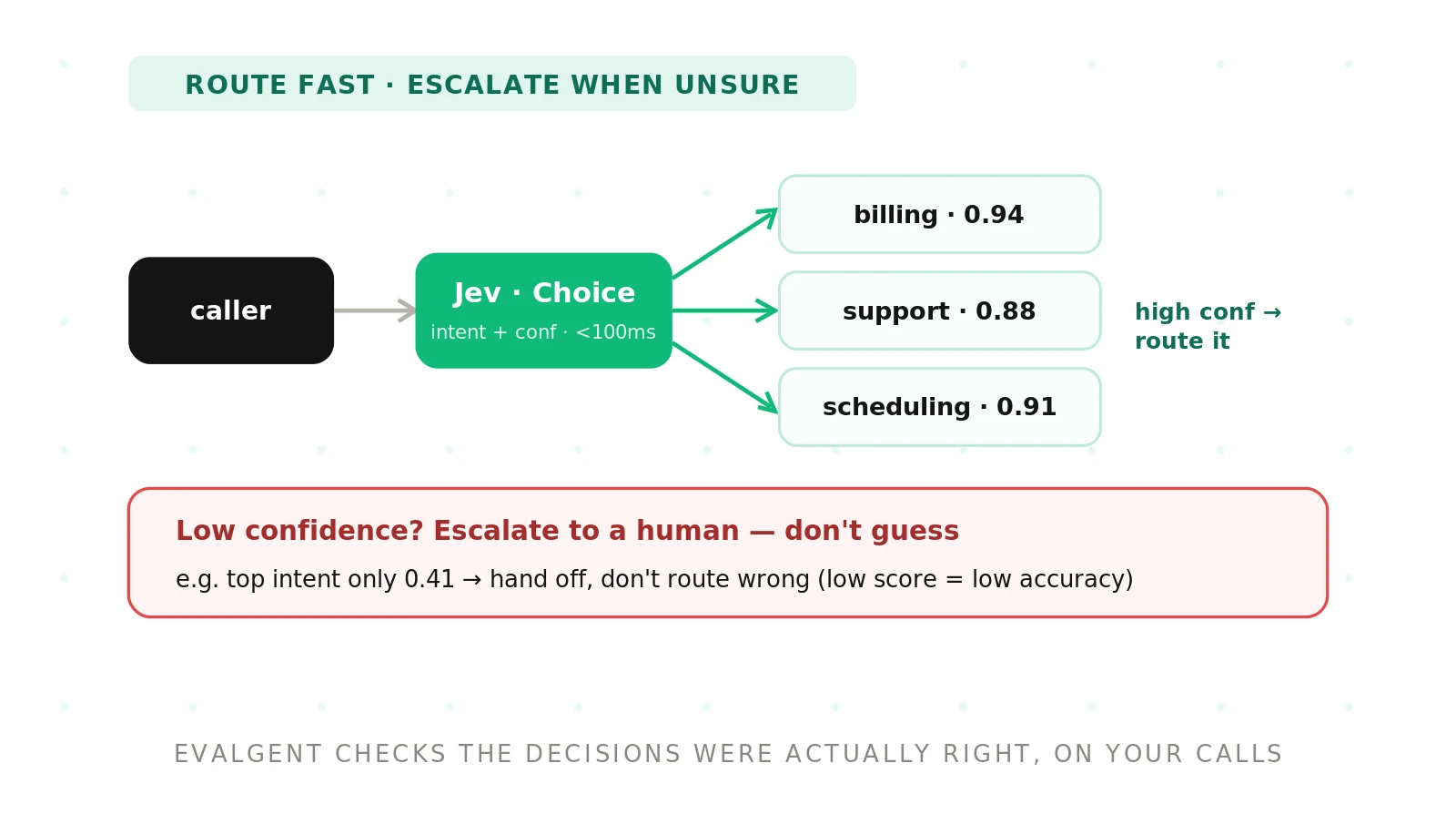
# Jev for real-time routing and escalation in voice agents
Quick answer
> Quick answer: Jev voice agent routing uses Jev, TypeSafe's System One model, to classify caller intent and pick a route in under 100ms. It answers a Choice question to route, and reports calibrated confidence so the agent escalates to a human when it is unsure instead of guessing.
Routing and escalation are two live-call jobs that must be fast and correct. A large language model can do both. But it is slow, it can hallucinate, and its confidence rarely matches its accuracy.
Jev is built for this narrow job. It does not write prose. It reads the call state and returns a typed decision with a confidence number. This post shows how to use Jev for routing and confidence-based escalation, and how Evalgent measures whether those decisions were right.
What Jev is, and what it is not
Jev: TypeSafe AI's first System One model, launched September 15, 2026, in early access. It reads a state and a set of questions, then returns typed probabilistic decisions with calibrated confidence.
Jev is not a language model. It does not generate text. You give it a "state" and one or more "questions." The state can be a transcript, structured data, or a message list. The output is a typed decision, not a sentence.
TypeSafe documents three question types. Each maps cleanly to a routing or escalation job:
- Choice picks one of up to 255 options. It returns a probability per option plus a confidence value.
- Score returns an ordered level, a continuous score, a distribution, and confidence.
- Noul returns a yes or no probability.
TypeSafe says Jev cannot hallucinate and produces zero type errors, because the schema constrains the output. It reports latency of 70 to 500ms. That is roughly 40 to 200 times faster than an LLM on the same call, per TypeSafe. Input is priced at $0.042 per million tokens, and output is free, which TypeSafe frames as about 400 times cheaper on classification. You can read the launch note on the TypeSafe blog and the TypeSafe docs.
The mental model is simple. Use an LLM for generation. Use Jev for fast structured decisions, the "smart if-statements" of your agent. Then verify, guardrail, and score with the same model.
Routing with Jev: intent, model, and tool selection
Routing is a classification problem. The caller says something. The agent must pick where the call goes next. That is a probabilistic classification task, and it maps directly to a Choice question.
Intent routing
The most common job is intent routing. The caller says "I want to check my balance." The agent must route to the billing flow, not the returns flow.
You send Jev the transcript so far as the state. You ask one Choice question: which department fits this caller? The options are your flows, up to 255 of them. Jev returns a probability for each, plus a confidence value.
TypeSafe reports Jev decisions land in the 70 to 500ms range. That fits inside a turn. The caller does not wait. For a deeper look at the decision, see our guide on intent routing accuracy.
Model routing
Not every turn needs your most expensive model. A "yes" or a ZIP code does not need a frontier LLM. A complex complaint might.
Jev can route between models. You ask a Choice question over your model options: cheap, standard, or powerful. The LangChain integration ships a `ModelRouterMiddleware` for exactly this. It picks a model by criteria before the turn runs. TypeSafe describes the pattern in the LangChain harness post.
Cheap routing decisions save money on every call. Because Jev output is free and input is $0.042 per million tokens, the router costs almost nothing. The savings come from sending fewer turns to the expensive model.
Tool and slot selection
Agents call tools. They fill slots. Both are Choice problems in disguise.
Which tool should run for this turn? That is a Choice question over your tool list. Which slot value did the caller mean? Another Choice question over the valid options. Jev returns a typed answer, so you never get a malformed tool name or an out-of-range value.
The `AutoModeMiddleware` in the LangChain integration goes further. It can gate or block a risky tool call before it fires. You ask Jev a Noul question: is this call safe to run now? A low-confidence yes becomes a hold.
Confidence-based escalation with Jev
Escalation is the second live-call job. The agent must decide: hand this call to a human now, or keep going?
The naive version is a Noul question. Should the agent escalate? Jev returns a yes or no probability. That already beats a brittle keyword rule.
The powerful version uses confidence. This is the core idea of a confidence-based escalation voice agent.
> Confidence-based escalation: the agent escalates to a human when its own decision confidence falls below a threshold, rather than only when a rule fires.
Here is the pattern. The agent asks Jev the routing question. Jev returns the best option and a confidence value. If confidence is high, the agent proceeds. If confidence is low, the agent escalates instead of guessing.
This turns "I am not sure" into a safe handoff. The agent no longer plows ahead on a shaky decision. It stops and gets a human. That is jev routing escalation voice agents in one sentence: route when sure, escalate when not.
You can gate on the routing confidence directly. You can also ask a dedicated Noul question about escalation and gate on its confidence. Both work. Many teams do both and take the stricter signal.
Timing matters here. Jev answers in well under a second, so the gate adds little latency). The caller does not notice the check. They only notice a smoother handoff. Our guide on escalation in voice agents covers the handoff mechanics in depth.
Why calibrated confidence beats an LLM's overconfidence
An LLM will tell you it is confident. That number is often wrong. Language models are frequently overconfident, and their stated certainty does not track their accuracy.
Jev is different by design. TypeSafe trained it with RLCD and reports that its confidence is calibrated. Higher confidence means higher accuracy. That property is the whole game for a gate.
> Calibration: a model is calibrated when its confidence matches its real accuracy. If it says 90% on many decisions, about 90% of them are correct.
Calibration is a measurable statistical property. You can read the formal definition on calibration (statistics)). A gate is only as good as the number it reads. A miscalibrated 0.9 is a trap. A calibrated 0.9 is a decision you can trust.
This is why calibrated confidence beats overconfidence for routing and escalation. The threshold means what you think it means. Set the bar at 0.85, and you know roughly how often a passing decision is right. With an LLM, the same 0.85 is noise.
There is a second win. Jev runs many questions per call in parallel. You can ask the routing question, the tool-safety question, and the escalation question at once. All come back with calibrated confidence in one round trip.
Mapping decisions to Jev question types
The table below maps each routing and escalation decision to its Jev question type. It also shows why calibrated confidence helps in each case.
| Decision | Jev question type | Why calibrated confidence helps |
|---|---|---|
| Intent routing | Choice (1 of up to 255 flows) | A low top-option confidence flags an ambiguous caller, so the agent clarifies or escalates instead of misrouting. |
| Model routing | Choice (cheap / standard / powerful) | Confidence gates the cheap path; borderline turns fall back to the stronger model rather than a wrong shortcut. |
| Tool and slot selection | Choice (valid tools or values) | Low confidence on a tool or slot triggers a confirm-back or a hold via AutoModeMiddleware before anything fires. |
| Escalate to human | Noul (yes / no) | A calibrated escalation probability sets a trustworthy threshold, so the agent hands off when unsure, not after failing. |
Every row is one Jev call, or one question inside a batched call. The confidence value is the control knob for each gate.
How to wire Jev routing and confidence-gated escalation into a voice agent
Follow these steps to add Jev routing and confidence-based escalation to a live voice agent.
1. Define your routes as a Choice schema. List every flow or department as an option, up to 255. Keep the labels distinct and short.
2. Capture the call state. Pass Jev the running transcript, plus any structured context you already hold. Jev works on text and structured data, not raw audio.
3. Ask the routing question. Send one Choice question for intent. Read back the top option and its confidence.
4. Set a confidence threshold. Pick a bar, for example 0.85. Above it, proceed to the chosen flow. Below it, escalate or ask a clarifying question.
5. Add a model router. Use `ModelRouterMiddleware` to pick cheap versus powerful per turn, gated on Jev confidence.
6. Gate risky tools. Ask a Noul question before any high-impact tool call. Use `AutoModeMiddleware` to block or hold on low confidence.
7. Add the escalation Noul. Ask "escalate now?" each turn. Take the stricter of the routing gate and this signal.
8. Wire the handoff. On escalation, transfer with full context so the human does not restart the call.
9. Log every decision. Store the state, the question, the chosen option, and the confidence. You will need this to measure accuracy.
10. Send the logs to an independent evaluator. Measure whether each route and each escalation was actually correct.
For an emerging low-latency setup, TypeSafe describes a pipeline with no LLM in the loop. Deepgram Flux handles speech-to-text and endpointing. Jev picks the reply and reports confidence at about 300ms. TTS speaks a pre-written response. It is fast, but it needs scripted answers, which we cover in the limits below.
Measuring whether the routing and escalation were right
Jev gives you a decision and a confidence number. It does not tell you whether the decision was correct. That is a separate question, and it is the one that matters in production.
This is where Evalgent comes in. Evalgent is an independent, third-party evaluator for AI voice agents. We do not build your agent or sell you a model. We measure whether your routing and escalation decisions were right, on your own calls.
For routing, we score classification quality. Did the intent route match the caller's real need? We report precision and recall per route, plus a confusion matrix across flows. Misrouting shows up as a specific off-diagonal cell, not a vague complaint.
For escalation, we measure escalation accuracy, not just escalation rate. Did the agent hand off at the right time? We score missed escalations, over-escalations, and timing. Our post on escalation accuracy and handoffs explains the metric in full.
We also test the confidence gate itself. Is Jev's confidence calibrated on your traffic? We check whether the threshold you set behaves as promised. A gate that drifts out of calibration is a silent risk, and we surface it.
Independent measurement is the point. A vendor grading its own routing is not a check. See why in our post on independent voice AI evaluation, and in our broader work on voice agent evaluation and voice agent testing.
Honest limits of Jev for routing and escalation
Jev is powerful, but it is not magic. Be clear about the edges.
Jev decides and scores. It does not generate language. For a talking agent, you still need pre-written responses or a hybrid with an LLM. The no-LLM pipeline only works with scripted replies.
Jev works on text and structured state, such as the transcript. It does not read raw audio. Your speech-to-text quality still shapes the input, so a weak transcript can mislead a good router.
Jev is in early access as of September 2026. Treat it as new. Pilot it, measure it, and keep a fallback path.
Confidence is calibrated, not perfect. Calibration is a statistical average, not a guarantee on any single call. That is exactly why you measure the gate on your own data instead of trusting the spec sheet. Our guide on latency in voice agents and our post on turn-taking evaluation cover the timing side of these trade-offs. For the full picture, see our roundup of orchestration for voice agents in 2026 and the broader Jev use cases for voice agents.
Frequently asked questions
How does Jev route voice agent calls?
Jev routes by answering a Choice question. You send the transcript as the state and list your flows as options, up to 255. Jev returns a probability for each option plus a confidence value. The agent routes to the top option when confidence clears your threshold, per TypeSafe's model design.
Can Jev decide when to escalate to a human?
Yes. Jev answers a Noul question, returning a yes or no probability for escalation. You can also gate on the routing confidence directly. When confidence falls below your threshold, the agent hands off to a human instead of guessing. This is confidence-based escalation.
What is confidence-based escalation in a voice agent?
Confidence-based escalation means the agent escalates when its own decision confidence is low, not only when a keyword rule fires. Jev reports calibrated confidence, so a low number reliably signals uncertainty. The agent then routes the call to a human rather than proceeding on a shaky decision.
How fast is Jev for routing decisions?
TypeSafe reports Jev latency of 70 to 500ms per decision. That is roughly 40 to 200 times faster than a large language model on the same task. In an emerging no-LLM pipeline, TypeSafe describes Jev picking a reply at about 300ms, fast enough to stay inside a single conversational turn.
Does Jev route between models?
Yes. Jev can pick which model handles a turn using a Choice question over your options, such as cheap, standard, or powerful. The LangChain integration ships a ModelRouterMiddleware for this. It selects a model by criteria before the turn runs, gated on Jev's calibrated confidence.
Why does calibrated confidence matter for routing?
Calibrated confidence means the number matches real accuracy. TypeSafe reports Jev is calibrated, so a 0.9 corresponds to about 90% correct. That makes a threshold trustworthy. Language models are often overconfident, so their stated certainty does not track accuracy and makes a poor gate.
How do you measure Jev routing accuracy?
You log each decision, then score it independently. Evalgent measures routing with precision and recall per flow, plus a confusion matrix. For escalation, we score missed escalations, over-escalations, and timing. We also test whether Jev's confidence stays calibrated on your own live traffic.
Can Jev replace the LLM in a voice agent?
Not fully. Jev decides and scores, but it does not generate language. A no-LLM pipeline works only with pre-written responses. For open-ended conversation you still need an LLM for generation, with Jev handling the fast structured routing, gating, and scoring decisions around it.
The bottom line
Jev is a fast, calibrated decision brain for routing and escalation, not a language generator. Use it to route in under 100ms and to escalate when confidence is low, then let an independent evaluator confirm those decisions were right.
Evalgent measures whether your Jev-driven routing and escalation actually served callers. Book a demo to audit your routing and confidence-gated escalation on your own calls.
Related Articles
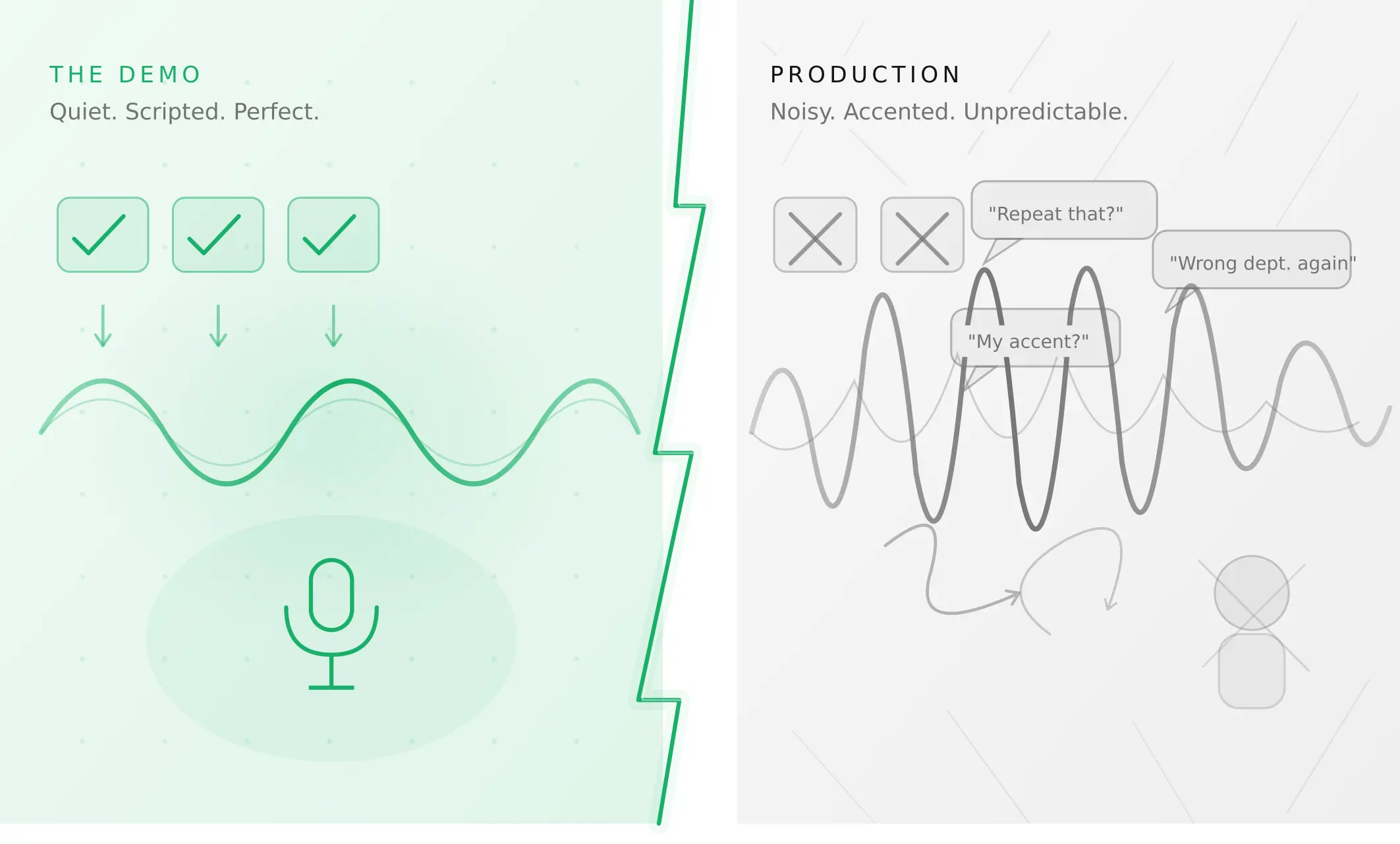
Why AI voice agents fail in production (and how to prevent it)
AI voice agents that ace demos still break in production. Learn the 5 root causes, how to test for each, and what production readiness actually means.
Read more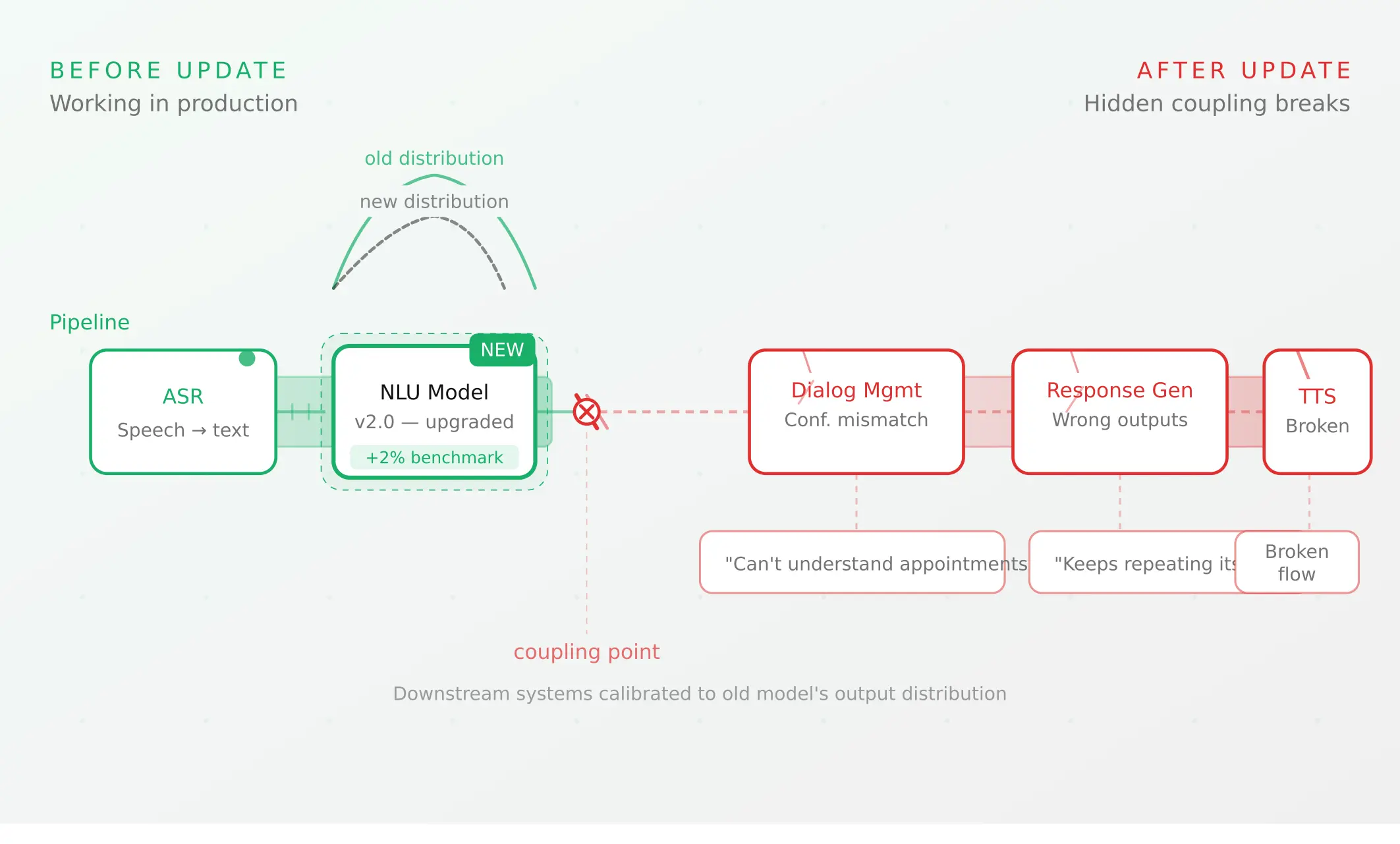
Voice agent regression testing: why LLM updates break production
LLM updates improve benchmarks but break voice agents in 5 predictable ways. How to detect and prevent regressions after every model or prompt change.
Read more