Open door for builders.
Jev vs LLMs for Voice Agents: When to Use Each
# Jev vs LLMs for voice agents: when to use each
Quick answer
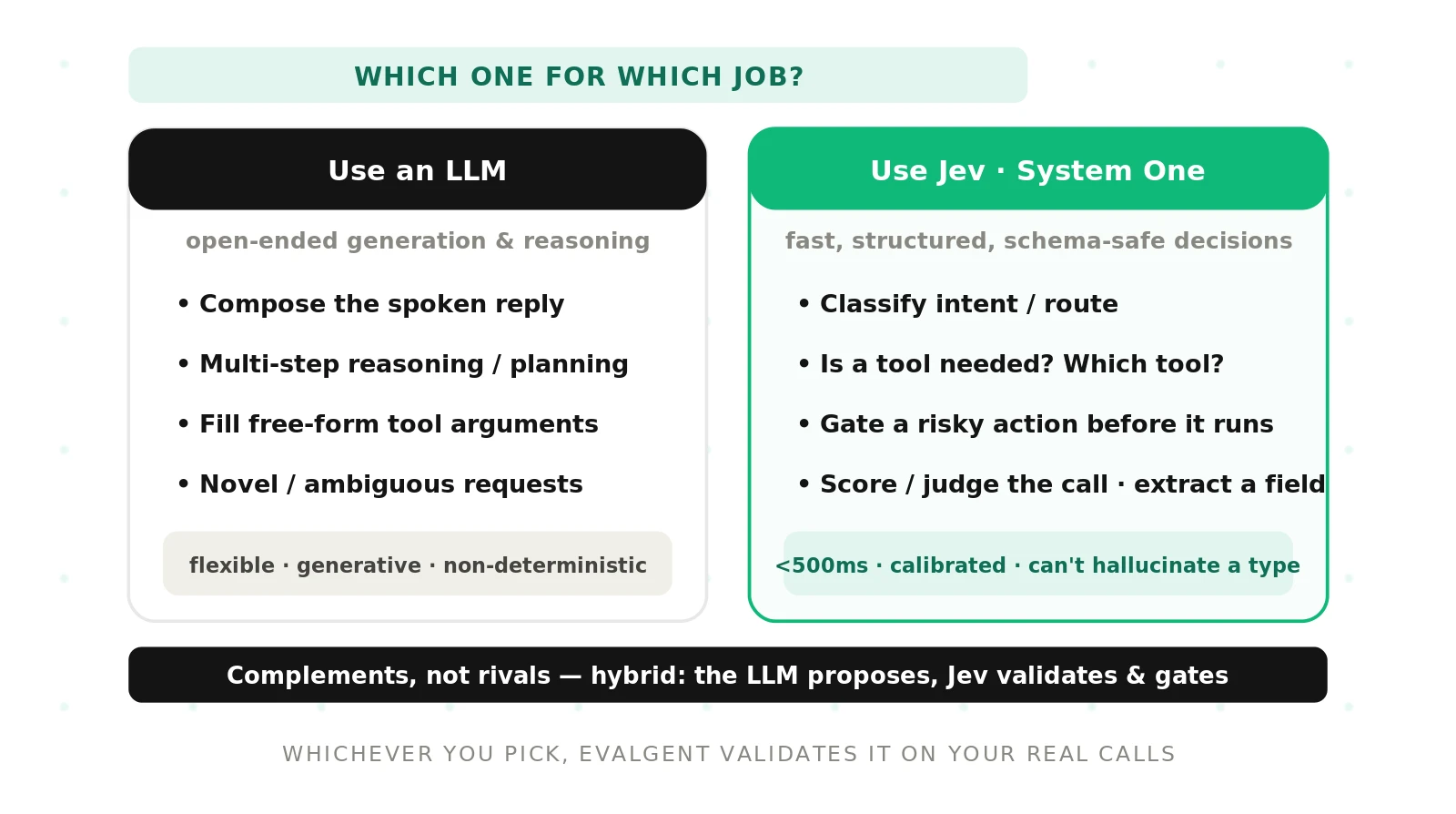
Jev vs LLM is not a contest. They do different jobs. Use an LLM for open-ended generation and reasoning. Use Jev, a System One model, for fast, schema-safe decisions like routing, tool gating, and scoring. Most voice agents need both, and both need independent evaluation on your real calls.
Voice teams keep framing this as a fight. It is not one. An LLM writes and reasons in free text. Jev decides, classifies, and scores under a fixed schema. This guide maps which tool fits which step in the agent loop, and why. It ends with the part vendors skip: you still have to check both on your own data.
Jev vs LLM: two different jobs, not rivals
Start with what each tool is built to do. The confusion comes from treating them as interchangeable. They are not.
An LLM is a generative model. It produces text token by token. That makes it flexible. It can compose a reply, plan several steps, and handle a request it has never seen. This is System Two work: slow, deliberate, open-ended.
Jev is TypeSafe AI's first "System One Model," launched September 15, 2026, in early access. It is not an LLM. It does not generate text. You send it a "state," such as a transcript or structured data, plus questions. It returns typed, probabilistic decisions with calibrated confidence. TypeSafe frames it as a function call: unstructured state in, typed decisions out. Think of it as smart if-statements.
> System One model: a model that takes unstructured state plus questions and returns typed, probabilistic decisions with calibrated confidence. It classifies, scores, and verifies rather than writing prose.
So the real question is never "jev vs llm, which wins." It is "which job is this step doing?" Generation and reasoning go to the LLM. Structured decisions go to Jev. For a deeper primer on the model itself, see our guide to Jev for voice agents.
Why an LLM fits generation and reasoning
An LLM earns its place wherever the output is free text or novel thinking. Four jobs fit this shape.
First, composing the spoken reply. The agent has to say something in natural language, tuned to context. Only a generative model does that well.
Second, multi-step planning. When a task needs several dependent moves, the LLM can reason through them and adapt as it goes.
Third, free-form explanation. If a caller asks "why was I charged twice," the answer is a novel paragraph, not a label.
Fourth, novel or ambiguous requests. When the input does not match any known category, the LLM can improvise a reasonable path.
The trade-off is real. LLMs are slower, cost more per call, and are non-deterministic. The same prompt can return different output twice. They can also hallucinate facts and mis-type structured fields. That is fine for prose. It is risky for a decision that gates a payment.
Why Jev fits fast, structured decisions
Jev earns its place wherever the output is one of a fixed set and speed matters. Its documentation describes three shapes of question.
- Choice. Pick one option from a defined set, up to 255 options. You get a probability per option plus confidence. This suits intent classification and routing.
- Score. Rate a state against ordered levels. You get a continuous score, a distribution, and confidence. This suits risk and sentiment.
- Noul. A yes or no question. You get the probability the statement is true. This suits guardrails and compliance checks.
The properties are what make Jev a good fit for these jobs. It cannot hallucinate, and it has 0% type errors because output is schema-constrained. It runs in 70–500ms, which TypeSafe reports as roughly 40–200x faster than an LLM on the same call. Its confidence is calibrated, so higher confidence tracks higher accuracy. It runs many questions on one state in a single call, so routing, a guardrail check, and a sentiment read can share one request. Jev is trained with RLCD.
Cost follows the same pattern. Input runs at $0.042 per million tokens, and output is free. On classification work, that is far cheaper than an LLM. For a concrete walk-through, see Jev for routing and escalation.
Jev vs LLM by task: the agent-loop map
Here is the practical map. Each row is a step a voice agent takes, and the tool that fits its job.
| Task in the agent loop | Use an LLM | Use Jev | Why |
|---|---|---|---|
| Generate the spoken reply | Yes | No | Free-text output; needs generation |
| Classify intent and route the turn | No | Yes | Fixed option set; sub-500ms; calibrated |
| Decide if a tool is needed | No | Yes | Yes/no decision; must be fast and typed |
| Fill free-form tool arguments | Yes | No | Open-ended text the schema cannot enumerate |
| Gate a risky action before execution | No | Yes | Schema-safe yes/no; cannot hallucinate a pass |
| Score or judge the call afterward | No | Yes | Ordered levels; calibrated; cheap at scale |
| Handle a novel open-ended request | Yes | No | Ambiguous input; needs reasoning |
| Extract a fixed field from a transcript | No | Yes | Known set of values; typed output |
Read the table by output shape, not by brand loyalty. Free text or novel reasoning points to the LLM. A fixed set of answers, under a latency budget, points to Jev.
The hybrid pattern: LLM proposes, Jev validates
The strongest voice architectures do not pick one model. They combine both, and each guards the other's weak spot.
The most common shape is LLM proposes, Jev validates. The LLM drafts a reply or a tool call. Jev then gates it with a Noul question before anything executes. LangChain's harness for Jev shows this directly. Its AutoModeMiddleware uses Jev to block risky tool calls before they run. Its ModelRouterMiddleware uses Jev to route a turn to the right model. LangChain reports this pattern delivering up to 200x faster inference and 400x lower cost on those decision points, attributed to Jev's structured design.
A second shape is Jev routes, then a constrained step fills in. Jev picks the tool or the branch. A narrow LLM call then fills the free-form arguments. Jev handles the decision; the LLM handles the language.
Both shapes respect the division of labor. The LLM does what only generation can do. Jev does the fast, typed decisions and stops a bad one before it lands. Our tool-calling with Jev piece goes deeper on the gating flow.
Voice's latency budget changes the math
Voice raises the stakes on every decision. A caller notices a pause. Each model call in the turn loop eats into a tight latency) budget before the reply even starts.
This is where Jev vs LLM stops being abstract. A routing or gating decision at 70–500ms barely dents the budget. The same decision routed through an LLM can cost far more time, plus the risk of a mis-typed field. When you have a fixed set of answers, spending an LLM call on it wastes both time and money.
So the rule for voice is simple. Push every structured decision to the fastest safe tool. Reserve the LLM for the reply itself and for genuinely open-ended turns. The tool-calling latency guide covers where those milliseconds go.
How to decide between Jev and an LLM for a step
Run each step in your agent loop through this short checklist. It resolves most cases in under a minute.
1. Is the output a fixed set or free text? A fixed set points to Jev. Free text points to an LLM.
2. What is the latency budget for this step? A tight, sub-500ms budget favors Jev's speed.
3. Does a wrong type or a hallucination cause harm here? If yes, prefer Jev's schema-constrained, 0% type-error output.
4. Can you tolerate non-determinism on this step? If not, Jev's typed decisions are more repeatable than free generation.
5. Is confidence or calibration useful here? If you want to route low-confidence turns to a human, Jev gives you calibrated confidence to threshold on.
6. Default to the hybrid. Let the LLM propose and generate. Let Jev decide, gate, and score.
The honest limits of both
Neither tool is magic. Sell yourself the limits before you ship.
Jev decides, scores, and classifies only. It does not generate free text and it does not explain its answers. It works on transcript or text state, not raw audio, so your speech-to-text quality still shapes every decision. Calibrated confidence is a property across many calls, not a guarantee on any single call. And Jev is in early access, so treat it as new infrastructure.
LLMs carry the mirror-image limits. They are flexible and can reason open-ended, but they are slower, costlier, and non-deterministic. They can hallucinate facts and mis-type structured output. That is exactly why a fixed-set decision should rarely ride on an LLM alone.
Why the choice does not remove the need to evaluate
Picking the right tool per step is architecture. It is not proof the step works on your calls. This is where most teams stop too early.
"Calibrated" is not the same as "correct on your data." Jev's confidence is calibrated in general, but your intents, accents, and edge cases are specific. You have to measure accuracy on your real transcripts before you trust a routing or gating threshold. An LLM step needs the same scrutiny, and more, because it is non-deterministic and can hallucinate.
Evalgent is the independent, third-party evaluator for whichever architecture you choose. We score the LLM's replies and the Jev decisions on your own calls, as a neutral outside party. We check routing accuracy, gate reliability, escalation timing, and confidence calibration against ground truth. If you use LLM judges anywhere in your stack, know their limits first, and pair them with verifiable rewards and calibrated models. See our voice agent evaluation overview for the full method.
Frequently asked questions
When should I use Jev instead of an LLM?
Use Jev instead of an LLM when the output is one of a fixed set and speed matters. Intent routing, tool gating, field extraction, and call scoring fit. These are typed decisions under 500ms. Keep the LLM for composing replies, reasoning through multi-step tasks, and handling novel requests.
Does Jev replace the LLM in a voice agent?
Jev does not replace the LLM in most voice agents. It replaces the LLM only on structured decisions, like routing or gating, where a fixed schema applies. The LLM still composes the spoken reply and handles open-ended reasoning. The common pattern runs both, with Jev deciding and the LLM generating.
What is the difference between a System One model and an LLM?
A System One model like Jev takes state plus questions and returns typed, calibrated decisions. It classifies and scores; it does not write text. An LLM is a generative System Two model that produces free text and reasons open-ended. System One is fast and schema-safe; the LLM is flexible but slower and non-deterministic.
Is Jev faster and cheaper than an LLM?
Jev runs decisions in 70–500ms, which TypeSafe reports as roughly 40–200x faster than an LLM on classification. Input costs $0.042 per million tokens and output is free, far cheaper for structured work. LangChain reports up to 200x faster inference and 400x lower cost on decision points, attributed to Jev.
Can Jev hallucinate like an LLM?
Jev cannot hallucinate and has 0% type errors, because its output is constrained to your schema. It can only return a value from the allowed set. An LLM can hallucinate facts and mis-type structured output. That difference is why a risky gate or a fixed-field extraction is safer on Jev than on an LLM alone.
Can Jev process raw audio from a voice call?
Jev works on transcript or text state, not raw audio. You transcribe the call first, then send the text and your questions to Jev. So your speech-to-text quality shapes every Jev decision. If transcription drops a word, Jev decides on the flawed text, which is one reason to evaluate the whole pipeline end to end.
How do I evaluate a hybrid Jev and LLM voice agent?
Evaluate both parts on your real calls, not vendor claims. Measure the LLM replies for accuracy and hallucination. Measure the Jev decisions for routing accuracy, gate reliability, and confidence calibration against ground truth. Calibrated is not correct on your data until checked. An independent third party like Evalgent scores whichever architecture you run.
Should intent routing use Jev or an LLM?
Intent routing should usually use Jev. Routing is a Choice question: pick one intent from a fixed set, with a probability and confidence per option. Jev answers it in under 500ms without hallucinating a category. An LLM can route too, but it is slower, costlier, and can invent an intent that is not in your set.
The bottom line
Jev and LLMs do different jobs, so the useful question is which tool fits each step, not which one wins. Use an LLM to generate and reason, use Jev for fast schema-safe decisions, and evaluate both on your real calls before you trust either.
Ready to see how your architecture actually performs on live calls? Book a demo and we will audit your LLM replies and Jev decisions as an independent third party.
Related Articles
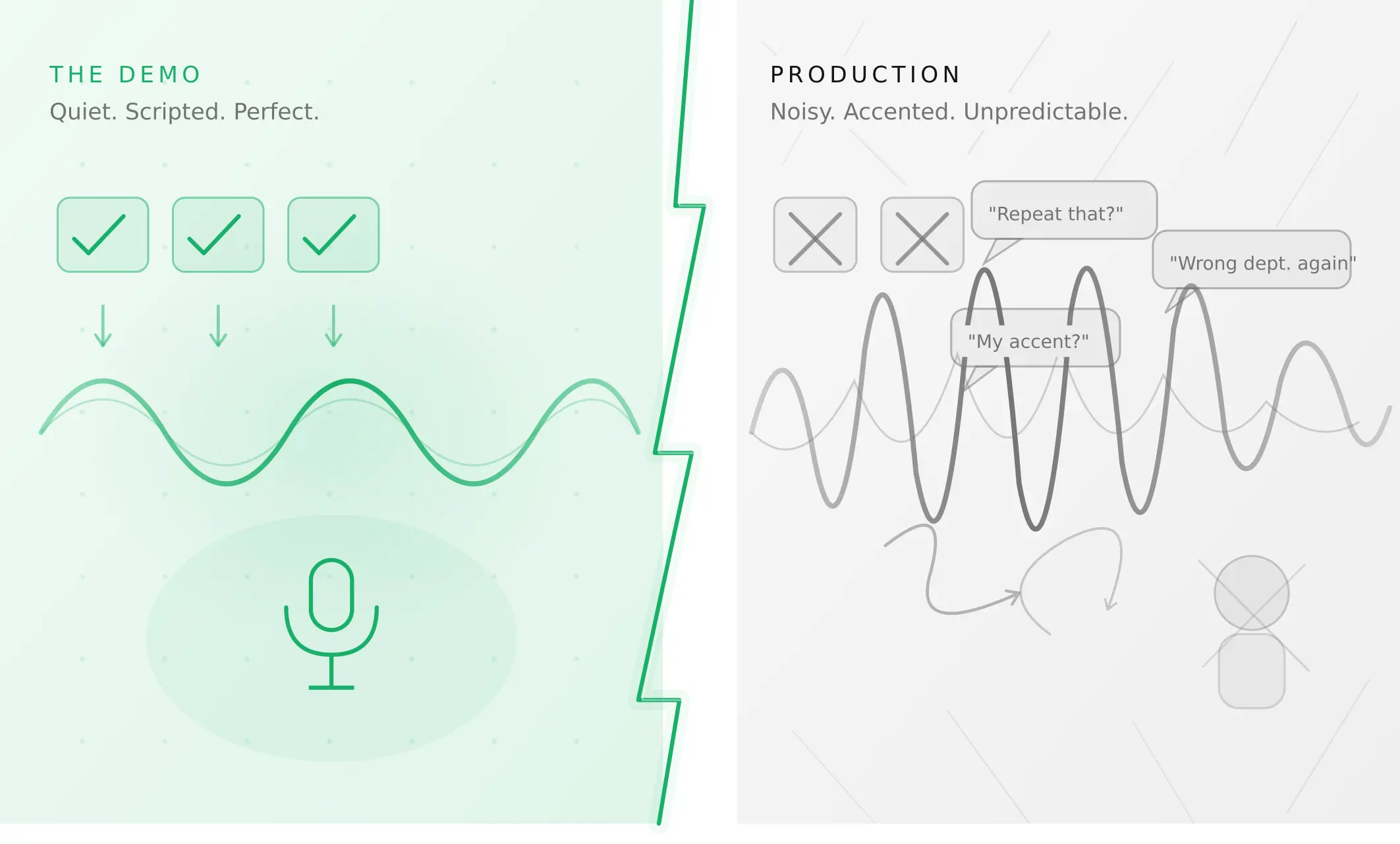
Why AI voice agents fail in production (and how to prevent it)
AI voice agents that ace demos still break in production. Learn the 5 root causes, how to test for each, and what production readiness actually means.
Read more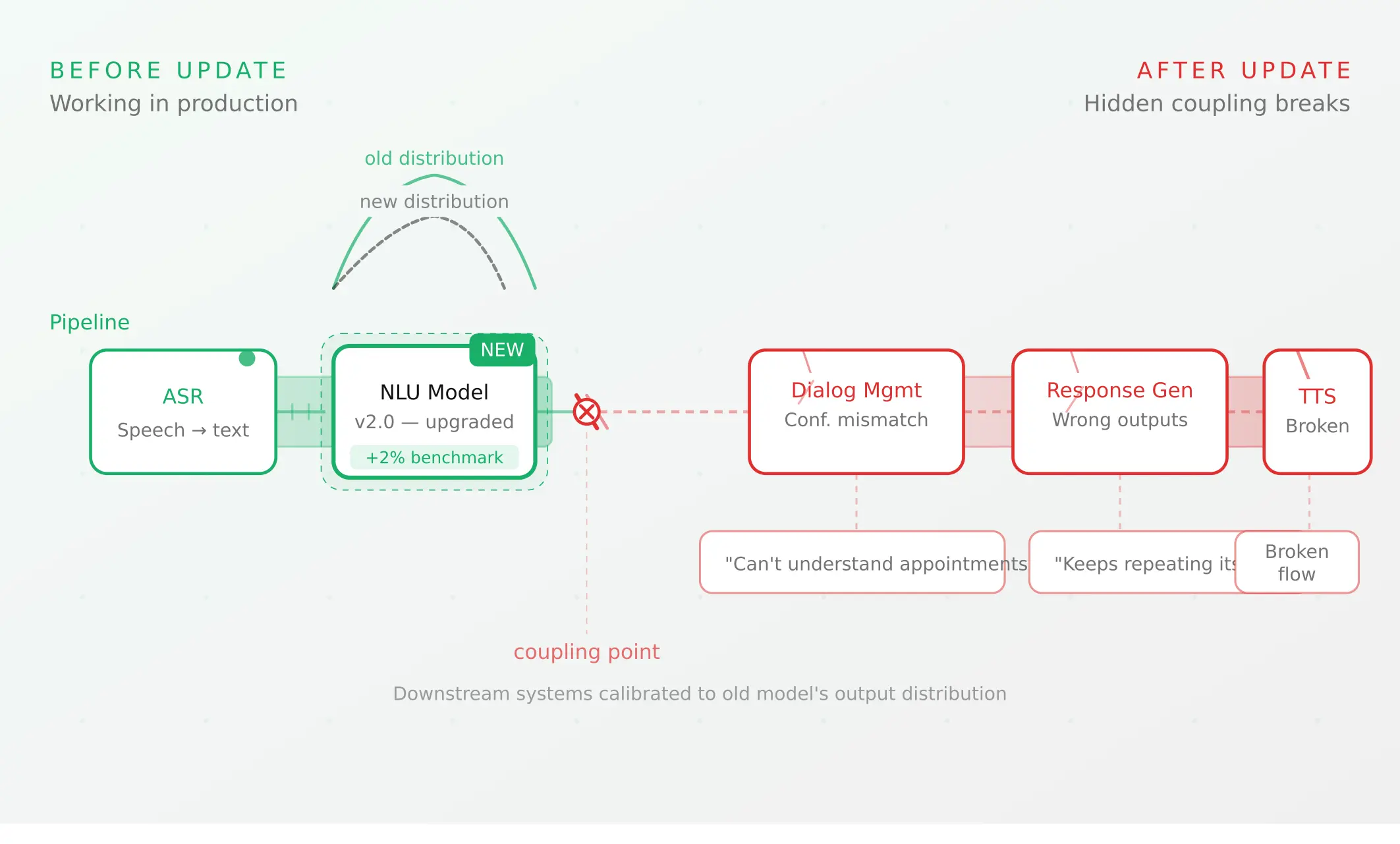
Voice agent regression testing: why LLM updates break production
LLM updates improve benchmarks but break voice agents in 5 predictable ways. How to detect and prevent regressions after every model or prompt change.
Read more