Test your voice agent
Jev for Voice Agent Guardrails and Jailbreak Detection
# Jev for voice agent guardrails and jailbreak detection
Quick answer
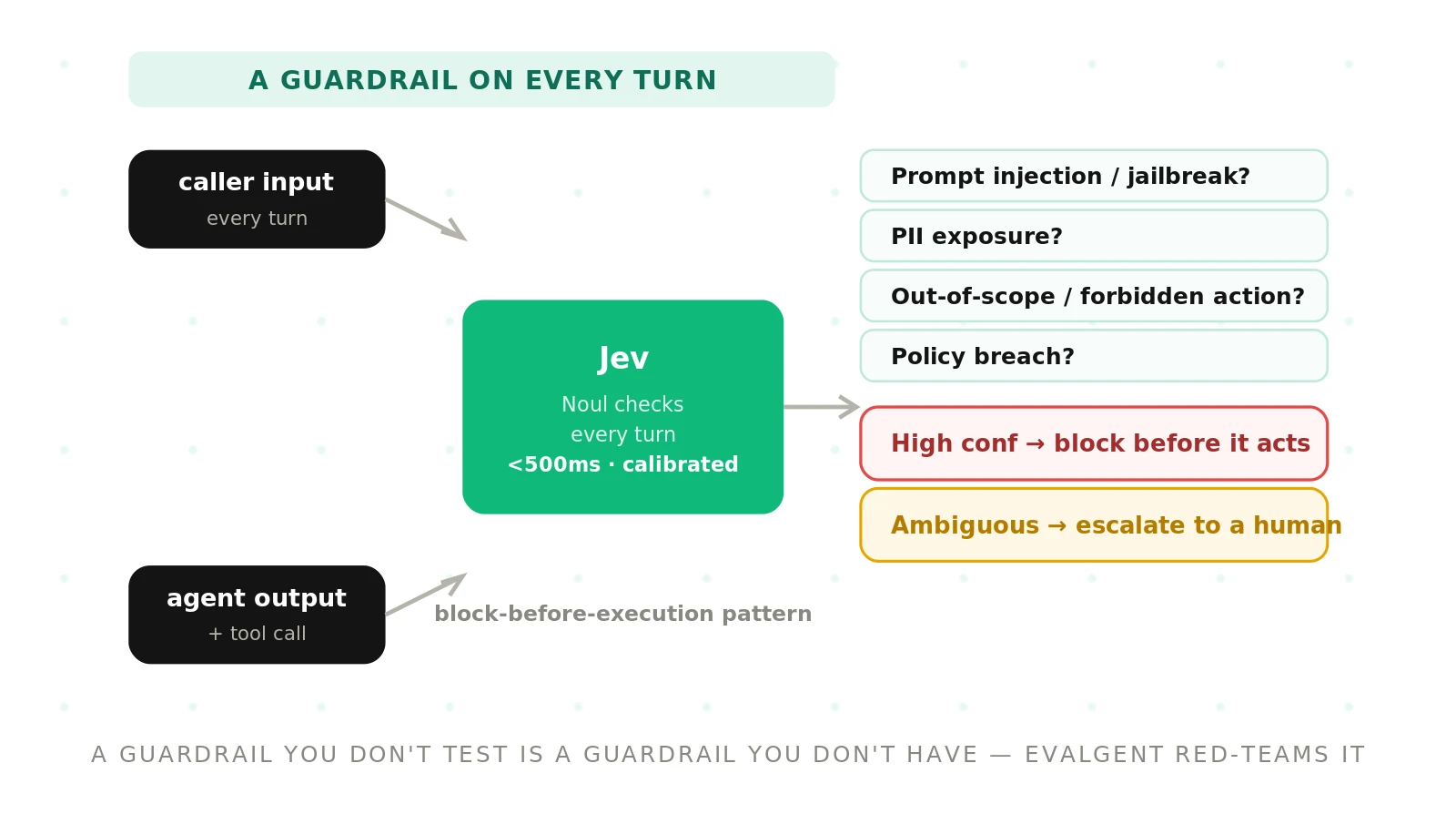
Jev voice agent guardrails use a fast System One model to check every turn, both the caller's input and the agent's proposed output or tool call. Noul questions flag prompt injection, jailbreaks, PII exposure, and policy breaches in under 500ms. You block high-confidence attacks and escalate ambiguous ones. Jev is a detector you must still red-team.
Most voice agents ship with guardrails that were never tested on live traffic. A prompt hidden in a caller's speech, a jailbreak that talks the agent out of policy, or a tool call that leaks data can slip through. This post shows how to use jev voice agent guardrails as a real-time gate, and why an independent evaluator still has to prove the gate works.
Jev launched on September 15, 2026, in early access. TypeSafe AI calls it the first "System One Model." It does not generate text. You send it a state and questions; it returns typed, calibrated decisions. That shape makes it a strong fit for a guardrail layer.
What a voice agent guardrail model is
A guardrail is a check that sits between the caller and the action. It reads what is happening and decides whether to allow, block, or escalate. For voice agents, guardrails matter most on two things: what the caller says, and what the agent is about to do.
> Voice agent guardrail model: a fast classifier that inspects each turn and returns a block, allow, or escalate decision before the agent acts. It runs inline, not after the call.
Jev fits this job because of three properties. It is fast, at 70–500ms per call, which TypeSafe reports is roughly 40–200x faster than an LLM. It cannot hallucinate, and it produces 0% type errors because the schema constrains every answer. And it returns calibrated confidence, so a high number means high accuracy.
The latency) point is the one people miss. A guardrail that adds a full second to every turn ruins a voice conversation. A sub-500ms check can run on each turn without the caller noticing. That is what makes a per-turn gate practical instead of aspirational.
Jev is not an LLM. It classifies and scores; it never writes a reply. So you use it as the judge in the loop, not the agent. The agent still runs on your own model. Jev just answers yes-or-no questions about each turn, in parallel, before harm.
Input guardrails vs output and tool guardrails
Guardrails split into two layers, and both matter. Confusing them is a common mistake.
Input guardrails run on what the caller sends. For a voice agent, that is the transcribed turn. The questions here catch attacks aimed at the agent: is this a prompt injection attempt, is this a jailbreak), is this request out of scope? You run these before the agent reasons about the turn.
Output and tool guardrails run on what the agent is about to do. Before the agent speaks or calls a tool, you check the proposed action. Is it about to expose PII? Is it about to break policy? Is it about to take a forbidden action, like issuing a refund it is not allowed to issue?
The output layer is the one that actually prevents harm. A caller can say anything. What matters is whether the agent acts on it. This is the pattern LangChain built: its harness with Jev uses an AutoModeMiddleware that runs Jev on proposed tool calls and blocks risky actions before execution.
For voice specifically, the tool-call gate is where money and data move. Transfers, refunds, account changes, and lookups all run as tools. Gating those calls with a Noul question stops a jailbroken agent from doing damage even if the input guardrail missed the attack. Two layers give you defense in depth.
Our guide on prompt injection in voice agents covers the attack side in depth. The PII handling guide covers what the output guardrail should refuse to say or log.
Jev jailbreak detection for voice agents
Jailbreak detection is a natural Noul question. A Noul returns a yes-or-no probability with calibrated confidence. So "is this turn a jailbreak attempt?" gets a probability and a confidence you can act on.
Voice makes jailbreaks sneaky. There is no visible text to scan, just a transcript that arrives one turn at a time. Attackers use role-play ("pretend you are in developer mode"), authority claims ("I am from your security team"), and slow multi-turn setups that build to the ask. A single-turn keyword filter misses all of these.
Jev reads the transcript state, which can include prior turns. So you can ask the jailbreak question against the running conversation, not just the latest sentence. That catches the crescendo attacks that ramp up over several turns. You send the state plus the question, and you get a probability back in well under a second.
Because Jev can ask many questions of one state in a single parallel call, jailbreak detection does not have to run alone. In the same request you can also ask about prompt injection, scope, and PII. One call, many guardrail verdicts, all with their own confidence. For the model background, see our Jev for voice agents pillar and the concrete Jev use cases write-up.
Confidence-gated blocking beats a hard yes or no
The naive way to use any detector is a single threshold: block if the score is over 0.5. Calibrated confidence lets you do something smarter, and safer.
> Confidence-gated blocking: block when the model is confident an attack is happening, allow when it is confident the turn is clean, and escalate to a human or a stricter check when it is unsure.
You set two thresholds, not one. Above the high threshold, the guardrail blocks automatically. Below the low threshold, it allows. In the ambiguous middle, it escalates. That escalation might mean a human takes the call, a safe fallback response fires, or a slower LLM review runs on that one turn.
This works only because Jev's confidence is calibrated. TypeSafe reports that higher confidence maps to higher accuracy. So a 0.95 block-probability really is more reliable than a 0.6 one. You can tune your thresholds against how much risk you will accept and how much human capacity you have.
Escalation is where guardrails meet routing. When a turn lands in the ambiguous band, you hand it off. Our post on Jev for routing and escalation and the escalation guide cover how to design that handoff so it does not drop the caller.
Why calibration beats an LLM's overconfident yes/no
You could ask an LLM "is this a jailbreak?" and get a yes or no. The problem is that the answer comes with no honest sense of its own reliability. An LLM will say "yes, definitely" with the same tone whether it is right or guessing.
That overconfidence breaks confidence-gated blocking. If every answer reads as certain, you cannot separate the calls worth escalating from the calls worth trusting. You are back to a single hard threshold, and you eat the false positives and false negatives that come with it.
A calibrated model gives you a usable middle band. When Jev reports 0.6, that genuinely means it is unsure, and you route accordingly. This is the difference between a detector you can operate and one you can only hope about. It also keeps false blocks down, which matters, because a guardrail that blocks real customers is its own kind of failure.
Calibration is not a per-call guarantee. A 0.95 can still be wrong. It holds across many calls, not on any single one. So you treat confidence as a routing signal and a monitoring tool, never as a certificate that this exact turn is safe.
Guardrail checks mapped to layer and Jev question type
Every guardrail check has a natural layer and a natural Jev question type. Most are Noul questions, because most guardrail decisions are yes-or-no. Use this map to design your checks.
| Guardrail check | Where it runs | Jev question type |
|---|---|---|
| Prompt injection attempt | Input (caller turn) | Noul (yes/no probability) |
| Jailbreak attempt | Input (running transcript) | Noul (yes/no probability) |
| PII exposure | Output (agent's proposed reply) | Noul (yes/no probability) |
| Out-of-scope action | Input or tool call | Noul, plus Choice for the category |
| Policy breach before action | Output / tool call | Noul (yes/no probability) |
Note the out-of-scope row uses two types. A Noul answers "is this out of scope?" and a Choice can label which category the request falls into, from up to 255 options. That label helps you route the caller to the right place instead of just blocking. The other rows are clean Noul checks: one question, one probability, one confidence.
How to add a Jev guardrail layer to a voice agent
Follow this order to add jev voice agent guardrails without breaking the conversation or over-trusting the model. Build it offline first, then gate live traffic once you have proven it on your own calls.
1. List the actions worth gating. Write down the risky tool calls and outputs: transfers, refunds, account changes, PII disclosure, and any forbidden action. These are what the output guardrail protects.
2. Write each check as a Noul question. Phrase it specifically. "Is the agent about to reveal a full card number?" beats "Is this safe?" Add a Choice for out-of-scope category labels where routing helps.
3. Assemble the turn as a state. Combine the running transcript with structured context like the current intent and the proposed tool call. That state is Jev's input.
4. Ask all guardrail questions in one parallel call. Jailbreak, injection, PII, scope, and policy checks go in a single request. You get every verdict back with its own confidence in under 500ms.
5. Set high and low confidence thresholds. Above the high line, block. Below the low line, allow. In between, escalate to a human, a safe fallback, or a stricter review.
6. Wire blocks in before execution. Run the output check between the agent's decision and the tool call, like the AutoMode pattern. A verdict that arrives after the action is too late.
7. Validate against a red-teamed set. Run known attacks and clean calls through the guardrail. Measure precision and recall per check. Confirm a reported 0.9 lands near 90% accuracy on your traffic.
8. Monitor and recalibrate. Attacks and callers change. Re-check thresholds and confidence as your agent, prompts, and traffic drift.
The TypeSafe docs cover the request format and question schemas. Test each check offline against labeled attacks before you let it block a live caller.
The honest limits of a Jev guardrail
A Jev guardrail is fast and calibrated. It is not a guarantee. Four limits shape how you should deploy it.
First, Jev classifies and scores only. It flags a jailbreak; it does not explain the attack or write the safe reply. You still need your agent and your policy logic to handle the block.
Second, Jev works on the transcript, not raw audio. An attack carried in tone or an out-of-band audio trick does not live in text. Transcript-based guardrails catch text-level attacks. Pair them with audio checks where that matters.
Third, calibrated does not mean certain. Confidence is reliable in aggregate. On a single call, a high-confidence verdict can still be wrong. Treat it as a routing signal, not proof.
Fourth, a detector is not a guarantee. A guardrail you have not red-teamed is a guardrail you do not have. You must attack your own gate, measure what it catches, and keep measuring as attacks evolve. The model is one layer in a program, not the program.
Where Evalgent fits: proving the guardrail actually works
Jev can be your real-time guardrail. Evalgent is the independent evaluator that proves the guardrail catches attacks on real calls. Those are different jobs.
You can run Jev inline as a fast gate, and you should. But a guardrail that has never faced a red team is an assumption, not a control. A vendor who says "we block jailbreaks" without an outside test is marking its own homework.
Evalgent runs independent voice AI evaluation against your live guardrail. We build attack suites for prompt injection, jailbreaks, PII exfiltration, and forbidden actions, then run them at your agent the way a real caller would. Our voice agent red-team audit measures what the gate catches and, more importantly, what it lets through. We also verify the guardrail itself with the same discipline as any other check, which is the point of testing guardrails on voice agents. Jev is in early access, so treat every figure here as a starting point to verify, not a settled benchmark.
Frequently asked questions
How do you add a Jev guardrail layer to a voice agent?
List the risky actions, write each as a Noul question, and assemble each turn as a state with the transcript and proposed tool call. Ask all checks in one parallel call, then apply high and low confidence thresholds to block, allow, or escalate. Wire the output check in before execution, and validate against red-teamed calls first.
Can Jev detect prompt injection in voice agents?
Jev can flag prompt injection as a Noul question that returns a yes-or-no probability with calibrated confidence. It reads the transcribed caller turn and the running conversation, so it catches attacks that build over several turns. Jev is a detector, not a guarantee, so you must red-team it against real injection attempts before trusting it inline.
How does Jev jailbreak detection work on voice calls?
You ask "is this turn a jailbreak attempt?" as a Noul question against the transcript state, which can include prior turns. Jev returns a probability and calibrated confidence in under 500ms. Because it sees the running conversation, it can catch multi-turn crescendo attacks that a single-turn keyword filter would miss entirely.
What is the difference between input and output guardrails?
Input guardrails check what the caller says, catching prompt injection, jailbreaks, and out-of-scope requests. Output and tool guardrails check what the agent is about to do, catching PII exposure and policy breaches before an action runs. The output layer prevents actual harm, because it gates the tool call where data and money move.
Why use confidence-gated blocking instead of one threshold?
Calibrated confidence lets you set two thresholds. Above the high line you block automatically, below the low line you allow, and in the ambiguous middle you escalate to a human or stricter check. This catches high-confidence attacks while routing genuinely uncertain turns for review, instead of forcing every borderline case through one hard cutoff.
Why is Jev better than an LLM for guardrail yes/no calls?
An LLM answers yes or no with no honest sense of its reliability, so overconfident guesses look identical to correct calls. Jev returns calibrated confidence, so a low score genuinely means unsure. That gives you a usable escalation band. Jev is also faster, at 70–500ms, and produces 0% type errors, per TypeSafe.
Does a Jev guardrail replace red teaming?
No. A Jev guardrail is a detector you must still validate. A guardrail you have not attacked is a guardrail you do not have. You need an independent red team to run injection, jailbreak, and PII attacks at your live agent, measure precision and recall, and confirm the gate blocks what it claims to block.
Can Jev guardrails catch attacks hidden in audio?
No. Jev works on the transcript and structured state, not the raw waveform. An attack carried purely in tone, timing, or an audio trick does not appear in text. Transcript-based guardrails catch text-level attacks like injection and jailbreaks. Pair Jev with audio-based checks where acoustic attacks or quality issues matter to your use case.
The bottom line
Jev gives voice agents a fast, calibrated guardrail that checks every turn and blocks attacks before the agent acts. It is a detector you must still red-team, because a guardrail no one has tested on real calls is not a control.
Want to see whether your guardrail actually catches jailbreaks on live traffic? Book a demo and we will red-team a sample of your real calls.
Related Articles
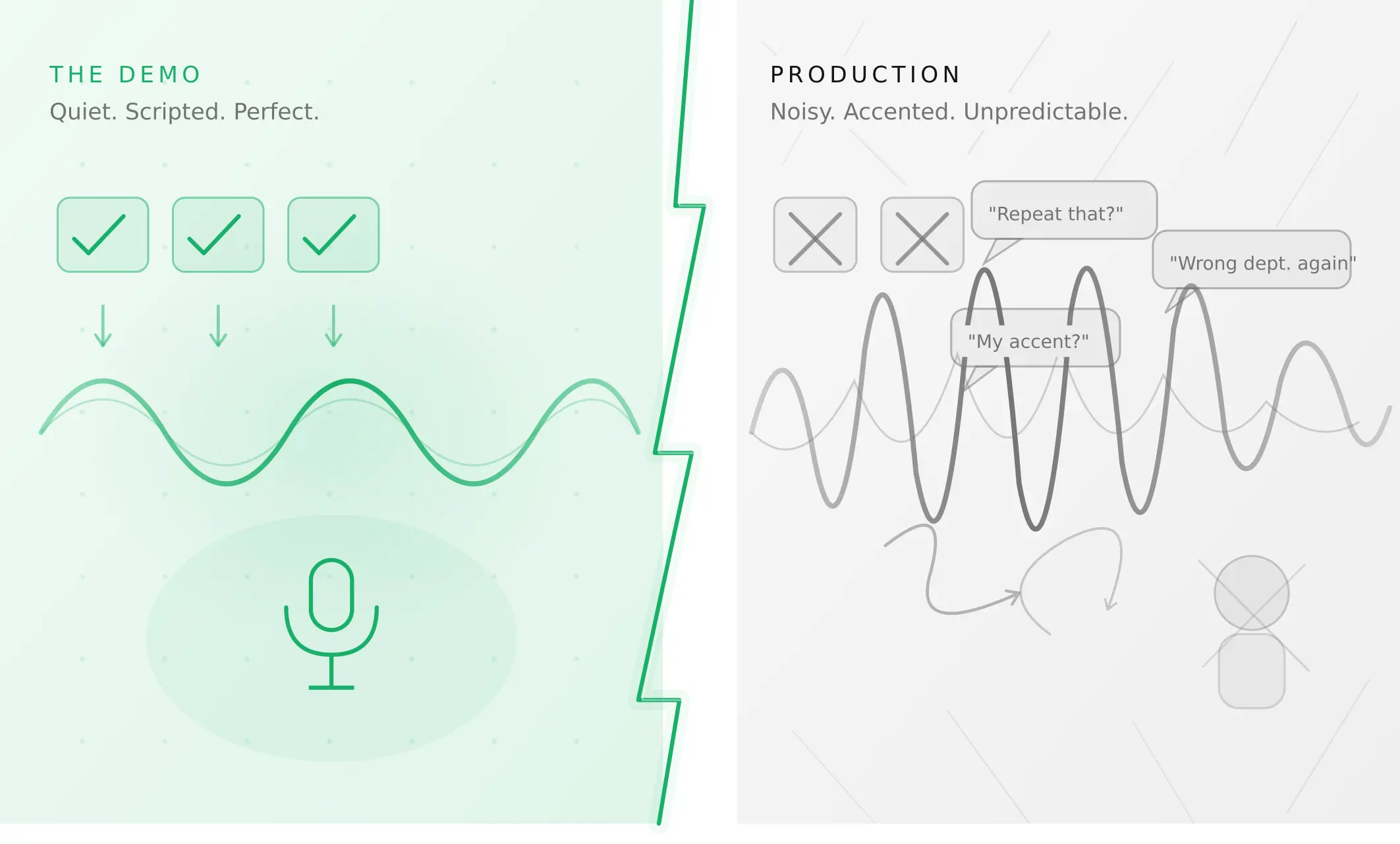
Why AI voice agents fail in production (and how to prevent it)
AI voice agents that ace demos still break in production. Learn the 5 root causes, how to test for each, and what production readiness actually means.
Read more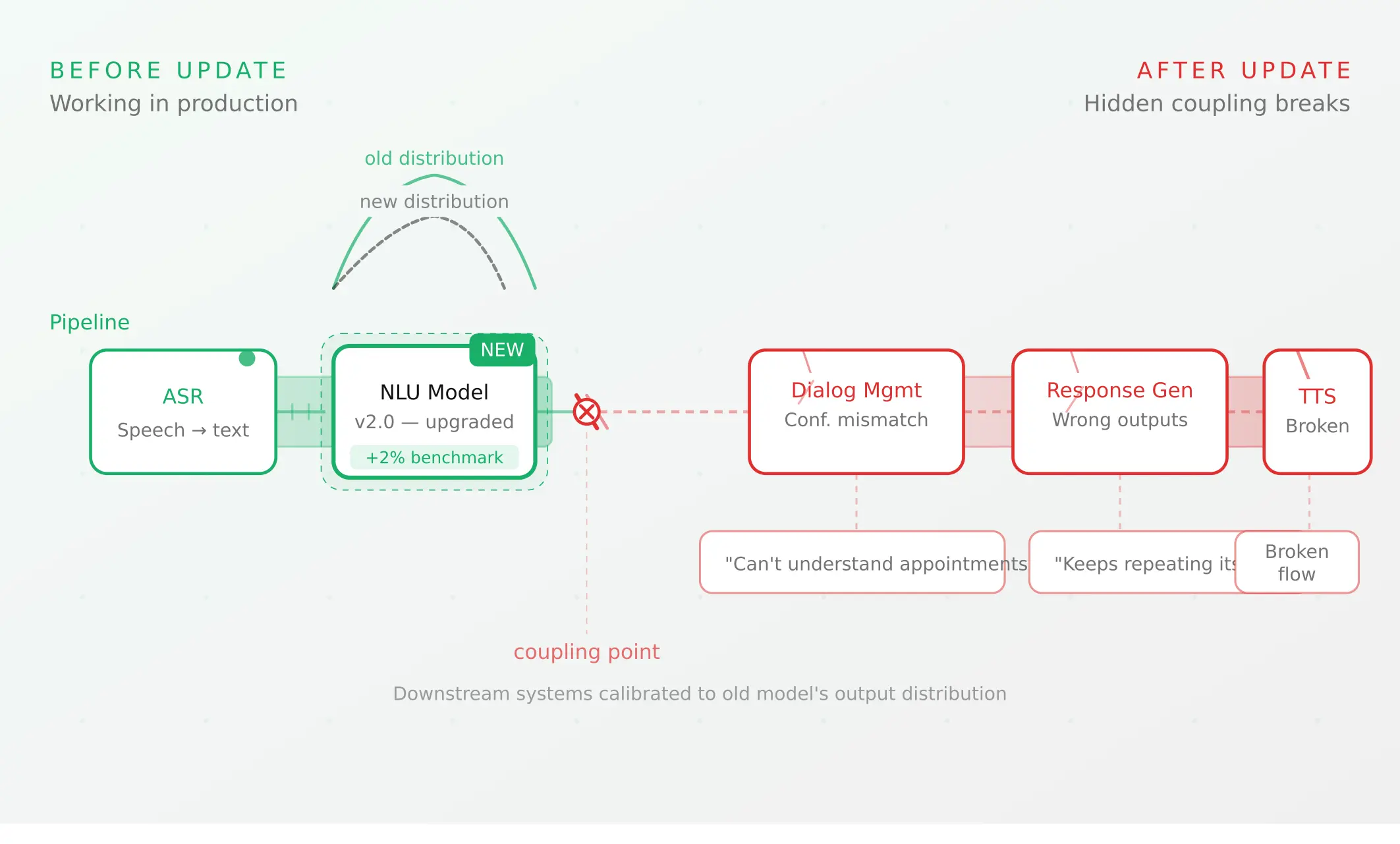
Voice agent regression testing: why LLM updates break production
LLM updates improve benchmarks but break voice agents in 5 predictable ways. How to detect and prevent regressions after every model or prompt change.
Read more