Test your voice agent
Use Cases of Jev for AI Voice Agents
# Jev use cases for AI voice agents
Quick answer
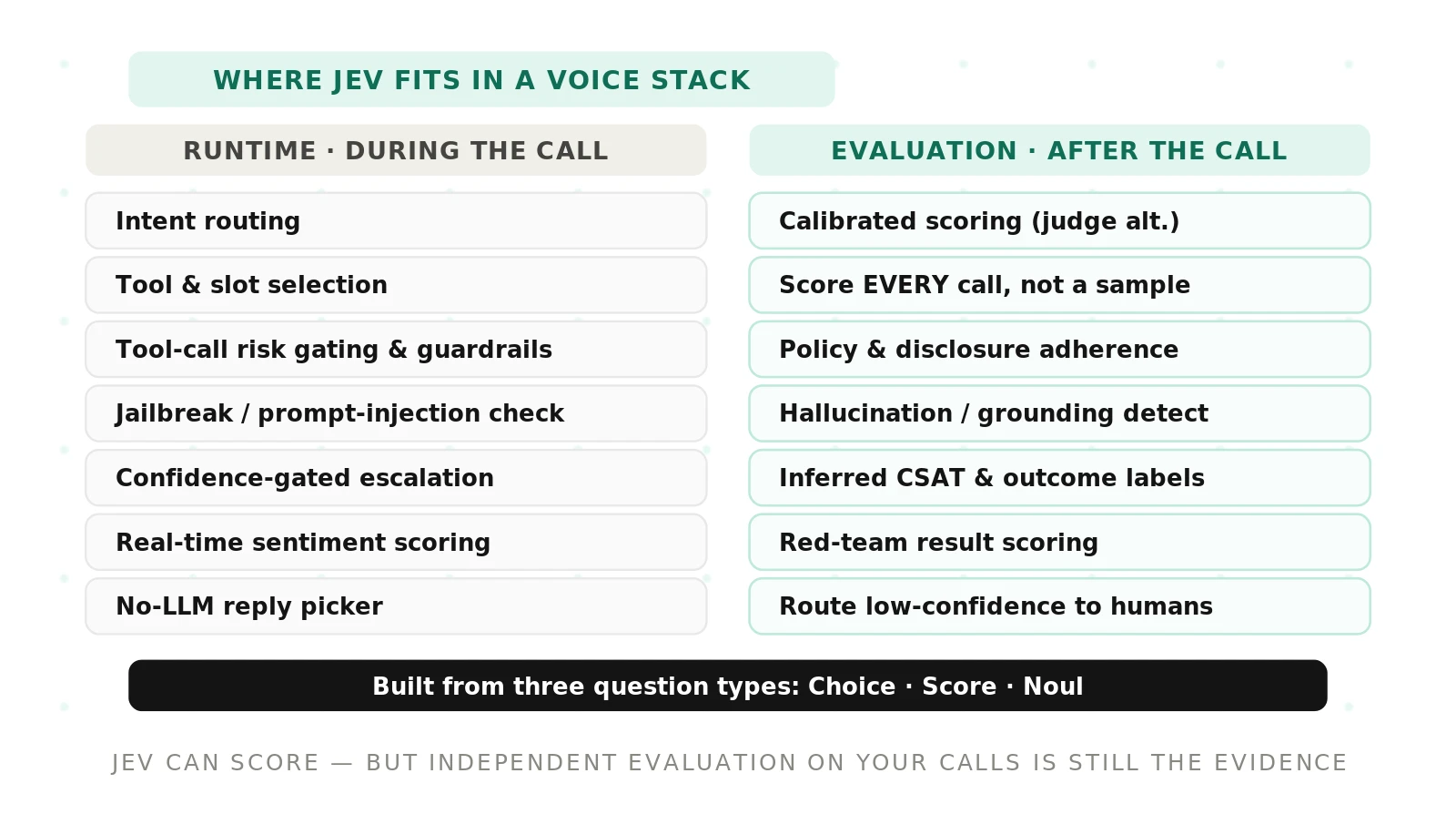
Jev use cases for voice agents fall into two groups. At runtime it makes fast, typed decisions: route intent, pick tools, gate risky actions, detect jailbreaks, and score frustration. In evaluation it scores every call with calibrated confidence, flags hallucinations, labels outcomes, and sends low-confidence cases to humans.
Jev is a new kind of model, and it is easy to misfile. It does not write sentences. It makes decisions. You hand it a "state" — a transcript, a message, some structured data — plus a question, and it returns a typed, probabilistic answer with a confidence number attached.
That shape turns out to be a strong fit for voice agents. A voice stack is full of small decisions that an LLM handles slowly and expensively: which intent is this, which tool to call, is this action safe, is this caller angry, did the agent resolve the issue. Jev answers those in tens of milliseconds, at a fraction of the cost, and it cannot invent an option that does not exist.
This post is the roundup. It maps where Jev fits in and around a voice agent, in two groups: runtime decisions inside the live call, and evaluation once the call is done. For the deeper background on the model itself, read our pillar on Jev for voice agents. For the single highest-value runtime pattern, see routing and escalation with Jev.
What Jev is, in one line
> Jev: TypeSafe AI's first "System One Model," launched September 15, 2026. It takes a state plus questions and returns typed probabilistic decisions with calibrated confidence. It does not generate text.
Jev answers three question types. A Choice picks one of up to 255 options and returns a probability per option plus confidence. A Score maps to ordered levels and returns a continuous score, a distribution, and confidence. A Noul returns a yes or no probability. TypeSafe reports it cannot hallucinate and posts a 0% type-error rate, because the schema constrains every output.
The other headline numbers, per TypeSafe's launch post: 70–500ms per call, roughly 40–200x faster than an LLM. Input costs $0.042 per million tokens and output is free, which TypeSafe frames as about 400x cheaper. You can ask many questions in one call, and adding questions barely moves latency or cost. Confidence is calibrated, so a reported 0.9 means what it says. Jev is trained with RLCD.
Two facts shape every use case below. Jev decides and scores; it does not produce language. And it reads text or structured state, not raw audio. Keep both in mind as you read.
Two places Jev fits: runtime and evaluation
Group A is runtime — decisions made while the caller is on the line, where latency is the constraint. Group B is evaluation and QA — scoring calls after the fact, where consistency and cost per judgment matter most. Group B is Evalgent's home turf, and we will be specific about the line between using Jev as a scorer and running an independent evaluation.
Jev use cases at runtime, inside the live call
These are "smart if-statements." Each one is a decision the agent has to make mid-call, fast, with a clear set of outcomes.
Intent routing
The classic first job. Given the caller's utterance and context, which intent is this: billing, cancellation, tech support, sales? A Choice question returns a probability across your intent list. Because the option set is fixed, Jev cannot route to an intent that is not in your menu. This replaces a small LLM classification call or a brittle regex layer, and it returns a confidence number you can act on.
Tool and slot selection
Once intent is known, the agent picks a tool and fills its arguments. A Choice question selects the tool from your registered set. Score or Choice questions can confirm slot values before the call fires. This complements your orchestration rather than replacing the tool call itself. It pairs well with disciplined tool argument accuracy work — see our guide to tool calling for voice agents.
Tool-call risk gating and guardrails
Before the agent executes something irreversible — a refund, a cancellation, a transfer — a Noul question asks: is this action safe to run given the transcript and the policy? Low confidence or a "no" holds the action for confirmation or handoff. Jev runs this check in parallel with the tool decision, so the guardrail adds almost no latency. This is the runtime cousin of the offline work in testing guardrails for voice agents.
Jailbreak and prompt-injection detection
Callers and injected content try to steer an agent off-policy. A Noul question scores whether the current turn looks like a jailbreak or an injection attempt. Because it is cheap and fast, you can run it on every turn, not just suspicious ones. A high probability triggers a refusal, a safe fallback, or an escalation. Jev's "verify everything" positioning fits this job directly.
Confidence-gated escalation
This is the pattern we like most. Instead of escalating on keywords, the agent escalates on Jev's own confidence. When a Choice or Score answer comes back with low confidence — the model is genuinely unsure — the agent hands off to a human. Calibrated confidence is what makes this trustworthy. We cover the full pattern in Jev voice agent routing and escalation and in our guide to escalation for voice agents.
Real-time frustration scoring
A Score question rates caller frustration on an ordered scale, turn by turn. The continuous score and its distribution let the agent adapt: slow down, apologize, or offer a human before the caller asks. This runs alongside every other Jev call in the same request, so it costs almost nothing extra. It replaces a separate sentiment model or an LLM prompt that would add hundreds of milliseconds.
Model routing
Not every turn needs your most expensive LLM. A Choice question can route the turn: handle it with a cheap model, a big model, or a canned response. Jev decides which path fits, in tens of milliseconds, before you spend tokens. This is a cost lever that pays for itself on high-volume lines.
The no-LLM-in-the-loop reply picker
The most radical use case. In an emerging architecture, the pipeline runs Deepgram Flux into Jev into text-to-speech, with no LLM generating the reply. Jev picks the response from a bank of pre-written options using a Choice question, in roughly 300ms, and reports its confidence. This only works when your replies are bounded and pre-authored. For open-ended conversation you still need an LLM, or a hybrid where Jev picks among templates and an LLM handles the long tail. This is the biggest honest caveat in the runtime group: Jev chooses language, it does not write it.
Jev use cases in evaluation and QA
This is where an independent evaluator lives. The same properties that make Jev good at runtime decisions — typed output, calibrated confidence, near-zero cost per judgment — make it a strong scoring engine for voice agent evaluation and testing.
Calibrated scoring as an LLM-judge alternative
Teams grade transcripts with an LLM-as-judge. It works, but judges are inconsistent and slow. LangChain's testing, reported in "Can Jev Be a Better Agent Evaluator?", found Jev's quality-score variance was 92–913x lower than GPT-5.6 Luna, Terra, and Claude Sonnet 4.6 as judges. It averaged 0.44 seconds and $0.00035 per call — $0.34 total against $28.17 for the Claude run. More consistent, faster, cheaper. A Score question replaces the judge prompt for anything that maps to an ordered rubric.
Scoring every call, not a sample
Here the economics flip. Most teams grade a small sample because judging is expensive. When judging is nearly free and fast, the sample stops making sense. This is a Jevons paradox effect: make judgment cheap enough and you consume far more of it. You can score 100% of calls on every rubric instead of 2% on one. Full coverage changes what you can catch — rare failures stop hiding in the unsampled 98%.
Policy and disclosure adherence scoring
Regulated calls require specific disclosures and forbidden phrases. A Noul question per rule asks: was the recording disclosure spoken, was the mini-Miranda read, did the agent avoid a prohibited promise? You run every rule on every call in one Jev request. This complements deterministic checks and verifiable rewards, which handle the parts that a simple assertion can prove.
Hallucination and grounding detection
A Noul question asks whether a claim in the transcript is grounded in the retrieved context or the knowledge base. When the agent states a policy detail or a price, Jev flags whether the source supports it. Because it is cheap, you can check every factual assertion, not a spot sample. This gives your grounding metric a per-call denominator instead of an estimate.
Inferred CSAT and sentiment
Post-call satisfaction surveys have single-digit response rates. A Score question infers a satisfaction level from the transcript for every call. You still validate against real survey responses where you have them, but you get a dense signal in between. The distribution Jev returns tells you how confident the inference is, so you can weight it.
Auto-labeling outcomes
Containment and resolution labeling is slow, manual work. A Choice question labels each call: contained, escalated, resolved, abandoned, callback. A Noul question can settle a binary like "was the issue resolved." This auto-labels your whole call log, turning raw transcripts into an analyzable dataset without a human touching each one.
Red-team result scoring
After a red-team run, someone has to grade thousands of adversarial transcripts: did the agent hold the line or break? A Noul question scores each attempt as a pass or a break, with confidence. Jev turns a manual grading backlog into a batch job that finishes in seconds and costs cents.
Routing low-confidence items to human review
Jev reports calibrated confidence on every score, which gives you a clean triage rule. High-confidence judgments post automatically. Low-confidence ones route to a human reviewer. This is human-in-the-loop evaluation done right: humans spend their time only where the model is genuinely unsure, not re-checking obvious passes.
Use case, Jev question type, and what it replaces
The table maps each use case to its Jev question type and what it stands in for. Choice picks one option, Score rates an ordered level, Noul answers yes or no.
| Use case | Jev question type | Replaces or complements |
|---|---|---|
| Intent routing | Choice | Small LLM classifier or regex router |
| Tool and slot selection | Choice + Score | LLM tool-choice reasoning |
| Tool-call risk gating | Noul | Hand-written safety rules |
| Jailbreak / injection detection | Noul | Separate moderation model |
| Confidence-gated escalation | Choice / Score confidence | Keyword-based escalation triggers |
| Real-time frustration scoring | Score | Standalone sentiment model |
| Model routing | Choice | Static routing rules |
| No-LLM reply picker | Choice | LLM generation (bounded replies only) |
| LLM-judge scoring | Score | LLM-as-judge prompt |
| Policy / disclosure adherence | Noul | Manual QA review |
| Hallucination / grounding | Noul | LLM grounding check |
| Inferred CSAT | Score | Post-call surveys |
| Outcome auto-labeling | Choice / Noul | Manual call labeling |
| Red-team result scoring | Noul | Manual transcript grading |
How to choose your first Jev use case in a voice stack
Do not try to adopt every use case at once. Pick one, prove it, then expand. Here is the order we recommend.
1. Start in evaluation, not runtime. Scoring is offline and low-risk. A bad score costs you nothing on a live call. Runtime decisions touch real callers, so earn confidence first.
2. Pick a decision you already make with an LLM. Look for an existing LLM-as-judge prompt or a classification step. That is your baseline to beat on cost, speed, and consistency.
3. Choose the question type by output shape. One of a fixed set is a Choice. An ordered rating is a Score. A yes-or-no is a Noul. Match the type to the decision, not the other way around.
4. Run Jev and your baseline side by side. Score the same calls with both. Compare variance, latency, and cost per judgment. Keep your existing labels as ground truth.
5. Check calibration on your data. Confirm that a reported 0.9 confidence maps to roughly 90% accuracy on your calls. TypeSafe reports calibrated confidence); verify it holds in your domain before you trust the number.
6. Set a confidence threshold for human review. Decide where low-confidence items route to a person. This is your safety net while you build trust in the model.
7. Only then move a decision to runtime. Once a use case is proven offline, promote it into the live call, starting with an advisory role before it gates actions.
Where Evalgent fits
Jev is a powerful scorer. It is not an evaluation program. You can use Jev as a calibrated judge, and it will be faster and more consistent than an LLM. But the vendor's own scorer grading the vendor's own agent is not independent evidence.
That is the gap we fill. Evalgent runs independent evaluation on your own calls and your own test cases, with methods you control and results you can defend. We use calibrated scorers where they help, alongside deterministic verifiable rewards and human review, and we keep the latency) and cost math honest. If Jev is the engine, an independent audit is the dyno. The full model background lives in our Jev for voice agents pillar, and the technical docs are here. Jev is in early access, so treat every number as a starting point to verify, not a settled benchmark.
Frequently asked questions
What are the use cases of Jev for voice agents?
Jev use cases split into two groups. At runtime: intent routing, tool and slot selection, risk gating, jailbreak detection, confidence-gated escalation, frustration scoring, model routing, and reply picking. In evaluation: LLM-judge-style scoring, policy adherence, hallucination detection, inferred CSAT, outcome labeling, red-team scoring, and low-confidence triage.
How do you use Jev for AI voice agents?
You send Jev a state — a transcript, message, or structured data — plus one or more questions, and it returns typed answers with calibrated confidence. Choose a Choice, Score, or Noul question to match the decision. Start in offline evaluation, prove it against your existing baseline, then promote proven decisions into the live call.
Can Jev replace an LLM judge for voice agents?
Jev can replace an LLM judge for anything that maps to a Choice, Score, or Noul. LangChain's testing found Jev's quality-score variance was 92–913x lower than GPT-5.6 and Claude judges, at 0.44s and $0.00035 per call. It cannot write freeform critique, so keep an LLM for narrative feedback.
What Jev question type do I use for routing?
Use a Choice question for routing. It picks one of up to 255 options and returns a probability for each plus a confidence score. Because the option set is fixed to your intents or tools, Jev cannot route to something outside your menu. Use the confidence value to trigger escalation when the model is unsure.
How do you use Jev to score every voice agent call?
Because Jev output is free and input is roughly 400x cheaper than an LLM, per-call judgment cost drops far enough to grade 100% of calls. Send each transcript with your rubric questions in one call. This is a Jevons paradox effect: cheap judgment means you consume far more of it, replacing thin samples with full coverage.
Can Jev detect jailbreaks in voice agents?
Jev can score jailbreak and prompt-injection risk with a Noul question that returns a yes-or-no probability per turn. Because it runs in 70–500ms and adds little cost, you can check every turn, not just suspicious ones. A high probability triggers a refusal, a safe fallback, or an escalation to a human agent.
How does Jev pick a reply with no LLM in the loop?
In an emerging architecture, Deepgram Flux feeds Jev, which feeds text-to-speech, with no LLM generating text. Jev uses a Choice question to pick a reply from a pre-written response bank in about 300ms and reports confidence. This works only for bounded replies. Open-ended conversation still needs an LLM or a hybrid design.
What can Jev not do for voice agents?
Jev does not generate language — it decides and scores, so freeform replies need a response bank or an LLM. It reads text and structured state, not raw audio, so it works on transcripts rather than the waveform. It is in early access. Treat published speed, cost, and quality figures as starting points to verify on your data.
The bottom line
Jev's use cases for voice agents divide cleanly into fast runtime decisions and cheap, consistent evaluation scoring. Use it as an engine for both, but run your production evaluation independently, on your own calls, so the results hold up under scrutiny.
Want to see where Jev fits in your stack and how independent evaluation catches what a self-graded scorer misses? Book a demo and we will score a sample of your real calls.
Related Articles
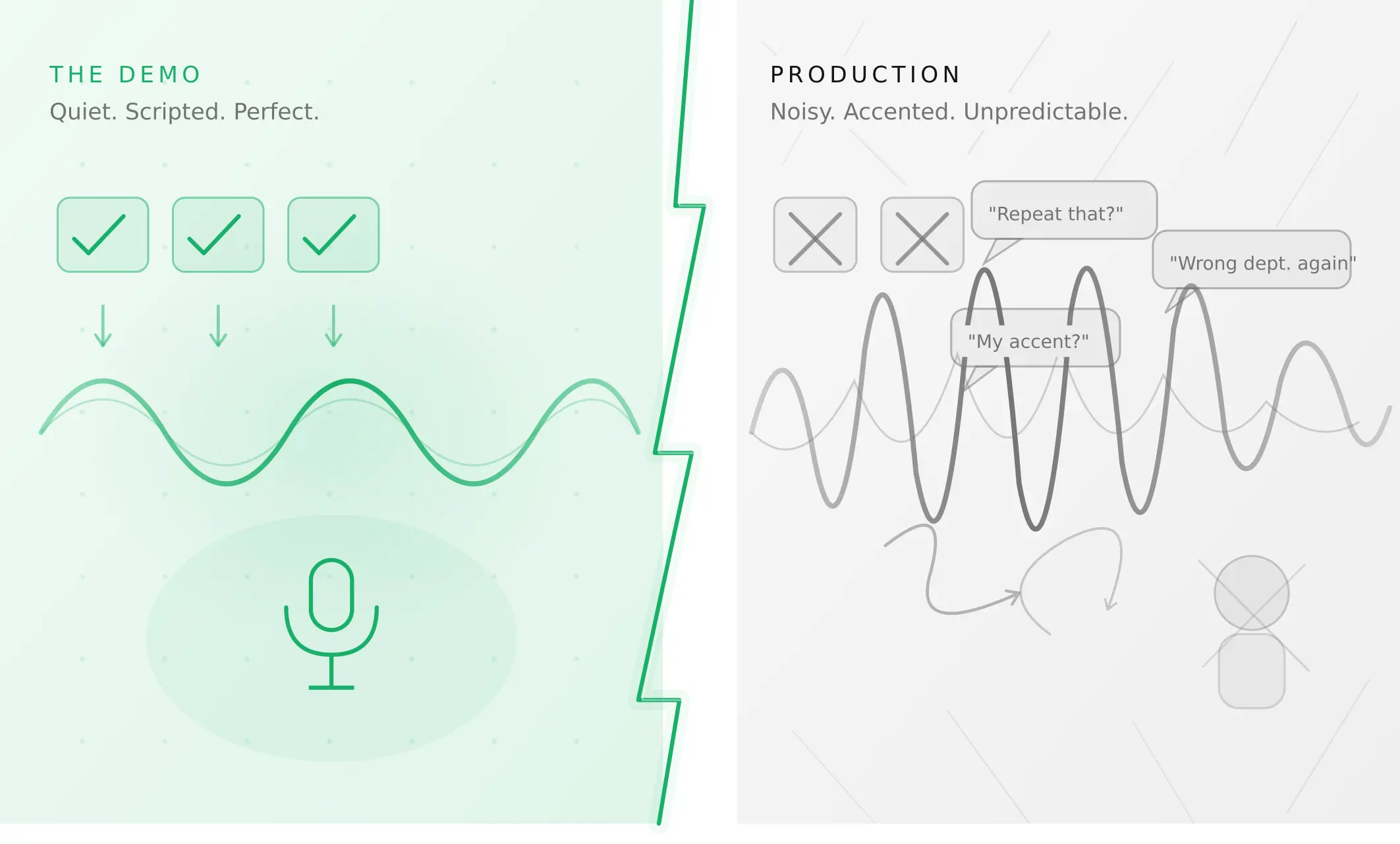
Why AI voice agents fail in production (and how to prevent it)
AI voice agents that ace demos still break in production. Learn the 5 root causes, how to test for each, and what production readiness actually means.
Read more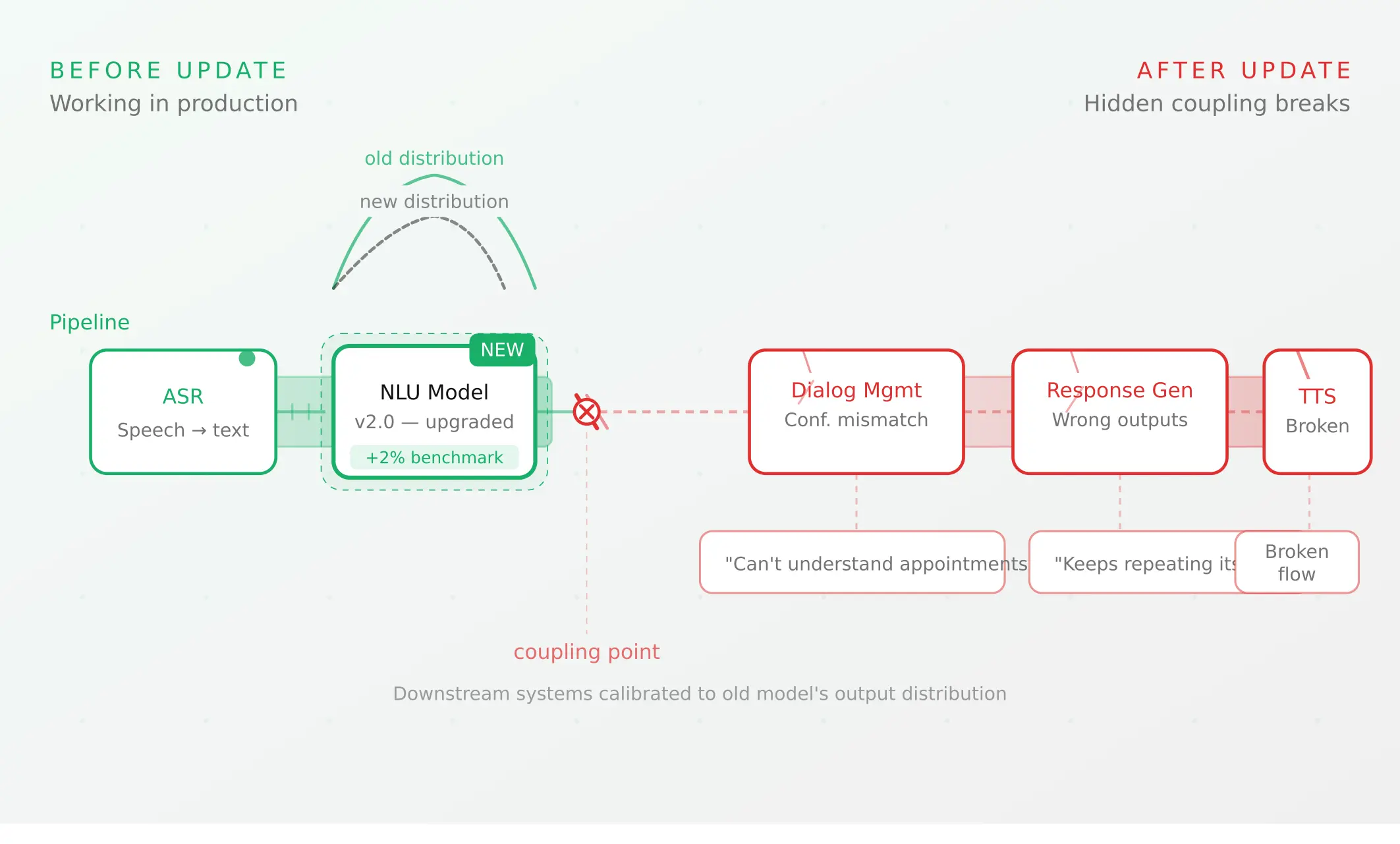
Voice agent regression testing: why LLM updates break production
LLM updates improve benchmarks but break voice agents in 5 predictable ways. How to detect and prevent regressions after every model or prompt change.
Read more