How to test escalation and handoff in AI voice agents
On this page
The worst voice agent experience is being stuck with a bot that will not let you reach a person. Good escalation is what prevents it. But an agent that escalates everything is just an expensive router. Evalgent tests the balance. Here is how handoff fails and how to test it.
Escalation: the handoff of a live call from the voice agent to a human, triggered by a caller request, a repeated failure, or a high-risk or out-of-scope situation.
What broken escalation looks like
These are the symptoms callers hit:
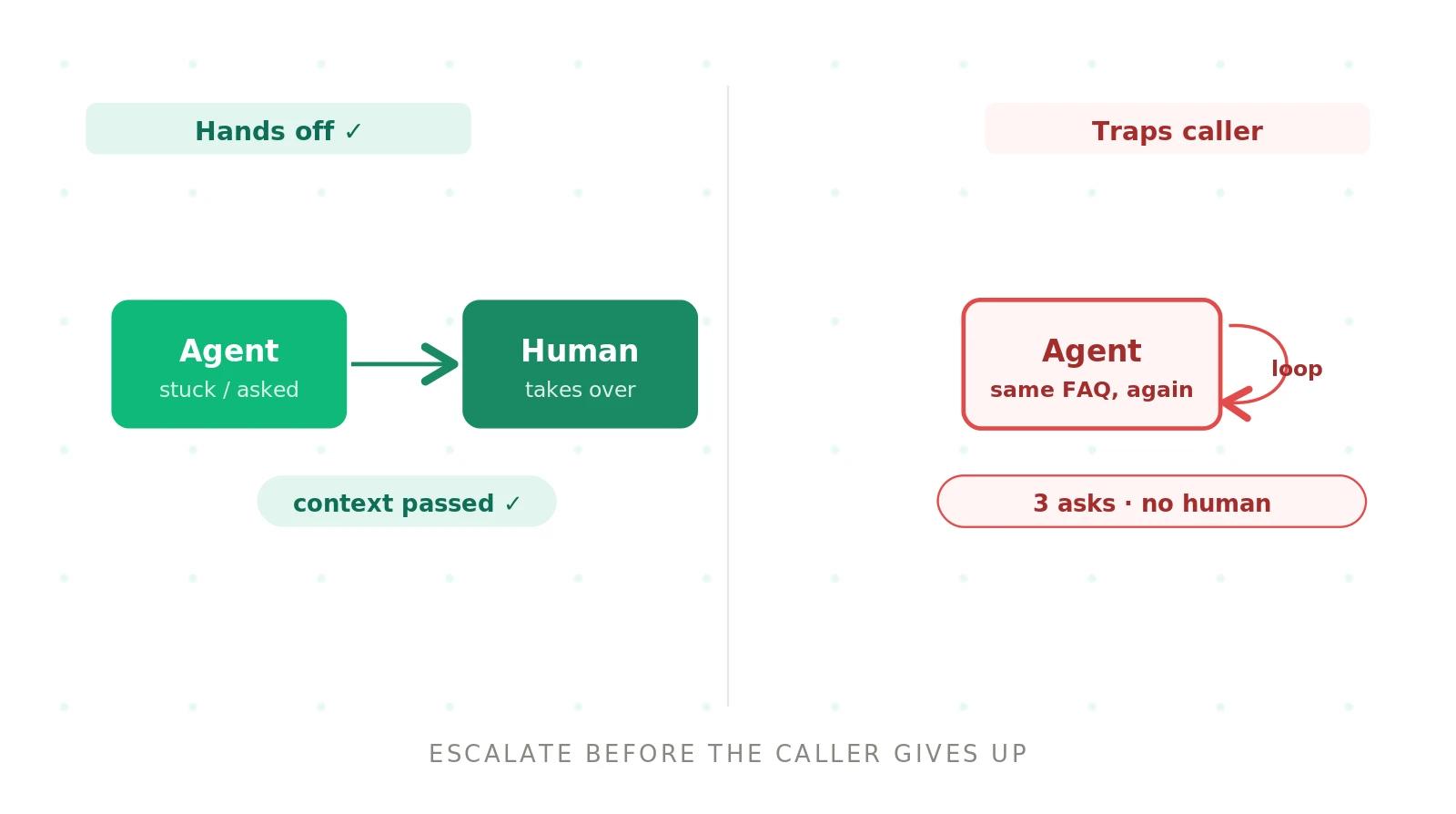
- The agent loops on a question it cannot answer and never offers a human.
- It ignores a direct "let me talk to a person."
- It transfers on the first hesitation, before it even tries.
- The human picks up with no context, so the caller repeats everything.
- It routes to the wrong queue or department.
The failure that hurts most is the trap: a caller who needs a human and cannot reach one.
Why escalation fails
Escalation fails when the triggers and the handoff are underspecified. The agent either has no clear rule for when to hand off, or no clean way to pass the call along. The table maps each cause to what you hear and how to fix it.
| Cause | How it shows on a call | Fix |
|---|---|---|
| No escalation triggers defined | Agent loops instead of handing off | Define explicit triggers: failures, risk, out-of-scope |
| Missed human request | Ignores "get me a person" | Detect explicit handoff requests and honor them |
| Threshold too eager | Transfers on the first hesitation | Set a sensible failure count before escalating |
| No context passing | Human starts blind; caller repeats all | Pass transcript, intent, and caller data on transfer |
| Wrong routing | Lands in the wrong queue | Map each escalation reason to the right destination |
| No fallback path | Dead end when no agent is free | Add a queue, callback, or voicemail fallback |
How to test escalation in AI voice agents
1. List the triggers — Define every condition that must cause a handoff: request, repeated failure, risk, out-of-scope.
2. Write a scenario per trigger — One call for each, including a caller who explicitly asks for a human.
3. Assert the handoff fired — Check the agent escalated within the defined limit, not one turn too late.
4. Check context passed — Assert the transcript, intent, and caller details reached the human or queue.
5. Test over-escalation — Confirm the agent resolves what it should, instead of transferring too soon.
6. Verify routing and fallback — Assert the right destination, and a graceful path when no agent is free.
A worked example
A caller repeated "I need to speak to someone" three times while the agent kept re-answering the same FAQ. It never escalated, because the only trigger was an internal confidence score that stayed high. The caller hung up. The fix was a direct rule: an explicit human request always escalates, immediately. A scenario now asserts that exact phrase triggers a handoff on the first mention, with the transcript attached.
Testing escalation with Evalgent
Evalgent tests handoff on realistic calls, both directions at once. Scenarios drive every escalation trigger — explicit requests, repeated failures, high-risk and out-of-scope cases — plus the calls that should stay contained. Profiles vary caller tone, so a calm request and a frustrated one are both tested. Metrics assert the agent escalated within the limit, passed context, and routed correctly, with thresholds you set. Evaluations run the suite as batches of synthetic callers before release. Reviews let you replay a trapped-caller call and hear the missed handoff. This is close to procedure testing — see SOP-based voice agents and testing SOP-based voice agents.
The bottom line
Escalation fails in two directions: trapping a caller who needs a human, and transferring one who did not. Define explicit triggers, pass context on every handoff, and test both under- and over-escalation before you ship.
Frequently asked questions
What is escalation in a voice agent?
Escalation is the handoff of a live call from the voice agent to a human. It is triggered when the caller asks for a person, when the agent repeatedly fails to resolve the issue, or when the case is high-risk or out of scope. Good escalation passes full context so the human does not start blind.
When should a voice agent escalate to a human?
It should escalate on an explicit request for a person, after a set number of failed attempts, on high-risk or sensitive cases, and when the request falls outside its scope. The exact thresholds depend on your risk tolerance, but an explicit human request should almost always trigger an immediate handoff.
How do you test escalation in a voice agent?
Define every escalation trigger, then write a scenario for each — including a caller who explicitly asks for a human. Drive the calls and assert the agent handed off within the defined limit, routed to the right destination, and passed the transcript and context. Also test that it does not over-escalate on cases it should resolve.
Why does my voice agent trap callers instead of escalating?
Usually because it has no clear escalation trigger, or it ignores explicit human requests and relies only on an internal confidence score. If that score stays high, the agent keeps trying and loops. The fix is a direct rule: an explicit request for a person always escalates, regardless of how confident the model feels.
How do you stop a voice agent from escalating too soon?
Set a sensible failure threshold, so the agent attempts a resolution before handing off, rather than transferring on the first hesitation. Test the contained path directly, asserting the agent resolves cases it should handle. Over-escalation is costly because it turns an automated agent into an expensive router to human staff.
What context should a voice agent pass on handoff?
It should pass the call transcript, the detected intent, any collected caller details, and the reason for escalation. Without this, the human starts blind and the caller has to repeat everything, which is a common source of frustration. Test that the context actually arrives at the human or queue, not just that the transfer happened.
What is the difference between escalation and containment?
Containment is the share of calls the agent resolves without a human. Escalation is the handoff when it cannot. They trade off: pushing containment too high can trap callers who need a person, while escalating everything wastes human time. The goal is not maximum containment but escalating exactly when a human is genuinely needed.
How often should you test escalation?
Test before every release, and re-run whenever you change the prompt, the triggers, or the routing. Escalation logic is easy to break with a small change. Production monitoring helps too, since real calls reveal missed handoffs and new situations that should escalate but were never in your original trigger list.
Related guides
How to test tool calling in AI voice agents
Tool calling fails when a voice agent picks the wrong function, fills bad arguments, or acts silently. Learn how to test tool calling and catch it.
How to reduce latency in AI voice agents
Voice agent latency is the pause before the agent replies. Learn what drives it, what a good target is, and how to reduce latency without losing quality.