Open door for builders.
Routing Use Cases of Jev in AI Voice Agents
# Routing use cases of Jev in AI voice agents
Quick answer
> Quick answer: Jev routing use cases cover every point where a voice agent picks one option from a fixed set. That means which model, tool, intent, language, or handoff. Jev's Choice question is the router, Noul is the gate, and Score prioritizes. Jev decides in 70 to 500ms with calibrated confidence.
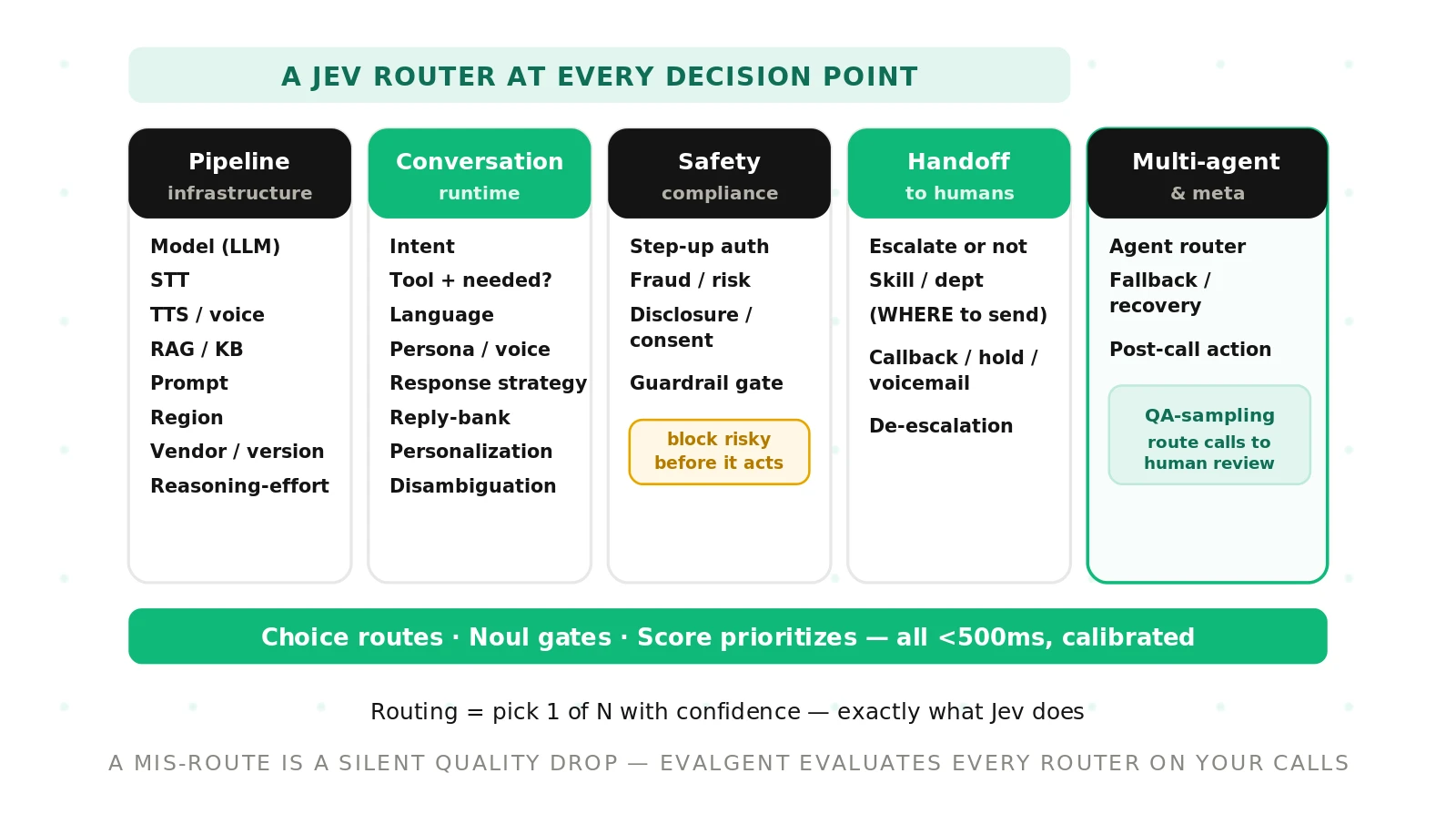
A voice agent is a long chain of small decisions. Which model answers this turn? Which tool fires? Which team gets the handoff? Each one is a router. This post catalogs every routing job Jev can do. It shows why each matters and how to check that the routing was correct.
Why routing is Jev's core job
Routing has one shape everywhere it appears. You pick one option from a fixed set. That is routing in networks, in call centers, and inside an agent loop. The set is closed and known ahead of time. The job is to pick the right member of it, fast.
That shape is exactly what Jev's Choice question does. An LLM can pick too, but it is the wrong tool for a closed-set pick. It is slower, it costs more, and it can invent an option that is not on your list. A schema-constrained router cannot.
> Jev: TypeSafe AI's first System One model, launched September 15, 2026, in early access. It reads a state plus questions and returns typed probabilistic decisions with calibrated confidence.
Jev is not a language model. It does not generate text. You give it a state, such as a transcript, structured data, or a message list. You attach one or more questions. It returns typed decisions. TypeSafe documents three question types, and they map to three routing roles.
> Choice: picks one of up to 255 options and returns a probability per option plus confidence. This is the router.
> Noul: returns a yes or no probability. This is the gate.
> Score: returns an ordered level, a continuous score, a distribution, and confidence. This is the prioritizer.
Three facts make Jev fit routing better than an LLM. It is fast, at 70 to 500ms per decision. TypeSafe puts that at 40 to 200 times faster than an LLM. It is cheap, with input at $0.042 per million tokens and output free. And it cannot emit an invalid option. The schema constrains the output to your set, so type errors sit at zero. You can read the launch note and the TypeSafe docs.
Jev was trained with RLCD, and TypeSafe positions it as a complement to LLMs. The mental model is simple. Use an LLM to talk. Use Jev to decide fast. TypeSafe calls these decisions "smart if-statements."
Because the router is near-free and near-instant, you can place one at every decision point. Because confidence is calibrated, you can gate the ambiguous ones. Higher confidence tracks higher accuracy. So you route confident calls automatically and escalate the rest.
Jev also runs many questions on one state in a single call. That means a turn's model router, tool gate, and risk score can share one round trip. You are not paying a separate call for each decision. This is what makes a router-at-every-step design practical, not just possible.
There is a catch. A mis-route is a silent quality drop. Nothing crashes. The wrong model just answers, or the wrong tool fires, and the caller pays for it. So every router is a decision that can be wrong quietly. Every router must be evaluated. Our pillar on Jev for voice agents sets the wider context. Jev vs an LLM covers when to use which.
Jev routing use cases: the master catalog
The table below lists every routing job Jev can do in a voice agent. It names the primitive, what gets routed, and the mis-route risk. Use it as a map, then read the grouped sections for detail.
Read the primitive column first. Choice is a router, so it appears wherever you pick one of many. Noul is a gate, so it appears wherever the answer is allow or block. Score is a prioritizer, so it appears wherever you rank or grade. Most jobs are Choice, because most routing is a many-way pick.
| Routing job | Primitive | What it routes | Mis-route risk |
|---|---|---|---|
| Model router | Choice | Turn to LLM tier | Wrong tier wastes cost. |
| STT router | Choice | Audio to speech engine | Raises word error rate. |
| TTS / voice router | Choice | Reply to voice engine | Hurts brand or clarity. |
| RAG / knowledge router | Choice | Query to index or source | Grounds on bad data. |
| Prompt / playbook router | Choice | Context to system prompt | Applies wrong policy. |
| Region / residency router | Choice | Call to regional endpoint | Breaches residency rules. |
| Vendor / version router | Choice | Traffic to vendor or version | Degrades quality. |
| Reasoning-effort router | Score | Turn to reasoning budget | Drops accuracy or adds latency. |
| Intent router | Choice | Utterance to intent or flow | Derails the whole call. |
| Is-a-tool-needed gate | Noul | Turn to tool call or not | Fires a needless action. |
| Tool router | Choice | Turn to specific tool | Returns wrong data. |
| Language / locale router | Choice | Speech to language or locale | Garbles replies. |
| Voice / persona router | Choice | Segment to persona | Feels wrong to caller. |
| Response-strategy router | Choice | Turn to answer, clarify, confirm, defer | Stalls the call. |
| Reply-bank router | Choice | Turn to canned reply | A wrong line misinforms. |
| Personalization router | Choice | Caller to segment treatment | Gives a bad offer. |
| Disambiguation router | Choice | Ambiguous input to one meaning | Acts on wrong request. |
| Step-up auth router | Noul | Request to auth check or not | Exposes a sensitive action. |
| Fraud / risk router | Score | Call to risk level | Lets fraud through. |
| Disclosure / consent router | Noul | Turn to disclosure or not | Creates a compliance gap. |
| Guardrail gate | Noul | Action to block or allow | Runs a banned action. |
| Escalate-or-not gate | Noul | Turn to human or not | Frustrates the caller. |
| Skill / department router | Choice | Handoff to team or skill | Forces a repeat transfer. |
| Callback / hold router | Choice | Wait to callback, hold, voicemail | Wastes caller time. |
| De-escalation router | Choice | Upset caller to recovery path | Escalates anger. |
| Agent router | Choice | Task to sub-agent | Handles it poorly. |
| Fallback / recovery router | Choice | Failure to recovery path | Leaves a dead end. |
| Post-call action router | Choice | Call to CRM, ticket, follow-up | Corrupts records. |
| QA-sampling router | Score | Call to human review or not | Hides real defects. |
Pipeline and infrastructure routing
These routers pick the plumbing before or during a turn. They are invisible to the caller and easy to get wrong. Because they are hidden, they rarely show up in a demo. They only surface when the bill or the quality slips in production.
The model router sends each turn to the cheapest LLM that can still handle it. Simple turns go to a small model; hard turns escalate. A ZIP code lookup does not need a frontier model. A tangled complaint might. The savings compound across thousands of calls. See our model routing deep dive for the full pattern.
The STT router picks the speech-to-text engine for the current audio. A noisy phone line may need a different engine than a clean VoIP call. The TTS / voice router picks the voice or synthesis engine for the reply. A short confirmation and a long explanation may not want the same voice.
The RAG / knowledge-base router chooses which index or source to query. A billing question hits billing docs, not the product wiki. See retrieval-augmented generation for the pattern it sits in front of.
The prompt / playbook router swaps the system prompt to match the situation. A returning VIP and a first-time caller may need different scripts. The region / data-residency router sends the call to the right regional endpoint to meet residency rules. The vendor / endpoint / version router shifts traffic across vendors or model versions during a migration or canary. The reasoning-effort router uses Score to set how much thinking budget a turn deserves. A simple lookup gets a low budget; a complex dispute gets more.
Conversation and runtime routing
These routers shape the live dialogue. They fire on nearly every turn, so speed matters most here. A slow router adds delay the caller can hear. This is exactly where Jev's 70-to-500ms decision pays off.
The intent router maps the caller's utterance to an intent or flow. It is the most common router in any agent. A misread here derails the whole call, because every later step trusts the intent. "I want to cancel" and "I want to change my plan" lead to different flows. Intent and escalation are covered in depth in our routing and escalation post.
Tool use needs two routers. The is-a-tool-needed gate is a Noul that decides whether any tool should fire at all. Many turns need no tool, just an answer. The tool router is a Choice that picks which tool. Splitting the gate from the pick keeps each decision simple to evaluate. Our tool calling post and the tool calling guide go deeper.
The language / locale router detects the caller's language and locale. It sets both the reply language and how numbers and dates read aloud. The voice / persona router matches persona to segment. The response-strategy router picks the dialogue act: answer, clarify, confirm, or defer. This is often the difference between a smooth call and a loop. The reply-bank router picks a pre-written reply with no LLM call at all. That is the cheapest turn you can serve. The personalization / segment router selects the treatment for the caller's segment. A new lead and a renewing customer may hear different offers. The disambiguation router resolves ambiguous input to a single meaning before the agent acts on it. It is better to pick the meaning with confidence than to guess and act wrongly.
Safety and compliance routing
Safety routers decide whether something risky is allowed to proceed. Most are Noul gates, because the answer is yes or no. These are the routers where a silent failure is most expensive. A wrong pick here can breach policy or expose a customer.
The step-up auth router is a Noul that decides when a request needs stronger verification. An example is a balance transfer. The fraud / risk router is a Score that rates how risky a call looks, so high scores trigger review. Score fits here because risk is a spectrum, not a yes or no. The disclosure / consent router is a Noul that decides when a required disclosure must play. A missed disclosure can turn a routine call into a regulatory problem.
The guardrail gate is a Noul that blocks or allows a risky action before it runs. Because Jev cannot hallucinate a pass, the gate stays schema-safe. An LLM guard can be talked into a yes; a typed gate cannot. Our guardrails and jailbreak post and the PII handling guide cover this layer.
Human-handoff routing
Handoff routers decide when and where a human takes over. Getting them wrong is expensive, because a bad transfer makes the caller repeat everything. A missed escalation traps a frustrated caller with the bot. A needless one wastes a human on a call the agent could close.
The escalate-or-not gate is a Noul that decides whether this turn needs a human. The skill-based / department router picks which team or skill should receive the handoff. That is the same job an automatic call distributor does with skills-based routing. The callback / hold / voicemail router chooses how to handle a wait. A long queue may be better served by a callback than a hold. The de-escalation router picks the recovery path for an upset caller. The wrong path here can turn a save into a lost account. The escalation guide has the full playbook.
Multi-agent and meta routing
These routers coordinate agents and decide what happens after a decision or a call. They sit above the single turn and shape the whole session.
The agent router picks which sub-agent handles a task in a multi-agent system. LangChain's ModelRouterMiddleware uses Jev to route to a model. Its AutoModeMiddleware uses Jev to gate risky tool calls; see the LangChain write-up. The fallback / recovery router picks what to do on low confidence or failure, so the agent never dead-ends. It can retry, rephrase, hand off, or apologize and close. This is the safety net for every other router in the system.
The post-call action router decides which CRM update, ticket, or follow-up a finished call needs. A wrong write here quietly corrupts your records for weeks. The QA-sampling router is a Score that decides which calls go to human review. That last router is the Evalgent angle. It is how you feed the right calls to reviewers instead of sampling at random. Random sampling wastes reviewer time on easy calls.
How to add a Jev router to any decision in a voice agent
Every router follows the same recipe. Use these steps for any decision point, from model choice to handoff. The pattern is the same whether the router picks a model, a tool, or a team. Learn it once and reuse it everywhere.
1. Identify the decision and its fixed option set. Write down the exact options, such as cheap, standard, or powerful. Routing needs a closed set. If the set is open-ended text, that is a job for an LLM, not a router.
2. Send the state plus a Choice question to Jev. The state is the transcript or structured context. The question names your options. Jev returns a probability per option and a confidence.
3. Set a confidence threshold for that decision. Higher-stakes routers get higher thresholds. A guardrail gate should be stricter than a voice picker.
4. Route high-confidence decisions automatically. When Jev is confident, act on the pick with no extra cost. This is the fast path for the bulk of your calls.
5. Escalate low-confidence decisions to a stronger model or a human. Confidence-gating catches the ambiguous cases before they cause harm. The router decides what it can and hands off the rest.
6. Run the question in parallel with your other questions. Jev answers many questions on one state in a single call. So routing, a guardrail check, and a sentiment read share one round trip.
7. Evaluate routing accuracy on real calls. A calibrated model is not guaranteed correct on your data, so measure it. Track both the routing accuracy and the call outcome it drives. This is where Evalgent comes in.
Evaluate every router: the Evalgent angle
Here is the honest limit. Jev decides and classifies; it does not generate. It works on transcript or text state, not raw audio. So a bad transcription can feed a bad decision, even when the router itself is right. Its confidence is calibrated in general, not guaranteed on any single call. And it is in early access. None of that removes the core risk. A mis-route is a silent quality drop that no error log will show.
That is why every router needs an independent check. A vendor grading its own router is not evidence. The accuracy that matters is the accuracy on your traffic, your accents, and your edge cases. Evalgent is the neutral, third-party evaluator that measures routing accuracy on your real calls. We test it on your data, not on a vendor's demo. We check whether the intent router picks the right flow. We check whether the model router escalates when it should. We check whether the guardrail gate blocks what it must. Low latency means nothing if the pick is wrong.
The QA-sampling router closes the loop. It scores every call and sends the risky ones to human review. Your reviewers then see the calls that matter. Evalgent runs that sampling for you and grades the routers against ground truth. We also flag drift, so a router that was accurate last month cannot quietly degrade. A router you cannot measure is a router you cannot trust. See our take on independent voice AI evaluation and the broader voice agent evaluation approach.
Frequently asked questions
What are the routing use cases of Jev in a voice agent?
Jev routing use cases span the whole stack: model, STT, TTS, RAG, and prompt routers in the pipeline; intent, tool, language, and persona routers at runtime; auth, fraud, and guardrail gates for safety; escalation and department routers for handoff; and agent, fallback, and QA-sampling routers for coordination. See the master catalog above.
Which Jev question type do I use for routing?
Use Choice for routing, because it picks one option from a fixed set of up to 255 and returns a probability per option. Use Noul for yes/no gates, such as blocking a risky action. Use Score for ordered priorities, such as risk level or which calls to sample for review.
How does Jev route to the right model in a voice agent?
Jev reads the turn as a state and answers a Choice question naming your model tiers. It returns the chosen tier plus calibrated confidence in 70 to 500ms. Confident turns route automatically to a cheap model; low-confidence turns escalate to a stronger one. The router adds almost no cost or latency.
Can Jev route which tool a voice agent calls?
Yes. Tool use needs two Jev questions. A Noul gate decides whether any tool is needed on this turn. A Choice question then picks which tool from your registered set. Because the schema constrains the output, Jev cannot invent a tool that does not exist, so type errors stay at zero.
What is the difference between the Choice, Noul, and Score questions?
Choice picks one of up to 255 options with a probability each, so it is the router. Noul returns a yes or no probability, so it is the gate for allow-or-block decisions. Score returns an ordered level and a continuous value, so it prioritizes, such as risk scoring or ranking which calls need review.
How fast and cheap is a Jev routing decision?
TypeSafe reports 70 to 500ms per decision, roughly 40 to 200 times faster than an LLM. Input costs $0.042 per million tokens and output is free, which TypeSafe puts near 400 times cheaper than an LLM on classification. That speed and price let you place a router at every decision point.
What happens if Jev mis-routes a decision?
A mis-route is a silent quality drop. Nothing crashes; the wrong model, tool, or team just handles the turn, and the caller pays for it. Jev's calibrated confidence lets you gate the ambiguous cases, but calibration is not a per-call guarantee. That is why every router must be evaluated on real calls.
How do you evaluate routing accuracy on real calls?
You compare each router's picks against ground truth on your own production calls, not on a vendor demo. Evalgent, an independent evaluator, measures routing accuracy and the downstream call quality it drives. The QA-sampling router feeds the riskiest and lowest-confidence calls to human reviewers so defects surface early.
The bottom line
Routing is pick-one-of-N with calibrated confidence, which is exactly Jev's Choice primitive, so you can place a fast, near-free router at every decision in a voice agent. Every router can be wrong silently, so Evalgent measures routing accuracy and downstream call quality on your real calls.
Ready to see which of your routers are quietly failing? Book a demo and we will grade them against your real calls.
Related Articles
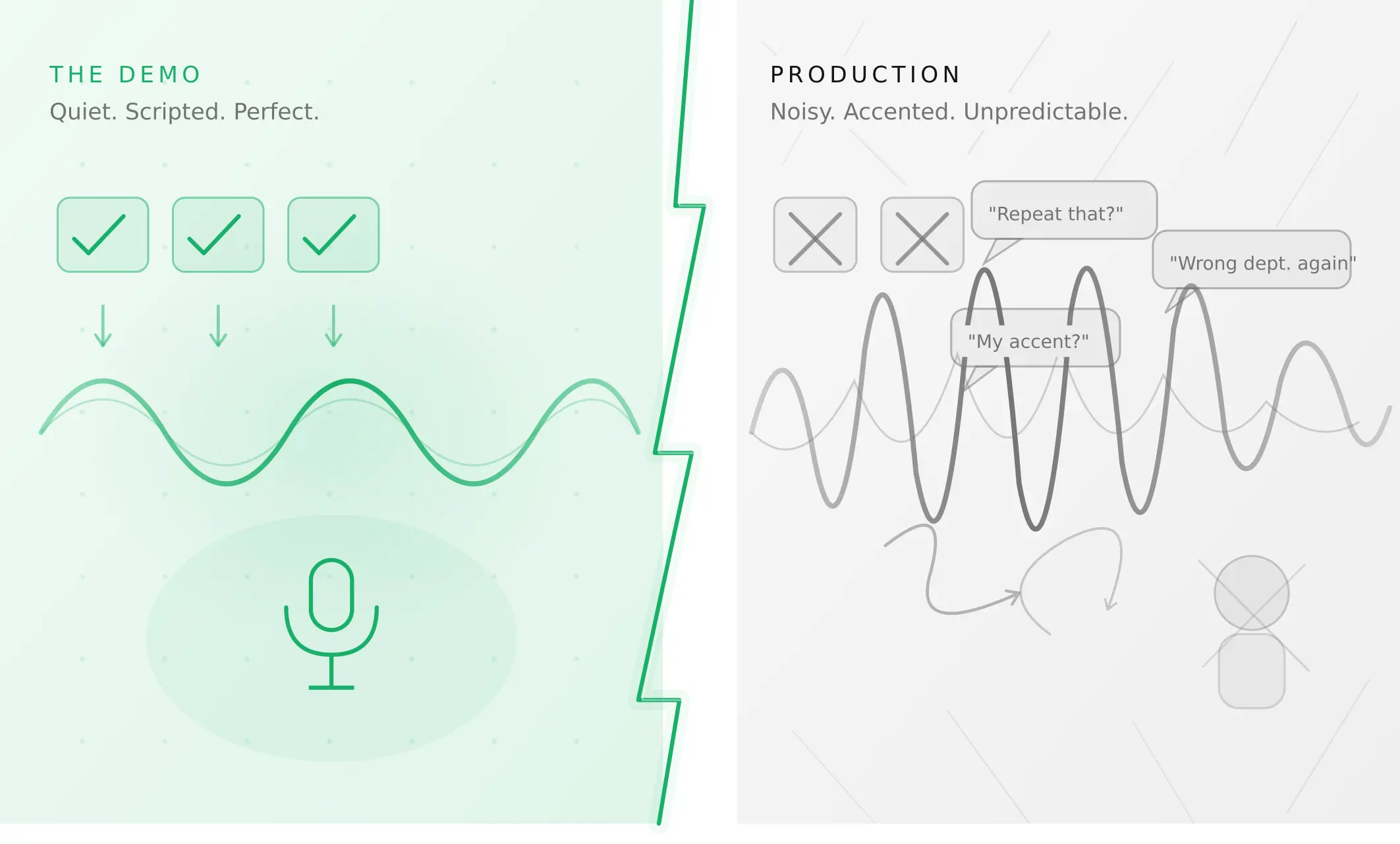
Why AI voice agents fail in production (and how to prevent it)
AI voice agents that ace demos still break in production. Learn the 5 root causes, how to test for each, and what production readiness actually means.
Read more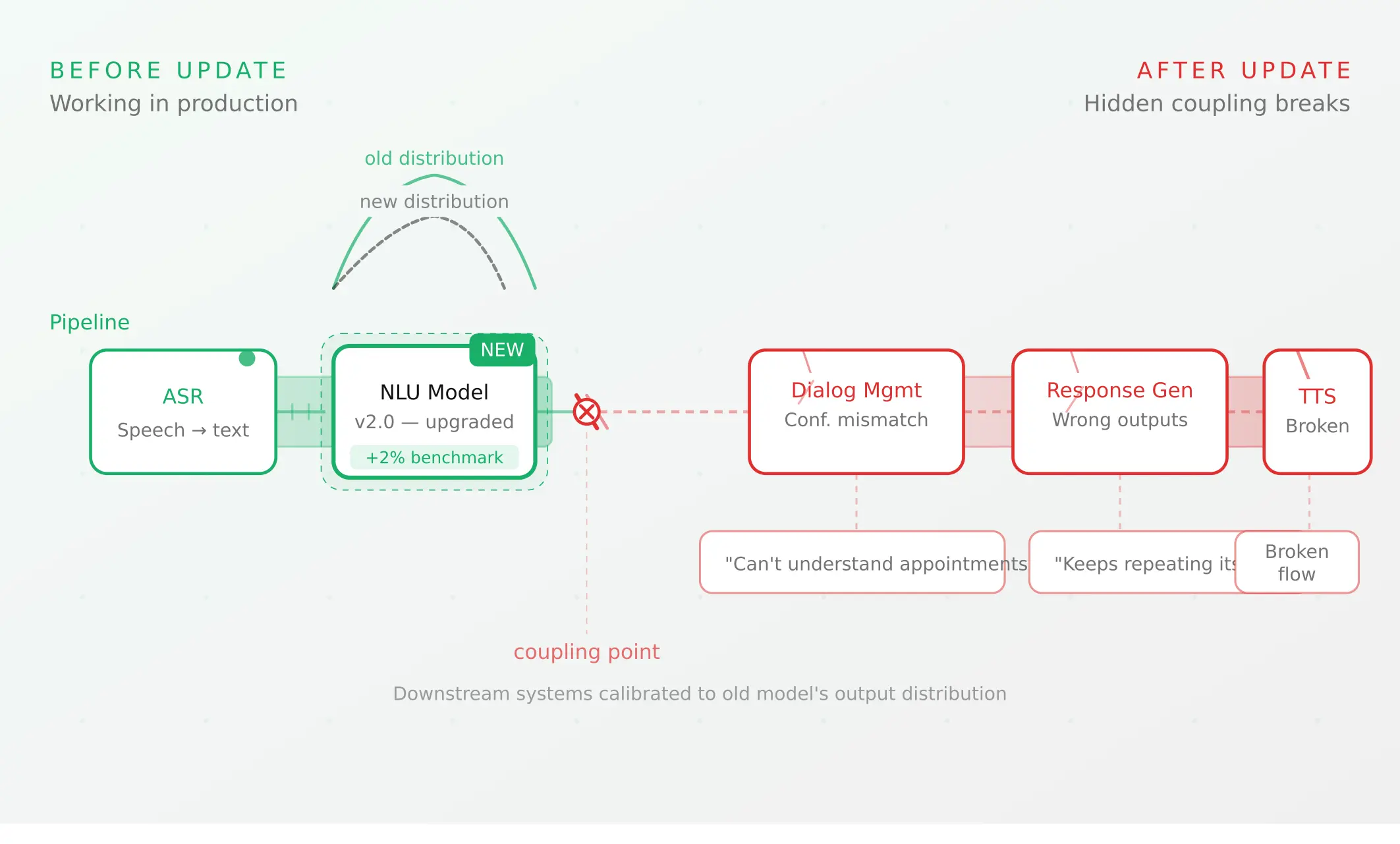
Voice agent regression testing: why LLM updates break production
LLM updates improve benchmarks but break voice agents in 5 predictable ways. How to detect and prevent regressions after every model or prompt change.
Read more