Open door for builders.
Jev for Model Routing in Voice Agents: Send Each Turn to the Right LLM
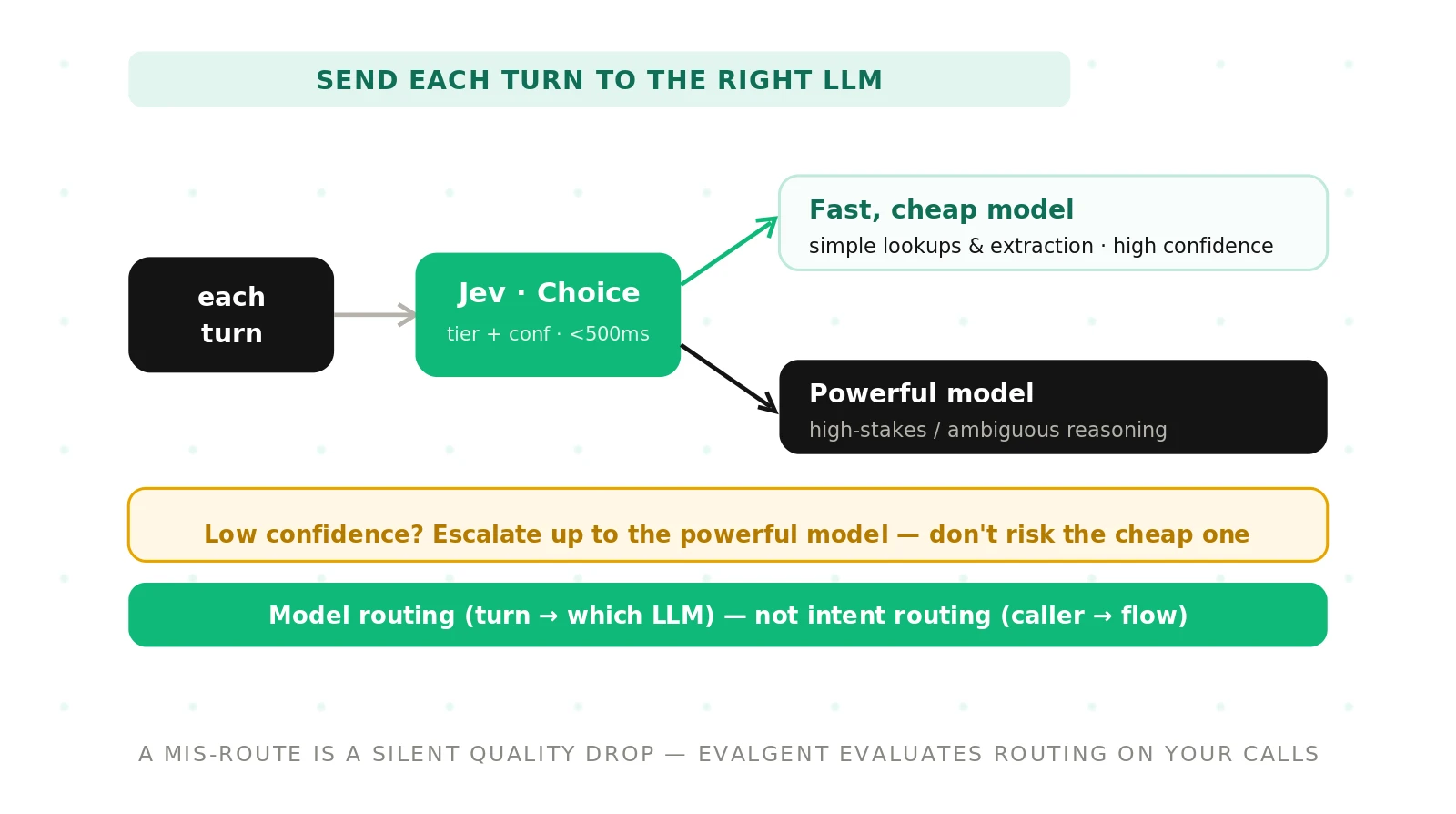
# Jev for model routing in voice agents: send each turn to the right LLM
Quick answer
> Quick answer: Jev model routing uses Jev, TypeSafe's System One model, to classify each voice agent turn and pick which LLM handles it. Simple turns go to a cheap, fast model. Hard turns escalate to a powerful one. Jev decides in 70 to 500ms with calibrated confidence, so the router costs almost nothing.
Not every turn in a call needs your best model. A ZIP code lookup does not need a frontier LLM. A tangled complaint might. Model routing sends each turn to the cheapest model that can still get it right.
The catch is speed. The routing decision itself must be near-instant and near-free. If it is slow or costly, the router eats the savings it was meant to create. This post shows how Jev fills that gap, and how Evalgent checks that the routing was actually correct.
Model routing vs intent routing
These two terms sound alike. They are different jobs. Mixing them up leads to the wrong design.
Model routing: deciding which LLM should handle a single turn. The output is a model choice, such as cheap, standard, or powerful.
Intent routing: deciding where the caller's request should go. The output is a flow, a department, or a human.
This post covers model routing only: turn to LLM. Intent routing is a separate job. It is covered in our post on voice agent routing and escalation. Do not conflate them. One picks a model. The other picks a destination.
Both can use Jev. Both are classification. But they answer different questions, and they fail in different ways.
What Jev is, and what it is not
Jev: TypeSafe AI's first System One model, launched September 15, 2026, in early access. It reads a state plus a set of questions, then returns typed probabilistic decisions with calibrated confidence.
Jev is not a language model. It does not generate text. You give it a "state" and one or more "questions." The state can be a transcript, structured data, or a message list. The output is a typed decision, not a sentence.
TypeSafe documents three question types:
- Choice picks one of up to 255 options. It returns a probability per option plus confidence.
- Score returns an ordered level, a continuous score, a distribution, and confidence.
- Noul returns a yes or no probability.
TypeSafe says Jev cannot hallucinate and produces zero type errors, because the schema constrains the output. It reports latency of 70 to 500ms. That is roughly 40 to 200 times faster than an LLM on the same call, per TypeSafe. Input costs $0.042 per million tokens. Output is free. You can read the launch note and the TypeSafe docs.
The mental model is simple. Use an LLM to talk. Use Jev to decide fast. Model routing is one of those decisions.
Why jev model routing fits a turn-by-turn decision
Picking a model per turn is a classification problem. A turn arrives. The router must label it. That label decides which LLM runs next.
This maps to a Jev Choice question. The options are your model tiers. Jev returns a probability for each tier, plus a confidence value. It reads the turn as transcript state, not raw audio.
Two properties make Jev a good fit. First, the decision is fast. TypeSafe reports 70 to 500ms, which fits inside a live turn. The caller does not wait. Second, the decision is cheap. Output is free, and input is $0.042 per million tokens. So the router adds almost nothing to your bill.
Compare that to routing with an LLM. An LLM router is slow and pricey. It can also state a confidence that does not match its accuracy. For why that gap matters, see Jev vs an LLM for voice agents.
There is a third win. Jev runs many questions per call in parallel. You can ask the routing question and a difficulty question at once. Both return in one round trip. This is the LangChain ModelRouterMiddleware pattern: assess the request, then pick a model by criteria you define.
Defining model tiers and routing criteria
Model routing starts with tiers. A tier is a model plus a purpose. Keep the set small and clear.
A common setup uses two or three tiers:
- Fast and cheap. A small model for direct lookups, extraction, and localized changes.
- Powerful. A frontier model for architecture, ambiguity, and high-stakes decisions.
- Standard. An optional middle tier for routine tasks.
The tier names above follow LangChain's own example. It routes lookups and extraction to a cheaper model, and hard reasoning to a stronger one. Your tiers should match your own stack.
Next you write routing criteria. Criteria describe when each tier applies. You can encode them as a Jev Choice over tiers, or as a Jev Score on turn difficulty. A Score gives you a continuous difficulty level, which is easy to threshold.
Write criteria in the caller's terms, not the model's. "Give me my balance" is a simple lookup. "Explain why my three refunds were reversed" is not. The clearer the criteria, the cleaner the routing. This is the core of any llm model router voice agent design.
Confidence-gated escalation to the stronger model
Calibrated confidence is what makes this safe. A calibrated model's confidence tracks its real accuracy. If it says 0.9 across many turns, about 90% are correct.
Confidence-gated escalation: the router sends a turn to the powerful model only when the cheap-tier decision is uncertain, based on Jev's confidence value.
Here is the pattern. Jev classifies the turn. If confidence in a cheap-tier route is high, the cheap model runs. If confidence is low, the turn escalates to the powerful model instead. You escalate only the ambiguous turns.
This is the whole point of calibration. TypeSafe trained Jev with RLCD, and reports that higher confidence means higher accuracy. So a threshold means what you think it means. Set the bar at 0.85, and you know roughly how often a passing route is right.
An LLM's stated 0.85 does not carry that guarantee. Language models are often overconfident. That makes their confidence a poor gate. Jev's calibrated number is a gate you can tune. Calibration is a per-population property, though, not a per-call promise. A single decision can still miss.
Cost and first-token-latency wins
Model routing pays off in two currencies: money and speed.
The money win is direct. Most turns are simple. Sending them to a cheap model instead of a frontier model cuts token spend on the bulk of the call. Over thousands of calls, that moves your cost per resolution. Because Jev output is free, the router itself barely registers on the bill. See total cost of ownership for the full picture.
The speed win is about first-token latency. A smaller model usually starts speaking sooner. In a voice call, the first token matters more than in chat. Silence feels wrong on a phone line. Routing simple turns to a fast model shortens that gap. Jev's own decision adds only 70 to 500ms of latency), which hides inside the turn.
The general idea is old. Routing means choosing a path by cost and quality. A model routing voice agent applies that idea per turn, in real time.
The silent-quality-drop risk of a mis-route
Model routing has one dangerous failure mode. A mis-route to an underpowered model is a silent quality drop.
Think about what happens. A hard turn gets labeled simple. The cheap model handles it. It does not crash. It does not error. It just answers a little worse. The call keeps going. No alarm fires.
That is the trap. Intent misroutes are loud, because the caller ends up in the wrong flow. Model misroutes are quiet. The agent still speaks. It just speaks with less capability than the turn needed. The damage shows up later, as a worse resolution or a confused caller.
Calibrated confidence reduces this risk but does not erase it. A calibrated 0.9 is right most of the time, not every time. So you cannot trust the router blind. You have to measure whether the cheap model actually handled what it was given. That is where evaluation comes in.
Turn types, routes, and Jev signals
The table maps common turn types to a route, the Jev signal behind it, and the risk if the route is wrong.
| Turn type | Route to | Jev signal | Risk if mis-routed |
|---|---|---|---|
| Simple lookup or extraction | Fast, cheap model | Choice: cheap tier, high confidence | Low; the cheap model handles it |
| Routine task | Fast, cheap or standard model | Score: low difficulty | Small quality dip if slightly underpowered |
| Ambiguous turn | Powerful model, via confidence gate | Choice with low confidence, or mid Score | Silent quality drop if kept on cheap tier |
| High-stakes reasoning | Powerful model | Score: high difficulty, high confidence | Serious; a weak model gives a wrong, costly answer |
Every row is one Jev call, or one question inside a batched call. The confidence value is the control knob for each gate.
How to add Jev model routing to a voice agent
Follow these steps to route each turn to the right LLM with Jev.
1. Define your model tiers. Pick two or three: a fast cheap model and a powerful model, plus an optional standard tier.
2. Write routing criteria. State when each tier applies, in caller terms. Lookups and extraction go cheap. Ambiguity and high stakes go powerful.
3. Send each turn to Jev. Pass the transcript state and a Choice question over tiers, or a Score on difficulty.
4. Route on the answer. Send the turn to the model Jev picked. Keep the probabilities and confidence in agent state.
5. Confidence-gate the ambiguous turns. When cheap-tier confidence is low, escalate that turn to the powerful model.
6. Measure cost and latency. Track token spend, first-token latency, and the share of turns on each tier.
7. Evaluate routing accuracy on real calls. Check whether the cheap model actually handled the turns it received.
Steps six and seven close the loop. Without them, you are routing blind.
Evaluating routing accuracy on real calls
A router makes a claim: this turn was simple enough for the cheap model. You have to test that claim. A mis-route is a silent quality regression, so it will not surface on its own.
This is the Evalgent job. We are an independent, third-party evaluator for AI voice agents. We do not sell a routing engine. We measure whether yours works.
Evalgent scores routing on your own real calls, not vendor demos. We check two things. First, routing accuracy: did each turn go to a model that could handle it? Second, downstream call quality: did the resolution hold up when a turn ran on the cheap tier? For the neutral case, see our post on independent voice AI evaluation.
We surface the mis-routes you cannot see. A turn that ran cheap but needed power. A confidence threshold set too loose. A tier that quietly degrades a whole call type. Then we tie those findings back to your metrics, using the methods in our voice agent evaluation guide.
The result is a router you can trust because it is checked, not assumed. Book a demo to see how Evalgent evaluates your model routing on real calls: /demo.
Frequently asked questions
What is jev model routing in a voice agent?
Jev model routing uses Jev to classify each turn and choose which LLM handles it. Jev reads the transcript state and answers a Choice over your model tiers, or a Score on difficulty. Simple turns go to a cheap model. Hard turns go to a powerful one. The decision takes 70 to 500ms.
How do I route to the right llm in a voice agent?
Define model tiers, write routing criteria, then send each turn to Jev as a Choice or Score question. Jev returns a tier plus calibrated confidence. Route the turn to that model. Gate the ambiguous turns so they escalate to the stronger model instead of guessing on a cheap one.
What is the difference between model routing and intent routing?
Model routing picks which LLM handles a turn: cheap, standard, or powerful. Intent routing picks where the caller goes: a flow, a department, or a human. Model routing optimizes cost and quality per turn. Intent routing optimizes the caller's destination. They are separate jobs, and Jev can drive both.
How does confidence-gated escalation to a stronger model work?
Jev classifies the turn and returns a confidence value. If confidence in a cheap-tier route is high, the cheap model runs. If confidence is low, the turn escalates to the powerful model. Because Jev's confidence is calibrated, the threshold is trustworthy. You escalate only the ambiguous turns, not every turn.
How fast is jev for a model routing decision?
TypeSafe reports Jev latency of 70 to 500ms per call. That is roughly 40 to 200 times faster than an LLM on the same task, per TypeSafe. The decision fits inside a live turn, so the caller does not wait. Speed is why the router does not cancel out its own savings.
How much does jev model routing cost per call?
TypeSafe prices Jev input at $0.042 per million tokens, with output free. A routing question sends a short state and a small schema, so the input cost is tiny. Because output is free, the router adds almost nothing per call. The savings come from sending most turns to a cheaper model.
What happens if jev mis-routes a turn to a weak model?
A mis-route to an underpowered model is a silent quality drop. The cheap model still answers. It does not error or crash. It just handles the turn a little worse, and the call keeps going. Nothing alarms. That is why you must evaluate routing accuracy rather than trust it.
How do you evaluate model routing accuracy on real calls?
Score real calls, not demos. Check whether each turn went to a model that could handle it, and whether the resolution held up on the cheap tier. Evalgent, an independent third-party evaluator, measures both routing accuracy and downstream call quality on your own calls, then ties findings back to your metrics.
The bottom line
Jev model routing sends each turn to the cheapest LLM that can handle it, in under 500ms, at near-zero cost. Its one real danger is the silent mis-route, which surfaces only when you evaluate routing accuracy on real calls.
Related Articles
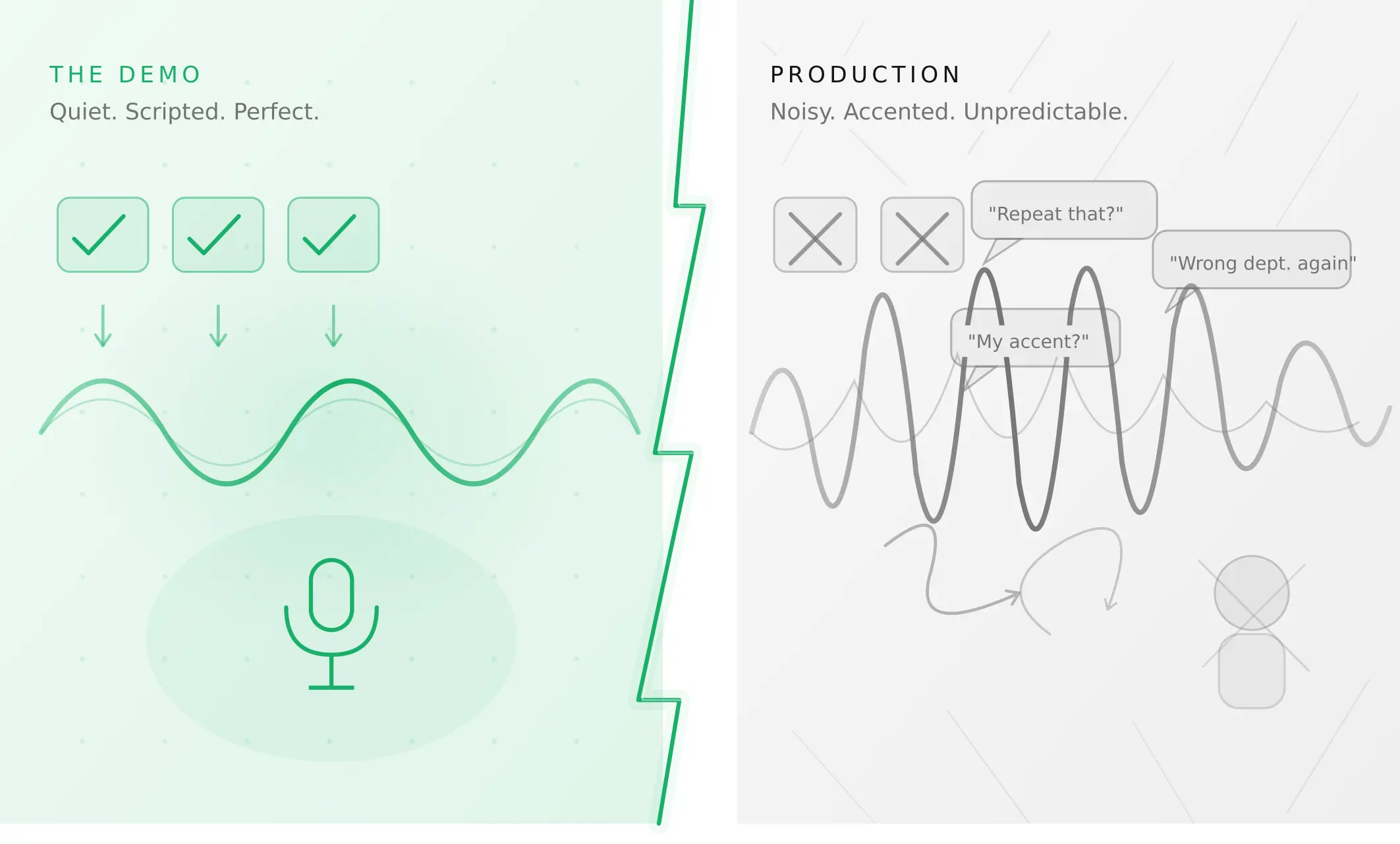
Why AI voice agents fail in production (and how to prevent it)
AI voice agents that ace demos still break in production. Learn the 5 root causes, how to test for each, and what production readiness actually means.
Read more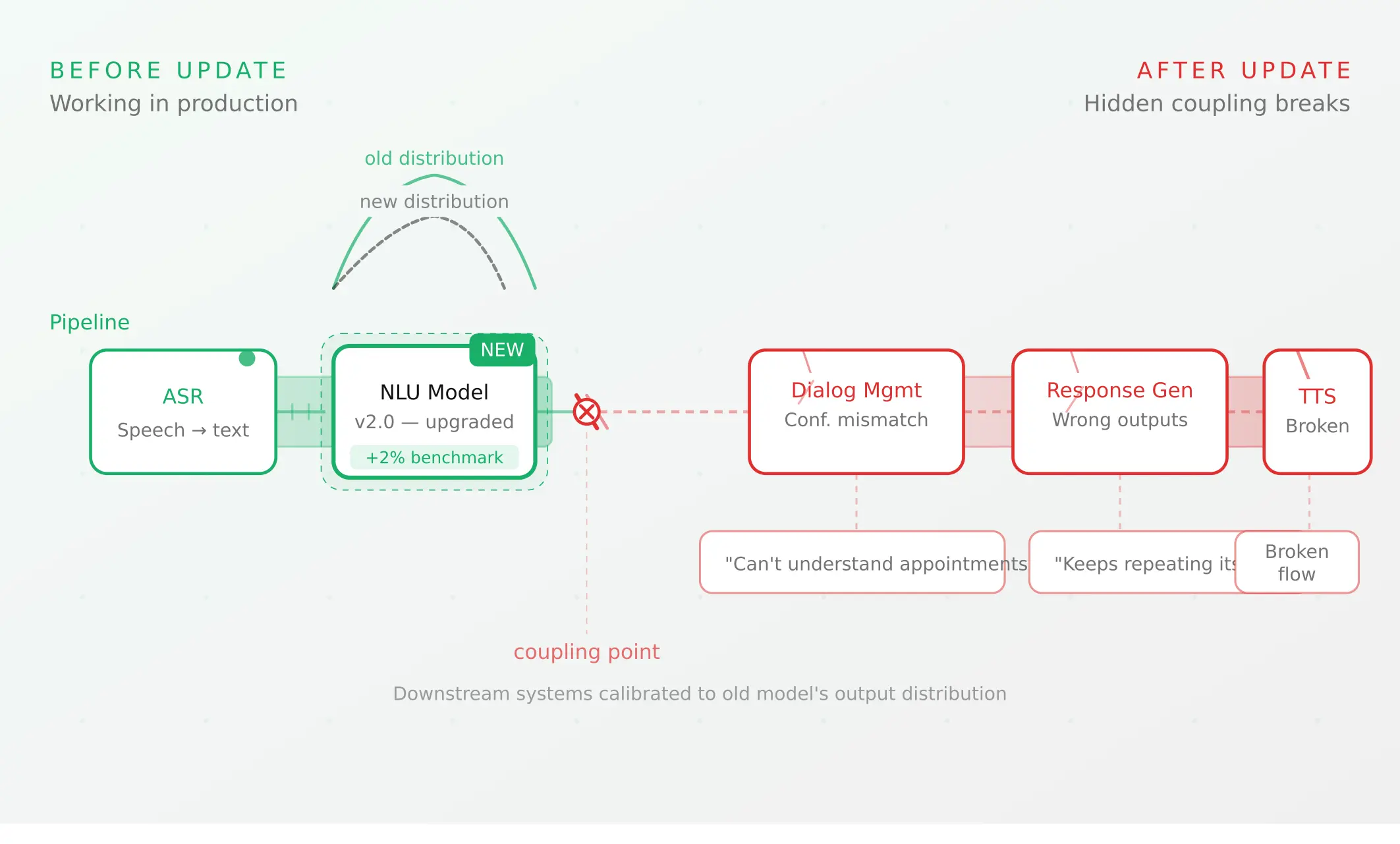
Voice agent regression testing: why LLM updates break production
LLM updates improve benchmarks but break voice agents in 5 predictable ways. How to detect and prevent regressions after every model or prompt change.
Read more