Test your voice agent
How to Choose a Voice Agent Orchestration Platform (2026)
# How to choose a voice agent orchestration platform (2026)
Quick answer
The best orchestration for voice agents in 2026 is the one that wins on your own calls, not on vendor slides. Judge it on turn-taking, latency, tool calling, state, observability, provider flexibility, and reliability. Test each on recorded calls. Then run managed and self-hosted through the same suite before you commit.
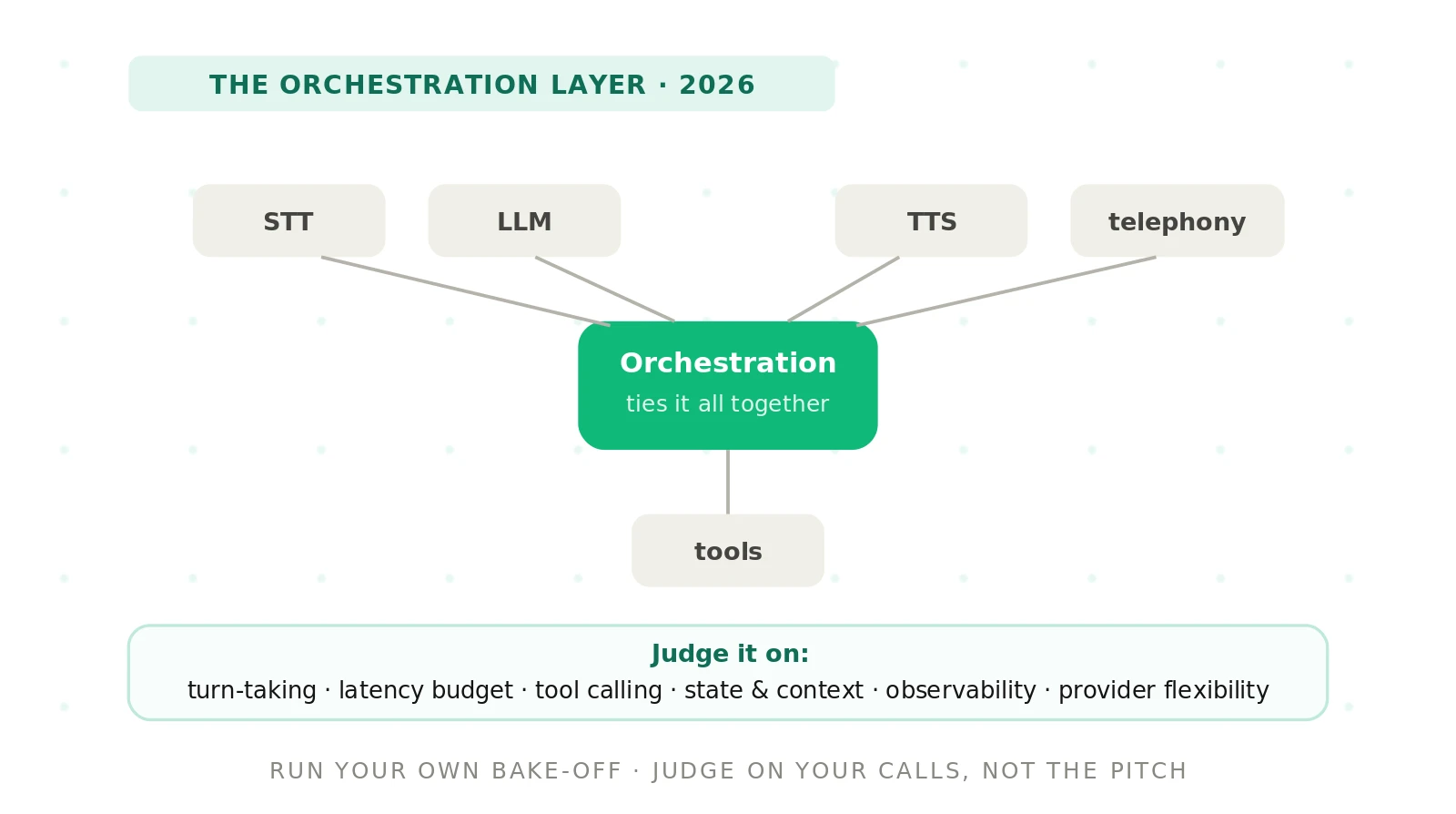
Every voice agent has a layer that ties the pieces together. It sits between the caller and your systems. It listens for the end of a turn, calls the language model, fires your tools, and speaks the reply. That layer is the orchestration platform. Get it right and the agent feels natural. Get it wrong and it talks over people or stalls mid-sentence.
Most teams choose this layer on the wrong evidence. They watch a scripted demo. They read a feature grid. They trust a latency number measured in a lab. None of that predicts how the platform behaves on your traffic, with your accents, your tools, and your noise. This guide gives you a neutral framework instead. It covers the criteria that matter and how to test each on real calls.
What a voice agent orchestration platform actually does
Orchestration) is the coordination of many moving parts into one flow. For a voice agent, those parts are speech-to-text, a language model, speech synthesis, telephony, and your business tools. The orchestration layer is the conductor for all of them.
> Orchestration layer: the runtime that sequences STT, the LLM, TTS, telephony, and tool calls into a single real-time conversation. It manages timing, state, and interruptions so the agent responds like a person, not a form.
It has to do several hard things at once. It detects when the caller stops talking. It streams audio in and out without gaps. It decides when to call a tool and when to just answer. It tracks what has been said so the agent does not repeat itself. And it does all of this fast enough that no one notices the machinery.
That is why the choice matters so much. The orchestration layer is where most production failures live. A brilliant model and a crisp voice cannot save a conversation if the timing is broken.
The criteria that decide the best orchestration for voice agents in 2026
Not every feature carries equal weight. Below are the criteria that separate a production-ready platform from a demo-ready one. Each is something you can test on your own calls.
Turn-taking and interruption handling
Turn-taking is the rhythm of who speaks when. Humans do it without thinking. Voice agents do it badly by default. The platform must detect the end of a turn quickly, without cutting the caller off. It must also let the caller barge in and stop the agent mid-sentence.
This is the single most common reason agents feel robotic. Test it hard. Our guide to barge-in and guide to endpointing cover the mechanics in depth.
Latency budget and streaming
Latency) is the delay between the caller finishing and the agent replying. It is the number callers feel most. The orchestration layer adds its own overhead on top of STT, the model, and TTS. A good layer streams tokens and audio as they arrive. It does not wait for a full response before speaking.
Watch the whole budget, not one hop. See our latency guide for how to measure each stage. On phone calls, VoIP transport adds delay too, so measure end to end.
Tool and function calling
Real agents do things. They look up an order, book a slot, or check a balance. That means calling functions and APIs mid-conversation. The platform must call tools reliably, handle failures gracefully, and keep the caller informed while it waits. It should also parallelize calls when it can.
Watch what happens when a tool is slow or errors. A weak platform goes silent or hallucinates a result. A strong one fills the gap and recovers.
State and context management
A conversation has memory. The agent must remember the caller's name, the reason for the call, and what it already said. Many platforms model this as a finite-state machine or a broader dialogue system. Either way, state must survive interruptions, tool calls, and long pauses.
Test the messy paths. Interrupt the agent, change your mind, then come back to the original request. A shallow state model loses the thread. A solid one picks it back up.
Observability
You cannot fix what you cannot see. Observability is the platform's ability to expose what happened on each call. You want per-turn traces, timing for every stage, tool inputs and outputs, and the full transcript with audio. Without it, debugging a bad call is guesswork.
Ask for a trace of a real call, not a dashboard screenshot. If the platform cannot show you why one turn was slow, you will be blind in production.
Provider flexibility
Voice AI moves fast. The best STT, model, or voice today may not lead next quarter. A good orchestration layer lets you swap speech recognition, the model, or the voice without a rewrite. It treats each as a component behind an interface, not a hard dependency.
This is your main defense against lock-in. Confirm you can change one provider and keep the rest. If swapping STT forces a full rebuild, that is a red flag.
Scale and reliability
A demo runs one call. Production runs thousands at once. The platform must hold latency and accuracy under concurrency, not just in a quiet test. It needs graceful degradation, retries, and clear failure modes. Ask how it behaves when a downstream provider slows down or drops.
Managed versus self-hosted
Finally, decide who runs the layer. Managed platforms are hosted and fast to launch. Self-hosted frameworks give you control, data residency, and better economics at scale. Neither is universally best. We cover the tradeoff in depth in managed versus self-hosted orchestration.
How to choose: what to look for and what to avoid
Use this table as a quick screen. It maps each criterion to a positive signal and a warning sign. Score every platform on your shortlist against all eight rows.
| Evaluation criterion | What to look for | Red flag |
|---|---|---|
| Turn-taking and interruption | Fast, tunable endpointing; clean barge-in that stops the agent instantly | Fixed silence timers; agent keeps talking over the caller |
| Latency and streaming | Streams tokens and audio; low added overhead; per-stage timing exposed | Waits for full responses; latency only quoted as one lab number |
| Tool and function calling | Reliable calls, graceful failure handling, parallel calls, filler while waiting | Silent gaps or hallucinated results when a tool is slow or errors |
| State and context | State survives interruptions, tool calls, and topic changes | Loses the thread after a barge-in or a mid-call correction |
| Observability | Per-turn traces, stage timing, tool I/O, transcript plus audio | Dashboard-only metrics; no way to trace a single bad call |
| Provider flexibility | Swap STT, model, or voice behind a stable interface | Swapping one provider forces a rewrite of the whole agent |
| Scale and reliability | Holds latency at concurrency; retries and clear degradation | Only tested at one call; no answer on downstream slowdowns |
| Managed vs self-hosted | Path from managed to self-hosted without a rewrite | Proprietary console that traps your call logic |
How to run your own orchestration bake-off
The only reliable way to choose is to test the finalists on your own calls. A bake-off runs each candidate through an identical set of scenarios and scores them on one scale. Here is the sequence we use.
1. Write down your weighted criteria first. List the eight criteria above. Assign a weight to each based on your use case. A collections agent weights accuracy and compliance. A support line may weight latency and interruption handling. Do this before you look at any platform.
2. Build a scenario suite from real calls. Pull recordings or transcripts from your actual traffic. Include happy paths, edge cases, interruptions, tool failures, and difficult callers. Turn them into a fixed, versioned set of test scenarios you own.
3. Fix your provider stack per candidate. Decide which STT, model, and voice each platform will use. Where possible, hold them constant so you test orchestration, not the components. Note where a platform forces a specific provider.
4. Run the identical suite against each platform. Replay the same scenarios through every candidate. Use realistic caller profiles that vary accent, pace, and line quality. Run at concurrency, not one call at a time, so you see behavior under load.
5. Score against pre-defined expected outcomes. Define the right outcome for each scenario before you run it. Then score every platform against that fixed definition. This keeps results comparable and stops you from grading on vibes.
6. Listen to the calls behind the scores. Numbers point you to the interesting calls. Then a human reviews the audio and transcript. This catches failures a metric misses, like an agent that is technically correct but sounds rude.
7. Weight, rank, and decide. Apply your weights to each platform's scores. Rank the finalists. The winner is the one that best fits your priorities on your calls, with the evidence to defend the choice later.
For deeper method, see our guides on benchmarking voice agents on your own data and running a vendor comparison.
Why marketing claims cannot decide this
Vendor benchmarks are run on the vendor's terms. They use clean audio, favorable scenarios, and a stack tuned for the demo. That is not your production. A latency figure from a lab ignores your telephony and your tool latency. An accuracy number on scripted speech ignores your callers.
This is why an independent, owned evaluation matters. When the test suite belongs to you, no platform can tune to it in advance. You measure every candidate on the same calls, with the same scoring. This is the core of independent voice AI evaluation, and it is how serious teams make the orchestration architecture choice defensible.
Choosing orchestration with Evalgent
The orchestration decision is only safe if you can measure every candidate on equal terms. Evalgent is the independent evaluator we use to do exactly that. It gives you a yardstick you own, held apart from any platform. Scenarios capture your real calls as a fixed, versioned suite. Profiles vary caller accent, pace, and line quality, so every platform faces the same range. Metrics score each run against pre-defined expected outcomes on one fixed definition, so results compare directly. Evaluations replay the identical suite against any orchestration layer or version at concurrency. Reviews let your team hear the call behind any score. Because the suite is yours and runs against anyone, you can compare platforms, graduate from managed to self-hosted, or run multiple vendors, and prove at every step that quality held. That last pattern is common enough that we wrote a guide on running multiple voice agent vendors. For the wider picture, start with our overview of voice agent evaluation. To put a neutral evaluation between you and every orchestration choice, book a demo.
Frequently asked questions
What is a voice agent orchestration platform?
A voice agent orchestration platform is the runtime that ties STT, the language model, TTS, telephony, and your tools into one real-time conversation. It manages turn-taking, latency, state, and interruptions. It is the layer that makes separate components behave like a single agent that can hold a natural phone call.
What is the best orchestration for voice agents in 2026?
The best orchestration for voice agents in 2026 is the one that performs best on your own calls. There is no universal winner. Score candidates on turn-taking, latency, tool calling, state, observability, provider flexibility, and reliability. Then run a bake-off on your real scenarios and pick the platform that fits your weighted priorities.
How much latency should a voice agent orchestration platform add?
The orchestration layer should add as little as possible on top of STT, the model, and TTS. Aim for a total response time that feels conversational, generally under about one second where you can reach it. Measure the whole budget end to end on your own telephony, not a single lab number from a vendor.
Should I choose managed or self-hosted orchestration?
Start managed when speed to launch and low operations burden matter most. Move to self-hosted when volume, data residency, or deep customization forces it. Many mature teams run a hybrid. Keep an abstraction layer so you can switch later without a rewrite. Decide based on your constraints, not on which sounds more advanced.
How do I test turn-taking and interruption handling?
Test turn-taking with real conversational patterns, not scripted lines. Interrupt the agent mid-sentence and check it stops instantly. Pause mid-thought and confirm it waits instead of cutting you off. Talk over it and see if it recovers. Run these on your own recorded calls, because default settings rarely survive real callers.
Can I swap STT, TTS, or LLM providers later?
With the right orchestration layer, yes. Good platforms treat each provider as a component behind a stable interface, so you can change STT, the model, or the voice without rebuilding the agent. Confirm this before you commit. If swapping one provider forces a full rewrite, that is a serious lock-in risk.
What observability should an orchestration platform provide?
An orchestration platform should expose per-turn traces, timing for every stage, tool inputs and outputs, and the full transcript with audio. You should be able to open any single call and see exactly why a turn was slow or wrong. Dashboard-only metrics are not enough. Without call-level traces, production debugging is guesswork.
How many test calls do I need to compare orchestration platforms?
Enough to cover your real variety, not a fixed count. Include your common flows, your edge cases, interruptions, tool failures, and your range of accents and line quality. A few dozen well-chosen scenarios, run at concurrency against each platform, usually reveal the differences that matter more than hundreds of near-duplicate happy-path calls.
The bottom line
Choose your orchestration platform on your own calls, scored on turn-taking, latency, tools, state, observability, flexibility, and reliability. Run every finalist through one owned test suite, so the winner is the one you can prove, not the one with the best slides.
Ready to compare orchestration platforms on your real calls? Book a demo and see it on your own traffic.
Related Articles
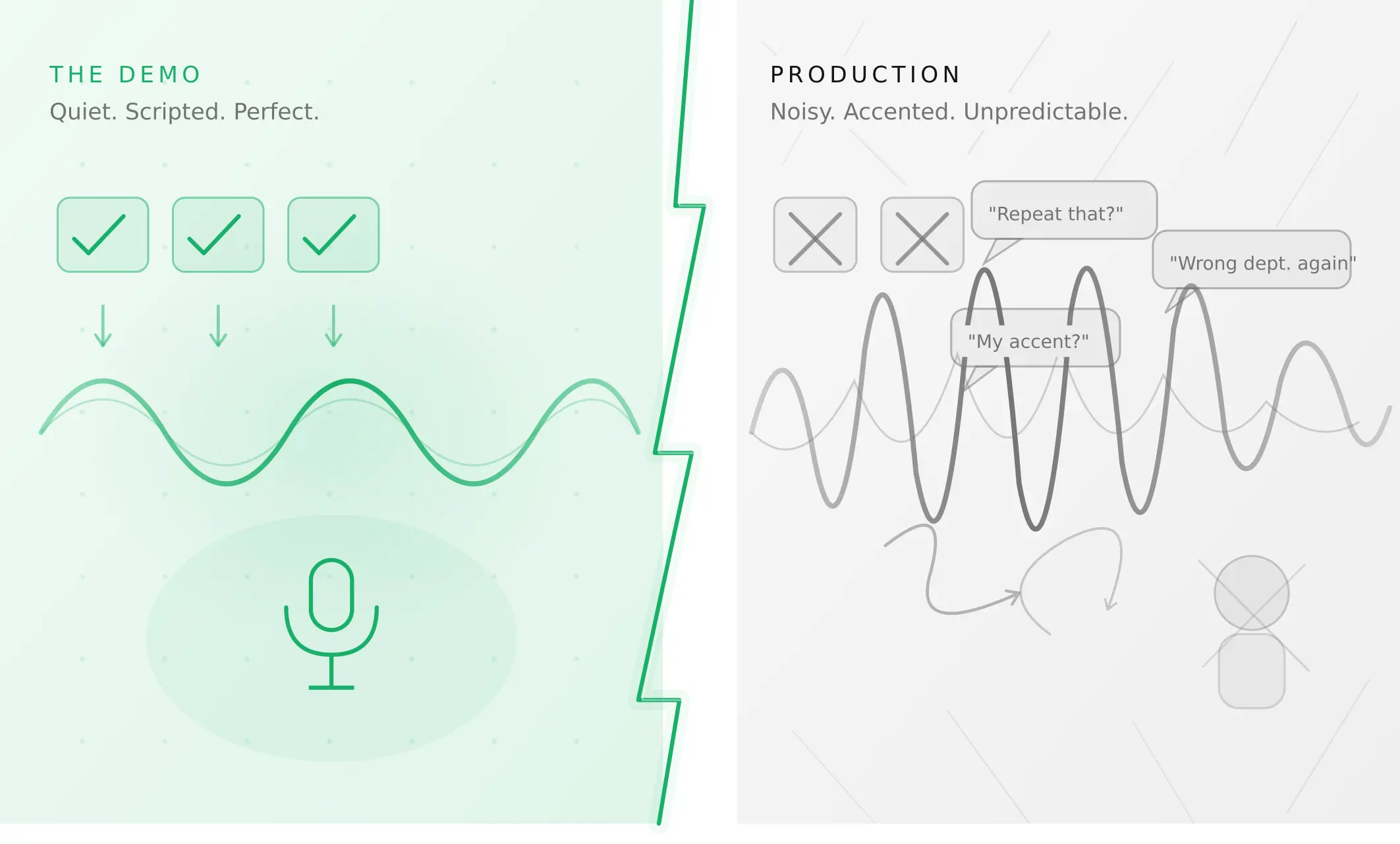
Why AI voice agents fail in production (and how to prevent it)
AI voice agents that ace demos still break in production. Learn the 5 root causes, how to test for each, and what production readiness actually means.
Read more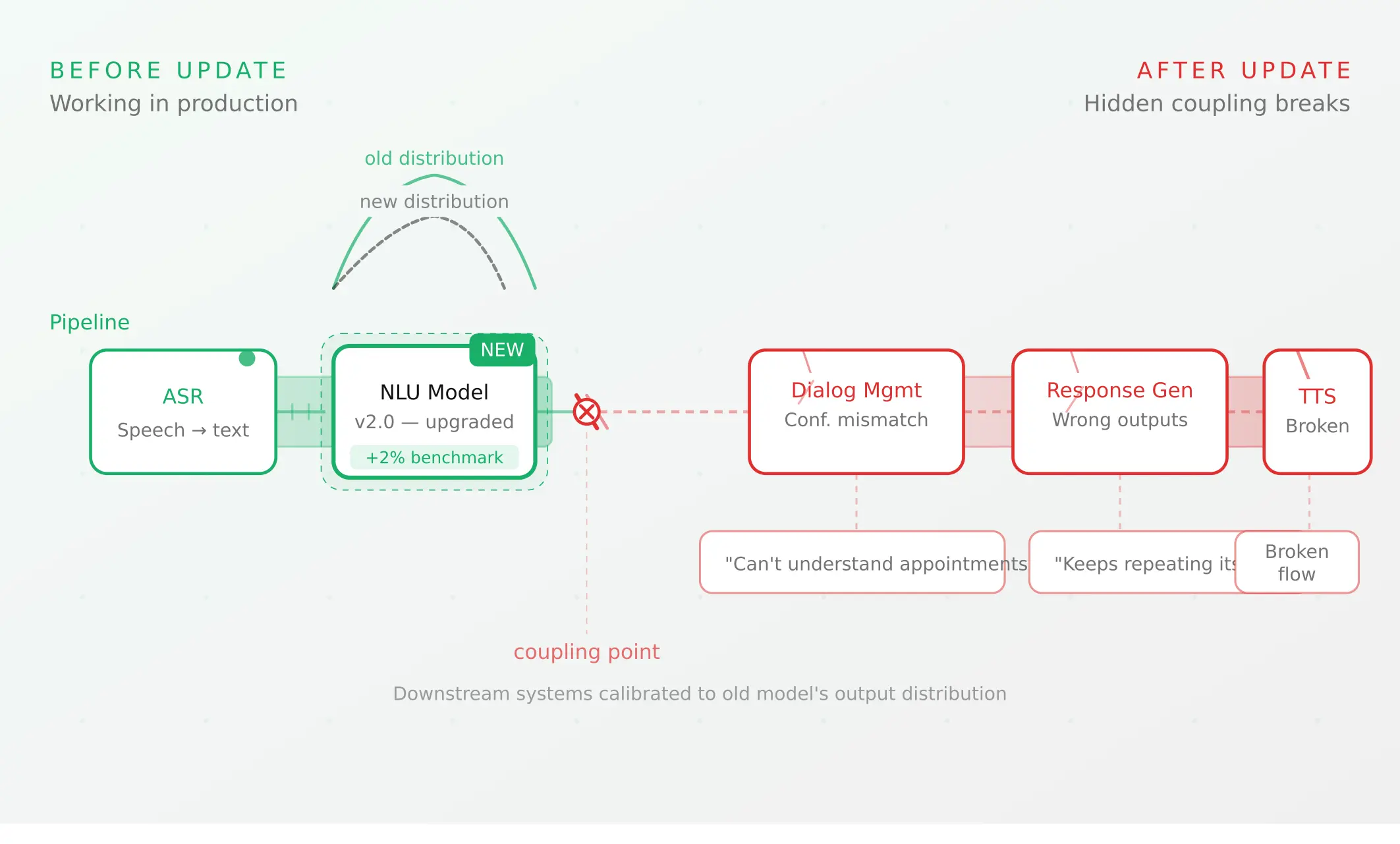
Voice agent regression testing: why LLM updates break production
LLM updates improve benchmarks but break voice agents in 5 predictable ways. How to detect and prevent regressions after every model or prompt change.
Read more