Test your voice agent
Score Every Call, Not a Sample: Voice-Eval Economics
# Score every call, not a sample: voice-eval economics
Quick answer
Scoring every voice agent call means grading 100% of production calls, not a sample. Human and LLM judges are too slow and costly, so teams sample. A cheap, fast, calibrated scorer like Jev flips the economics. You can score the whole population, catch rare failures, and still validate the scorer independently.
Voice teams have always sampled. You pull a few hundred calls, grade them, and hope they represent the rest. The reason was never a lack of interest. It was cost.
Grading is expensive. A human reviewer takes minutes per call. An LLM judge takes seconds and cents per call. Multiply either by a million monthly calls, and a full review is a non-starter. So teams sample and live with the blind spots.
That constraint is starting to move. A cheap, fast, calibrated decision model changes the math behind voice agent evaluation economics. This post explains why sampling was forced on us, what full-population scoring unlocks, and where the honest limits sit.
Why voice agent evaluation has always meant sampling
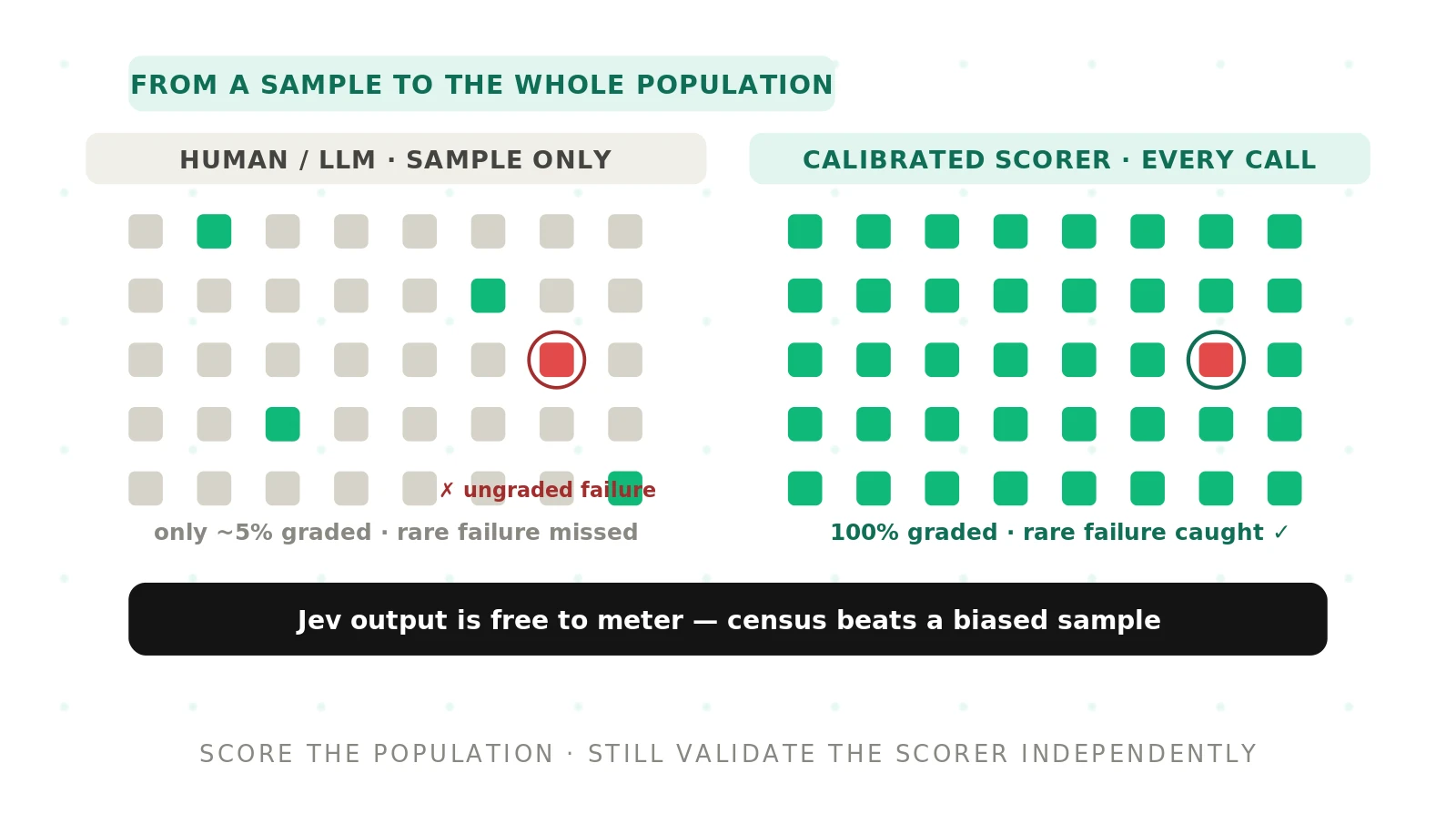
Sampling) is a workaround, not a goal. You sample because you cannot afford to measure everyone. A census is better data. It is just usually too expensive.
Voice evaluation inherited that constraint. Grading a call means judging intent, resolution, policy, and tone. For years the only graders were humans and, later, LLM judges. Both are slow. Both cost real money at scale.
> Sampling: measuring a subset of a population to estimate a property of the whole. A census measures every unit instead, trading cost for completeness.
Human review is the gold standard for nuance. It is also the slowest and priciest option. A QA analyst might grade 30 to 50 calls a day. At a million calls a month, full human review is impossible. So teams grade a fraction and extrapolate.
LLM judges made scoring faster and cheaper. They did not make it free. An LLM judge still reads the transcript, reasons, and writes a verdict. That costs seconds and a few cents each time. It also drifts, and the raw output needs parsing. We cover the tradeoffs in testing vs evaluation for voice agents.
The result is the same everywhere. Teams sample. Our guide to sampling live calls for voice agents covers how to do it well when you must. This post argues you may not have to as often.
The economics of scoring a call
Every evaluation choice is a cost-benefit analysis. The benefit is coverage and confidence. The cost is time and money per graded call. Sampling wins that trade only because the per-call cost of grading was high.
Lower the per-call cost enough, and the trade flips. If scoring a call costs a fraction of a cent and lands in under a second, a census beats a sample on every axis. You stop rationing coverage.
This is where Jev enters. Jev is TypeSafe AI's first "System One Model," launched September 15, 2026, in early access. It is not an LLM and does not generate text. You send it a state, such as a transcript, plus questions. It returns typed, probabilistic decisions with calibrated confidence. TypeSafe describes it in its System One launch post.
> System One model: a model that takes unstructured state plus questions and returns typed, probabilistic decisions with calibrated confidence. It classifies, scores, and verifies rather than writing free-form text.
The numbers matter here. TypeSafe reports Jev runs in 70 to 500ms per call, roughly 40 to 200 times faster than comparable LLMs on classification. On input, it costs $0.042 per million tokens, which is $42 per billion input tokens. Output is free, which TypeSafe calls "too cheap to meter." That is around 400 times cheaper than comparable LLMs on classification tasks.
Independent testing points the same way. In LangChain's writeup, "Can Jev Be a Better Agent Evaluator?", Jev as a judge averaged 0.44 seconds and $0.00035 per call. On that task, Jev's total was $0.34 versus $28.17 for Claude. That is about 83 times cheaper for the same evaluation work, per LangChain's numbers. The API details sit in the TypeSafe docs.
An illustrative cost comparison
The following math is illustrative. It uses LangChain's reported per-call figures scaled to a round call volume. Your transcripts, questions, and pricing will differ.
Say you run 1,000,000 calls a month. At LangChain's reported $0.00035 per Jev call, scoring every call costs about $350. At the ratio implied by their reported totals, an LLM judge doing the same census would cost roughly 83 times more. That is tens of thousands of dollars for one month of full coverage.
Sampling exists to avoid that second number. When the first number is $350, the reason to sample largely evaporates. You can afford to score 100% of calls.
What a cheap, calibrated scorer changes
Jev answers three shapes of question, and each maps to a voice evaluation task. This is what makes it a scorer rather than a writer.
- Choice. Pick one option from a defined set, up to 255 options, with a probability per option plus confidence. Good for intent and outcome labels.
- Score. Rate a state against ordered levels, returning a continuous score, a distribution, and confidence. Good for risk and sentiment.
- Noul. A yes or no question, returning the probability the statement is true. Good for policy and compliance checks.
Many questions ride on one state in a single call. Parallel questions barely add latency or cost. So one pass over a transcript can label intent, resolution, policy, and escalation at once.
Jev cannot hallucinate a new answer. Its outputs are schema-constrained, and TypeSafe reports 0% type errors. It was trained with RLCD, giving calibrated confidence) on each decision. Higher confidence tends to mean higher accuracy.
There is a fitting irony in the name. Jev honors economist William Stanley Jevons, and the Jevons paradox says cheaper resources get used more, not less. Make scoring cheap, and teams will score everything.
Sampling vs scoring every call
The table below compares a sampled subset against a full-population census across the axes that matter for voice quality. Values assume a cheap, calibrated scorer like Jev for the census column.
| Dimension | Sampling a subset | Scoring every call (census) |
|---|---|---|
| Cost model | Bounded, but scales with reviewer time | About $350 per million calls (illustrative, per LangChain figures) |
| Coverage | A few hundred to a few thousand calls | 100% of production calls |
| Rare/tail failure detection | Weak; a 0.5% failure often escapes a small sample | Strong; every occurrence is scored |
| Selection bias | High risk; sample rarely matches the population | Removed; there is no sample to skew |
| Drift signal | Noisy; changes hide inside sampling error | Clean; the whole population is remeasured daily |
| Per-segment truth | Thin; small segments have too few sampled calls | Full; every segment is measured directly |
What scoring 100% of calls unlocks
A census is not just more data. It removes specific failure modes that a sample cannot fix.
- Rare and tail failures surface. A 0.5% failure rate is easy to miss in 300 sampled calls. Across a million scored calls, that is 5,000 real incidents. You see them because you scored them.
- Selection bias disappears. Selection bias creeps in whenever your sample skews from the population. With no sample, there is nothing to skew. You measure what actually happened.
- Drift detection gets real. Sampling error hides small shifts. Scoring everything gives a clean daily signal, which pairs well with our work on voice agent metric drift.
- Per-segment truth becomes possible. A rare intent or a single problem number has too few sampled calls to judge. A census measures every segment directly, even the small ones.
This is the core case for benchmarking on your own traffic rather than vendor demos. See benchmark voice agents on your own data for why production calls beat synthetic ones.
The honest limits of scoring every call
A cheaper scorer is not a free lunch. Full-population scoring has real boundaries, and pretending otherwise would be dishonest.
Jev decides and scores. It does not generate language. It works on the transcript and structured state, not raw audio. So it reads what was said, not how it sounded. Prosody, overlap, and tone from the waveform still need audio-aware methods.
Jev answers classification-style questions well. Choice, score, and yes/no map cleanly onto its outputs. Open-ended reasoning, like writing a nuanced narrative critique of a call, is not what a System One model does. Match the question to the tool.
Calibrated confidence is statistical, not a guarantee. Calibration means high-confidence answers are right more often across many calls. It does not certify any single call. You still sample low-confidence decisions for human review.
Most important, the scorer itself needs validating. A cheap scorer scoring everything wrongly is worse than a good sample. You must confirm the scorer agrees with human labels on your calls before you trust its census. That is the case for independent voice AI evaluation, run on your own data by a third party. We compare approaches in verifiable rewards vs LLM judges vs Jev and in Jev for voice agent evaluation.
How to move from sampled to full-population scoring
Use this sequence to shift from a sampled review to a census without losing rigor.
1. Define your scoring questions. Write the exact Choice, Score, and Noul questions that map to your quality bar. Cover intent, resolution, policy, and escalation.
2. Build a labeled validation set. Have humans grade a few hundred representative calls. This becomes your ground truth for the scorer, not your only evaluation.
3. Validate the scorer against human labels. Run the scorer on the labeled set. Confirm agreement is high and that confidence is calibrated before you trust it at scale.
4. Score the full population. Wire the validated scorer to every finished call. Score transcripts as they land, not once a quarter.
5. Set confidence thresholds for review. Route low-confidence decisions to humans. Let high-confidence decisions pass. This keeps human time on the hard cases.
6. Monitor drift on the census. Track scored metrics daily across the whole population. Investigate shifts that clear your noise threshold.
7. Keep independent evaluation on your own calls. Have a third party re-score a sample and audit the scorer itself. The census is your coverage; independent evaluation is your evidence.
For the foundational framework behind all of this, start with our overview of voice agent evaluation and how to read containment vs deflection once you have full coverage.
Frequently asked questions
What does it mean to score every voice agent call?
Scoring every voice agent call means grading 100% of production calls instead of a sample. Each finished transcript is passed to a scorer that labels intent, resolution, policy, and escalation. It is a census rather than a subset. This is only practical when scoring is cheap and fast enough to run on the whole population without breaking the budget.
How much does voice agent evaluation cost per call?
Cost depends on the grader. Human review takes minutes per call. LLM judges take seconds and a few cents each. LangChain reported Jev as a judge at $0.00035 per call and 0.44 seconds. On that task, Jev totaled $0.34 versus $28.17 for Claude. Cheaper scoring is what makes full-population coverage affordable rather than a budget breaker.
Can you really score 100% of calls instead of sampling?
Yes, when the per-call cost is low enough. A fast, cheap, calibrated scorer like Jev can grade every transcript for a fraction of a cent in well under a second. That makes a census cheaper than most sampling programs. You still validate the scorer against human labels and keep independent evaluation on your own calls.
Is scoring every call better than sampling live calls?
Scoring every call beats sampling on coverage, rare-failure detection, selection bias, and drift signal. A census sees every incident and every segment. Sampling still has a role for nuanced human judgment and for validating the scorer. The honest answer is a hybrid: score everything cheaply, then sample the hard and low-confidence cases for humans.
What is voice agent evaluation economics?
Voice agent evaluation economics is the cost-benefit trade behind how many calls you grade. The benefit is coverage and confidence. The cost is time and money per graded call. Sampling won historically because grading was expensive. When per-call scoring cost drops sharply, the trade flips toward scoring the full population instead of a sample.
Does scoring every call remove selection bias?
Scoring every call removes sampling-based selection bias, because there is no sample to skew from the population. You measure what actually happened across all calls. It does not remove every bias. The scorer can still carry its own biases, which is why you validate it against human labels and audit it independently on your own call data.
What are the limits of using Jev to score every call?
Jev decides and scores rather than generating language. It reads the transcript and structured state, not raw audio, so it misses waveform cues like tone. Its calibrated confidence is statistical, not a per-call guarantee. It handles classification-style questions, not open-ended critique. And the scorer itself must be validated before you trust its census.
Do you still need independent evaluation if you score every call?
Yes. A census gives you coverage, not proof your scorer is right. An independent third party re-scores a sample, checks calibration, and audits the scorer on your own calls. That is your evidence. Scoring everything in-house and grading yourself is a conflict of interest, so independent evaluation stays essential even at full coverage.
The bottom line
Voice evaluation sampled because grading was slow and expensive. A cheap, fast, calibrated scorer flips that economics so you can score the whole population and still validate the scorer independently.
Ready to see what your voice agent actually does on every real call? Book a demo and we will score your calls and audit the scorer as an independent third party.
Related Articles
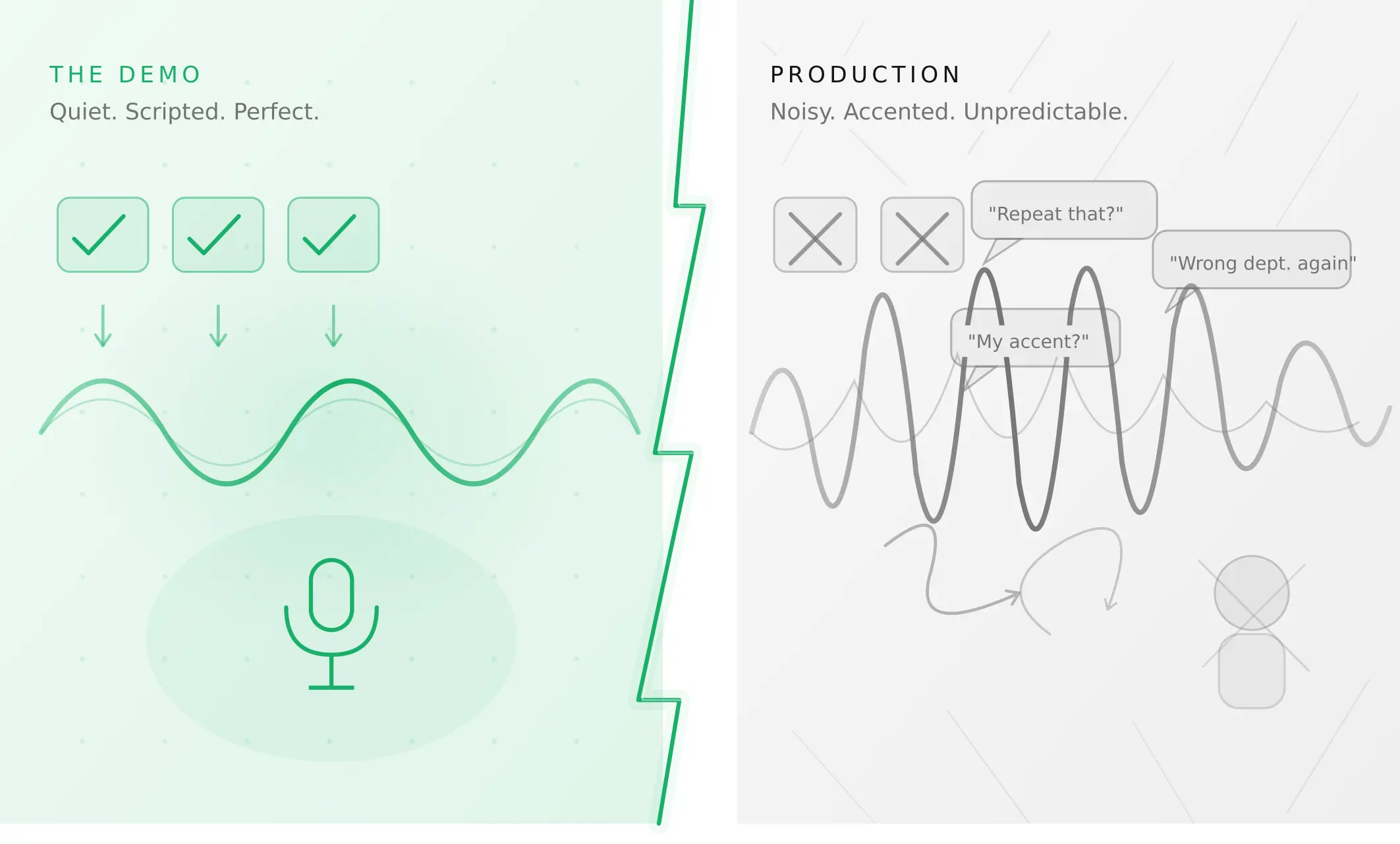
Why AI voice agents fail in production (and how to prevent it)
AI voice agents that ace demos still break in production. Learn the 5 root causes, how to test for each, and what production readiness actually means.
Read more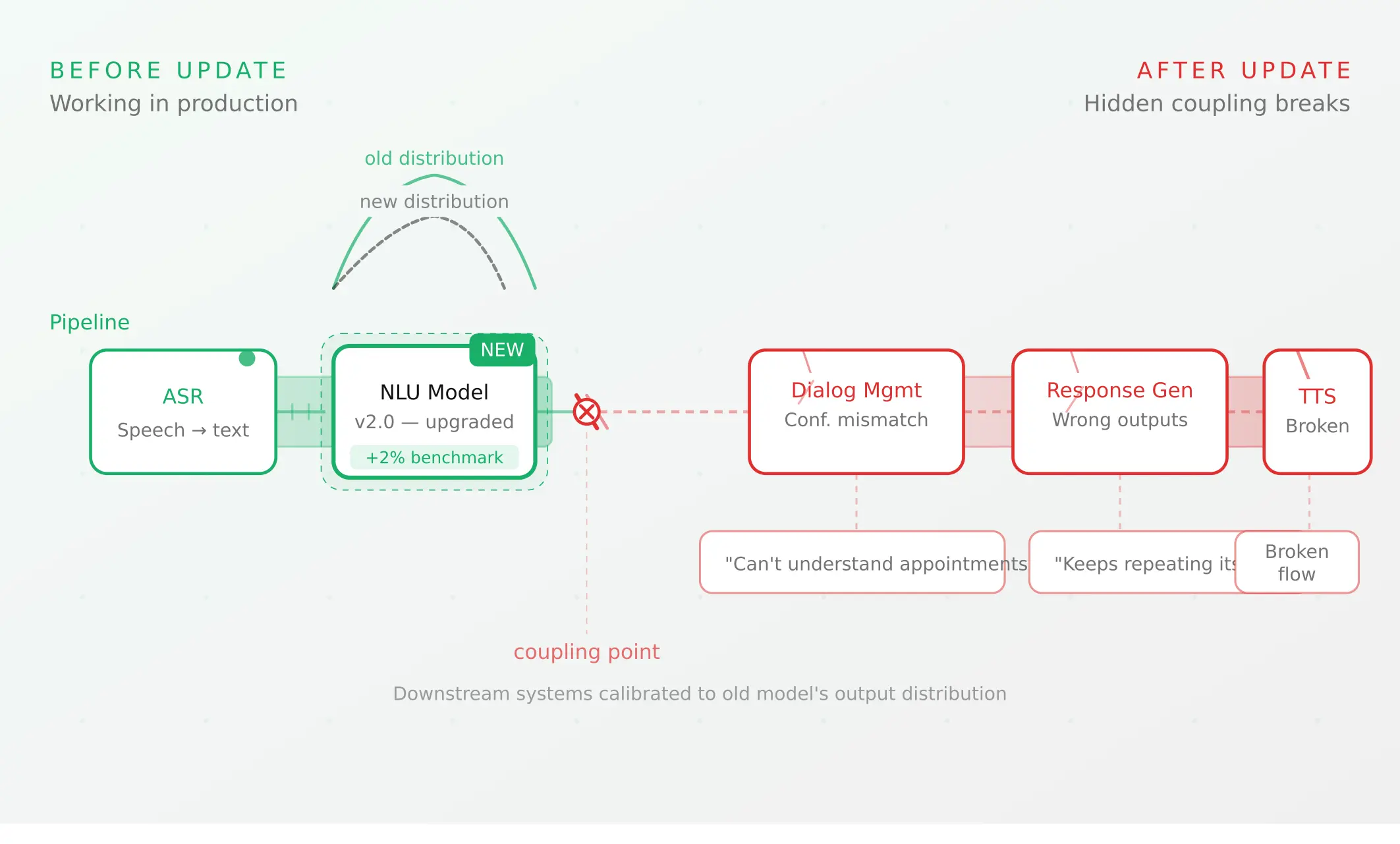
Voice agent regression testing: why LLM updates break production
LLM updates improve benchmarks but break voice agents in 5 predictable ways. How to detect and prevent regressions after every model or prompt change.
Read more