Test your voice agent
Jev for AI Voice Agents: What a System One Model Changes
# Jev for AI voice agents: what a System One model changes
Quick answer
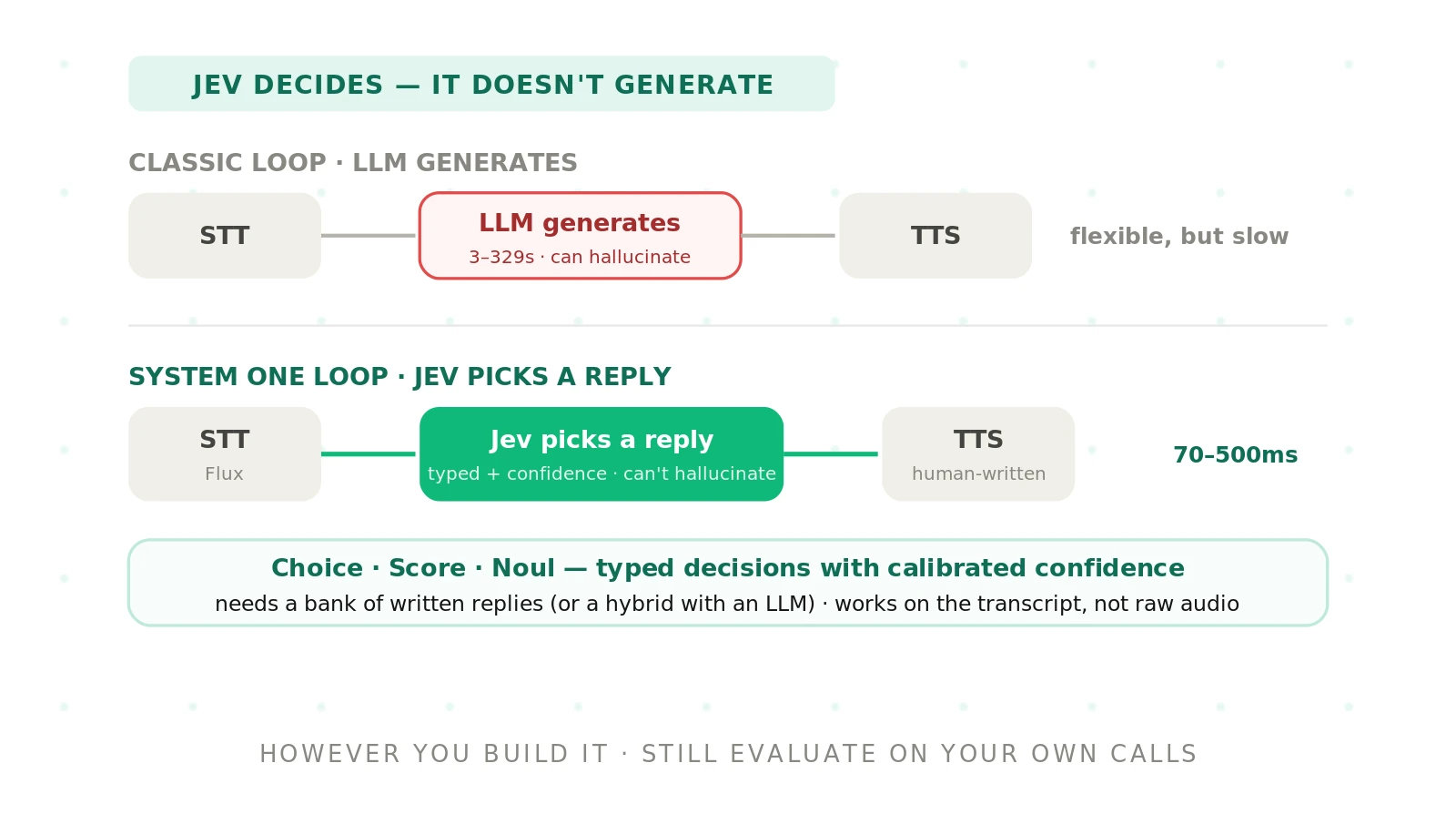
Jev is TypeSafe AI's first System One model. It does not generate text. You send it a state plus questions, and it returns typed, calibrated decisions in 70–500ms. In a voice agent, Jev picks from human-written replies instead of an LLM writing them. You still need independent evaluation of its choices.
Voice teams have spent two years wiring LLMs into the turn loop. Jev asks a different question. What if the model in the loop only decided, and never wrote a word?
Jev launched on September 15, 2026, in early access. TypeSafe AI, founded by ex-OpenAI researcher Diogo Almeida, calls it the first "System One Model". This post explains what Jev is, how a jev voice agent is built, and where it fits against an LLM. It closes on what all of this changes for evaluation.
What a System One model actually is
Start with the name. Jev nods to Daniel Kahneman's Thinking, Fast and Slow. System 1 is fast, intuitive thinking. System 2 is slow and deliberate. Frontier LLMs are System Two machines. They reason, plan, and write.
> System One model: a model that takes unstructured state plus questions and returns typed, probabilistic decisions with calibrated confidence. It classifies, scores, and verifies. It does not generate free-form language.
Jev is not an LLM. It never produces a sentence. You give it a "state" — a transcript, structured data, or messages. You also give it questions. It returns fast, typed answers. TypeSafe frames this as "a frontier-intelligence function call: unstructured state in, typed probabilistic decisions out." Think of it as smart if-statements.
The model name also honors economist William Stanley Jevons. The Jevons paradox says cheaper resources get used more, not less. Cheap, fast decisions tend to multiply across a system.
The three question types
Jev answers three shapes of question. Each shape maps to a common voice task.
- Choice. Pick one option from a defined set, up to 255 options. You get a probability per option plus confidence. Useful for intent and routing.
- Score. Rate a state against ordered levels, like low, medium, or high. You get a continuous score, a distribution, and confidence. Useful for risk and sentiment.
- Noul. A yes or no question. You get the probability the statement is true. Useful for guardrails and compliance checks.
Many questions can ride on one state in a single call. Parallel questions barely add latency or cost. That matters when a single turn needs routing, a guardrail check, and a sentiment read at once.
System One vs LLM: two kinds of thinking
An LLM writes. Jev decides. That single line explains most of the design tradeoffs.
LLMs are open-ended. They handle ambiguity, generate novel phrasing, and reason across long context. That power comes with cost. They are slow, they can hallucinate, and their raw output is free text. Free text needs parsing and guarding before you trust it.
Jev is closed-ended by construction. Its outputs are schema-constrained, so an invalid or wrong-typed value is mathematically impossible. TypeSafe reports 0% type errors. Because Jev only chooses among defined answers, it cannot hallucinate a new one.
TypeSafe trained Jev with RLCD, Reinforcement Learning for Calibrated Decisions. The result is calibrated confidence) on every answer. Higher confidence means higher accuracy. Similar inputs return similar answers. That consistency is rare in LLM land.
The speed gap is large. TypeSafe measures Jev at 70–500ms end to end. Frontier LLMs on similar tasks run 3 to 329 seconds. That is roughly 40 to 200 times faster on System-One-shaped work. Input costs $0.042 per million tokens, and output is free. TypeSafe calls the output "too cheap to meter." On classification, that lands near 400 times cheaper than comparable LLMs.
The "no LLM in the loop" voice agent
Here is the architecture that makes people stop and stare. It is the no LLM in the loop voice agent.
The emerging reference stack is short: Deepgram Flux for speech-to-text and endpointing, then Jev, then text-to-speech. There is no LLM anywhere in the turn loop. Every line the agent can say is pre-written by a human. Jev only chooses which line to say. It also reports how confident it is. Each decision lands around 300ms.
Read that again. The agent never writes. A human writes the script. Jev picks the branch. This is a system one model voice agent in its purest form.
The flow per turn looks like this. Flux transcribes the caller and marks the turn end. Jev receives the transcript as state. Jev answers your questions: which intent, which reply, is this in policy, how confident. Your code takes the chosen reply and sends it to TTS. The caller hears a human-authored line, selected by a fast decision model.
This design trades flexibility for control. You lose free-form generation. You gain speed, predictability, and auditability. Every possible utterance was reviewed before launch. Nothing novel can slip out mid-call.
Why sub-300ms, can't-hallucinate, and calibrated matter for voice
Voice is unforgiving about time. Humans notice gaps of a few hundred milliseconds. Latency) is the difference between a natural call and an awkward one. Our voice agent latency guide breaks down the full budget.
An LLM turn can add seconds. A Jev decision adds around 300ms. That leaves room for STT and TTS inside a natural response window. Speed alone changes the feel of the call.
Hallucination matters more in voice than in chat. A wrong sentence spoken aloud is gone before anyone can edit it. In regulated calls, an invented promise is a liability. Jev cannot invent a reply. It can only pick a vetted one, so the failure mode shifts from "said something false" to "picked the wrong vetted line."
Calibrated confidence is the quiet superpower. Each decision carries a trustworthy probability. You can route low-confidence turns to a human or to an LLM fallback. You can hold a hard action until confidence clears a bar. This is how a jev voice agent stays safe without a second reasoning model.
Where Jev fits versus an LLM in your voice stack
Jev complements LLMs. It does not replace them. Use an LLM for open-ended generation and reasoning. Use Jev for fast structured decisions: score, judge, verify, guardrail, and detect jailbreaks.
The table below compares the two roles inside the voice turn loop.
| Dimension | LLM in the voice loop | Jev / System One in the voice loop |
|---|---|---|
| Latency | 3–329s on similar tasks | 70–500ms end to end (~300ms per decision) |
| Hallucination | Possible; needs guarding | Impossible by construction; 0% type errors |
| Cost | Baseline | ~400x cheaper on classification; output free |
| Output | Free-form generated text | Typed choice, score, or yes/no |
| Confidence | Not calibrated by default | Calibrated confidence on every answer |
| Best use | Open-ended generation, reasoning | Decisions: route, score, verify, guardrail |
Most production teams will land on a hybrid. Jev handles the fast decisions and guardrails. An LLM handles the moments that need real language. A LangChain integration exists for teams building that harness. For a wider view of loop design, see our guide to orchestration for voice agents and the cascading versus speech-to-speech breakdown.
How to decide where Jev fits in your voice stack
Use this order to place Jev without over-committing. It moves from cheap wins to bigger bets.
1. List every decision in one call. Write out each branch, routing choice, guardrail, and score. These are your candidate Jev calls. Generation steps are not.
2. Map each decision to a question type. Route and intent are Choice. Risk and sentiment are Score. Policy and compliance are Noul. If it fits, it is a Jev job.
3. Start with guardrails and routing. These are low-risk, high-value, and easy to test. See our post on Jev for routing and escalation for patterns.
4. Write the response bank for scripted paths. Where replies are predictable, have humans author every line. Jev will only choose among them.
5. Keep an LLM for open-ended turns. Free-form answers, summaries, and novel reasoning stay with the LLM. Route to it when Jev confidence is low.
6. Set confidence thresholds per action. Decide the bar for auto-action versus human handoff. Tie it to the calibrated confidence Jev returns.
7. Instrument every decision. Log the state, the questions, the chosen answer, and the confidence. You cannot evaluate what you do not capture.
For concrete tasks Jev suits well, see our roundup of Jev voice agent use cases. For decisions that trigger actions, pair this with our tool calling for voice agents guide.
The honest limits of a Jev voice agent
Jev is powerful and narrow. Be clear about both.
First, Jev does not generate language. A Jev-only agent needs a bank of human-written responses. Someone must author, review, and maintain every possible line. That is real work, and it scales with call complexity. A hybrid with an LLM removes that ceiling but adds a generation step back into the loop.
Second, Jev consumes text and structured state, not raw audio. It reads the transcript, not the waveform. So your STT quality still gates everything. A missed word upstream becomes a wrong decision downstream. Endpointing errors still cut callers off.
Third, Jev is in early access. Specs and pricing may shift. Treat the numbers here as launch figures from TypeSafe, not eternal truths.
None of this makes Jev a gimmick. It makes Jev a specialist. The teams who win with it will scope it to decisions and keep generation where it belongs.
What this changes for voice agent evaluation
Here is the part most posts will miss. Jev changes what you test.
With an LLM, you evaluate generated text. Was the answer correct, safe, on-brand, and grounded? With Jev, you evaluate a decision model. Did it pick the right choice? Was its confidence honest? Did similar calls get similar answers?
Those are different tests. Choice accuracy is a classification problem. Confidence quality is a calibration problem. You now audit whether high-confidence decisions really are more accurate. You check that the response bank never leaves a caller in a dead end.
However you build — LLM, Jev, or hybrid — you still need independent evaluation on your own calls. Vendor benchmarks run on vendor data. Yours will differ. Evalgent is a third-party evaluator, so we test the decisions and the confidence, not just the text. Our work on voice agent evaluation and independent voice AI evaluation explains why the auditor should not be the builder.
A no LLM in the loop voice agent is not automatically safe because it cannot hallucinate. It can still route wrong, escalate late, or over-trust a shaky decision. That is exactly what an audit surfaces. For the broader method, see our AI voice agent testing overview and how to evaluate a realtime voice API.
Frequently asked questions
What is Jev for voice agents?
Jev is TypeSafe AI's System One model used inside a voice stack. It does not generate speech. It takes the transcript as state and returns typed decisions, like which reply to pick or whether a turn is in policy. Each decision lands in 70–500ms with calibrated confidence, so the agent chooses fast without an LLM writing text.
How is a System One model different from an LLM?
A System One model decides; an LLM generates. Jev classifies, scores, and verifies against defined options, so it cannot hallucinate a new answer. An LLM writes open-ended text and can invent content. Jev returns typed outputs in milliseconds with calibrated confidence, while LLMs reason more slowly and produce free-form language that needs parsing.
What is a no LLM in the loop voice agent?
It is a voice agent with no language model in the turn loop. The reference stack is Deepgram Flux for speech-to-text, then Jev, then text-to-speech. Humans pre-write every line the agent can say. Jev only chooses which line to speak and reports its confidence, at roughly 300ms per decision.
Does Jev generate speech or text for voice agents?
No. Jev never generates language of any kind. It reads a state and returns typed, probabilistic decisions. For a Jev-only voice agent, humans must author a bank of responses in advance. Jev selects among them. If you need free-form generation, pair Jev with an LLM in a hybrid design and route open-ended turns there.
How fast is Jev for voice agents?
TypeSafe measures Jev at 70–500ms end to end, around 300ms per decision. That is roughly 40 to 200 times faster than frontier LLMs on similar classification tasks, which the launch reports at 3 to 329 seconds. That speed keeps a full turn inside a natural response window when you add speech-to-text and text-to-speech.
Can a Jev voice agent hallucinate?
No. Jev outputs are schema-constrained, so an invalid or wrong-typed value is mathematically impossible, and TypeSafe reports 0% type errors. Jev can only pick from defined answers, so it cannot invent one. It can still choose the wrong vetted option, which is why independent evaluation of its choices and confidence still matters.
When should I use Jev versus an LLM?
Use Jev for fast structured decisions: routing, scoring, verification, guardrails, and jailbreak detection. Use an LLM for open-ended generation and reasoning. Most teams run a hybrid. Jev handles decisions and guardrails cheaply, and the LLM handles turns that need real language. Confidence thresholds decide when to hand a turn to the LLM.
How do you evaluate a Jev voice agent?
You test a decision model, not generated text. Measure choice accuracy against labeled calls. Check that confidence is calibrated, so high-confidence answers really are more accurate. Verify the response bank has no dead ends. Confirm routing and escalation fire correctly. An independent evaluator like Evalgent runs this on your own call data, not vendor benchmarks.
The bottom line
Jev moves the model in the loop from writing to deciding, giving voice teams sub-300ms, can't-hallucinate, calibrated choices. That shifts your evaluation from grading text to auditing decisions and confidence, which you should do independently on your own calls.
Ready to test what your voice agent actually does on real calls? Book a demo and we will audit its decisions, confidence, and escalations as an independent third party.
Related Articles
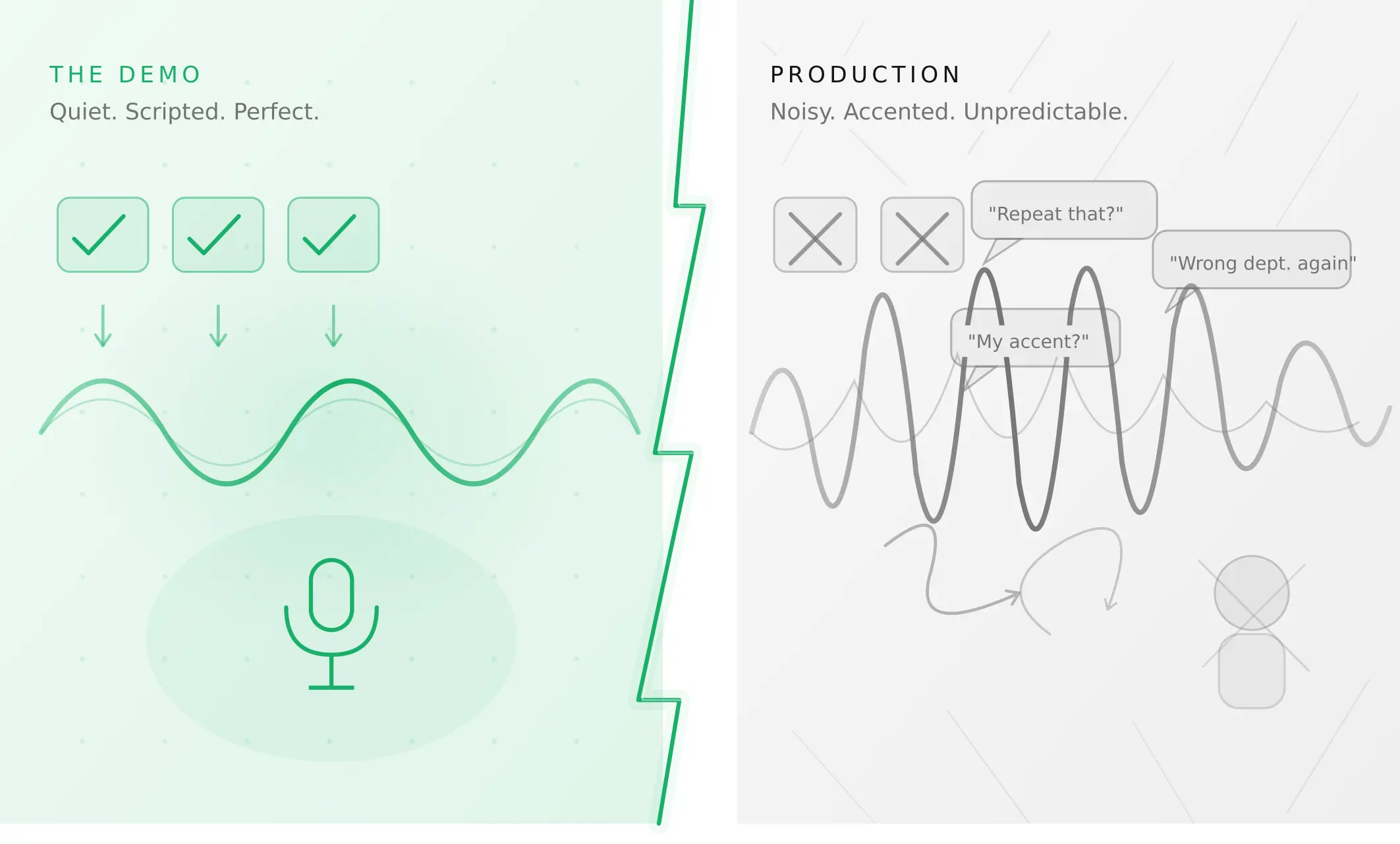
Why AI voice agents fail in production (and how to prevent it)
AI voice agents that ace demos still break in production. Learn the 5 root causes, how to test for each, and what production readiness actually means.
Read more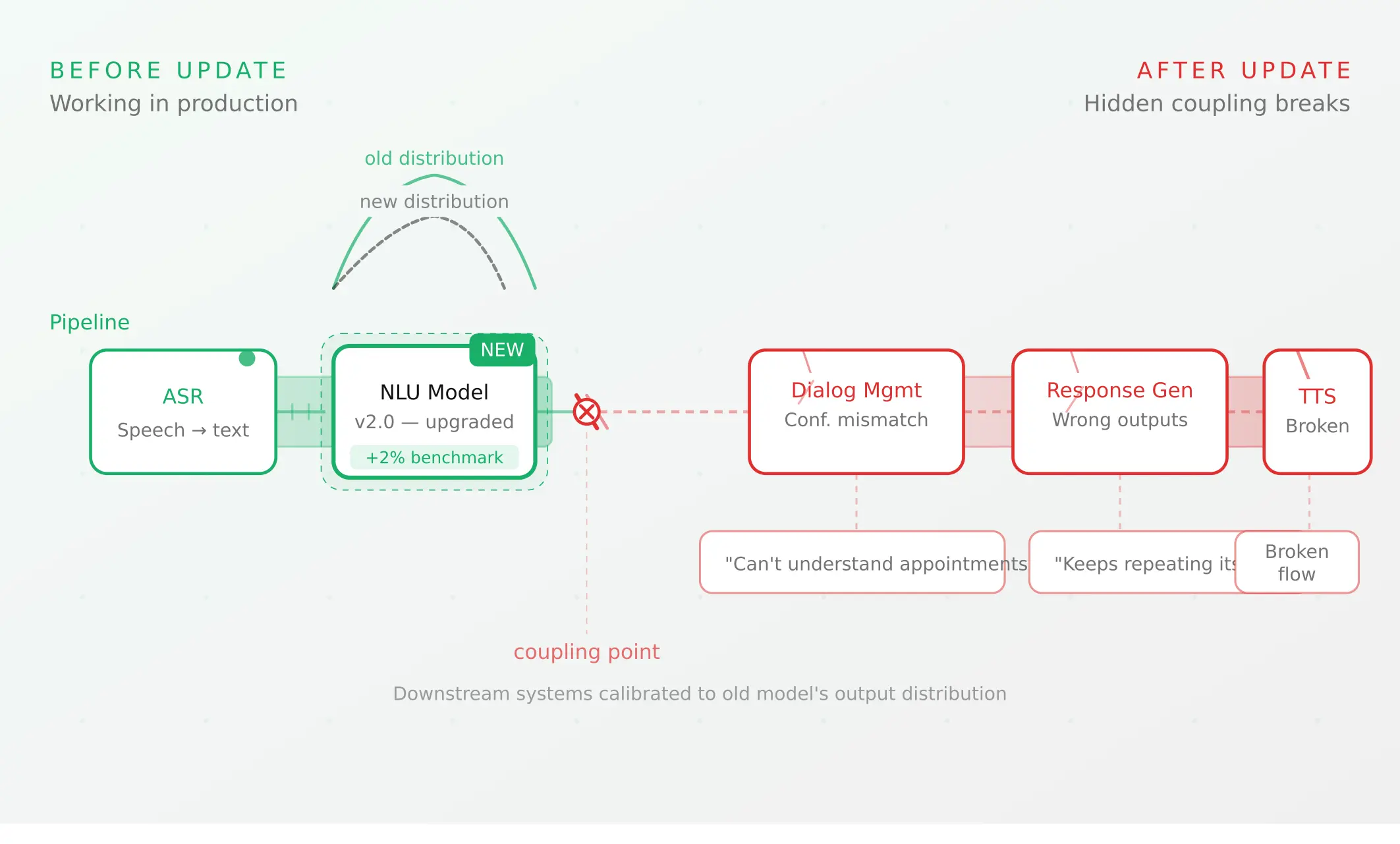
Voice agent regression testing: why LLM updates break production
LLM updates improve benchmarks but break voice agents in 5 predictable ways. How to detect and prevent regressions after every model or prompt change.
Read more