Test your voice agent
Voice Agent Testing for Engineering Managers
# Voice agent testing for engineering managers
Quick answer
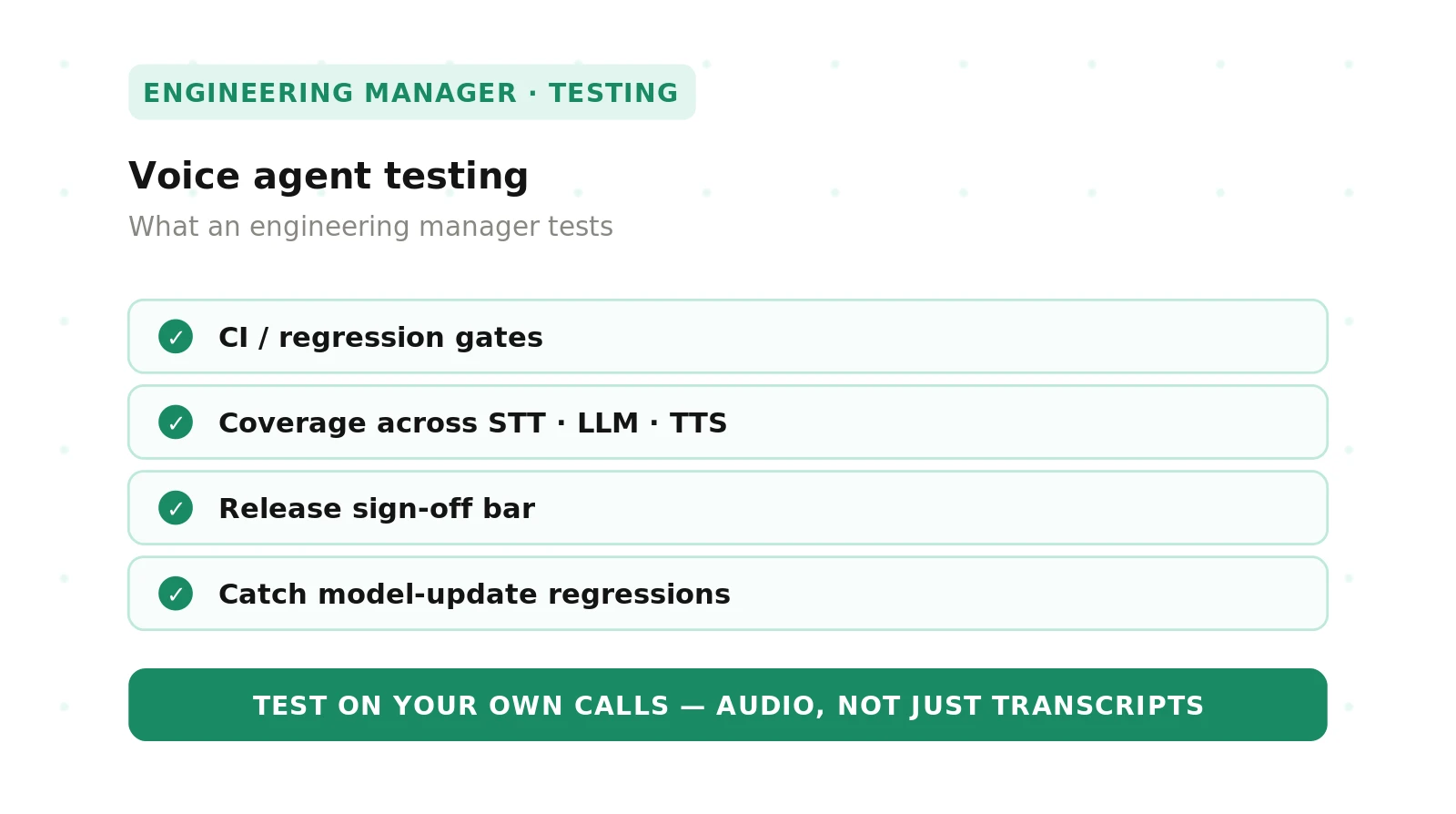
Voice agent testing for an engineering manager means owning the process, not writing every test. You define the quality bar, wire regression gates into CI, spread coverage across the STT, LLM, and TTS pipeline, assign clear ownership, and hold release sign-off. The goal is repeatable releases that balance velocity against risk.
Your team ships a prompt tweak on Friday. It passes every unit test. On Monday, callers start getting transferred for requests the agent used to handle. Nobody changed the transfer logic. The upstream model changed under you, and no gate caught it.
That is the engineering manager's version of the voice agent problem. You are not judging one demo call. You own a process that keeps quality steady while the team ships and the models shift beneath you. This post is about owning that process. It is not about picking a vendor.
If you want the broader discipline first, start with our overview of AI voice agent testing. This post narrows it to your lens as the manager who signs off.
Why testing is the engineering manager's problem, not just QA's
A voice agent is a pipeline of models you do not control. Speech-to-text, a language model, and text-to-speech each update on the vendor's schedule. Your prompt sits on top. Any layer can shift without a code change on your side.
That breaks the mental model most teams carry over from web apps. In a normal service, the code you shipped is the code that runs. Here, the behavior can drift while your repository stays still. Regression testing has to run on a schedule, not only on commits.
So the quality bar cannot live in one engineer's head. It has to be written down, automated, and owned. That ownership is a management task. You decide what "good enough to ship" means and what blocks a release. QA runs the tests. You own the bar they test against.
This also shapes headcount and roadmap. Untested drift turns into on-call pages and churned customers. A cheap process now is cheaper than firefighting later. Treating this as core software quality assurance work, not a side chore, is the first decision you make.
What you own versus what you delegate
Your job is to design the system and hold the line. The individual work is delegated. The table below maps each responsibility to what you put in place and the risk if you skip it. It is the core of the engineering manager's lens.
| Testing responsibility | What to put in place | Risk if skipped |
|---|---|---|
| Define the quality bar | A written scorecard of pass thresholds per metric | Every release argues about "good enough" from scratch |
| Regression gates | Automated test suite wired into CI on every merge | Silent drift ships to callers unnoticed |
| Pipeline coverage | Cases spanning STT, LLM logic, and TTS output | A whole failure class stays untested until production |
| Model-update watch | Scheduled runs plus alerts on vendor version changes | An upstream update degrades quality with no warning |
| Ownership map | Named owner per test suite and per failure type | Failures fall between people and rot |
| Release sign-off | A gate you or a delegate approves before deploy | Velocity wins every argument and risk compounds |
| Independent audit | Third-party evaluation on your own call data | You grade your own homework and miss blind spots |
None of this requires you to hand-write test cases. It requires you to make sure each row has an owner, a tool, and a threshold. For how the bar itself gets set, see our guide on the voice agent production readiness bar.
Coverage across the STT, LLM, and TTS pipeline
Coverage in a voice agent is not a single number. A voice agent is three systems in a row, and a test that only checks final text misses two-thirds of the failure surface. Think about test coverage per stage, not just overall.
Break coverage down by layer. Speech-to-text can mishear names, numbers, and accents. The language model can reason well on clean text but pick the wrong action. Text-to-speech can mangle a phone number or sound robotic on a key phrase. Each stage needs its own cases.
The trap is testing only the middle. Teams write great cases for the language model because it feels like code. Then a caller with a strong accent breaks the transcript, and the perfect prompt never sees the right words. Latency is its own axis here; our guide on latency in voice agents covers where the delay hides.
A practical coverage checklist for a manager to demand:
- STT under noise, accents, names, and spoken numbers
- LLM logic on ambiguous, multi-intent, and out-of-scope requests
- TTS on numbers, dates, spellings, and brand terms
- End-to-end flows that cross all three, including interruptions
- Failure paths: transfers, retries, and graceful fallbacks
You do not need every combination. You need at least one case per class so no failure type is invisible. For a structured set of measures to track per stage, use the voice agent metrics scorecard.
Catching model-update regressions before your callers do
This is the failure mode unique to voice agents, and it is the one that will page you at 2 a.m. A vendor updates a model. Your code is untouched. Behavior shifts anyway. Regular regression testing assumes stable dependencies, so it does not fire.
The fix is scheduled evaluation, not just commit-triggered tests. Run your full suite on a cadence, nightly or weekly, against a fixed set of cases. When scores move without a deploy on your side, an upstream change is the likely cause. That signal is the whole point.
Version pinning helps where vendors allow it, but it is not a full defense. Pinned versions get deprecated, and some platforms update silently. So you treat every model as a moving dependency and watch its output, not its version string.
To make drift visible, hold a stable baseline. Grade new runs against a fixed reference set built from your own traffic. Our post on benchmarking voice agents on your own data explains why generic benchmarks miss the regressions that matter to you.
Volume matters too. A regression that hits one caller in fifty is invisible in ten manual test calls. You need enough runs to see it. Synthetic callers for voice agent testing let you scale that volume without recruiting real people for every run.
Balancing velocity against risk at release sign-off
Every gate you add slows a release. That tension is real, and pretending it away helps no one. Your job is to make the trade explicit so it is a decision, not an accident. Tie your gates to a service-level objective, so the bar is a number, not a mood.
Set tiers. A copy change to a rarely used prompt is low risk and can ship on a light gate. A change to transfer logic, payment handling, or a core intent is high risk and blocks on the full suite. Match the gate to the blast radius.
Build the gates into the pipeline so they are automatic, not a favor. Continuous integration and CI/CD practice already gives you the machinery. The test run reports a pass or fail, and the fail blocks the merge. No human has to remember.
Sign-off is where you stay in the loop. For high-risk changes, the gate reports results and a named person approves. That person can be you or a delegate you trust. The point is that someone with the quality bar in mind says yes before callers do.
The teams that move fastest here are not the ones with no gates. They are the ones whose gates are fast, trusted, and automatic. A flaky suite gets ignored, and an ignored suite is worse than none. Reliability of the tests is itself a metric you manage.
How to stand up a voice agent testing process
Here is the sequence I would follow to go from ad hoc calls to an owned process. Work top to bottom; each step assumes the one above it.
1. Write the quality bar down. List the metrics that matter and the pass threshold for each. Keep it to one page so the team actually reads it. This is your scorecard.
2. Build a baseline set from real traffic. Pull real call transcripts and audio. Turn the common and the painful ones into fixed test cases. This set is your reference for drift.
3. Automate the suite. Wire the cases into a runner that scores them without manual listening. Aim for a run you can trigger in one command.
4. Wire it into CI. Make the suite run on every merge to your agent's prompts, logic, or config. A fail blocks the merge for high-risk paths.
5. Add scheduled runs. Run the full suite nightly or weekly against pinned baselines. Alert when scores move with no deploy, which flags a model update.
6. Assign ownership. Give every suite and every failure type a named owner. Put it in the on-call rotation so failures get triaged, not ignored.
7. Define sign-off tiers. Map change types to gate strength. Decide who approves high-risk releases and document it.
8. Add an independent check. Bring in third-party evaluation for release sign-off, so the grader is not the same team that built the agent.
Run this loop for a few cycles and tune the thresholds. The first version will be too strict or too loose. That is expected. For the difference between the two disciplines you are combining, read our guide on testing versus evaluation for voice agents.
Where an independent testing layer fits
Internal tests have a blind spot. The team that wrote the prompt also writes the cases, and both share the same assumptions about how callers behave. Real callers do not read your spec. An independent layer exists to test the cases you would not think to write.
That is the role Evalgent plays. It is a third-party evaluation platform that runs your voice agent against realistic caller scenarios and grades the results against your bar. As an engineering manager, you get an outside signal you can attach to sign-off without staffing a full test org. For why the independence matters, see our post on independent voice AI evaluation.
It also stands up fast. You do not have to build a synthetic-caller harness or a scoring pipeline from scratch to start gating releases. The independent runs slot into the process above as the audit step, alongside your own CI suite rather than in place of it. Our overview of voice agent evaluation covers how scoring works in practice.
What load and stress add to the picture
Coverage and regression catch correctness. They do not tell you what happens at 200 concurrent calls. A voice agent that is perfect on one call can fall apart under load, with latency climbing and turns getting dropped. That is a separate axis you also own.
Fold load into the process as its own suite with its own thresholds. Our guide on stress testing voice AI covers how to find the breaking point before a marketing campaign does. Treat the concurrency ceiling as a number you sign off on, the same way you sign off on accuracy.
This is also where the manager's lens differs from a single engineer's. An engineer optimizes one call path. You are accountable for behavior across the whole traffic distribution, at the peak, on a bad day.
How this connects to the rest of the team
Testing is a shared job, and the other roles carry pieces of it. The QA engineer and QA lead run and organize the suites. The conversation designer shapes the cases from real dialog. Your job is to connect these into one process with one bar.
The product manager sets which outcomes matter, and you translate those into gates. On the delivery side, the solutions engineer and forward-deployed engineer see how the agent behaves at each customer. If you carry the founder hat too, our founder view frames the same process against runway and risk.
Frequently asked questions
What does voice agent testing mean for an engineering manager specifically?
It means owning the process rather than the individual tests. You define the quality bar, wire regression gates into CI, ensure coverage across the pipeline, assign ownership, and hold release sign-off. Engineers write cases; you own the bar they test against and decide what blocks a release.
How is voice agent testing different from testing a normal web app?
The models you depend on update on the vendor's schedule, not yours. Behavior can drift with no code change on your side. So regression testing must run on a schedule, not only on commits, and you treat every model as a moving dependency you watch continuously.
How do I catch regressions from a model update I did not make?
Run your full test suite on a schedule against a fixed baseline set. When scores move without a deploy on your side, an upstream model change is the likely cause. Version pinning helps where vendors allow it, but scheduled evaluation is the reliable signal for silent drift.
What should test coverage include across the STT, LLM, and TTS pipeline?
At least one case per failure class per stage. Speech-to-text under noise, accents, names, and numbers. The language model on ambiguous and out-of-scope requests. Text-to-speech on numbers and brand terms. Plus end-to-end flows that cross all three, including interruptions and fallback paths.
How do I balance shipping speed against testing rigor?
Tier your gates by blast radius. Low-risk copy changes ship on a light gate. High-risk changes to core logic or payments block on the full suite. Make gates automatic in CI so they are fast and trusted. A flaky, ignored suite is worse than a small reliable one.
Do I need a full QA team to test a voice agent?
No. You need a written bar, an automated suite, CI gates, and clear ownership. A small team can run this with the right tooling. An independent evaluation layer can cover the audit step without you staffing a full test organization, which is often the faster path to gated releases.
Where does independent evaluation fit into my process?
At the audit step, alongside your own CI suite, not instead of it. Independent evaluation tests the caller scenarios your team would not think to write, because the people who built the agent share the assumptions the tests should challenge. It gives sign-off an outside signal you did not grade yourself.
How do I know my testing process is actually working?
Track whether regressions are caught before callers report them, how often gates block real problems, and whether failures have owners who triage them. A healthy process catches drift in scheduled runs, not support tickets. If your suite is ignored or flaky, that is the metric to fix first.
The bottom line
Voice agent testing for an engineering manager is process ownership, not test authorship. Set the bar, automate the gates, watch for model drift, and keep an independent check on sign-off.
Ready to add an independent testing layer you can stand up fast? Book a demo to see how Evalgent fits your release process.
Related Articles
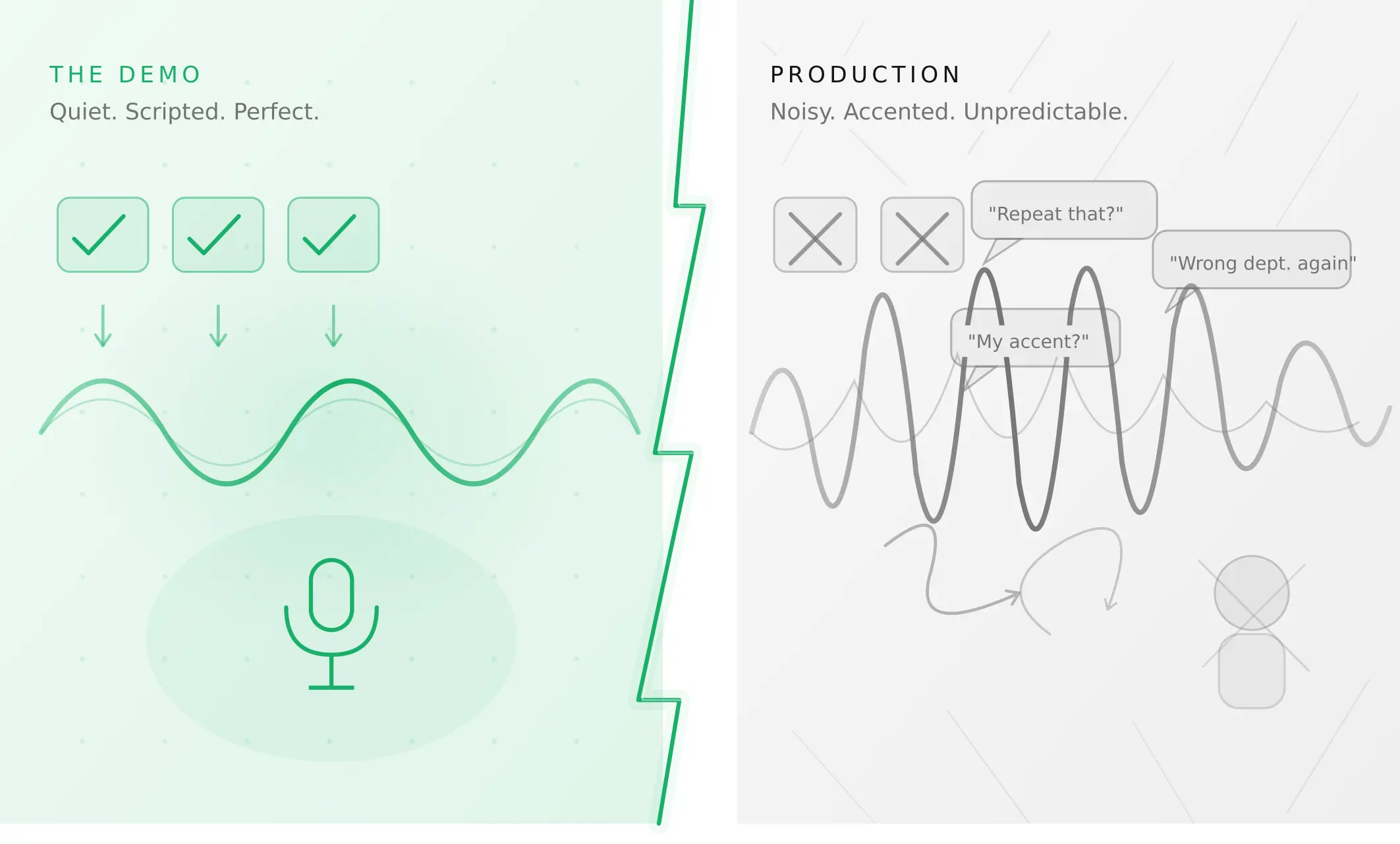
Why AI voice agents fail in production (and how to prevent it)
AI voice agents that ace demos still break in production. Learn the 5 root causes, how to test for each, and what production readiness actually means.
Read more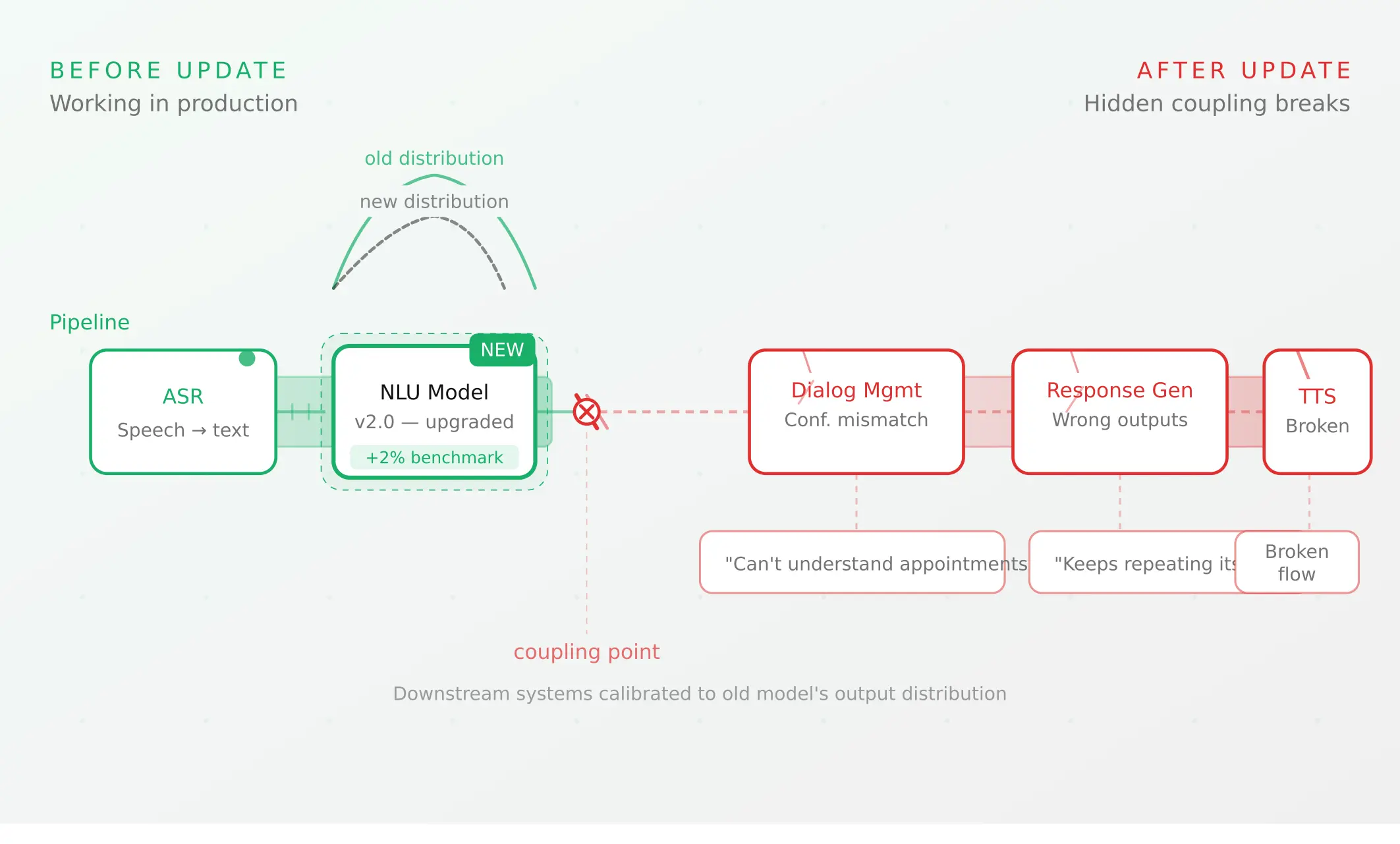
Voice agent regression testing: why LLM updates break production
LLM updates improve benchmarks but break voice agents in 5 predictable ways. How to detect and prevent regressions after every model or prompt change.
Read more