Test your voice agent
Voice Agent Testing for QA Engineers
# Voice agent testing for QA engineers
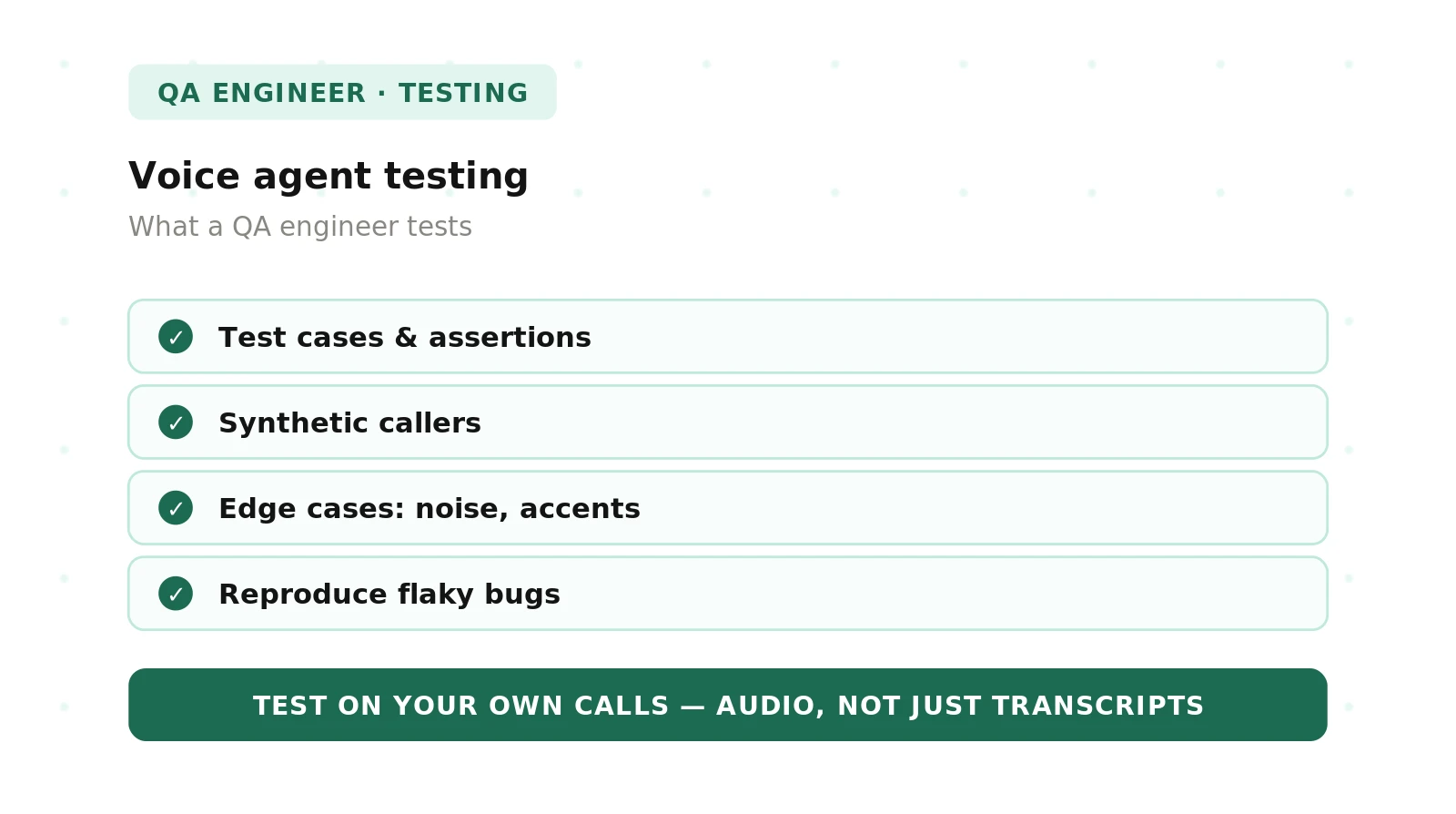
> Quick answer: Voice agent testing for a QA engineer means writing voice test cases, driving them with synthetic callers, and asserting on both the transcript and the audio. You cover accents, noise, interruptions, names, and numbers, reproduce bugs from non-deterministic runs, and lock passing behavior into a regression suite.
Testing a voice agent breaks most habits a QA engineer brings from web and API work. There is no DOM to query. The output is not deterministic. The same input can pass on Monday and fail on Tuesday. A run that reads fine as text can sound broken when you listen to the audio.
This guide takes the hands-on QA lens. It covers how to design voice test cases, drive them with synthetic callers, and write assertions that check both what was said and how it sounded. It sits under the AI voice agent testing pillar and stays focused on testing, not vendor selection.
Why voice testing is different from web and API QA
A REST endpoint returns the same JSON for the same request. A voice agent does not. Two identical calls can diverge on wording, timing, and tool calls. The transcription layer adds its own noise before the agent even reasons.
That non-determinism is the core challenge. You cannot assert on an exact string. You assert on meaning, on task outcome, and on measurable timing instead. A single misheard digit can fail a task that a loose match would call a pass.
The input space is also larger than it looks. Accents, speaking pace, background noise, interruptions, and half-finished sentences are all part of the surface. So is silence. A pause the caller means as thinking time can trigger the agent to repeat itself.
Voice test case: a defined caller scenario, the audio or synthetic input that drives it, and the assertions that decide pass or fail. It names the intent, the persona, the conditions, and the expected outcome.
What a voice test case actually contains
A good voice test case is more than a script. It fixes every variable that affects the result, so a failure points to one cause. Vague cases produce flaky runs and wasted triage time.
Each case should pin down five things. The caller persona and intent. The input audio or synthetic-caller behavior. The environment, including noise and channel. The expected task outcome. And the assertions on transcript and audio.
Treat these like any other automated test. The discipline of test automation applies directly: cases are versioned, repeatable, and reviewed. The difference is that your fixtures are audio and personas, not payloads and mocks.
Write cases for the happy path first, then branch. Add one variable per case where you can. A case that changes accent and noise and interruption at once tells you something failed, but not what.
Driving tests with synthetic callers
You cannot hire a hundred people with different accents to call your agent on every deploy. Synthetic callers solve this. They are generated voices that follow a scripted or goal-driven persona and talk to your agent like a real caller would.
A synthetic caller can be cooperative or difficult on purpose. It can interrupt, go off-script, mumble a digit, or refuse to confirm. That lets you cover the edge cases real traffic produces without waiting for a real caller to hit them. Our guide to synthetic callers for voice agent testing goes deeper on building them.
Run each persona many times, not once. Because output is non-deterministic, one green run proves little. Ten runs of the same persona expose the variance that a single run hides.
Synthetic callers also let you scale volume. You can push the same suite at expected peak concurrency and watch accuracy and latency degrade, which our stress-testing voice AI guide covers in detail.
The one table: test type, what it catches, how to build it
This table maps the test types a QA engineer runs against a voice agent. Use it to decide coverage. Each row is a distinct failure surface, not a rephrasing of the last.
| Test type | What it catches | How to build it |
|---|---|---|
| Transcription accuracy | Misheard names, digits, dates; wrong intent from a wrong transcript | Feed reference audio, compute word error rate, weight critical entities separately |
| Task and tool-calling | Right words, wrong action; backend side effect never happened | Assert on the tool call and the downstream state, not the transcript alone |
| Turn-taking and barge-in | Talking over the caller; treating a pause as a cue to repeat | Synthetic callers that interrupt mid-sentence and go briefly silent |
| Latency | Slow first response and long turns that read as a freeze | Measure time to first audio and turn latency at p90 and p95 |
| Edge-case robustness | Failures on accents, noise, odd names, and unusual numbers | Vary one condition per case; add edge cases drawn from real logs |
| Guardrail and safety | Out-of-scope answers, prompt injection, leaked data | Adversarial personas; see testing guardrails |
| Regression | A fixed bug returning after a prompt or model change | Save passing runs as baselines; re-run on every change |
How to build a voice agent test suite as a QA engineer
Build the suite in this order. Each step produces an artifact the next step depends on, so resist skipping ahead.
1. Mine real calls for scenarios. Pull transcripts and audio from real or pilot traffic. List the intents, the personas, and the failures that already happened. These become your first cases, grounded in what callers actually do.
2. Write the happy-path cases first. For each intent, define the persona, input, environment, expected outcome, and assertions. Get these green before adding hard cases, so a later failure is a real regression.
3. Add edge-case variants one variable at a time. Branch each happy path into accent, noise, interruption, and odd-entity variants. Change one condition per case so a failure names its own cause.
4. Wire up synthetic callers. Turn each persona into a synthetic caller that drives the case automatically. Include cooperative and deliberately difficult personas.
5. Write assertions on transcript and audio. Assert on task outcome and tool calls, on entity accuracy, on latency at the tail, and on audio quality. Never rely on an exact-string match.
6. Run each case many times. Because runs are non-deterministic, execute every case repeatedly and record the pass rate. Treat a flaky case as a signal, not noise to ignore.
7. Set thresholds and gate the build. Attach a pass/fail bar to every assertion. Block the deploy on any failure. A suite that never blocks anything is documentation, not testing.
8. Lock passing runs into a regression baseline. Save the passing behavior and re-run the whole suite on every prompt, model, or config change.
Writing assertions on transcript and audio
The transcript is only half the truth. A call can read perfectly and still sound broken. Dead air, clipped words, a robotic cadence, or a mispronounced name never show up in text. So you assert on both layers.
On the transcript, assert on meaning and outcome. Did the agent capture the right intent? Did it extract the account number correctly? Did the tool call fire, and did the backend actually change? An assertion) here checks the fact, not the phrasing.
On the audio, assert on timing and delivery. Measure time to first audio. Check for silences longer than your threshold. Confirm names and numbers are pronounced correctly. Our transcript vs audio evaluation guide explains why both layers matter.
Avoid brittle assertions. An exact-match check will fail on harmless rewording and pass on a subtle logic bug. Assert on the entity, the action, and the measurable metric. Let the wording vary.
Use semantic checks for open-ended replies. A rubric that scores whether the answer resolved the caller's request travels better than a string compare. This is where testing and evaluation blur, and where scoring matters.
Covering edge cases: accents, noise, interruptions, names, and numbers
Edge cases are where voice agents actually fail. The happy path almost always works. Production breaks on the caller with a strong accent, the one on a highway, and the one who interrupts.
Cover accents and dialects your callers actually have. A suite built only on clean American English hides the failures your real user base will hit. Pull accent variety from your own traffic, not from assumptions.
Test against realistic noise. A car, a call center, a busy street. Background noise degrades transcription first, and a wrong transcript cascades into a wrong action. This is core edge-case coverage for voice.
Names and numbers deserve their own cases. Spell an unusual last name. Read a sixteen-digit number fast. Give a date in a non-standard order. These are where a single misheard token fails a whole task, so weight them heavily.
Interruptions and silence round it out. Have a synthetic caller barge in mid-answer and confirm the agent yields the floor. Have another go quiet and confirm the agent waits rather than repeating. Escalation belongs here too; our escalation guide covers the handoff conditions.
Reproducing bugs from non-deterministic runs
The hardest part of voice QA is reproducing a bug. A tester reports a bad call. You re-run the same input. It passes. Nothing is broken on this run, and the bug hides again.
The fix is to stop treating one run as the truth. Capture the full context of the failing call. The exact input audio, the seed or config, the transcript, the tool calls, and the timing. A bug you cannot reproduce is still a bug you can characterize.
Then run the same case many times and measure the failure rate. A bug that appears in one call out of twenty is a twenty-run problem, not a single-run one. Report it as a rate, not a yes or no. This turns an anecdote into a defect you can track and verify as fixed.
Where non-determinism itself is the risk, borrow from fuzzing. Vary inputs slightly and at volume to surface the calls that break. Save every failing input as a permanent regression case, so the bug can never quietly return.
Building a regression suite that survives model updates
Voice agents change constantly. A prompt edit, a new model version, a swapped provider. Each one can silently reintroduce a bug you already fixed. Regression testing is how a QA engineer stops that.
Save every passing run as a baseline. When a caller finds a bug and you fix it, add that exact call as a permanent case. The suite grows into a memory of every failure you have ever seen and closed.
Re-run the whole suite on every change, not just the code near the edit. A prompt tweak that improves one intent can degrade another. Only a full re-run catches that. Benchmarking against your own captured data, covered in our benchmark on your own data guide, keeps the baseline honest.
Track pass rates over time. A regression is often a slow drift, not a hard break. A case that ran at 98 percent and now runs at 90 percent is a regression even if it still sometimes passes. Watching the trend catches what a single gate misses.
Where an independent evaluation layer fits
A QA engineer builds the suite. An independent evaluation layer scores it consistently and without the bias of the team that shipped the agent. Evalgent is that layer. You run your test suite through it, and it evaluates the results as a neutral third party.
This matters because self-graded voice QA drifts. The team that wrote the prompt tends to grade its output kindly. An independent layer applies the same rubric every time, on transcript and audio, so a pass in March means what it meant in January. Our independent voice AI evaluation and voice agent evaluation guides explain the model.
It also fits the broader team. A QA lead uses it for coverage strategy, an engineering manager for release gates, and a product manager for outcome reporting. The QA engineer's suite is what feeds all of it.
Frequently asked questions
How do I write voice test cases for a voice agent as a QA engineer?
Define five things per case: caller persona and intent, input audio or synthetic behavior, environment including noise, expected task outcome, and assertions on transcript and audio. Start with happy-path cases, get them green, then branch into edge-case variants that change one condition at a time so failures point to a single cause.
Why can't I use exact-string assertions on voice agent output?
Voice agent output is non-deterministic, so the same input produces different wording each run. An exact-string match fails on harmless rewording and can pass a subtle logic bug. Assert on task outcome, tool calls, extracted entities, and measurable timing instead. Let the phrasing vary while the fact and the action stay fixed.
What are synthetic callers and why do QA engineers use them?
Synthetic callers are generated voices that follow a scripted or goal-driven persona and talk to your agent like real callers. QA engineers use them to cover accents, noise, and interruptions on every deploy without recruiting real people. They can be cooperative or deliberately difficult, and they scale to high concurrency for stress runs.
Should I test the transcript or the audio of a voice agent?
Both. The transcript catches wrong intents, misheard entities, and failed tool calls. The audio catches dead air, clipped words, robotic cadence, and mispronounced names and numbers that never appear in text. A call can read perfectly and still sound broken, so assert on meaning and outcome in text and on timing and delivery in audio.
How do I reproduce a bug from a non-deterministic voice agent run?
Stop treating one run as the truth. Capture the failing call's full context: input audio, seed or config, transcript, tool calls, and timing. Re-run the same case many times and report the failure as a rate, not a yes or no. Save every failing input as a permanent regression case so the bug cannot quietly return.
What edge cases matter most in voice agent testing?
Accents and dialects your real callers have, realistic background noise like cars and call centers, interruptions and silence, and unusual names and numbers. Names and numbers deserve dedicated cases because a single misheard token can fail an entire task. Draw edge cases from your own call logs, not assumptions, so coverage matches actual traffic.
How do I build a regression suite for a voice agent?
Save every passing run as a baseline. When a caller finds a bug and you fix it, add that exact call as a permanent case. Re-run the whole suite on every prompt, model, or config change, not just the edited path. Track pass rates over time, since regressions often show up as slow drift rather than a hard break.
How many times should I run each voice agent test case?
Run each case many times, never once. Because output is non-deterministic, a single green run proves almost nothing. Ten or more runs of the same persona expose the variance a single run hides. Record the pass rate for each case and treat a flaky case as a real signal to investigate, not noise to ignore.
The bottom line
Voice agent testing for a QA engineer is API testing with the ground rules changed: non-deterministic output, an audio layer, and an input space full of accents, noise, and interruptions. Design versioned test cases, drive them with synthetic callers, assert on transcript and audio, run each many times, and lock passing behavior into a regression suite — then book a demo to score that suite through an independent evaluation layer.
Related Articles
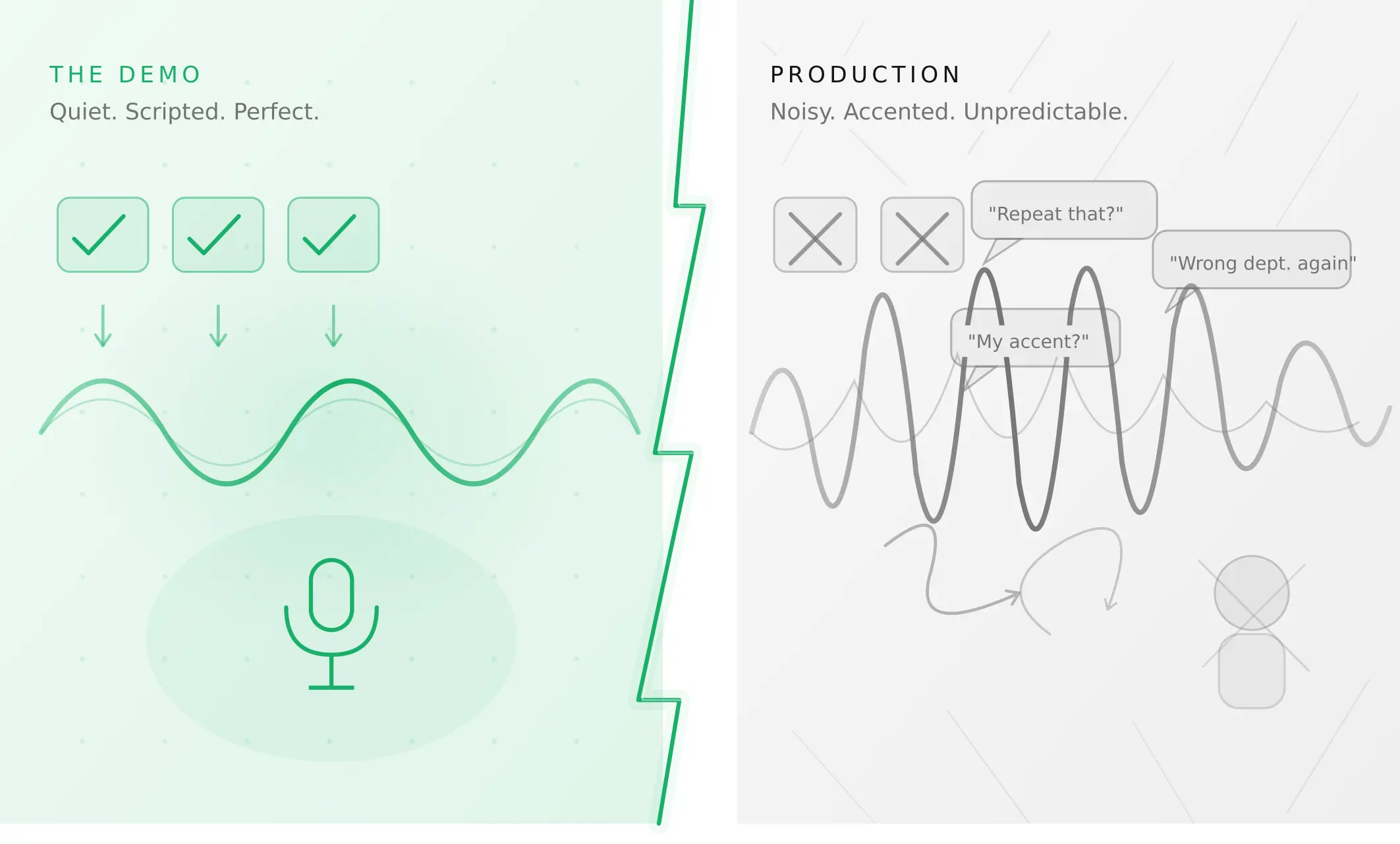
Why AI voice agents fail in production (and how to prevent it)
AI voice agents that ace demos still break in production. Learn the 5 root causes, how to test for each, and what production readiness actually means.
Read more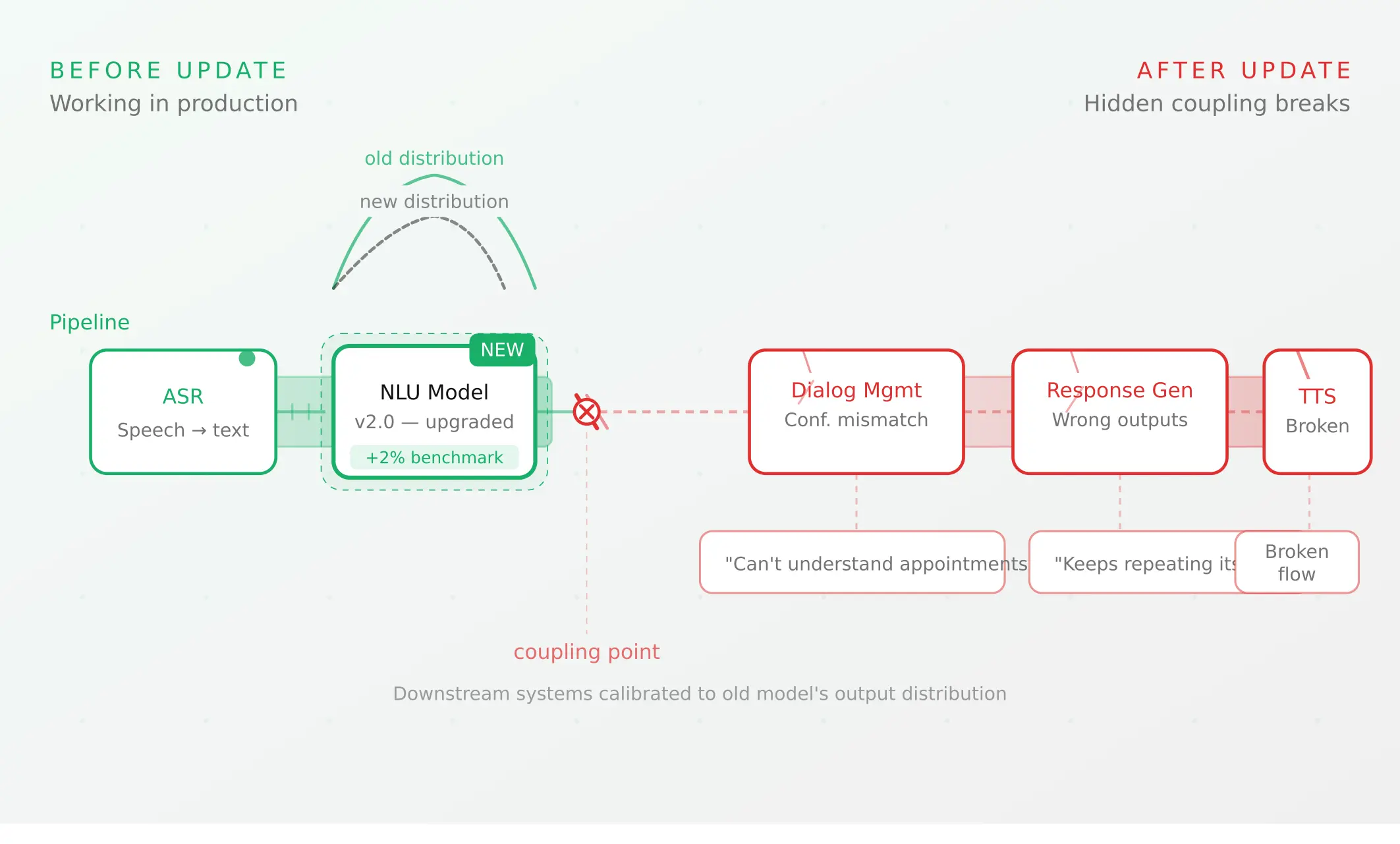
Voice agent regression testing: why LLM updates break production
LLM updates improve benchmarks but break voice agents in 5 predictable ways. How to detect and prevent regressions after every model or prompt change.
Read more