Test your voice agent
Voice Agent Testing for Founders
# Voice agent testing for founders
Quick answer
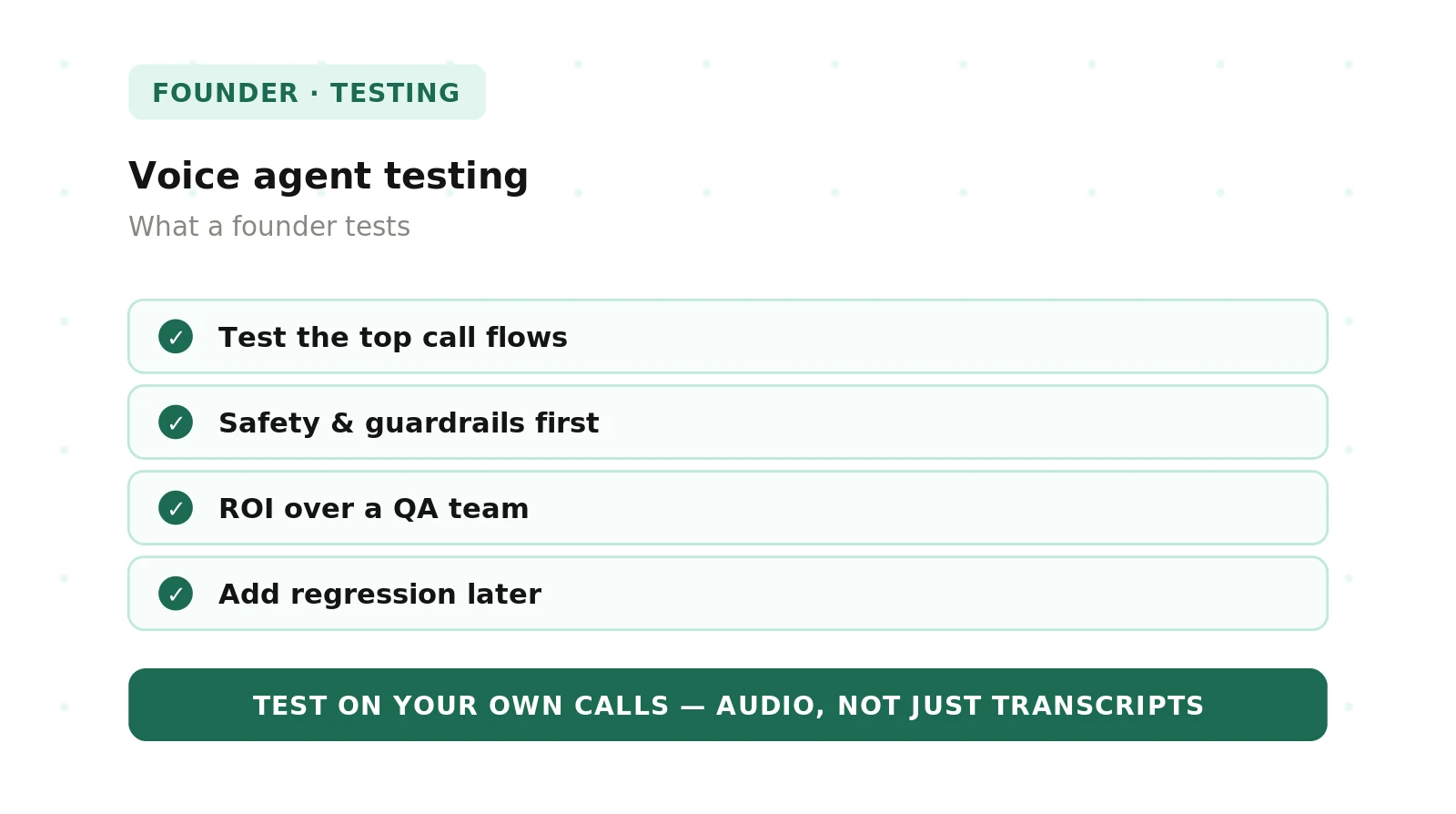
Voice agent testing for founders means proving the few things that can sink a launch: task success on your top call flows, safety guardrails, and clean escalation. Skip the exhaustive QA suite early. Test the flows that carry real money or risk, then add regression coverage once the agent is live.
Founders ship voice agents with no QA team, no test budget, and a launch date already promised to a customer. The instinct is to test everything or test nothing. Both are wrong. The right move is to test the small set of things that actually decide whether the launch survives its first week. This post is the founder's version of voice agent testing: what matters early, when to add more, and whether to build the testing yourself or hand it off.
What a founder actually needs to test first
A voice agent is not a website. When it fails, it fails out loud, on the phone, to a real customer, in real time. A broken form is a bounce; a broken call is a refund, a bad review, or a compliance incident. That asymmetry is why testing is not optional even at the earliest stage.
But founders operate under a hard constraint: time and headcount are scarce. Treating a voice agent like a mature product with full regression suites is a way to miss the launch entirely. The founder's job is to find the minimum viable product of testing — the least work that still catches the failures you cannot afford. Everything past that line is a nice-to-have you buy later.
So the first question is not "how do I test everything?" It is "what would actually hurt if it broke?" For most voice agents the answer is short. The agent gives wrong information. The agent does something unsafe. The agent fails the handful of tasks that make up most of your call volume. Test those three, and you have covered the failures that end launches. The rest can wait.
The three things that matter before launch
Early testing comes down to three buckets. Get these right and you have de-risked the launch. Miss any one and you are gambling.
Task success on your top flows. Most of your calls are the same few things: booking, checking status, answering a common question, taking a payment. If the agent completes those reliably, it earns its keep. Task success — did the caller get what they called for — is the metric that maps to revenue and retention. Measure it on your real flows, not a demo script. This is the core of any voice agent evaluation, and for a founder it is the first thing to prove.
Safety and guardrails. A voice agent will be asked things you never scripted. It will be pushed, tricked, and confused. Before launch you need to know it refuses what it should refuse, never invents a policy or a price, and never says something that creates legal or reputational risk. This is risk management applied to a machine that talks to strangers. The downside of a single unsafe answer is far larger than the cost of testing for it.
The top five call flows and clean escalation. You cannot test infinite conversations. You can test your five most common ones end to end, plus the escape hatch. When the agent is out of its depth, does it hand off to a human cleanly, or does it trap the caller in a loop? A reliable escalation path is the safety net that makes an imperfect agent shippable. If the agent can nail its top flows and gracefully bail on the rest, it is ready for a limited launch.
Notice what is not on this list: exhaustive edge-case coverage, every accent, every rare intent, a full regression suite. Those matter — later. Early, they are a distraction that trades your launch date for coverage you do not yet need.
When to add regression testing
Regression testing is re-running old tests to confirm that a change did not break something that used to work. For a voice agent, "a change" means a new prompt, a new model version, a new integration, or a tweaked flow. Each of those can silently break a call path that worked yesterday.
Here is the founder's rule: you do not need regression testing before launch, but you need it the moment you start changing a live agent. Pre-launch, there is nothing to regress against — the agent has never worked. Post-launch, every edit is a chance to reintroduce a bug in front of paying customers. That is when a fixed set of test cases you re-run on every change stops being overhead and starts being insurance.
Skipping this step is how technical debt accrues in a voice agent. You ship a fix for one flow, it quietly breaks another, and you find out from a customer instead of a test. A small, versioned suite of your top flows — run automatically before each change goes live — is the cheapest debt payment you will ever make. Build it from the flows you already tested for launch, so the work compounds instead of restarting.
The ROI of testing versus a bad-call blowup
Founders think in return on investment, so frame testing that way. The cost of testing is real but bounded: some hours, maybe a tool, maybe an outside evaluation. The cost of not testing is a tail risk — mostly nothing, occasionally catastrophic. A single bad-call blowup can cost far more than a year of testing: a churned flagship customer, a viral clip of your agent saying something absurd, a regulator's attention, or a refund wave.
The math is the math of insurance. You are not paying to prevent the average call; you are paying to cap the worst one. For a startup whose reputation is its main asset, the worst call is existential in a way it simply is not for an incumbent. The founder who says "we will fix it when it breaks" is accepting an unbounded downside to save a bounded cost. The deeper version of this argument is in the ROI of voice agent testing, but the founder's short form is this: test enough to make the catastrophic call improbable, and stop there.
There is also an upside beyond avoiding disaster. An agent you have measured is an agent you can improve and sell. A claim like "our agent resolves most billing calls without a human" is one you can only make if you tested for it. Testing turns a vague product into a quantified one. That helps close customers and raise money.
Build or outsource the testing itself
The last founder decision is not what to test but who does the testing. You can build a testing practice in-house or bring in an independent evaluator. The tension is familiar to any founder: build gives you control and costs your scarcest resource, engineering time; outsource costs money but returns speed and, crucially, independence.
The independence part matters more for testing than for most things you outsource. If the same person builds the agent and grades it, they grade to pass. That is not dishonesty, it is human nature — you test around the flows you know work and skip the ones you are unsure about. An independent voice AI evaluation removes that bias by having someone with no stake in the outcome measure the agent against a bar it did not set. For a founder about to tell a customer or an investor "it works," that outside check is worth a lot.
The pragmatic split most resource-constrained teams land on: outsource the rigorous, adversarial evaluation — the stress tests, the safety probes, the benchmark on your own data — and keep a lightweight internal check for day-to-day changes. You get an independent verdict at the moments that matter (pre-launch, pre-contract, post-incident) without staffing a full QA function you cannot yet afford. That is the founder's version of build-versus-buy: buy the judgment, build the habit.
Minimum testing by stage
Testing needs scale with stakes. Here is the minimum for each stage a founder passes through, and the specific risk of skipping it.
| Stage | Minimum testing | Risk if skipped |
|---|---|---|
| Prototype / demo | Manual runs of 1–2 happy-path flows | Demo fools you into thinking the agent is ready |
| Pre-launch (first customer) | Task success on top 5 flows, safety probes, escalation check | Agent gives wrong info or unsafe answers to real callers |
| Live with real traffic | Regression suite on every change, plus monitoring | A prompt or model edit silently breaks a working flow |
| Scaling volume | Stress and concurrency testing, benchmark on own data | Agent degrades or drops calls under real load |
| Regulated or high-value calls | Independent evaluation against a formal readiness bar | Compliance incident or blowup you cannot afford |
The pattern is that each row adds to the one above it — you do not swap testing out, you layer it on as the downside grows. A founder at the prototype stage who is already worrying about concurrency is over-investing; one taking real payment calls with only manual happy-path testing is under-investing. Match the row to where you actually are.
How to build a lean voice agent testing plan
This is the founder's testing plan: enough to launch safely, light enough to actually finish. Do it in order.
1. List your top five call flows. Write down the five things callers most want to do. These are what you test first, because they are most of your volume and most of your revenue.
2. Define success for each flow. For every flow, write one sentence: what does a successful call look like? "Caller books the correct appointment slot and gets a confirmation" is testable. "Agent is helpful" is not.
3. Write realistic test cases, not demo scripts. Include messy callers — interruptions, accents, wrong turns, people who change their mind. Draw from real calls if you have them; the case for testing on your own traffic is in benchmarking on your own data.
4. Probe safety and refusals. Deliberately try to make the agent misbehave: invent policies, quote prices it does not know, handle sensitive requests. Confirm it refuses or escalates instead of improvising.
5. Test the escalation path. Force the agent past its limits and check that it hands off to a human cleanly. A reliable escape hatch makes an imperfect agent launchable.
6. Set a pass/fail bar and hold it. Decide the thresholds the agent must clear to go live, and do not ship below them. Borrow the structure of a production-readiness bar instead of judging by feel.
7. Stress the agent before you scale. Before you point real volume at it, confirm it holds up under concurrent calls. The approach is covered in stress testing voice AI.
8. Freeze the suite and re-run it on every change. Turn your launch tests into a regression suite. Any prompt, model, or flow change re-runs it before going live.
That is the whole plan. It scales from a solo founder to a small team without a rewrite, and every step earns its place by catching a failure you would otherwise ship.
Common founder mistakes
The mistakes cluster around confusing motion with coverage. Trusting the demo — a polished happy path convinces the room, and the messy real call never gets tested. Testing scripts the agent has effectively memorized instead of the unscripted calls it will actually get. Confusing evaluation with testing; the distinction, and why you need both, is laid out in testing versus evaluation. Grading your own agent and grading it to pass. Chasing edge cases before the top flows are solid. And measuring containment — calls kept in the agent — as if it were success, when a contained call that fails the caller is worse than a clean handoff. Each mistake feels like progress and leaves the launch-ending risks untested.
Where Evalgent fits
Evalgent is the independent evaluation a founder brings in at the moments that matter, without staffing a QA team to do it. It tests your agent on your own call flows, probes safety and escalation, and measures task success against a bar you can defend to a customer or investor. Because Evalgent has no stake in the agent it grades, its verdict is the outside check that makes "it works" credible — the de-risking a resource-constrained team cannot get by grading itself. To pressure-test your agent before you launch it, book a demo.
The bottom line
Founders should test the few things that can end a launch — task success on top flows, safety, and clean escalation — and skip exhaustive coverage until the agent is live and changing. Add regression testing the moment you edit a working agent, and bring in an independent evaluation for the launches, contracts, and incidents where a bad call would cost more than a year of testing.
Frequently asked questions
What is voice agent testing for a founder?
Voice agent testing for a founder is the minimum set of checks that de-risk a launch when time and headcount are tight. It focuses on task success across your top call flows, safety and guardrails, and a clean escalation path. It deliberately skips exhaustive edge-case coverage early, adding more testing only as the agent goes live and the stakes grow.
How much testing does a founder need before launch?
Enough to prove three things: the agent completes your top five call flows reliably, it refuses or escalates unsafe requests, and it hands off to a human cleanly when stuck. That is the launch bar. Exhaustive accents, rare intents, and full regression suites can wait until after launch, when there is a working agent to protect.
When should a startup add regression testing for its voice agent?
The moment you start changing a live agent. Before launch there is nothing to regress against. After launch, every prompt, model, or flow edit can silently break a call path that worked yesterday. A small suite of your top flows, re-run automatically before each change ships, is the cheapest insurance against reintroducing bugs in front of paying customers.
What is the ROI of testing a voice agent?
Testing costs a bounded amount of time and money; a bad-call blowup costs an unbounded amount — a churned customer, a viral clip, a compliance incident, or a refund wave. The return is insurance against the worst call, not the average one. For a startup whose reputation is its main asset, capping that downside is worth far more than the testing costs.
Should a founder build voice agent testing in-house or outsource it?
Most resource-constrained teams do both. Build a lightweight internal check for day-to-day changes, and outsource the rigorous, independent evaluation for the moments that matter: pre-launch, pre-contract, and post-incident. Independence matters because whoever builds the agent tends to grade it to pass. An outside evaluator measures against a bar the builder did not set, removing that bias.
Which metrics matter most for a founder's voice agent?
Task success — did the caller get what they called for — matters most, because it maps to revenue and retention. Safety, or how reliably the agent refuses and escalates, matters second because its downside is largest. Escalation quality matters third. Chase these before latency percentiles or transcription accuracy, which matter but rarely end a launch on their own.
How do you test a voice agent without a QA team?
Write down your top five call flows, define one clear success sentence for each, and test them with realistic, messy calls rather than demo scripts. Probe safety and the escalation path, set a pass/fail bar, and hold it. Then freeze those tests as a regression suite. This plan scales from a solo founder to a small team without a rewrite.
Why does independent evaluation matter for an early-stage voice agent?
Because the person who builds an agent naturally tests around the flows they know work and grades to pass. An independent evaluation removes that bias by measuring the agent against a bar it did not set, with no stake in the result. For a founder about to tell a customer or investor "it works," that outside verdict is what makes the claim credible.
Related Articles
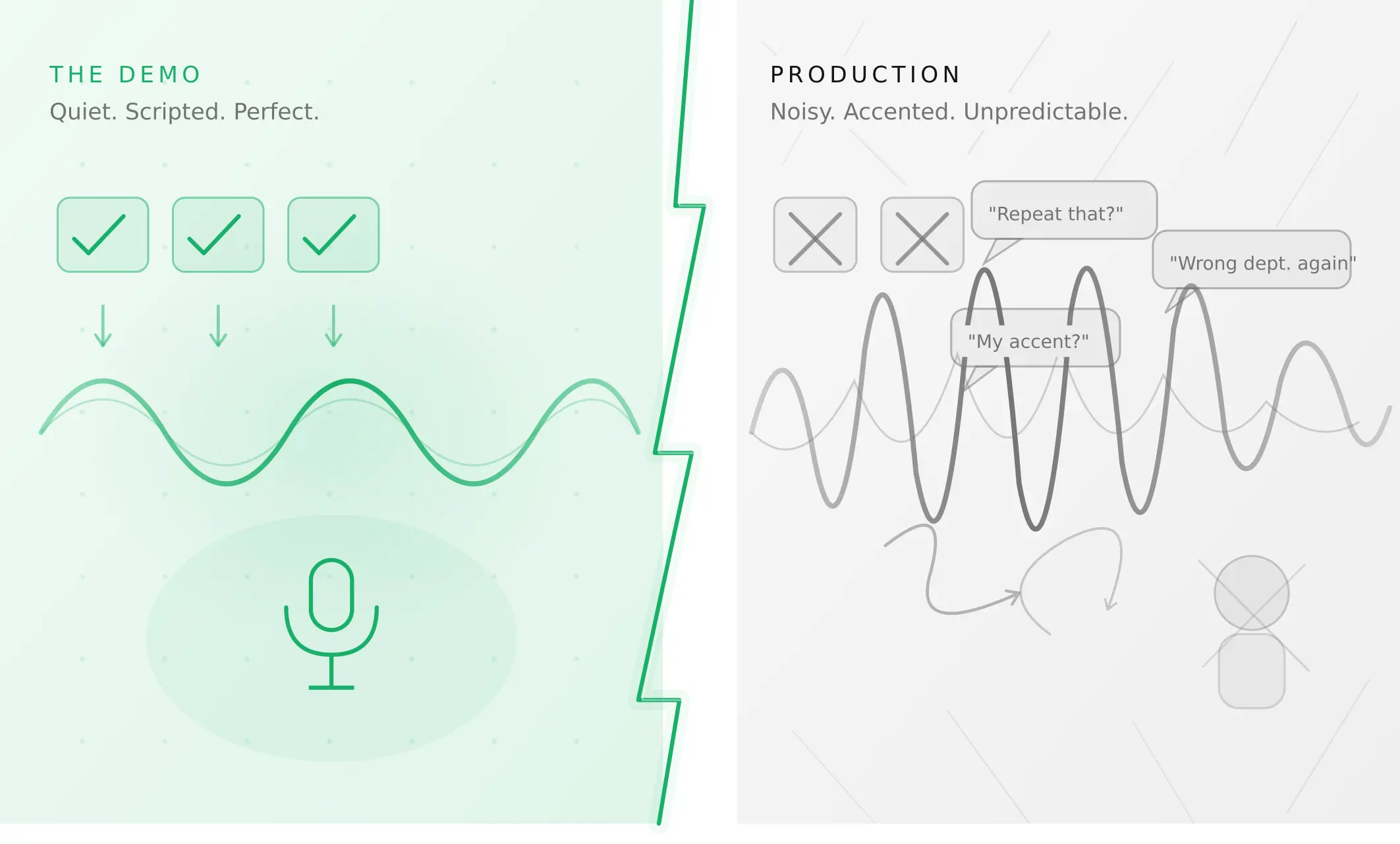
Why AI voice agents fail in production (and how to prevent it)
AI voice agents that ace demos still break in production. Learn the 5 root causes, how to test for each, and what production readiness actually means.
Read more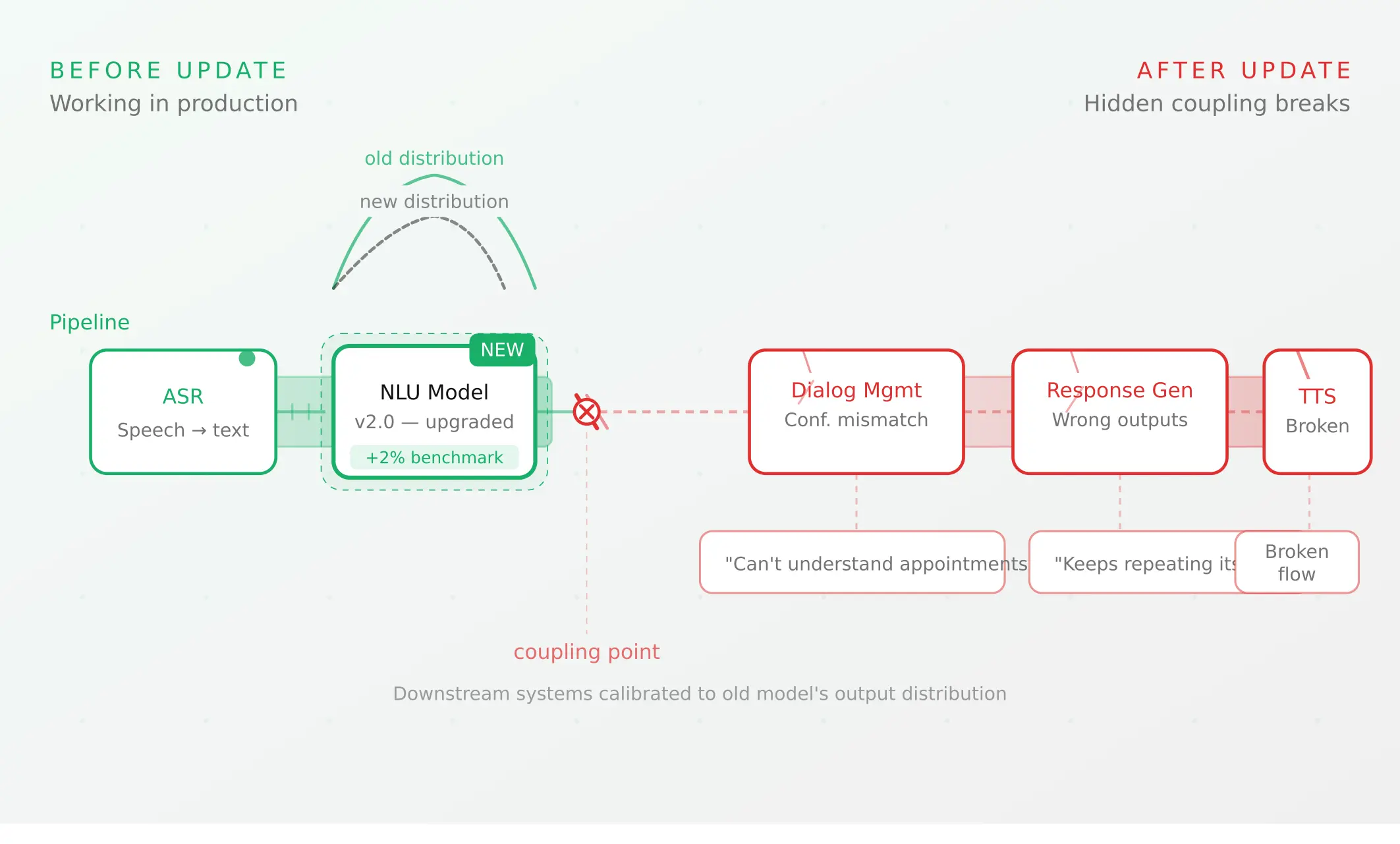
Voice agent regression testing: why LLM updates break production
LLM updates improve benchmarks but break voice agents in 5 predictable ways. How to detect and prevent regressions after every model or prompt change.
Read more