Testing vs evaluation for voice agents: what's the difference?
On this page
"Testing" and "evaluation" get used as if they mean the same thing, and for voice agents the blur causes real confusion about what a team is actually doing. They are related but distinct, and knowing which one you need — a gate that says ship or don't, or a score that says how good — changes how you set it up. Evalgent does both, and this guide draws the line clearly.
Testing: verifying that a voice agent behaves correctly, producing a pass or fail against expected behavior on defined scenarios.
Evaluation: measuring how good a voice agent is, producing a score across quality metrics rather than a binary result.
Testing vs evaluation: the core difference
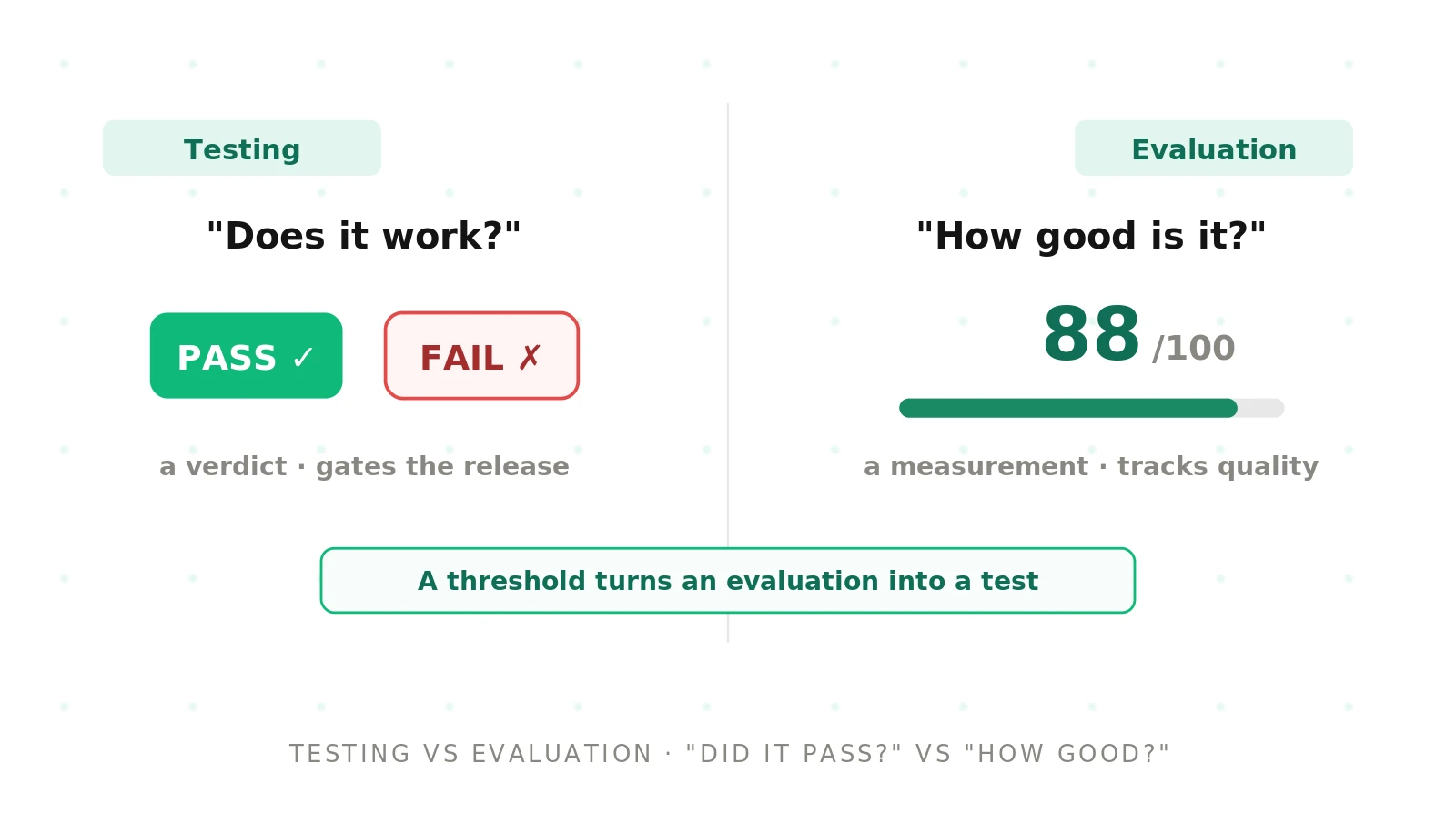
The cleanest way to tell them apart is by the question each one answers. Testing asks "does it work?" and returns a verdict. Evaluation asks "how good is it?" and returns a measurement.
| Dimension | Testing | Evaluation |
|---|---|---|
| Question | Does it work? | How good is it? |
| Output | Pass or fail | A score or metric |
| Purpose | Gate a release | Track and improve quality |
| Cadence | Before shipping a change | Continuous, over time |
| Example | "The agent escalated on request" | "Task completion was 88%" |
Testing is binary by design — a scenario either passed or it did not, and a failure blocks the release. Evaluation is graded — it tells you the agent completed 88% of tasks or hit a word error rate of 6%, which is a measurement, not a verdict. Both matter, and they are not in competition.
How testing and evaluation work together
The reason the two blur is that they are deeply connected: a test is usually an evaluation with a threshold. When you measure task completion and get 88%, that is evaluation. When you add a rule that says "block the release if task completion drops below 85%," that same measurement becomes a test. The score is the evaluation; the threshold turns it into a gate.
In practice you run them together. You drive scenarios (testing), score the outputs with metrics (evaluation), and set thresholds that turn the scores into pass/fail gates. Evaluation without thresholds just measures; testing without evaluation only checks the obvious. This is the heart of eval-driven development, where you define what good looks like as a metric and let it gate every change. For how both sit alongside production monitoring, see testing vs monitoring vs observability.
How to test and evaluate a voice agent
The practical workflow uses both, in order.
1. Define scenarios — Write the realistic calls the agent must handle, including edge cases.
2. Evaluate the outputs — Score each run on metrics: accuracy, latency, task completion, and quality.
3. Set thresholds — Decide the score each metric must hit for the agent to be acceptable.
4. Gate on the thresholds — Turn the evaluations into pass/fail tests that block a release on failure.
5. Track over time — Keep evaluating in production and across changes to watch quality trend, not just pass/fail.
6. Re-test on every change — Re-run the gated scenarios after any prompt, model, or data change.
A worked example
Take one call where a caller asks to cancel an order. The testing view asks: did the agent verify identity, call the cancel tool with the right order, and confirm? Each is a pass or fail, and any fail blocks the release. The evaluation view asks: how natural was the response, how long did it take, did the caller's sentiment stay positive? Those come back as scores. Same call, two lenses — one gives a verdict you can ship on, the other gives quality you can improve. You need both to know the agent both works and works well.
Testing and evaluation with Evalgent
Evalgent runs testing and evaluation as one workflow. Scenarios drive the realistic calls that testing needs, across accents, noise, and edge cases. Metrics evaluate each run — task completion, accuracy, latency, and custom quality scores — turning raw calls into measurements. Thresholds convert those evaluations into pass/fail gates, so the same score that tracks quality also blocks a bad release. Evaluations run the whole suite as automated batches, giving you both the verdict and the trend. Reviews let you inspect any call to see the behavior behind a fail or a low score.
The result is both answers at once: a gate that tells you whether to ship, and a measurement that tells you how good the agent is and whether it is getting better. For the wider discipline, see the AI voice agent testing pillar.
The bottom line
Testing verifies behavior and returns pass or fail; evaluation measures quality and returns a score. Testing gates the release, evaluation tracks how good the agent is, and a threshold is what turns an evaluation into a test.
You need both. An agent that passes every test can still be mediocre, and an agent with great scores can still fail a critical case — only testing and evaluation together tell you it works and works well.
Frequently asked questions
What is the difference between testing and evaluation for voice agents?
Testing verifies that a voice agent behaves correctly, returning a pass or fail against expected behavior on defined scenarios. Evaluation measures how good the agent is, returning scores across quality metrics like accuracy, latency, and task completion. Testing gates releases; evaluation tracks quality over time. The two connect, because a test is usually an evaluation with a pass/fail threshold attached.
Is evaluation the same as testing?
No, though they overlap. Evaluation is measurement — it scores how good the agent is. Testing is verification — it returns a pass or fail against expected behavior. The link is that adding a threshold to an evaluation turns it into a test: a task-completion score becomes a test once you say a release fails below a certain number. Evaluation measures; testing gates.
Do you need both testing and evaluation?
Yes. An agent can pass every test and still be mediocre, and an agent with strong scores can still fail a critical scenario. Testing tells you the agent works on the cases you gate; evaluation tells you how good it is overall and whether quality is trending up or down. Using both is the only way to know it works and works well.
What is an example of testing versus evaluation?
On a cancellation call, testing asks whether the agent verified identity, called the right tool, and confirmed — each a pass or fail. Evaluation asks how natural the response was, how long it took, and whether sentiment stayed positive — each a score. The same call, seen as a gate you ship on and as a quality measurement you improve.
How does evaluation become a test?
By attaching a threshold. A raw evaluation produces a number — task completion of 88%, latency of 400 milliseconds. On its own that is just a measurement. When you add a rule that a release fails if task completion drops below 85% or latency exceeds a ceiling, the evaluation becomes a pass/fail test gate. The score is the evaluation; the threshold makes it a test.
What metrics are used to evaluate a voice agent?
Common evaluation metrics include task completion rate, word error rate for transcription, latency at percentiles, containment or escalation accuracy, and quality scores like naturalness. Which ones matter depends on the use case. Any of them can be turned into a test by setting a threshold, so the metric you evaluate on is often the same one you gate releases with.
Is LLM-as-judge testing or evaluation?
It is evaluation — an automated way to score qualities like helpfulness or groundedness that are hard to check with a simple rule. It produces a graded judgment, not a verdict, so it is measurement. It becomes part of a test when you gate on its score. Use it with care, since it grades language and can miss confident errors, as our LLM-as-judge limits piece explains.
When should you test versus evaluate a voice agent?
Test when you need a go/no-go decision — before shipping a change, as a release gate. Evaluate continuously — to track quality, compare versions, and see whether the agent is improving. In practice you do both together: evaluate to get the scores, then gate on thresholds to test. Testing answers "can we ship?"; evaluation answers "how good is it, and is it getting better?"
Related guides
VAD vs endpointing: what's the difference in a voice agent?
VAD detects whether someone is speaking; endpointing decides when they've finished. Learn the difference and why confusing them cuts callers off.
Interruption vs context in voice agents: what's the difference?
Interruption is a turn-taking event; context is conversational memory. Learn why a caller cutting in tests both, and how to tell which one failed.