Test your voice agent
Voice Agent Testing for Forward-Deployed Engineers
# Voice agent testing for forward-deployed engineers
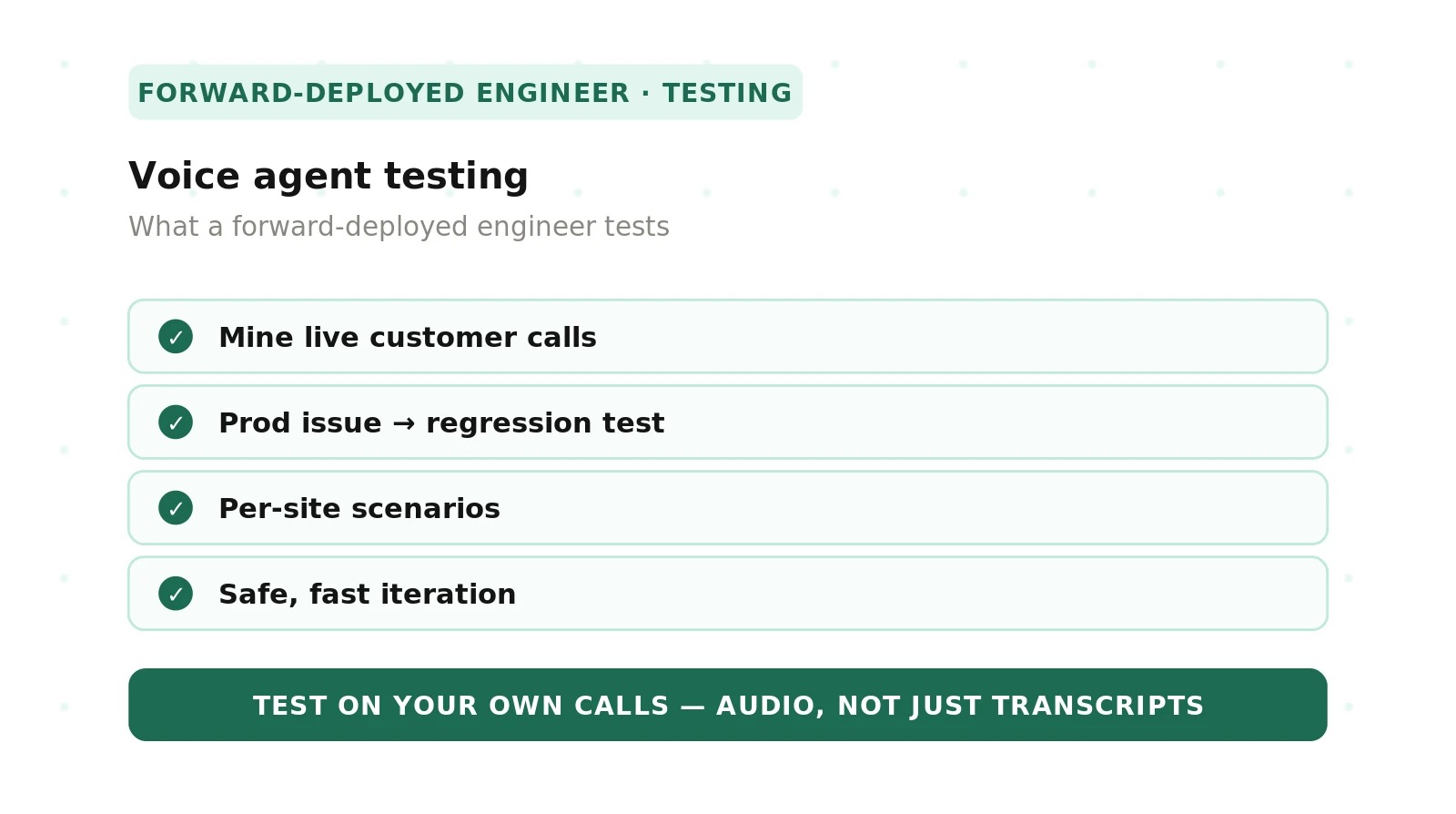
Quick answer: Voice agent testing for a forward-deployed engineer means mining live customer calls for failures, then turning each one into a regression test fast. You iterate on prompts and config in the field, against real traffic, and prove every fix with an independent test before it ships.
A forward-deployed engineer lives at the customer site. You are embedded, post-sale, watching the voice agent handle real callers every hour. The demo is over. The contract is signed. Now the agent has to work on this customer's traffic, with their accents, their edge cases, and their compliance rules.
That job is different from pre-sales work. The solutions engineer proves a concept in a controlled proof of value. You keep it working after go-live, when the caller pool is messy and the stakes are a real customer relationship. Your testing loop has to match that pace.
Forward-deployed engineer: an engineer embedded with a specific customer after the sale, tasked with making the product succeed on that customer's real workload through rapid, on-site iteration.
This post covers the field testing loop for that role. It shows how to mine production calls, convert failures into tests, build per-site scenarios, iterate safely on prompts, and close the loop from monitoring back into your suite.
Why field testing is a different discipline
Testing in the field is not a smaller version of lab testing. It is a different discipline with a different clock.
In the lab, you own the inputs. You write test cases, run them, and read the results. In the field, the inputs arrive whether you are ready or not. Every real call is a test you did not write, run against a version you may have shipped an hour ago.
That inverts the usual order. You do not design the test first and observe the failure second. You observe the failure first, in production, and design the test after. The skill is reading live traffic well enough to catch the failure before the customer escalates it.
Speed matters more here than coverage. A forward-deployed engineer who ships a fix in a day, backed by one solid regression test, beats one who spends a week building a perfect suite. The customer is watching call quality now, not next sprint. This is closer to continuous delivery than to a release train.
But speed without proof is reckless. A prompt tweak that fixes one caller can break three others. So the loop needs a fast, independent check on every change. That is where third-party evaluation earns its place. It answers one question the customer cares about: did this fix actually work, on real calls, without regressing anything else?
For the conceptual split between the two words, see the guide on testing versus evaluation for voice agents. In the field you do both, in tight rotation.
Mining real calls for failures
Your richest test source is the call log in front of you. Every deployed voice agent produces a stream of transcripts, recordings, and metadata. Most of it is fine. A small slice hides the failures worth testing.
The job is to find that slice fast. You are looking for calls where the agent did the wrong thing, said the wrong thing, or took too long to do the right thing. Three signals surface most of them.
First, containment breaks. The agent hands off to a human when it should have resolved the call, or holds a caller it should have escalated. Both are failures, in opposite directions.
Second, silence and latency. Long gaps before a response tell you the agent stalled. High latency is a failure a caller feels even when the words are correct.
Third, sentiment and repetition. Callers who repeat themselves, raise their voice, or ask for a human are telling you the agent missed. These calls cluster around specific intents.
Do not read every call. Sample by signal. Pull the calls with handoffs, the calls over a latency threshold, and the calls flagged by sentiment. That triage turns thousands of calls into a reviewable set of dozens. Structured production monitoring for voice agents makes this sampling routine instead of manual.
The point of mining is not to fix each call by hand. It is to spot the pattern. One caller mangling an account number is noise. Twenty callers failing the same account-number capture is a test you need to write.
From field signal to regression test
The core move of the role is conversion. You take a signal from production and turn it into a repeatable test. Do it once and the failure can never ship silently again.
A regression test locks in a fix. It reproduces the exact condition that failed, asserts the correct behavior, and runs on every future change. When you convert a real call into one, you protect the customer from that failure forever, not just today.
The table below maps common field signals to the test they should become and the failure that test prevents. This is the working reference for the conversion step.
| Field signal (from live traffic) | How to turn it into a test | What the test prevents |
|---|---|---|
| Caller repeats an account number three times | Synthetic caller reads varied digit strings, assert correct capture | Silent data-capture failures on a core intent |
| Agent hands off on a question it can answer | Scenario replays that question, assert self-resolution | Containment drops that inflate human cost |
| Long pause before agent responds | Latency assertion on that turn against a fixed budget | Dead-air moments that make callers hang up |
| Agent gives a non-compliant disclosure | Scripted scenario with an assertion on required language | Regulatory exposure on a specific customer's rules |
| Accent or dialect trips transcription | Synthetic callers across accents on that phrase set | Recognition gaps that hit one region's callers |
| Caller interrupts and agent talks over them | Barge-in scenario, assert the agent yields | Turn-taking failures that feel rude on the phone |
| Agent loops on the same clarifying question | Multi-turn scenario, assert forward progress | Conversational dead ends that force escalation |
Each row starts with something you saw on a real call. Each ends with a test that runs forever. That is the whole discipline compressed into one table.
To generate the varied inputs each test needs, lean on synthetic callers for voice agent testing. One real failure becomes a family of test cases: the same intent across accents, speeds, and phrasings.
How to run a field testing loop as an FDE
This is the loop that keeps a deployed agent healthy without slowing your iteration. Run it as a continuous cycle, not a one-time project.
1. Watch the live signals daily. Pull the day's calls flagged by handoff, latency, and sentiment. Skim the transcripts. Note the clusters, not the one-offs.
2. Reproduce the top failure. Take the most common failure and recreate it as a scenario. Use a synthetic caller so you can run it on demand, without waiting for a real caller to hit it again.
3. Write the assertion. Decide what correct behavior looks like. Assert it precisely: the right data captured, the required disclosure spoken, the response inside a latency budget.
4. Add it to the suite. Commit the new test alongside the existing ones. Your suite grows by one real, earned case every time you close a failure.
5. Change one thing. Edit the prompt, the config, or the routing. Change a single variable so you can attribute the result. This is disciplined A/B testing, not guesswork.
6. Run the full suite independently. Re-run every test, not just the new one, through an independent evaluator. Confirm the fix works and nothing else regressed.
7. Ship behind a guard. Roll the change to a slice of traffic first. Watch the same live signals to confirm the fix holds on real calls.
8. Feed the result back in. New failures from the guarded rollout re-enter at step one. The loop never ends; it just gets tighter.
The loop is deliberately small. Each pass should take hours, not weeks. Speed comes from reusing the same synthetic callers and the same assertions, so only the changed variable is ever in question.
Per-site custom scenarios
Every customer site is its own test surface. A generic suite will not catch what breaks at this site, because this site has its own callers, data, and rules.
A forward-deployed engineer builds scenarios that reflect the deployment in front of them. A healthcare intake line needs scenarios with insurance IDs and appointment logic. A collections line needs scenarios with dispute language and required disclosures. The same agent, two sites, two suites.
Start from the customer's real intents. List the top call reasons from their traffic. Build a scenario per reason, then add the edge cases you found by mining calls. This is how you benchmark voice agents on your own data rather than on a vendor's generic set.
Custom scenarios also carry the customer's rules. If this site must read a specific disclosure, that language becomes an assertion. If this site routes VIP callers differently, that routing becomes a test. The suite encodes the contract, so a prompt change can never quietly violate it.
Keep the site suite versioned next to the customer's config. When you hand off the account or rotate out, the next engineer inherits a living record of what this site needs and why each test exists.
Iterating safely on prompts and config
Rapid iteration is the job, but rapid means safe, not careless. The failure mode is fixing one caller's problem while breaking another's. Independent evaluation is how you avoid it.
Change one variable at a time. A prompt edit and a routing change in the same deploy make attribution impossible. If quality moves, you will not know which change moved it. One variable per pass keeps the feedback loop clean.
Run the full suite before every ship. It is tempting to run only the new test, but regressions hide in the tests you did not re-run. The whole point of building the suite is that it re-runs cheaply. Use it.
Guard the rollout. Send the change to a small slice of live traffic first, then widen it as the signals hold. This borrows the canary pattern from continuous delivery: expose the change to real callers gradually, with a fast path back if it degrades.
Keep an independent scorer in the loop. A vendor's own dashboard has an incentive to look good. An independent voice AI evaluation has an incentive to be right. When you tell the customer a fix worked, you want that claim to come from a third party, not from the tool you are tuning.
For failures that only appear under pressure, add load. Some regressions surface only at concurrency. Stress testing your voice AI catches the ones that hide until many callers hit the agent at once.
Closing the loop from monitoring to test suite
The last discipline is the one that compounds. Every production incident should end as a test. If it does not, the same failure will return.
This mirrors mature incident management. A good incident process does not stop at the fix. It asks what would have caught this earlier and builds that check. Google's postmortem culture formalizes the idea: the deliverable of an incident is a durable safeguard, not just a restored service.
For a voice agent, the durable safeguard is a test. When a caller hits a failure the customer notices, you fix it, and then you convert it. The convert step is not optional cleanup. It is the reason the same failure never recurs.
This is what turns monitoring from an alarm into a memory. Observability) tells you something broke. The test suite remembers that it broke and blocks it from breaking again. Monitoring without conversion is a bell that keeps ringing. Monitoring with conversion is a suite that keeps growing stronger.
Over a deployment's life, the suite becomes the customer's institutional knowledge. Every real failure they ever hit is encoded as a test that runs on every change. That is the asset a forward-deployed engineer leaves behind, and it is worth more than any single fix.
The foundational patterns here apply to any deployment. The pillar on AI voice agent testing and the broader voice agent evaluation guide cover the methods that this field loop specializes.
Where the FDE role sits among the others
The forward-deployed lens is one of several. Each role tests the same agent from a different position, and the suites overlap more than they differ.
The solutions engineer proves the concept before the sale. You take over after it, on live traffic. The engineering manager owns the process across many deployments, while you own the depth of one. The QA engineer and QA lead build the rigor your field tests borrow from.
The product manager decides what good means, the conversation designer shapes the dialogue you are testing, and the founder cares whether the whole thing holds together. Your job connects all of them to one customer's real calls.
Frequently asked questions
What is voice agent testing for a forward-deployed engineer?
Voice agent testing for a forward-deployed engineer is field testing done at the customer site after the sale. You mine live calls for failures, convert each into a regression test, and iterate on prompts and config against real traffic. An independent evaluator confirms every fix before it reaches more callers.
How is field testing different from pre-sales testing?
Field testing runs on real customer traffic after go-live, not on curated demo scenarios. You observe failures in production first, then design tests to catch them. Pre-sales work proves a concept in a controlled proof of value. The forward-deployed engineer keeps that concept working once the caller pool is messy and unpredictable.
How do I turn a production call into a regression test?
Reproduce the failing call as a scenario, usually with a synthetic caller so you can run it on demand. Write a precise assertion for correct behavior: the right data captured, the required disclosure spoken, or a response inside a latency budget. Commit it to your suite so every future change re-runs it automatically.
Which live call signals should I watch first?
Watch three signals daily. Containment breaks show handoffs the agent could have resolved. Latency and silence show stalls callers feel. Sentiment and repetition show callers who missed an answer or asked for a human. Sample by these signals instead of reading every call, and act on clusters rather than one-off failures.
How do I iterate on prompts without breaking other callers?
Change one variable per pass so you can attribute any quality shift. Run the full test suite through an independent evaluator before every ship, not just the new test. Then guard the rollout: send the change to a small slice of live traffic first, widen it as signals hold, and roll back fast if quality drops.
Why use independent evaluation instead of the vendor dashboard?
A vendor's own dashboard has an incentive to look good, which undermines trust when you report results to a customer. Independent evaluation scores the agent on your own calls with no stake in the outcome. When you tell a customer a fix worked and nothing regressed, that claim carries more weight from a neutral third party.
What are per-site custom scenarios and why do they matter?
Per-site custom scenarios are tests built from one customer's real intents, data, and rules. A healthcare line needs insurance and appointment logic; a collections line needs dispute language and disclosures. Generic suites miss what breaks at a specific site. Custom scenarios encode that site's contract, so a prompt change cannot quietly violate its requirements.
How does monitoring feed back into the test suite?
Every production incident should end as a test. Fix the failure, then convert it into a regression test that runs on every future change. Monitoring alone is an alarm that keeps ringing. Monitoring plus conversion builds a suite that remembers each failure and blocks it from recurring, turning one deployment's incidents into durable institutional knowledge.
The bottom line
Voice agent testing for a forward-deployed engineer is a loop, not a project: mine live calls, convert failures into tests, iterate on one variable, and prove each fix independently before it ships. The suite you build from real incidents becomes the customer's durable safeguard, growing stronger with every failure you close.
Ready to iterate on real customer calls with an independent evaluator in the loop? Book a demo and see how Evalgent turns production failures into regression tests fast.
Related Articles
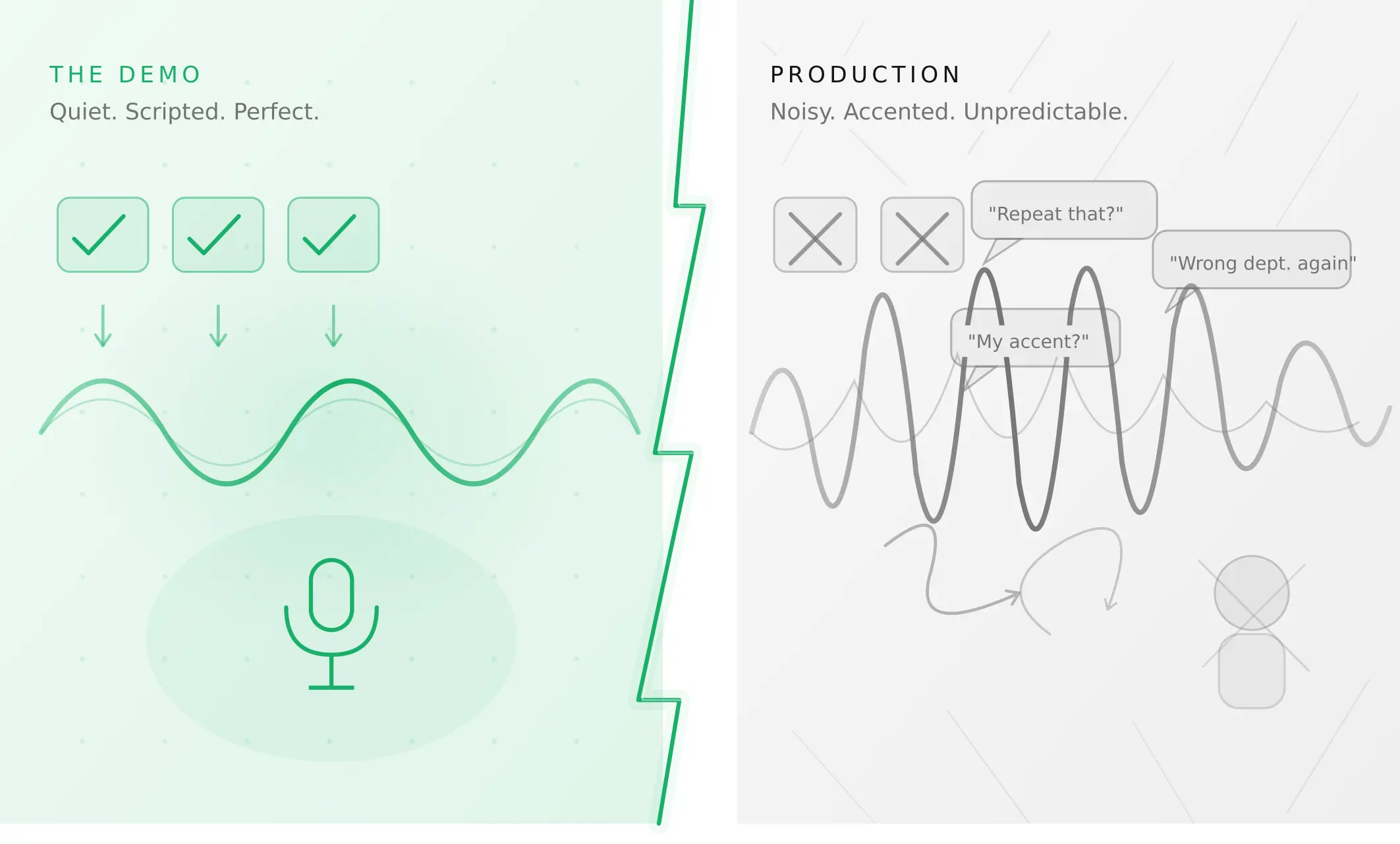
Why AI voice agents fail in production (and how to prevent it)
AI voice agents that ace demos still break in production. Learn the 5 root causes, how to test for each, and what production readiness actually means.
Read more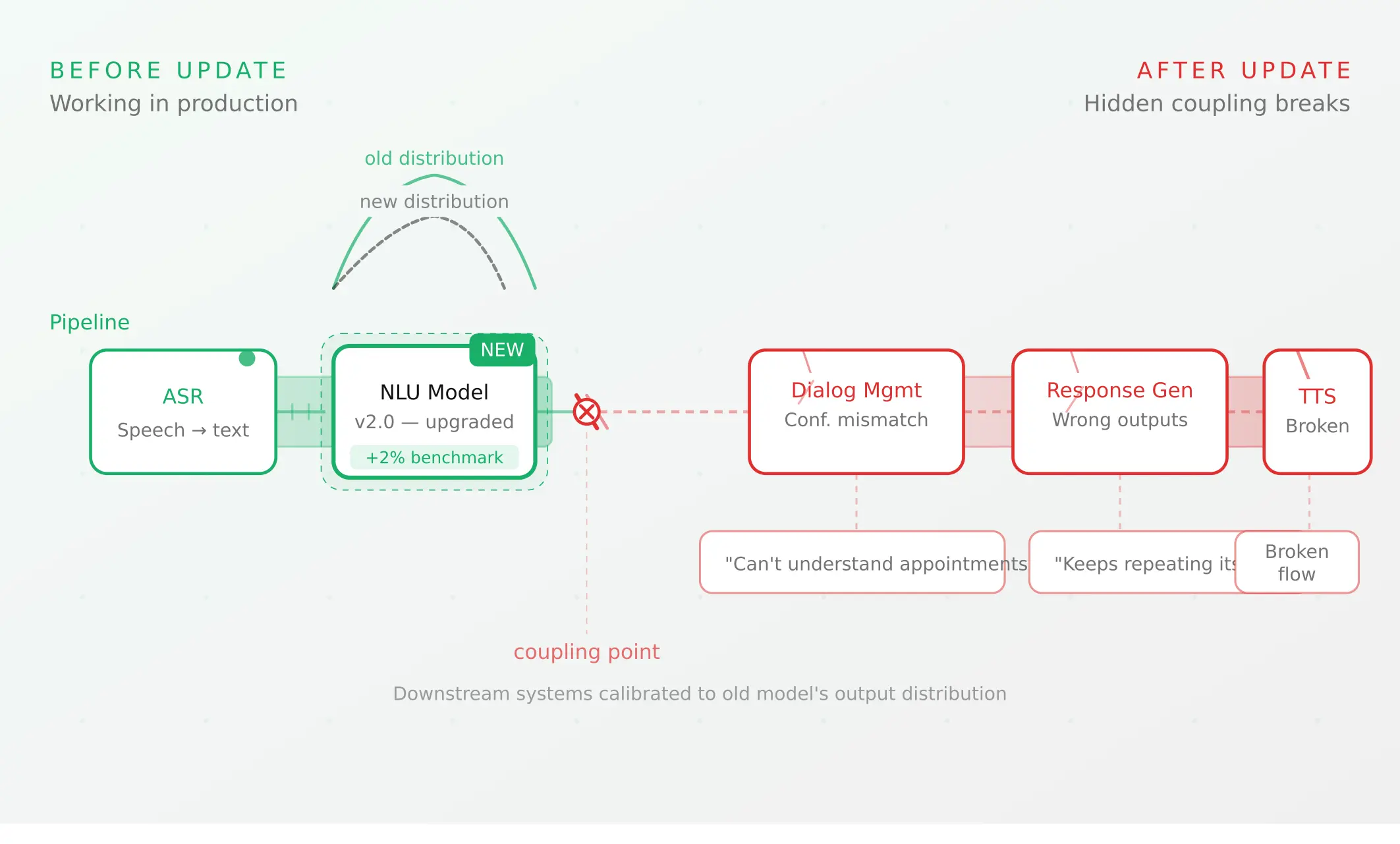
Voice agent regression testing: why LLM updates break production
LLM updates improve benchmarks but break voice agents in 5 predictable ways. How to detect and prevent regressions after every model or prompt change.
Read more