Conversational AI testing: the complete voice agent stress testing guide
On this page
Your voice agent works flawlessly in every demo. Clear audio, cooperative users, scripted conversation paths, patient testers who wait for prompts. Everything succeeds.
Then a user with a strong regional accent calls from a factory floor. Another interrupts every response. A third asks three questions in a single breath. None of them complete the interaction. None of them were in the test script.
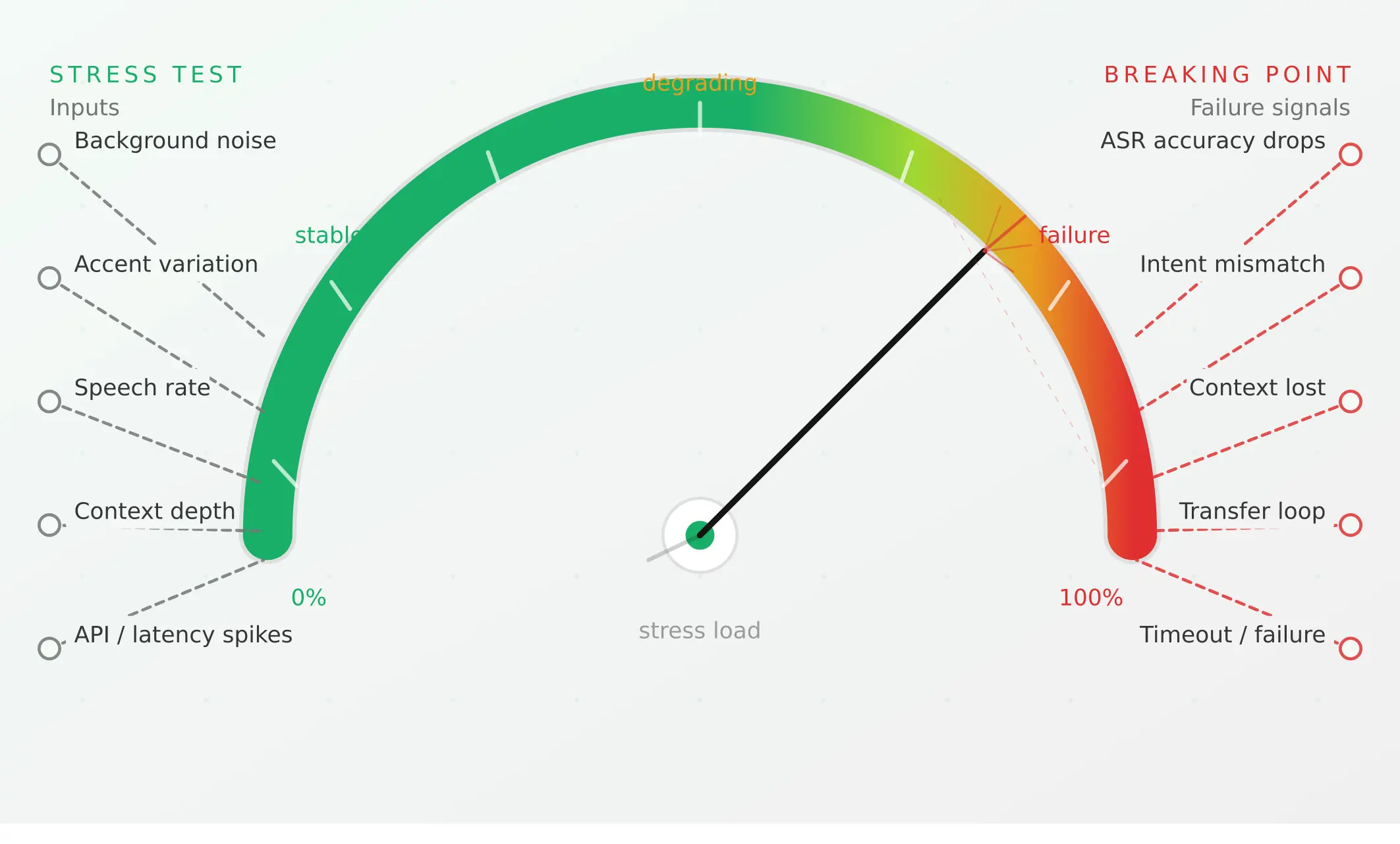
Conversational ai testing that only covers happy paths validates capability. It does not reveal resilience. Every voice agent has a set of boundaries — noise thresholds, speech rate limits, context depth ceilings, latency tolerances — where performance transitions from reliable to degraded to broken. Voice agent stress testing is the practice of finding those boundaries systematically, before production traffic does it for you.
This guide covers what voice agent stress testing is, how to run it across each failure dimension, how to map the voice agent degradation zones that matter for production ai voice agent performance, and how to build a testing practice — ai for testing that actually reflects real-world conditions — that scales with your deployment.
What is voice agent stress testing?
Voice agent stress testing is a form of conversational ai testing that deliberately applies conditions beyond normal operating parameters to identify the exact points at which agent performance degrades. Unlike functional testing — which verifies that an agent handles expected inputs correctly — voice agent performance testing asks: how far can conditions deviate from ideal before this agent breaks?
The answer defines the agent's production envelope and its voice agent resilience boundary. Every voice ai test reveals a different edge of that envelope. The only variable is whether you find those edges before deployment or after.
Voice agent stress testing operates across five distinct dimensions: acoustic conditions, speech patterns, conversational dynamics, input edge cases, and system infrastructure. Each dimension has its own degradation curve and its own set of thresholds that matter for production reliability.
Voice agent breaking points are not always binary failures. Voice agent degradation moves through four zones:
- Zone 1 — Robust: The agent handles inputs reliably. Errors are rare and self-correcting.
- Zone 2 — Graceful degradation: Accuracy decreases but the agent remains usable. It asks for clarification more often, takes longer to respond.
- Zone 3 — Unreliable operation: Errors become frequent. Task completion drops. Users notice problems.
- Zone 4 — Breakdown: The agent fails completely — misunderstanding nearly everything, looping, or producing nonsensical outputs.
Stress testing maps these voice agent degradation zones for each dimension. This is what speech test ai methodology looks like in practice — not a pass/fail judgment but a degradation curve that reveals exactly where each condition crosses from acceptable to unacceptable.
The table below shows how each stress dimension maps to the components it primarily tests and the measurable signal that indicates a breaking point has been crossed.
| Stress dimension | Primary component tested | Breaking point signal |
|---|---|---|
| Acoustic / noise | ASR (STT layer) | WER exceeds 12% at target SNR |
| Codec / telephony | ASR + audio pipeline | WER degrades >5% vs WebRTC baseline |
| Speech rate | ASR + intent classification | Intent accuracy drops below 80% |
| Accent / dialect | ASR + NLU | Task completion rate drops by accent group |
| Disfluency | Intent classification | Misclassification rate rises above 15% |
| Barge-in / interruption | VAD + turn detection | Context loss rate exceeds 10% |
| Context depth | LLM context window | Reference resolution fails at N turns |
| Multi-intent | NLU + dialogue management | Partial completion or intent drop rate |
| Latency injection | Full pipeline | P95 exceeds 800ms; barge-in increases |
| Failure injection | Error handling layer | Recovery failure rate / silent failures |
| Concurrency / load | Infrastructure + rate limits | P95 degradation; error rate increase |
Dimension 1: acoustic stress testing
Acoustic stress is the most direct form of conversational ai testing for voice agents. Sound is the medium. Degrading the acoustic signal reveals how quickly the ASR layer breaks under real-world conditions.
Background noise injection
Most voice agent training data comes from clean studio recordings. Production calls do not. Test with realistic noise profiles across four environments: office (keyboard, HVAC, background conversations), outdoor (traffic, wind, crowds), home (television, children, appliances), and industrial (machinery, alarms, vehicles).
The critical variable is not noise type alone — it is noise intensity. Test each profile at three SNR levels: quiet (~45 dB), moderate contact-centre ambient (~65 dB), and high-noise street (~75 dB). Deepgram's State of Voice AI 2025 benchmarks show background noise at contact-centre levels (55–65 dB SNR) reduces ASR accuracy by 15–30% depending on model and codec. Deepgram Nova-3 achieves 6.84% WER on clean audio — that number rises significantly under realistic conditions.
The question voice agent performance testing answers is: at which SNR level does your WER cross the threshold where task completion begins to fail? That is your acoustic breaking point. Without how to test voice agent with background noise as an explicit testing practice, this threshold is invisible until users discover it.
Codec and bandwidth stress
Conversational ai testing that only uses browser WebRTC misses real telephony conditions. Test with audio processed through narrowband telephony (300–3400 Hz, standard PSTN/SIP), VoIP compression with codec artefacts and packet loss simulation, Bluetooth degradation, and poor cellular jitter. An agent trained on wideband audio may degrade significantly on narrowband PSTN. If your deployment involves phone calls — and most production voice agent deployments do — all acoustic stress tests must use audio processed through the actual telephony path.
The caller profiles in Evalgent let you configure eight behavioural parameters per synthetic caller including noise level and acoustic conditions, enabling systematic acoustic stress testing across any combination.
Dimension 2: speech pattern stress testing
Speech pattern stress is conversational ai testing that explores the variation in how people speak — independent of what they say. Even when intent is clear, how users express it can break the ASR layer or intent classification.
Speech rate variation
Test at four rates relative to your training baseline: 0.8× (slow), 1.0× (baseline), 1.25× (moderately fast), 1.5× (fast — upper range of normal speech). Many ASR systems degrade measurably above 1.25× average rate. Identifying where accuracy drops below acceptable levels is essential for deployments targeting fast-speaking demographics.
Accent and dialect coverage
How to test voice agent with different accents requires a systematic approach. Map the accent profiles in your target user base, then test against each explicitly.
For India — one of the fastest-growing voice AI markets — coverage must include regional English variation, code-switching between Hindi or regional languages and English, and pacing patterns that differ structurally from the Western English on which most ASR models are predominantly trained. Accent failures are both common and inequitable. An agent that works for 90% of users but fails for a specific accent group has a voice agent reliability problem that aggregate metrics never surface. Deepgram and Sarvam's STT models offer India-specific training — accent stress testing will reveal whether your current STT choice handles your user base.
Disfluency injection
Natural speech includes filled pauses ("um," "uh"), false starts ("I want to — actually, can I—"), repetitions, and incomplete sentences. Test with disfluency injection at increasing rates. An agent that fails when users say "uh, actually wait, let me — can I reschedule?" has a speech pattern stress vulnerability clean-text testing will never find.
Dimension 3: conversational stress testing
Conversational stress is the dimension of conversational ai testing most aligned with how people actually talk — not the acoustic signal, but the dynamics of dialogue itself.
Voice agent barge-in testing
Voice agent barge-in testing evaluates how the agent handles user interruptions during its own responses. Barge-in is among the most common and damaging real-world failure modes. Users interrupt constantly — before the agent finishes, mid-sentence, repeatedly, with corrections.
A well-functioning implementation requires Silero VAD (or equivalent) detecting the interruption within 50–100ms, the agent stopping speech immediately, and conversation context being preserved. Test at: early interruption (200ms after agent begins); mid-sentence; rapid successive interruptions; and corrections referencing two turns back.
Pipecat's Smart Turn model processes audio in approximately 65ms to determine turn completion — among the lowest-latency turn detection implementations available. ElevenLabs' TTS streaming must also handle barge-in cleanly, stopping without artefacts. Test both layers under barge-in stress.
Context depth testing
Test how many turns of context your agent maintains reliably: 2-turn references ("Book that one"), 5-turn references ("The first option you mentioned"), and 10-turn references ("Go back to the flight times you mentioned"). Context degradation typically begins at 3–5 turns and becomes pronounced at 7–10.
Multi-intent utterances
Real users combine requests: "Check my balance and transfer £100 to savings." "What time is my appointment and can I reschedule it?" Multi-intent utterances, conditionals, and mid-sentence corrections are normal conversational behaviour, not edge cases. Conversational ai testing that excludes them is not testing realistic conversational AI conditions.
Dimension 4: input edge case testing
Input edge cases are the long tail of conversational ai testing that matters at scale. At 10,000 daily calls and 99% success, that is 100 failures per day — most in this dimension.
Test with inputs most consequential for your domain: unusual names and identifiers; amounts with common transcription errors ("fifteen" vs "fifty"); ambiguous temporal references ("next Friday," "last time I called"); and domain-specific terminology likely under-represented in general ASR training data.
For adversarial inputs — gibberish, complete silence, extreme volume, multiple simultaneous speakers, non-speech audio — the test question is: does the agent fail gracefully with a recovery message, or does it loop, hallucinate, or time out silently? The answer defines voice agent robustness at the input boundary.
Dimension 5: system stress testing
System stress is the conversational ai testing dimension that shifts from human behaviour to infrastructure — testing what happens when the technical components your voice agent depends on degrade or fail.
Voice agent latency stress test
A voice agent latency stress test evaluates how the agent behaves when components respond more slowly than normal. Add artificial delays: ASR +200ms/+500ms/+1000ms; LLM inference +300ms/+1000ms/+2000ms; TTS +100ms/+300ms; downstream API calls up to timeout. According to ITU-T G.114, one-way audio delay above 150ms begins affecting conversation quality. Always measure P50, P90, P95, and P99 — averages hide the worst user experiences.
Failure injection
Your error handling is invisible until something fails. Test deliberately: STT returns no transcript; LLM takes 10 seconds; TTS fails mid-sentence; CRM or booking API returns 500. Does the agent communicate the problem clearly and offer recovery, or does it produce silence or loop? Every voice agent built on Vapi, Retell, or LiveKit should have explicit failure injection testing before production launch.
Voice agent concurrency testing
Voice agent concurrency testing evaluates performance under simultaneous load. Test at 1×, 2×, and 5× expected peak call volume. Watch for P95 latency degradation, error rate increases, and rate limit failures from LLM or TTS providers — ElevenLabs has documented character-budget exhaustion failures at scale that produce silent call failures. Bluejay's stress testing methodology covers 500+ behavioural variables simultaneously and recommends soak testing at 50% capacity for 24 hours to catch memory leaks and connection pool exhaustion. Hamming's 4-layer framework treats system stress as the infrastructure layer that all other quality layers depend on.
Building a conversational AI testing practice: a 5-step checklist
Stress testing delivers the most value as a continuous discipline, not a one-time pre-launch exercise. Here is the five-step framework for building it into your development cycle.
1. Map your production distribution first. How to stress test a voice agent effectively starts here — before designing tests, document the acoustic environments, accent profiles, and edge cases your agent will actually encounter. The voice agent breaking points methodology is only as good as the production reality it is grounded in.
2. Define breaking point thresholds for each dimension. Establish explicit pass/fail criteria before running tests. Typical thresholds: WER must not exceed 12% under target acoustic conditions; task completion must remain above 85%; P95 latency must stay below 800ms; escalation rate must stay below 15%.
3. Run parameterised scenarios across the full stress space. Structure tests with adjustable parameters — noise type, noise level, speech rate, accent profile. A single appointment booking scenario across three noise levels × four accent profiles × three speech rates produces 36 data points that map the voice agent reliability surface of that scenario.
4. Map degradation, not just failures. The output should be a voice agent degradation map: at which SNR does WER cross 12%? At which speech rate does intent accuracy drop below 80%? This makes production failure patterns predictable rather than surprising.
5. Feed breaking points back into regression testing. Every breaking point found in stress testing becomes a permanent regression test case. This is how stress testing and regression testing compound — each cycle sharpens the suite. Use synthetic callers to run this at scale automatically on every change.
From stress testing to improvement
Finding breaking points is only the first half. The second half is knowing what to do with them.
Acoustic breaking points — address through ASR-layer work: training data augmentation with matched noise profiles, noise-robust model selection, and audio preprocessing before the ASR layer receives the signal.
Speech pattern breaking points — address through STT model selection and confidence-based fallback triggers ("I didn't catch that — could you repeat?") and disfluency-tolerant endpointing in the VAD layer.
Conversational breaking points — address through context window extension, explicit state tracking for multi-turn references, and clarification strategies that recover gracefully rather than loop.
System breaking points — address through latency budget allocation across the pipeline, provider fallback logic, and rate limit management for TTS providers — a common and often-missed failure mode that transcript analysis never surfaces.
Not all breaking points are equally urgent. Prioritise by frequency of the condition in production and severity of failure when it occurs.
Summary
Voice agent stress testing is systematic conversational ai testing that maps where performance degrades across acoustic, speech pattern, conversational, edge case, and system stress dimensions. Every voice agent has breaking points. Conversational ai testing that maps those boundaries — rather than discovering them through user complaints — is the foundation of deliberate, confident deployment at scale.
Frequently asked questions
What is voice agent stress testing?
Voice agent stress testing is conversational ai testing that deliberately applies conditions beyond normal parameters — background noise, fast speech, repeated interruptions, high concurrency — to find where performance degrades. It maps the agent's breaking points across five dimensions: acoustic, speech pattern, conversational, input edge cases, and system stress. The output is a degradation map, not a binary pass/fail result.
How do I stress test a voice agent?
Structure tests as parameterised scenarios across acoustic profiles, speech rates, and accent combinations. Cover all five dimensions: inject noise at 45 dB, 65 dB, and 75 dB SNR; test speech rates from 0.8× to 1.5×; test barge-in at early, mid-sentence, and successive interruption points; inject latency at each pipeline stage; run concurrency tests at 2× and 5× expected peak volume.
What is voice agent barge-in testing?
Voice agent barge-in testing evaluates how an agent handles user interruptions during its own speech. It tests whether Silero VAD or equivalent detects the interruption within 50–100ms, whether TTS output stops cleanly, and whether the agent maintains conversation context after the interruption. Test at early interruption (200ms after agent starts speaking), mid-sentence, and rapid successive interruptions.
How does background noise affect voice agent performance?
Background noise reduces ASR word error rate by degrading the signal-to-noise ratio. At contact-centre ambient levels (55–65 dB SNR), Deepgram's benchmarks show transcription accuracy drops 15–30% depending on the model. A 5% WER increase compounds through intent classification and task completion downstream. Testing must cover quiet (~45 dB), moderate (~65 dB), and high-noise (~75 dB) profiles.
What is voice agent concurrency testing?
Voice agent concurrency testing evaluates performance when the agent handles many simultaneous calls. Test at 1×, 2×, and 5× expected peak call volume. Watch for P95 latency degradation, error rate increases, LLM or TTS provider rate limit failures, and context corruption under load. An agent handling 10 concurrent calls reliably may fail at 100 — concurrency testing finds that threshold before production does.
What metrics define a voice agent's breaking point?
Key thresholds: WER above 12% indicates the acoustic or speech stress boundary has been crossed; task completion below 85% signals a functional breaking point; P95 latency above 800ms degrades conversational naturalness per ITU-T G.114 standards; escalation rate above 15% indicates the agent is losing user trust. Any metric crossing its threshold under specific stress conditions identifies that condition as a breaking point.
How is voice agent stress testing different from regression testing?
Stress testing finds the boundaries of performance under new or extreme conditions — mapping where the agent degrades. Regression testing verifies that previously passing scenarios still pass after a system change. They are complementary: stress testing discovers breaking points, regression testing ensures those breaking points do not move unexpectedly after updates. Breaking points found in stress testing become permanent regression test cases.
How do I test voice agent accent coverage?
Map the accent profiles in your target user base — do not assume. Configure synthetic caller profiles for each group, run the same scenarios across all profiles, and track WER and task completion separately per profile. Accent failures are invisible in aggregate metrics. For Indian deployments, include regional English accents, Hinglish code-switching, and state-specific pacing that differs from Western-trained ASR baselines.
Related Articles
ElevenLabs voice agent testing guide: what to check before going live
Test your ElevenLabs voice agent before launch: scenario gaps, real user behaviour, tool calls, concurrency limits, and voice-quality regression.
Read more
Vapi voice agent testing guide: what to check before going live
Test your Vapi voice agent before going live. Covers BYOK costs, Squads handoff gaps, webhook failures, and prompt regression before real users find them.
Read more