Test your voice agent
Voice Agent Testing for QA Leads
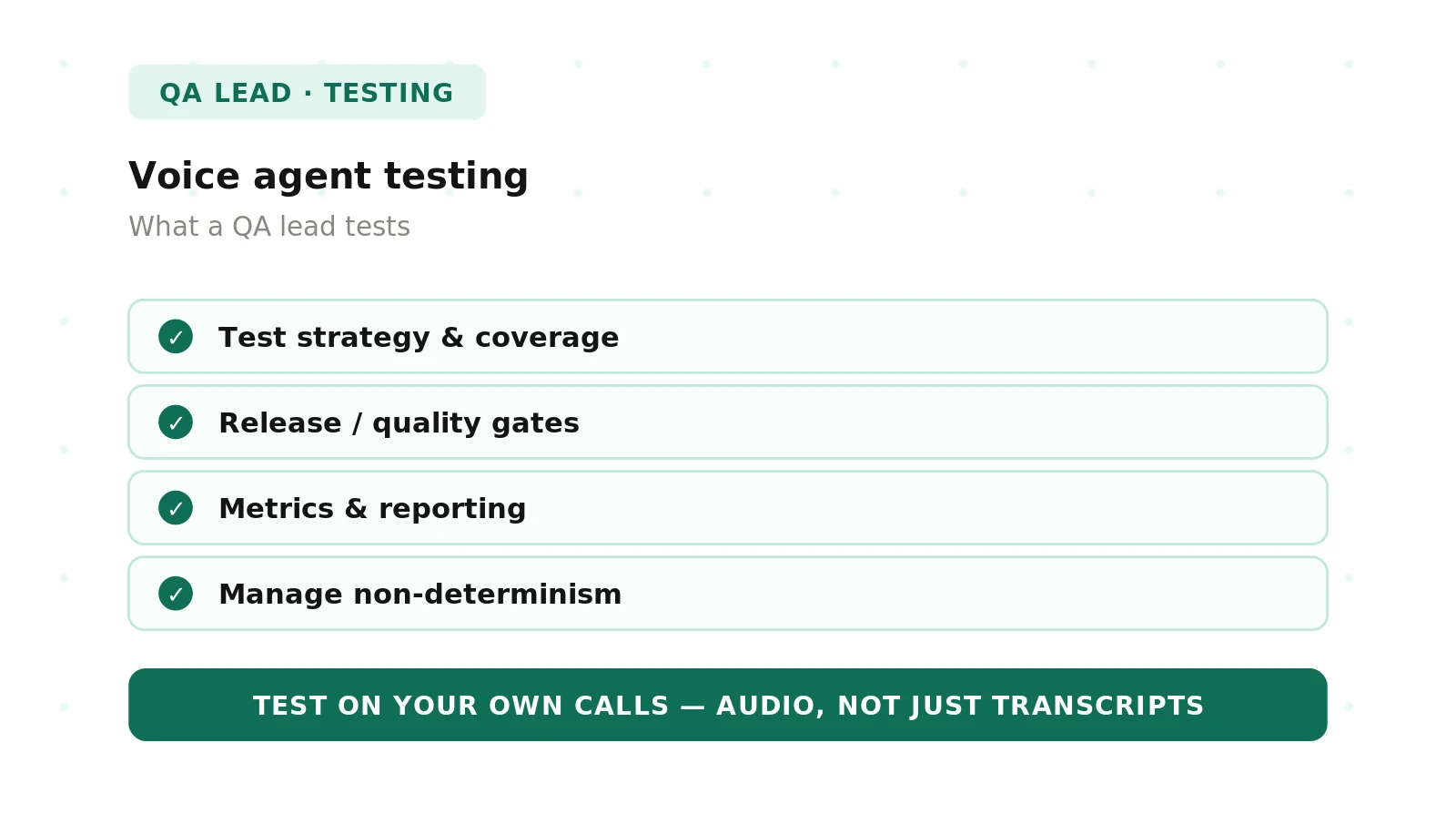
# Voice agent testing for QA leads
Quick answer: Voice agent testing for a QA lead is owning the strategy, not the keystrokes: defining coverage, setting release gates with numeric pass bars, choosing metrics, and reporting risk to stakeholders. You decide what "ready" means, who owns each gate, and how non-determinism gets measured — then hold every release to that line.
A QA engineer runs the test. A QA lead decides which tests exist, what counts as a pass, and whether the release ships. That is a different job, and voice agents make it harder than any web app you have owned before. The output is non-deterministic, the input is messy audio, and "it worked in the demo" is the most dangerous sentence in the project.
This post is the QA-lead lens on voice agent testing: coverage and test strategy, release and quality gates, metric selection, reporting, managing non-determinism across a whole team, and prioritizing risk. If you want the hands-on execution view, read the companion post on voice agent testing for QA engineers. For the full discipline, start from the voice agent testing pillar.
Why the QA lead owns the definition of "ready"
On a deterministic system, "ready" is close to a fact. The tests pass or they do not. On a voice agent, "ready" is a probability distribution, and someone has to decide where to draw the line on it. That someone is the QA lead.
Leave the line undrawn and it gets drawn for you — by a launch date, by whoever ran the last demo, by the loudest person in the room. Your job is to fix the target before the deadline pressure distorts it. That is the essence of a test strategy: a written statement of what you will test, what you will not, and what standard the result must meet.
The strategy also makes quality defensible. Instead of "it felt good in review," you can tell leadership, security, and procurement "it cleared every gate on our own call data." Numbers travel across the org in a way that gut feel never does. And a written standard guards every future release, not just the first — the same gate that clears launch catches the regression a model swap introduces three months later.
Coverage: what a voice agent test strategy has to span
Coverage planning is where QA leads earn their title. The failure mode is testing the happy path deeply and everything else not at all. A voice agent breaks in the places you did not think to look, so the coverage map matters more than the depth on any one path.
Plan coverage across these axes, and write the map into your test plan so the team tests against a shared target:
- Task scenarios. Every intent the agent claims to handle, plus the handoffs between them. Coverage is measured against intents, not scripts.
- Audio conditions. Accents, dialects, background noise, cross-talk, poor connections, and speakerphone. Clean studio audio is the least representative test you can run.
- Conversation dynamics. Interruptions, corrections, mid-sentence topic changes, silence, and callers who talk over the agent.
- Edge and adversarial cases. Out-of-scope requests, prompt injection, attempts to extract data, and inputs designed to break policy.
- Load. Behavior at peak concurrency, because accuracy and latency both drift under load — see stress testing voice AI.
- Safety and compliance. Refusals, escalation, disclosures, and data handling for your regulatory context.
You will never test all of this exhaustively, and pretending otherwise wastes the team. The discipline is deciding, deliberately, where you accept thin coverage and recording that decision as a known risk. Test coverage on a probabilistic system is a risk-allocation exercise, not a percentage you chase to 100.
Choose metrics before you choose tools
A metric your stakeholders do not understand is a metric you will end up defending instead of using. Pick a small set that maps to outcomes, and define exactly how each is measured before the first test runs. The scorecard discipline is covered in depth in the voice agent metrics scorecard.
Task success is the headline metric. An agent can transcribe every word correctly and still fail the call, so task success outranks any component metric. Accuracy on the entities your tasks depend on — names, amounts, dates, account numbers — matters more than a clean-audio word error rate. Latency is read at the tail using a percentile, because the average hides the calls that felt broken. Escalation accuracy tells you whether stuck callers reach a human instead of a loop. Safety pass rate is close to non-negotiable for regulated work.
Resist the pull of vanity metrics. "95% transcription accuracy" sounds great and tells a stakeholder nothing about whether callers got what they called for. For the difference between measuring components and judging the whole experience, read testing vs evaluation for voice agents.
Release and quality gates: the QA lead's core artifact
A quality gate is a checkpoint in your release management process where a specific, measured condition must hold or the release does not advance. For voice agents, each gate pairs a metric with a numeric threshold and — this is the part teams skip — a named owner. An unowned gate is a suggestion, not a gate.
The table below is a starting set of gates for a general customer-facing agent. Treat the thresholds as defaults to adapt to your use case and risk tolerance, not universal law. What should not change is the shape: every gate has a threshold, an owner, and a clear answer to "does missing this block the release?"
| Quality gate | Metric / threshold | Owner | Blocks release? |
|---|---|---|---|
| Task success | Success rate >= 85% on representative calls | QA lead | Yes |
| Critical-entity accuracy | Entity error <= 5% | QA engineer | Yes |
| Response latency | Turn latency p95 under your target | Engineering | Yes |
| Escalation accuracy | Correct handoff >= 90% | Conversation design | Yes |
| Safety and compliance | Pass rate ~ 100% on the safety suite | Compliance / QA lead | Yes (hard) |
| Regression | No drop vs last release baseline | QA lead | Yes |
| Load stability | Gates hold at peak concurrency | Engineering | Conditional |
Two rules make this artifact work. First, agree the gates and thresholds with the stakeholders who own the launch before testing begins — a threshold negotiated after seeing the results is an excuse, not a bar. Second, distinguish hard gates from soft ones. A safety miss is a hard no-go, not a discussion. A soft gate can ship with a documented risk and a follow-up ticket. For the full set of numeric defaults, see the voice agent production-readiness bar.
How to build a voice agent test strategy as a QA lead
This is the sequence I use to stand up a strategy from nothing. Do it in order; each step depends on the one before.
1. Map the risk surface. List every task the agent handles and rank each by blast radius — what breaks, and who it hurts, if it fails. Compliance-sensitive and money-moving tasks go to the top. This ranking drives where coverage goes.
2. Define the coverage map. For each task, decide the audio conditions, conversation dynamics, and edge cases you will test, and record where you are accepting thin coverage as a known risk.
3. Select metrics and pass bars. Choose the small metric set, define exactly how each is measured, and set a numeric threshold per metric tied to the task's risk rank.
4. Design the quality gates. Turn thresholds into gates. Assign each an owner and mark it hard or soft. Get stakeholder sign-off in writing before any test runs.
5. Build the test set on your own data. Assemble representative scenarios from real call transcripts, not vendor demos, so results reflect your callers — see benchmark voice agents on your own data.
6. Handle non-determinism. Set the number of runs per scenario and the pass rule (for example, pass on N of M runs), so a flaky result cannot masquerade as a clean one.
7. Establish the baseline and gate releases. Run the full suite, record the baseline, and wire the gates into release sign-off so every future build is measured against it — the loop described in voice agent evaluation.
8. Report and iterate. Publish results in a fixed format each release, feed production failures back into the test set, and revisit thresholds as the risk picture changes.
Managing non-determinism at scale
The single hardest thing about leading QA on voice agents is that the same input can produce different outputs. A test that passed yesterday can fail today with no code change. Treat this as a first-class part of the strategy, not an annoyance the team works around.
Three practices keep it manageable. First, run each scenario multiple times and judge on a pass rate, not a single result — a scenario that passes 4 of 5 runs is a different risk than one that passes 1 of 5. Second, separate flakiness in your agent from flakiness in your test set; a test that is itself ambiguous will produce noise forever. Third, track pass rates over time so you can see drift before it becomes a regression.
This is also where independent evaluation earns its place. Grading thousands of non-deterministic calls by hand does not scale, and a team grading its own agent tends to grade generously. An independent evaluator like Evalgent scores every call against your rubric consistently, so the pass rate you report is a measurement, not an opinion. That consistency is what makes the number safe to gate a release on.
Reporting to stakeholders
Your gates and metrics only matter if the people who authorize the launch trust them. Reporting is a core QA-lead deliverable, not an afterthought.
Report the same shape every release so stakeholders learn to read it fast: gate-by-gate pass/fail, the metric value against its threshold, the delta from last release, and the open risks with owners. Lead with the go/no-go verdict, then the evidence. A finance or CX leader does not need your test IDs; they need to know whether the agent cleared the bar and what is still open. Tie failures to their defect tracking records so every miss has an owner and a status, and so regression testing can confirm the fix held. When the source of the score is an independent audit rather than the building team, the report carries more weight — the case for that is in independent voice AI evaluation.
Prioritizing risk across the team
You cannot test everything, so leadership is mostly about where you point the effort. Rank by consequence, not by ease of testing. The tasks that are simplest to script are rarely the ones that will hurt you.
Put the deepest coverage on tasks that move money, touch regulated data, or carry legal exposure. Give the safety and escalation suites the most runs, because their failures are the ones that make the news. Accept thinner coverage on low-stakes informational intents, and write that trade-off down so it is a decision on record, not an accident. When a production incident happens, its scenario goes straight into the test set — that is how coverage compounds instead of stagnating. Sibling perspectives on how this looks from other seats are worth a read: the engineering manager, product manager, and founder posts each frame the same agent from a different set of stakes, and the conversation designer, solutions engineer, and forward-deployed engineer posts cover the delivery-side view. The containment question that so often drives these gates is unpacked in containment vs deflection.
Frequently asked questions
What does voice agent testing for a QA lead involve?
Voice agent testing for a QA lead means owning the strategy rather than executing tests. You define coverage, choose metrics, set numeric pass bars, design release gates with named owners, manage non-determinism across the team, and report go/no-go verdicts to stakeholders. The QA engineer runs the tests; you decide what "ready" means and whether the release ships.
How is a QA lead's role different from a QA engineer's on voice agents?
The QA engineer builds and runs test cases, reproduces failures, and files defects. The QA lead sets the test strategy, decides coverage priorities, defines pass thresholds, owns the release gates, and reports risk upward. One is execution; the other is definition and ownership. Both roles are needed, and they are covered in separate posts.
What quality gates should a voice agent release have?
A voice agent release should gate on task success rate, critical-entity accuracy, response latency at the tail, escalation accuracy, a safety and compliance pass rate, and no regression against the last baseline. Each gate needs a numeric threshold and a named owner. Safety gates should be hard blocks, not negotiable discussions.
How do you set pass thresholds for a voice agent?
Set pass thresholds before testing begins, tied to each task's risk rank, and agree them with the stakeholders who own the launch. Higher-risk tasks like payments or disclosures get stricter bars. Base the numbers on your own call data, not vendor claims, and write them down so no one renegotiates the line after seeing results.
How should a QA lead handle non-determinism in voice agent testing?
Handle non-determinism by running each scenario multiple times and judging on a pass rate instead of a single result. Define the pass rule up front, such as passing on four of five runs. Separate agent flakiness from ambiguous test cases, and track pass rates over time so drift is visible before it becomes a regression.
What metrics matter most when leading voice agent QA?
Task success rate matters most, because an agent can transcribe perfectly and still fail the call. Then critical-entity accuracy, tail latency, escalation accuracy, and safety pass rate. Avoid vanity metrics like raw transcription accuracy that sound impressive but do not map to whether callers got what they needed.
How should a QA lead report voice agent test results to stakeholders?
Report in a fixed format each release: the go/no-go verdict first, then gate-by-gate pass or fail, each metric against its threshold, the delta from last release, and open risks with owners. Lead with the verdict and evidence, not test IDs. Consistent formatting lets stakeholders read results quickly and trust them over time.
Why use an independent evaluator instead of testing voice agents in-house?
An independent evaluator scores every call against your rubric consistently, which manual in-house grading cannot do at scale, and it removes the bias of a team grading its own agent. That consistency and independence make the reported pass rate a measurement rather than an opinion — the kind of evidence a QA lead can safely gate a release on.
The bottom line
A QA lead's job on voice agents is to turn "is it ready?" from a feeling into a line: written coverage, numeric gates, named owners, and reports stakeholders trust. Independent evaluation on your own call data is what makes that line defensible — book a demo to see how Evalgent gives your release gates a consistent, third-party pass rate.
Related Articles
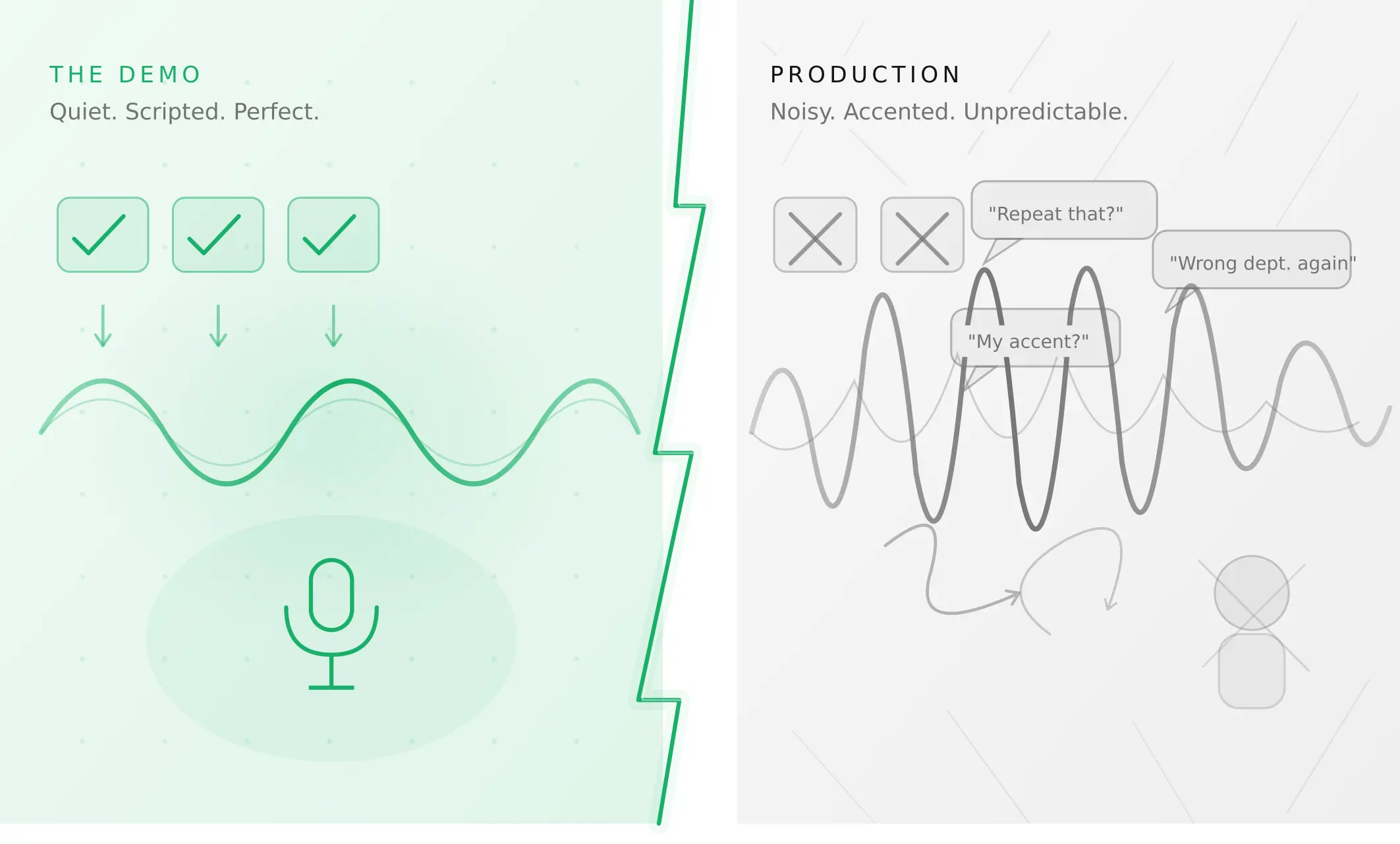
Why AI voice agents fail in production (and how to prevent it)
AI voice agents that ace demos still break in production. Learn the 5 root causes, how to test for each, and what production readiness actually means.
Read more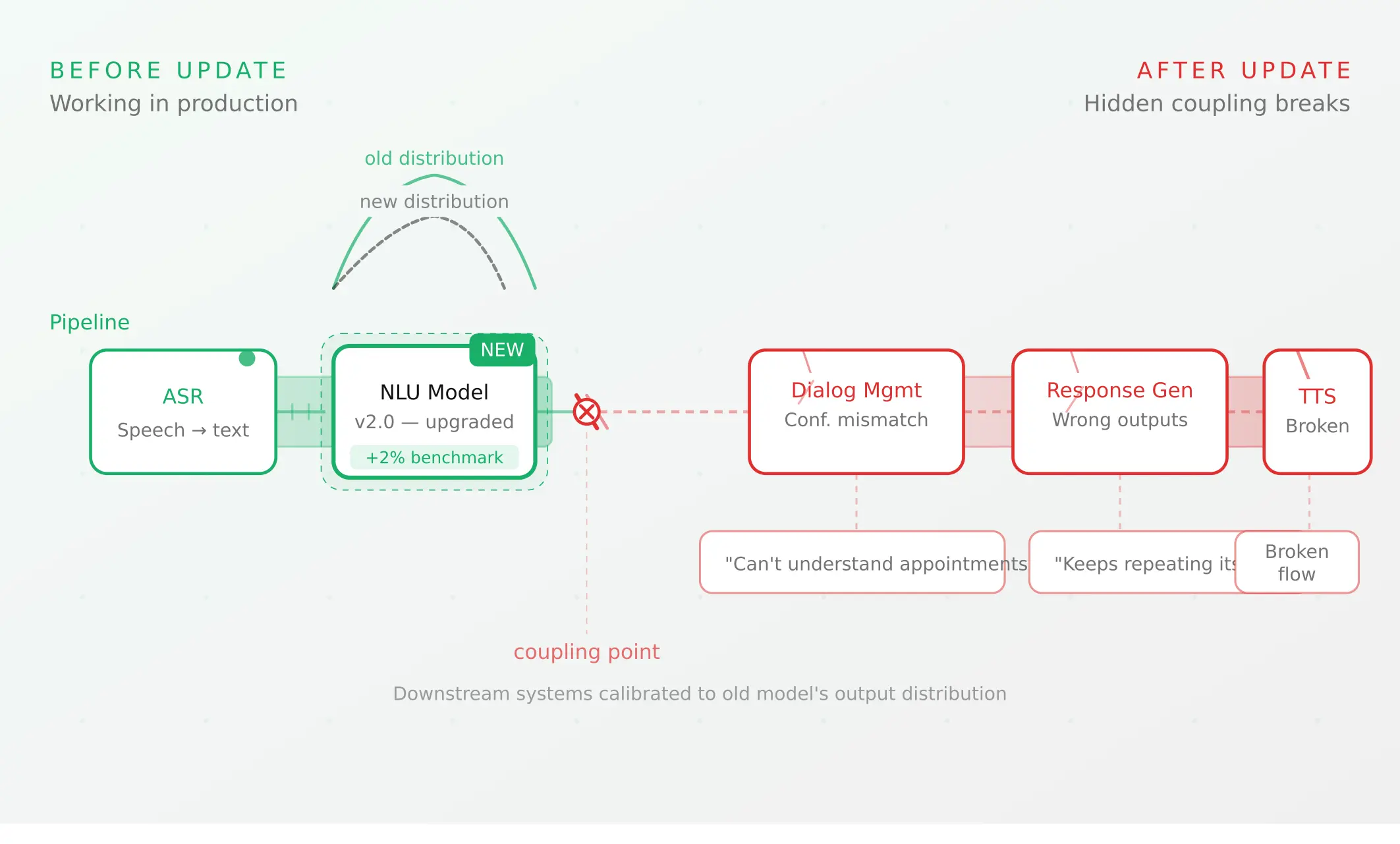
Voice agent regression testing: why LLM updates break production
LLM updates improve benchmarks but break voice agents in 5 predictable ways. How to detect and prevent regressions after every model or prompt change.
Read more