Test your voice agent
Voice Agent Testing for Conversation Designers
# Voice agent testing for conversation designers
You wrote the persona. You shaped the greeting, the confirmations, the fallback lines. Then the agent went live, and a caller heard something you never approved. The words were fine on the page. The delivery was not. This is the gap conversation designers live in.
Quick answer
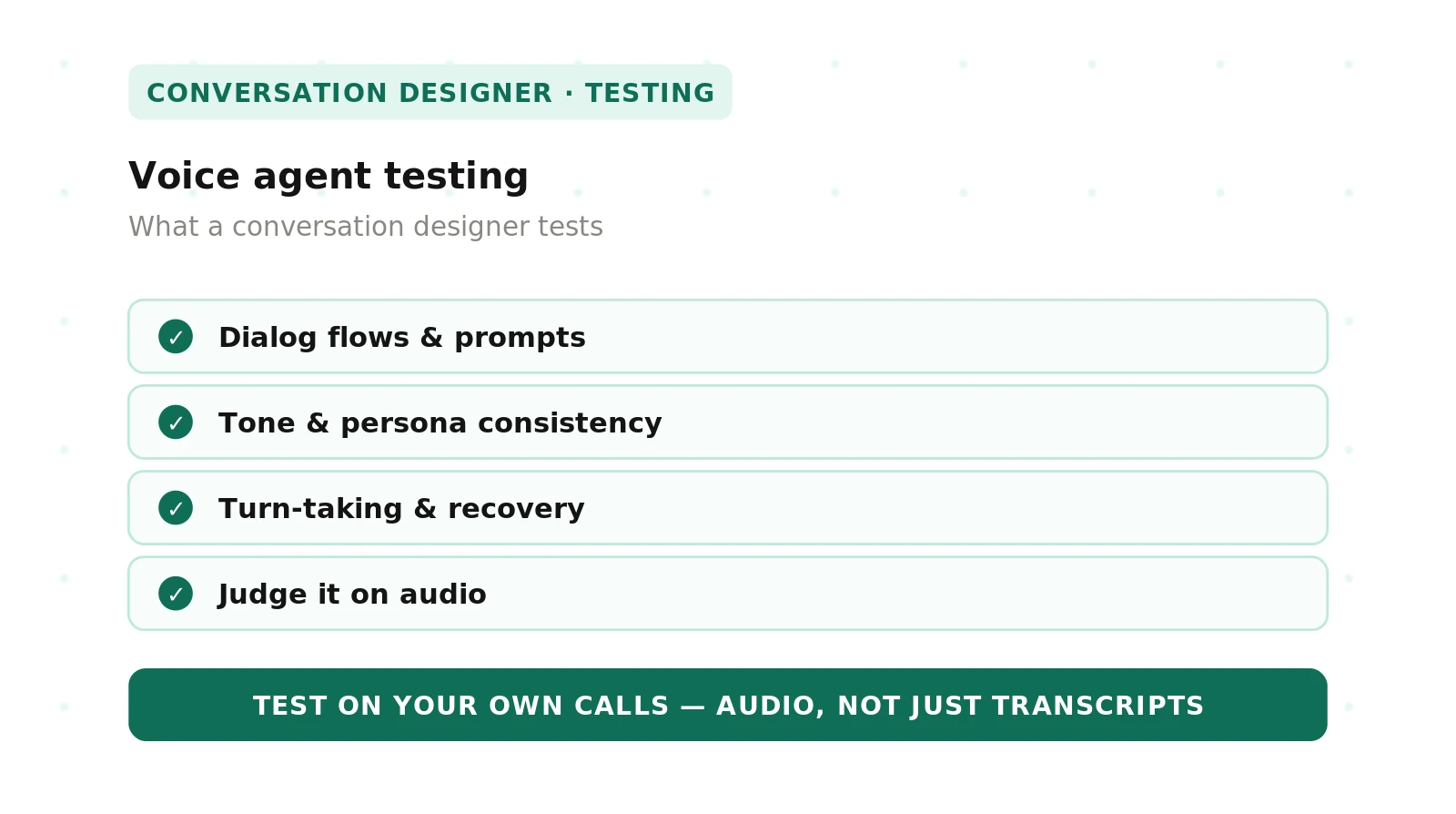
Voice agent testing for conversation designers means checking that dialog flows, tone, and persona survive real speech. You test varied phrasings, turn-taking, interruptions, misunderstandings, and recovery, then score the recorded audio, not just the transcript. Prompt tweaks can regress other paths, so you retest the whole design after every change.
Why conversation designers own more of the test than they think
Most testing advice is written for engineers. It talks about latency, uptime, and token cost. Those matter, but they are not your lens. Your lens is the dialog itself: does it sound like the persona, does it recover well, does it take turns like a person. Testing the parts you own starts with seeing how much of the agent is really yours.
A voice agent is a dialogue system wrapped around a large language model. The model generates words. Your design decides what those words should be, when they should come, and how they should land. Engineers own the pipeline. You own the conversation.
That ownership is easy to lose track of. The prompt is a text file, so it feels like copy. But every line you write becomes spoken behavior. A single word in the system prompt can change how the agent confirms an address, how it apologizes, or how quickly it gives up and escalates.
So testing is not a step that happens after your work. It is part of your work. If you hand off an untested design, you are shipping a script you have never heard performed. The performance is where designs break.
What testing means through the conversation-designer lens
Testing, for you, is not unit tests on functions. It is structured listening to how the design behaves across many real conversations. The unit under test is the exchange, not the endpoint.
There is a useful split here between two words teams often blur. Testing confirms the design does what you built it to do. Evaluation scores how good that behavior actually is against a bar you set. The distinction matters, and we cover it in depth in testing versus evaluation for voice agents.
Your test cases are conversations, not inputs. A good set covers the happy path, the messy middle, and the failure edges. It includes callers who mumble, interrupt, change their mind, and speak in ways your prompt never anticipated. The broader discipline is laid out in our guide to AI voice agent testing.
The dialog dimensions worth testing
Conversation design has more surface area than a flowchart shows. Each dimension below fails in its own way, and each needs its own test. Treat this table as your coverage map.
| Dialog dimension | Failure it prevents | How to test it |
|---|---|---|
| Intent handling and varied phrasings | Agent misreads a request it should understand | Feed 15–20 real phrasings per intent, including slang and partial sentences |
| Tone and persona consistency | Agent drifts off-brand or contradicts its own character | Score audio across long calls and edge paths for voice, word choice, and register |
| Turn-taking and pacing | Agent talks over the caller or leaves dead air | Time gaps and overlaps on recorded calls; test barge-in mid-sentence |
| Misunderstanding and recovery | Agent loops, guesses wrong, or blames the caller | Inject misrecognitions and off-topic replies; check the repair move |
| Confirmation and grounding | Agent acts on the wrong value it never confirmed | Test names, numbers, and dates; verify explicit read-back before action |
| Escalation and handoff | Caller gets trapped with no human path | Force repeated failures and confirm a clean, well-timed transfer |
| Policy and disclosure lines | Agent skips a required statement under pressure | Run scenarios that tempt shortcuts; check the required language is spoken |
Varied phrasings and misunderstandings
Callers do not speak in your test phrases. They say "yeah I need to move my thing" when your intent is named "reschedule appointment." Good natural language understanding should catch that. Testing is how you find out whether it does.
The harder case is the misunderstanding. Speech recognition mishears a name. A caller answers a different question than the one asked. Your design needs a repair move for both. Test it by injecting the error on purpose and listening to what the agent does next.
Tone and persona consistency
You defined a persona) for a reason. It carries the brand and sets caller expectations. The risk is drift: the agent sounds warm in the greeting, then clipped and robotic three turns later.
Drift hides in the paths you rarely demo. Error handling, long calls, and edge intents are where a model reverts to a generic voice. Test the persona there, not just on the golden path.
Why you test on audio, not just the transcript
The transcript lies by omission. It shows the words and hides the delivery. A line that reads as polite can sound cold, rushed, or sarcastic once spoken.
Several failures never appear in text at all. Two speakers talking at once collapse into clean, ordered lines. A failed barge-in reads as a normal turn. Prosody) problems, wrong stress, flat questions, awkward pauses, leave no trace. So does a mispronounced customer name.
This is why audio evaluation catches what transcript scoring misses. The recorded call is the real artifact the caller experienced. We compare the two methods, and their costs, in transcript versus audio evaluation. The short version: read the transcript to triage, but score the audio to judge.
Turn-taking is the clearest example. Human conversation runs on tight timing, studied for decades in conversation analysis and turn-taking research. Gaps of even half a second feel wrong. An agent that starts too soon steps on the caller. One that starts too late feels dead. You can only test that on the clock, from audio.
Interruptions and barge-in
Real callers interrupt. They cut in with a correction or a new request before the agent finishes. The agent must stop cleanly, listen, and adapt. This behavior is barge-in, and it is distinct from simple turn-taking, as our guide on barge-in versus turn-taking explains.
Test it by interrupting mid-sentence, repeatedly, at different points. A weak design keeps talking, ignores the new input, or loses the thread entirely. The failure is invisible in text and obvious in audio.
How prompt tweaks cause regressions somewhere else
Here is the trap that catches every conversation designer. You fix one line and break three others you never touched.
The system prompt is a single shared instruction. Change the fallback wording to sound friendlier, and you may soften a required disclosure. Add a rule to confirm phone numbers, and the agent may start over-confirming everything, adding a turn to every call. Tighten the persona, and it may refuse a valid off-script request.
Prompts are global, but conversations are local. One edit ripples across every path the model can take. This is why a change that looks safe in isolation can regress calls you did not test. The only defense is a fixed suite you rerun after every edit.
That means testing on your own conversations, not the vendor's demo script. Rerun the same real calls before and after each change and compare. We walk through this in benchmarking voice agents on your own data. Policy lines deserve special attention here, because they are the first thing a friendly-tone edit tends to erode; see testing policy adherence for voice agents.
How to test a conversation design as you iterate
Use this loop every time you touch a prompt or a flow. It keeps small edits from becoming production incidents.
1. Freeze a real test set. Pull 30–50 recorded or scripted calls from actual traffic, covering happy paths, misunderstandings, interruptions, and escalations. This is your fixed baseline.
2. Define the bar per dimension. Write down what passes for tone, turn-taking, recovery, and confirmation. Vague goals produce vague scores.
3. Run the current design against the full set. Do not test only the path you just changed. Regressions hide in the paths you ignored.
4. Score the audio, not the transcript. Listen for delivery, timing, overlap, and pronunciation. Use the transcript only to locate moments worth hearing.
5. Diff against the last run. Compare this version to the previous one call by call. Flag any path that got worse, even if your target path improved.
6. Trace each regression to the edit. Tie a failing call back to the specific prompt or flow change that caused it. This is how you learn the ripple patterns.
7. Log and repeat. Keep the scores over time so you can see drift across many small edits, not just the last one.
The point is discipline, not volume. A small fixed set you rerun faithfully beats a huge set you run once.
Where independent evaluation fits
You can and should test as you design. But grading your own dialog has a blind spot. You know the intended reading, so you hear it in the audio even when a fresh caller would not. Independent evaluation removes that bias.
Evalgent is a third-party evaluation and auditing platform for AI voice agents. We do not build the agents we score, so we have no stake in the result. We run your real conversations against the design, score the recorded audio on the dialog dimensions above, and flag regressions after each prompt change. You get a per-dimension scorecard, tone, turn-taking, recovery, escalation, not a single vague pass. The case for an outside grader is made in independent voice AI evaluation, and the wider practice sits inside voice agent evaluation.
Escalation is worth calling out. A design that never hands off well traps callers, and containment counted that way is a false win. Our guides on escalation for voice agents and containment versus deflection cover why. Other roles test the same agent from other angles: see the companion posts for the QA engineer, QA lead, product manager, and engineering manager.
Frequently asked questions
How do conversation designers test voice agent dialog flows?
They build a fixed set of real conversations, not single inputs, covering happy paths, misunderstandings, interruptions, and escalations. They run the current design against the whole set, score the recorded audio per dialog dimension, and diff each run against the last. Every prompt or flow edit triggers a full rerun so regressions in untouched paths surface early.
How do you test tone and persona consistency in a voice agent?
Score the audio across long calls and edge paths, not just the greeting. Personas drift most in error handling, fallbacks, and rare intents where the model reverts to a generic voice. Define what on-brand voice, word choice, and register sound like, then listen for departures. Independent scoring helps, since designers tend to hear the intended tone rather than the delivered one.
Why test voice agents on audio and not just the transcript?
The transcript shows words but hides delivery. Overlapping speech, failed barge-in, flat intonation, awkward pauses, and mispronounced names leave no textual trace. A polite line can sound cold or rushed once spoken. Read the transcript to triage which calls to review, but score the recorded audio to judge how the caller actually experienced the conversation.
How do prompt changes cause regressions in a voice agent?
The system prompt is one shared instruction, but conversations branch into many paths. A friendlier fallback can soften a required disclosure. A new confirmation rule can add a turn to every call. A tighter persona can refuse valid off-script requests. Because one edit ripples across every path, changes that look safe in isolation break calls you never retested.
How do you test turn-taking and interruptions in a voice agent?
Test on the clock from audio. Measure the gap before the agent speaks and any overlap when it does. Interrupt mid-sentence, repeatedly and at different points, to check barge-in. A weak design talks over the caller, leaves dead air, or ignores the interruption and loses the thread. These timing failures are invisible in a transcript.
How do you test misunderstandings and recovery in a voice agent?
Inject errors on purpose. Feed misrecognized names, off-topic answers, and requests phrased in ways the prompt never anticipated. Then listen to the repair move. A good agent reconfirms, narrows, or asks a clean clarifying question. A weak one loops, guesses, or blames the caller. Recovery quality often matters more to caller trust than first-try accuracy.
What should a conversation designer test in a voice agent?
Test the dimensions you own: varied phrasings and intent handling, tone and persona consistency, turn-taking and interruptions, confirmation and grounding, misunderstanding and recovery, escalation and handoff, and required policy lines. Cover happy paths and failure edges. Score the audio for each dimension separately, so a strong greeting cannot mask a broken recovery path or a skipped disclosure.
How do you keep testing a conversation design as you iterate?
Freeze a real test set of 30–50 calls and reuse it. Define a pass bar per dimension. Run the full set after every edit, score the audio, and diff against the previous run call by call. Trace each regression to the specific change that caused it. Log scores over time to catch slow drift across many small edits.
The bottom line
Conversation designers own the dialog, so they must test the dialog: varied phrasings, tone, turn-taking, recovery, and escalation, scored on real audio rather than the transcript. Because one prompt edit ripples across every path, rerun a fixed set of real calls after every change, and let an independent evaluator score what you are too close to hear.
Want to know how your dialog actually sounds to callers? Book a demo and we will score your agent on the conversation dimensions you designed.
Related Articles
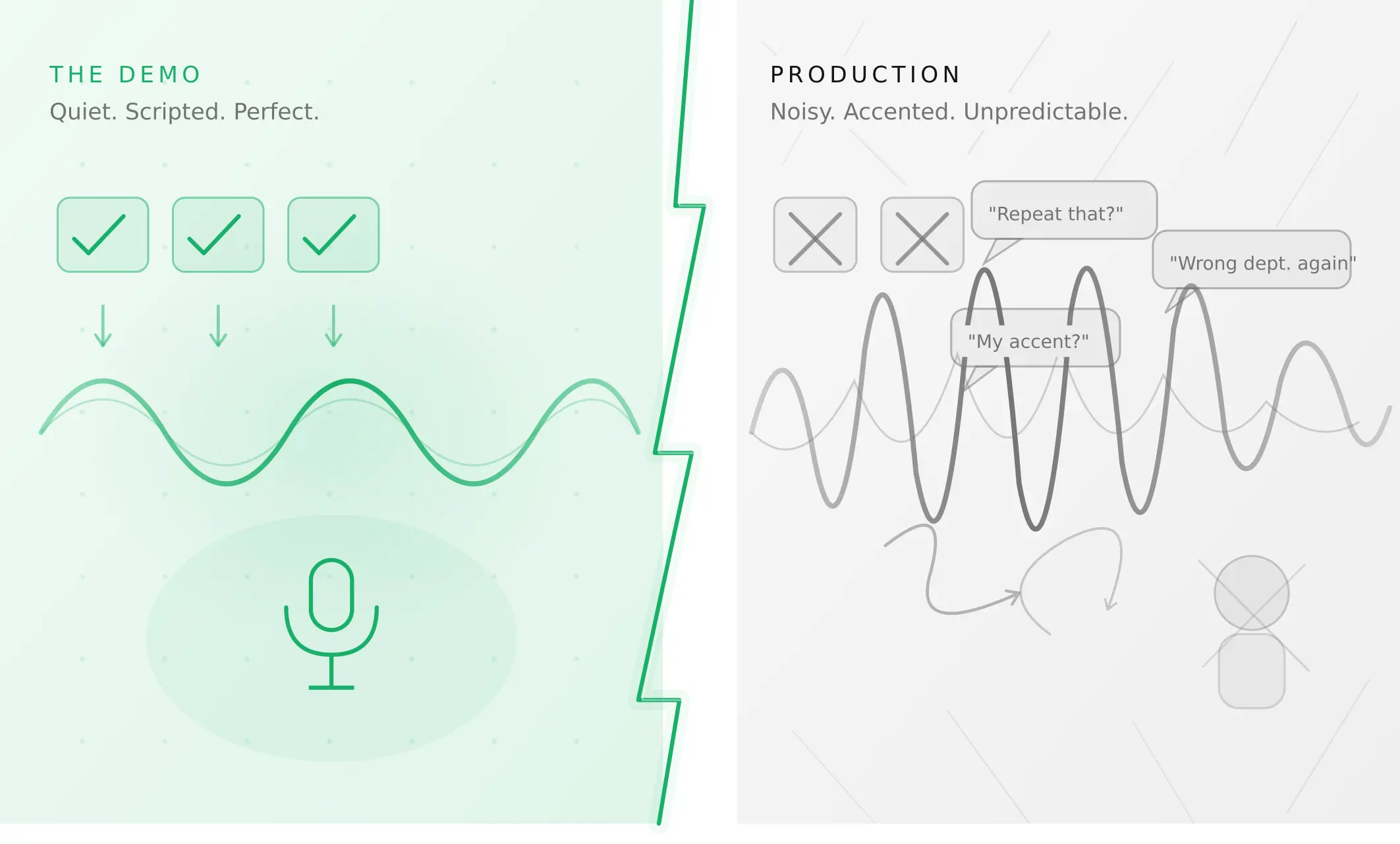
Why AI voice agents fail in production (and how to prevent it)
AI voice agents that ace demos still break in production. Learn the 5 root causes, how to test for each, and what production readiness actually means.
Read more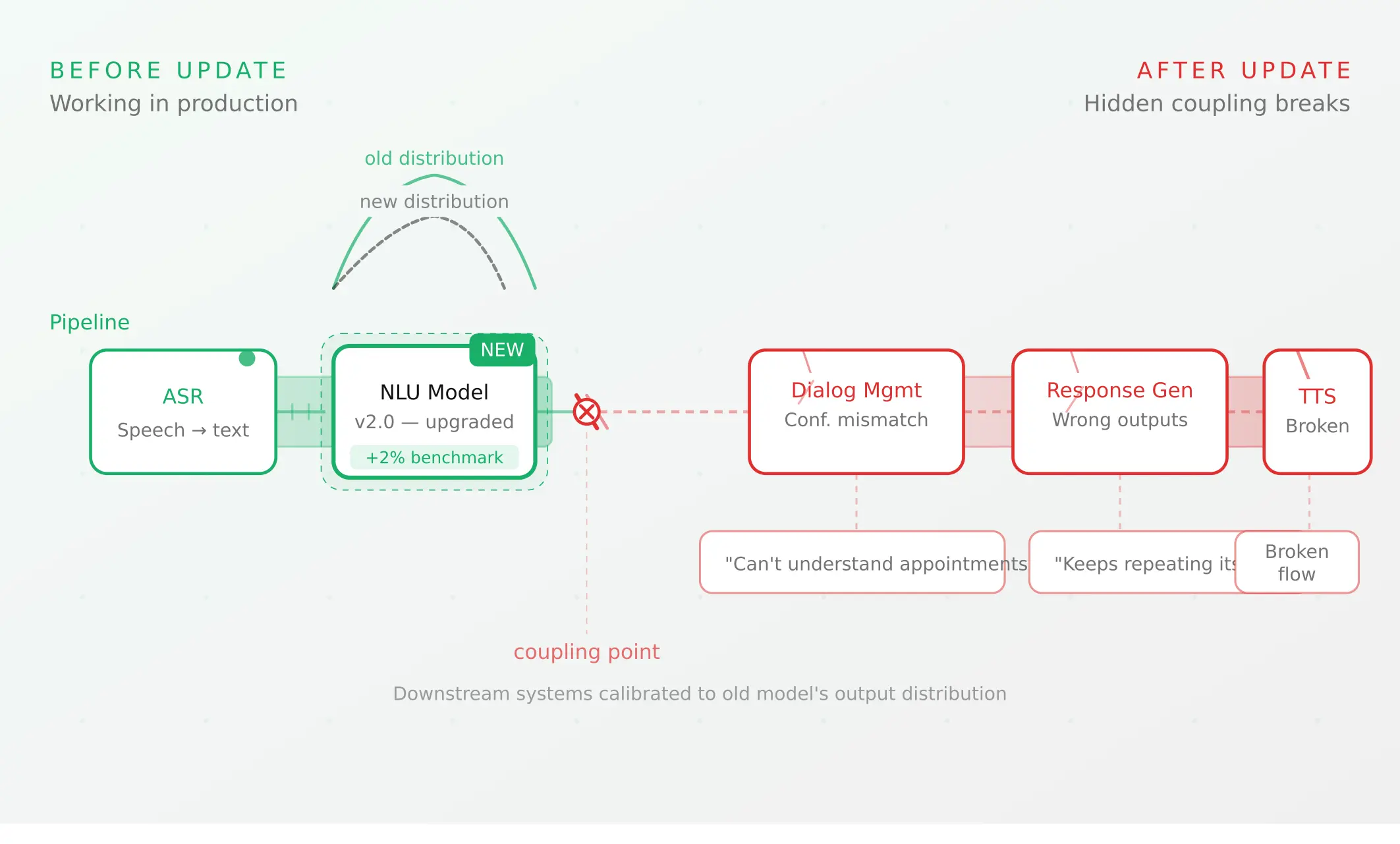
Voice agent regression testing: why LLM updates break production
LLM updates improve benchmarks but break voice agents in 5 predictable ways. How to detect and prevent regressions after every model or prompt change.
Read more