Test your voice agent
Voice Agent Testing for Solutions Engineers
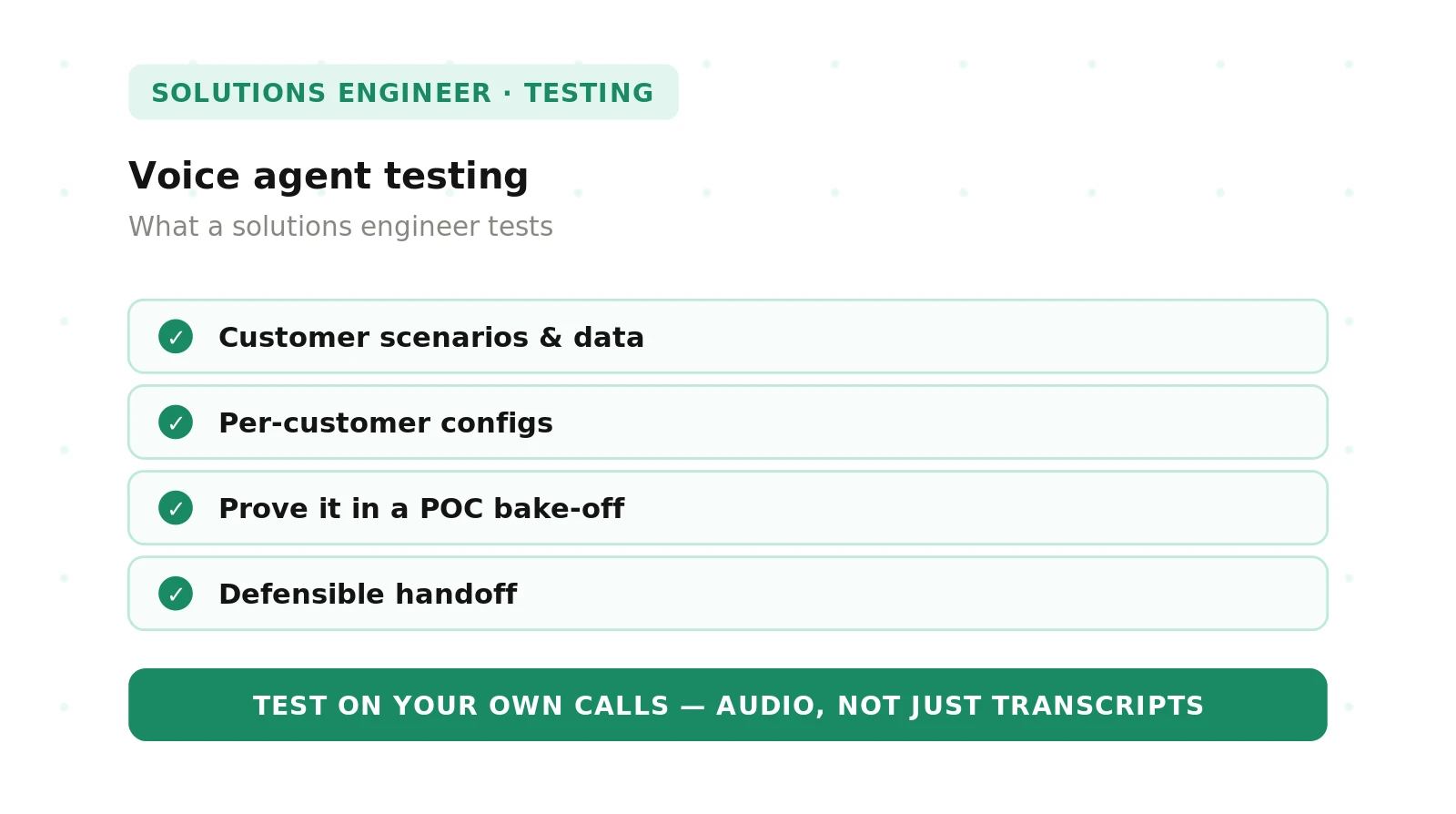
# Voice agent testing for solutions engineers
> Quick answer: Voice agent testing for solutions engineers means validating an agent against each customer's real scenarios and data during a POC, not a scripted demo. You test per-customer configs and integrations, prove agreed success criteria, and hand back an independent, defensible result the buyer can trust.
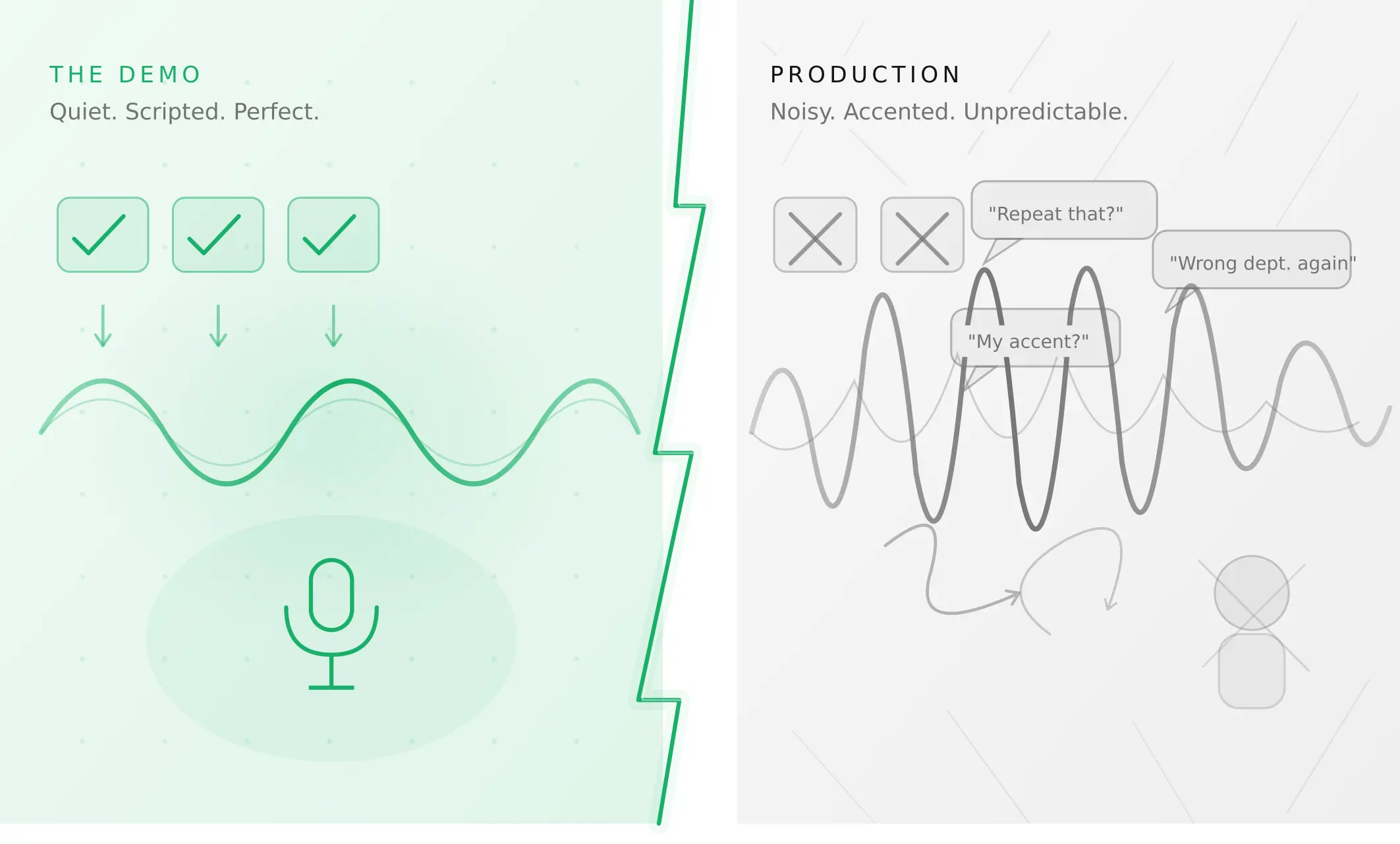
The demo always works. That is the problem you inherit as a solutions engineer. You get the deal to the point where a prospect says yes on the call. Then production traffic hits, and the agent that sailed through the pitch starts fumbling accents, transfers, and edge cases nobody scripted.
Your job is to close that gap before it becomes a churned account. This post takes the sales engineering lens on testing voice agents: the pre-sales POC, the per-customer deployment, and the evidence you leave behind. It is about testing, not vendor buying. If you want the buying-committee angle, the founder and product manager posts cover that.
Why the solutions engineer owns voice agent testing
Most roles test to protect something they already own. The QA engineer protects a release. The engineering manager protects a roadmap. You test to earn something you do not have yet: the customer's trust and signature.
That changes what you optimize for. You are not proving the agent is perfect. You are proving it clears a bar the customer agreed to, on their traffic, in a bounded window. The result has to survive a skeptical buyer, a security review, and a procurement team reading the fine print.
So the SE lens has three constraints the others lack. First, the tests belong to the customer, not to you. Second, the window is short, often two to four weeks. Third, the output is a document someone signs against, not a green build. Get those three right and the deal moves.
What a solutions engineer tests that other roles do not
You test the agent as it will actually be deployed for this one customer. That is the distinction. A generic accuracy benchmark tells you little about whether this bank's collections script survives this bank's callers.
Concretely, you own these testing threads during a POC and deployment:
- Customer scenarios. The real call types this account handles, in their words, not a template library.
- Per-customer configuration. Prompts, knowledge base, business hours, and disclosures set for this account.
- Integrations. The CRM lookup, the payment step, the calendar write, the transfer target that only exists in their stack.
- Success criteria. The numeric bar the buyer agreed to, written down before testing starts.
- Failure and safety paths. What happens on a bad transfer, a wrong lookup, or an out-of-scope request.
Notice how situational these get. "We are a regional health system, and the agent has to book appointments against our scheduling system without ever quoting a copay." That is the shape of a real POC request. It is not "is the STT accurate." Testing has to match that framing, because that is what the buyer will judge.
The deployment stages and what to test at each
Testing is not one event. It maps to the deployment path, and each stage produces a different artifact you hand to the customer. Miss a stage and you either overpromise in the demo or under-deliver at go-live.
The table below is the SE's map. Read it as: at this stage, test this, and leave behind this artifact.
| Deployment stage | What you test | Artifact you deliver |
|---|---|---|
| Scoping | Call types, volume, integrations, and success criteria | Signed test plan with a numeric bar per scenario |
| Sandbox build | Per-customer config, prompts, knowledge base, disclosures | Config checklist and a working sandbox agent |
| POC validation | Customer scenarios run with synthetic callers on their data | Scored result set with pass or fail per criterion |
| Integration test | CRM lookups, payments, transfers, calendar writes end to end | Integration test log with request and response evidence |
| Bake-off | Two or more candidates on identical test cases | Side-by-side scorecard with the recommendation |
| Pre-launch | Load, latency at concurrency, escalation, and safety paths | Production readiness sign-off document |
| Post-launch | Live traffic sampled and re-scored against the same bar | Recurring audit report the customer can defend |
Two things about this table matter for a solutions engineer. The POC validation row is where deals are won, because it is the first time the buyer sees their own scenarios pass. The post-launch row is where deals are kept, because a model update can silently regress an agent that passed at sign-off. That is a production readiness bar you defend continuously, not once.
How to run a customer POC validation as a solutions engineer
This is the core play. A proof of concept that proves nothing measurable is just a longer demo. Run it like a bounded experiment with a pass or fail bar the customer set.
Here is how to run a voice agent bake-off or single-vendor POC validation, start to finish.
1. Agree on success criteria first. Write down the numeric bar before any testing. Example: 85% task completion, correct transfer 95% of the time, p95 response under 1.5 seconds. Get the buyer to sign it. Vague criteria let a losing agent look like a winner.
2. Collect the customer's real scenarios. Pull the top 15 to 30 call types from their transcripts, tickets, and call recordings. Use their language and their edge cases. This is the difference between testing a voice agent on a customer's scenarios and testing a demo.
3. Build the per-customer sandbox. Configure prompts, knowledge base, disclosures, and business hours for this account. Wire the integrations in a safe test mode. Confirm the config matches what will ship.
4. Generate synthetic callers. Turn each scenario into repeatable test cases driven by synthetic callers with varied accents, noise, and interruptions. Repeatable cases let you compare candidates fairly and re-run later.
5. Run every candidate on identical cases. If it is a bake-off, all vendors get the exact same test set. Comparing agents on the same test cases is the only way to make the result honest.
6. Score independently, not by vibes. Judge recorded transcripts and audio against the agreed criteria. Do not trust vendor dashboards. This is where independent evaluation earns the customer's trust.
7. Test the failure paths on purpose. Force wrong lookups, bad inputs, and out-of-scope asks. Confirm the agent escalates cleanly instead of guessing. Read the escalation guide for what good handoff looks like.
8. Deliver a defensible result. Hand back a scored report with evidence per criterion, not a claim. The buyer should be able to defend it to their own leadership without you in the room.
Run it this way and the POC does double duty. It de-risks the deployment, and it gives the buyer the internal ammunition to say yes.
Per-customer configuration and integration checks
Two agents on the same platform behave differently once configured for two customers. The per-customer voice agent configuration checks are where deployments quietly break, so treat them as first-class tests.
Check the config surface for this account: the system prompt, the knowledge base version, disclosures and compliance language, business hours, and the escalation targets. A stray default disclosure or a stale knowledge base article will surface in front of the buyer at the worst moment.
Then test the integrations as a real systems integration problem, end to end. A CRM lookup that returns the wrong record is worse than no lookup. Run these checks against the customer's test environment:
- CRM and lookups. Right record returned, missing records handled, timeouts do not hang the call.
- Payments and sensitive steps. Correct amounts, correct confirmations, no data leaked into transcripts.
- Transfers. The call transfer lands on the right queue with context attached.
- Calendar and writes. The booking actually appears in their system, with the right time zone.
This is acceptance testing in the classic sense. Acceptance testing asks one question: does the system do what the customer needs in their environment. For a voice agent, the answer only counts when you test on the customer's data and stack, not a clean sandbox that hides the seams.
How to demo a voice agent safely
A demo is a sales tool, not evidence. The risk is that a great demo writes a check the deployment cannot cash. You can demo a voice agent safely by being deliberate about what you show and what you promise.
Keep the demo honest with a few rules. Show scenarios you have actually tested and scored. Never live-demo an integration you have not verified that morning. When a prospect throws a curveball, treat it as a test case to run in the POC, not a claim to make on the spot.
The strongest move is to reframe the demo as a preview of the POC. Tell the prospect the demo shows the shape of the solution, and the POC on their traffic is what proves it. That sets up the difference between testing and evaluation: the demo is a test you controlled, and the evaluation is the independent judgment they can trust. It also protects you. You are never on the hook for a claim the numbers have not backed yet.
Handing back a defensible result
The deliverable that closes the deal is a defensible voice agent evaluation result. Defensible means the buyer can hand it to a skeptical CFO, a security reviewer, or a procurement lead, and it holds up without you defending it live.
That result has four parts. The agreed success criteria, stated as they were signed. The test set, described so it can be re-run. The scored outcome per criterion, with transcript and audio evidence. And the independence of the scoring, so no one can dismiss it as vendor marketing.
This is where an independent evaluation platform changes the SE's position. When you benchmark on the customer's own data and the scoring is third-party, the result stops being your opinion and becomes a record. Evalgent exists for exactly this: it runs the customer's scenarios through repeatable voice agent evaluation and produces the scored, independent artifact you hand over. You bring the deal knowledge; the platform brings the proof.
There is a commercial reason too. A defensible result feeds directly into the service-level agreement you negotiate. If the POC proved 95% correct transfer on their scenarios, that number can anchor the SLA and the renewal conversation. A demo cannot anchor anything.
Where this fits with the rest of the team
Your POC result is the start of a longer test lifecycle, not the end. Once the account is live, the forward-deployed engineer iterates on the agent in the field, the QA lead owns the regression suite, and the conversation designer tunes the dialogue. The through-line is a shared, versioned test set.
The best SEs hand off their POC test cases as the seed of that suite. The scenarios you proved at sign-off become the regression tests that protect the account after the next model update. That continuity is the point of AI voice agent testing done as a discipline rather than a one-off. It also keeps you honest against frameworks like the NIST AI Risk Management Framework, which treats measurement and monitoring as continuous, not a launch-day box to tick.
Frequently asked questions
How does a solutions engineer test a voice agent?
A solutions engineer tests a voice agent by running the customer's real scenarios through a bounded POC, not a scripted demo. You agree on numeric success criteria, build a per-customer sandbox, drive repeatable test cases with synthetic callers, verify integrations end to end, and score the recorded results independently against the agreed bar.
What is voice agent proof of concept validation?
Voice agent proof of concept validation is a time-boxed test that proves an agent clears agreed success criteria on the customer's own scenarios and data. It replaces demo impressions with scored evidence. Done well, it de-risks the deployment and gives the buyer the internal proof they need to sign, rather than a vendor claim.
Why isn't a demo enough to prove a voice agent works?
A demo runs on clean audio, a scripted path, and one call you controlled. Production runs on accents, noise, interruptions, bad data, and concurrency. The demo shows the agent can succeed under ideal conditions. It says nothing about the callers you cannot control. Only a POC on the customer's traffic closes that gap.
How do you run a voice agent bake-off?
Run a voice agent bake-off by giving every candidate the exact same test cases built from the customer's scenarios. Set numeric success criteria first, drive each agent with identical synthetic callers, and score the recorded transcripts and audio independently. Comparing candidates on the same cases with third-party scoring is the only way to make the recommendation defensible.
What are per-customer voice agent configuration checks?
Per-customer voice agent configuration checks confirm the prompt, knowledge base, disclosures, business hours, and escalation targets are set correctly for one account. Two customers on the same platform behave differently once configured. A stale knowledge base article or a default disclosure will surface in front of the buyer, so verify the config matches exactly what will ship.
How do you prove voice agent success criteria in a POC?
Prove success criteria by agreeing on a numeric bar before testing, then scoring recorded results against it per scenario. Example bars are task completion above 85%, correct transfer above 95%, and p95 response under 1.5 seconds. Get the buyer to sign the criteria first, so a passing result is defensible and a failing one is honest.
How do you demo a voice agent safely without overpromising?
Demo only scenarios you have already tested and scored, and never live-run an unverified integration. When a prospect throws a curveball, capture it as a POC test case rather than making a claim on the spot. Reframe the demo as a preview and the POC on their traffic as the proof. That protects you and the deal.
What makes a voice agent evaluation result defensible?
A defensible voice agent evaluation result states the agreed criteria, describes a re-runnable test set, scores each criterion with transcript and audio evidence, and uses independent third-party scoring. That combination lets the buyer defend the result to a CFO, a security reviewer, or procurement without you in the room, and it can anchor the SLA you negotiate.
The bottom line
Voice agent testing for solutions engineers is about proving, on the customer's own scenarios and data, that an agent clears a bar the buyer agreed to before the POC started. Hand back an independent, re-runnable, scored result, and the deal moves on evidence instead of a demo.
Turn your next POC into a result the buyer can defend to their own leadership. Book a demo to see how Evalgent runs a customer's scenarios and produces the independent evidence your voice agent deployment can stand on.
Related Articles
Why AI voice agents fail in production (and how to prevent it)
AI voice agents that ace demos still break in production. Learn the 5 root causes, how to test for each, and what production readiness actually means.
Read more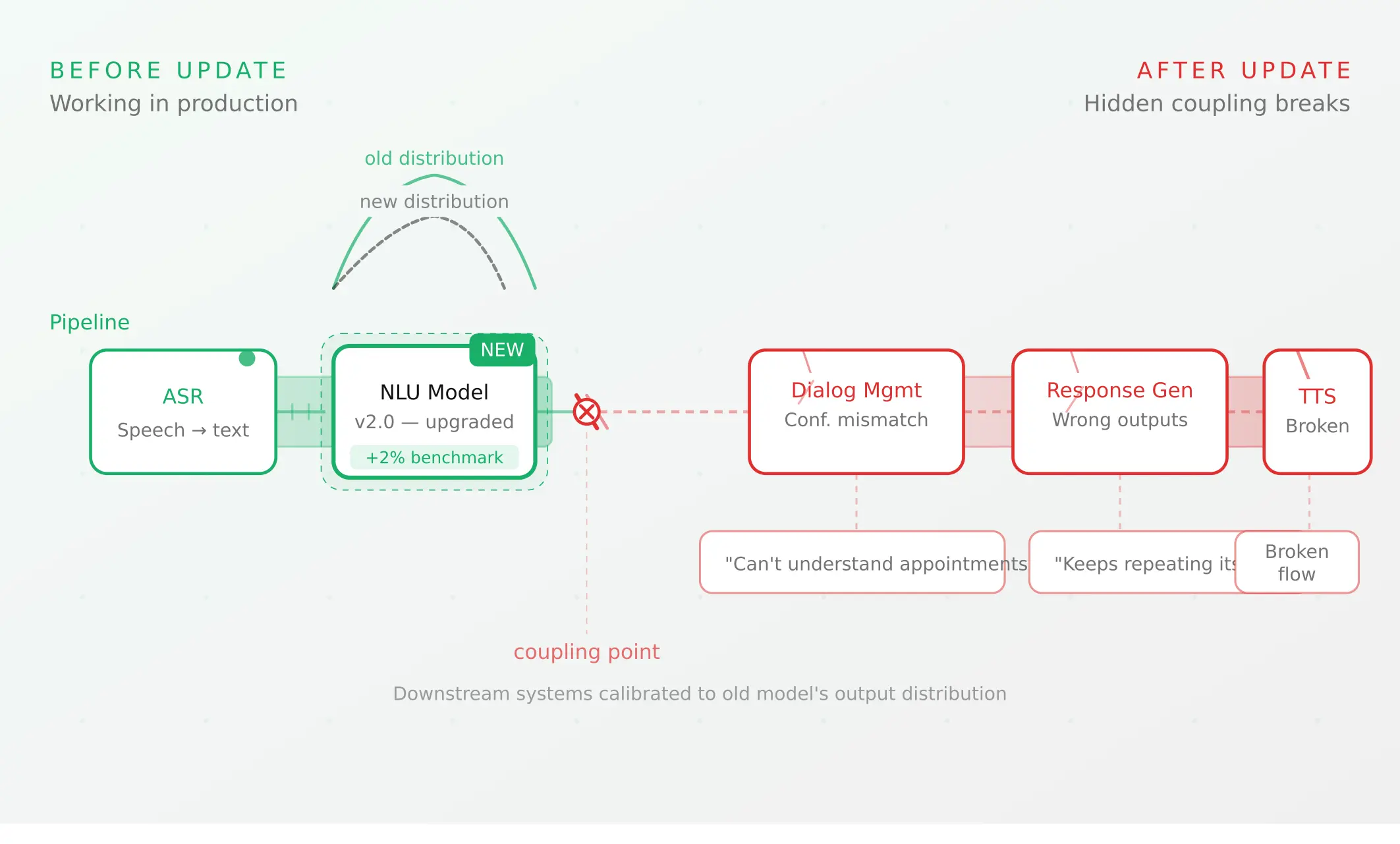
Voice agent regression testing: why LLM updates break production
LLM updates improve benchmarks but break voice agents in 5 predictable ways. How to detect and prevent regressions after every model or prompt change.
Read more