Test your voice agent
Voice Agent Testing for Product Managers
# Voice Agent Testing for Product Managers
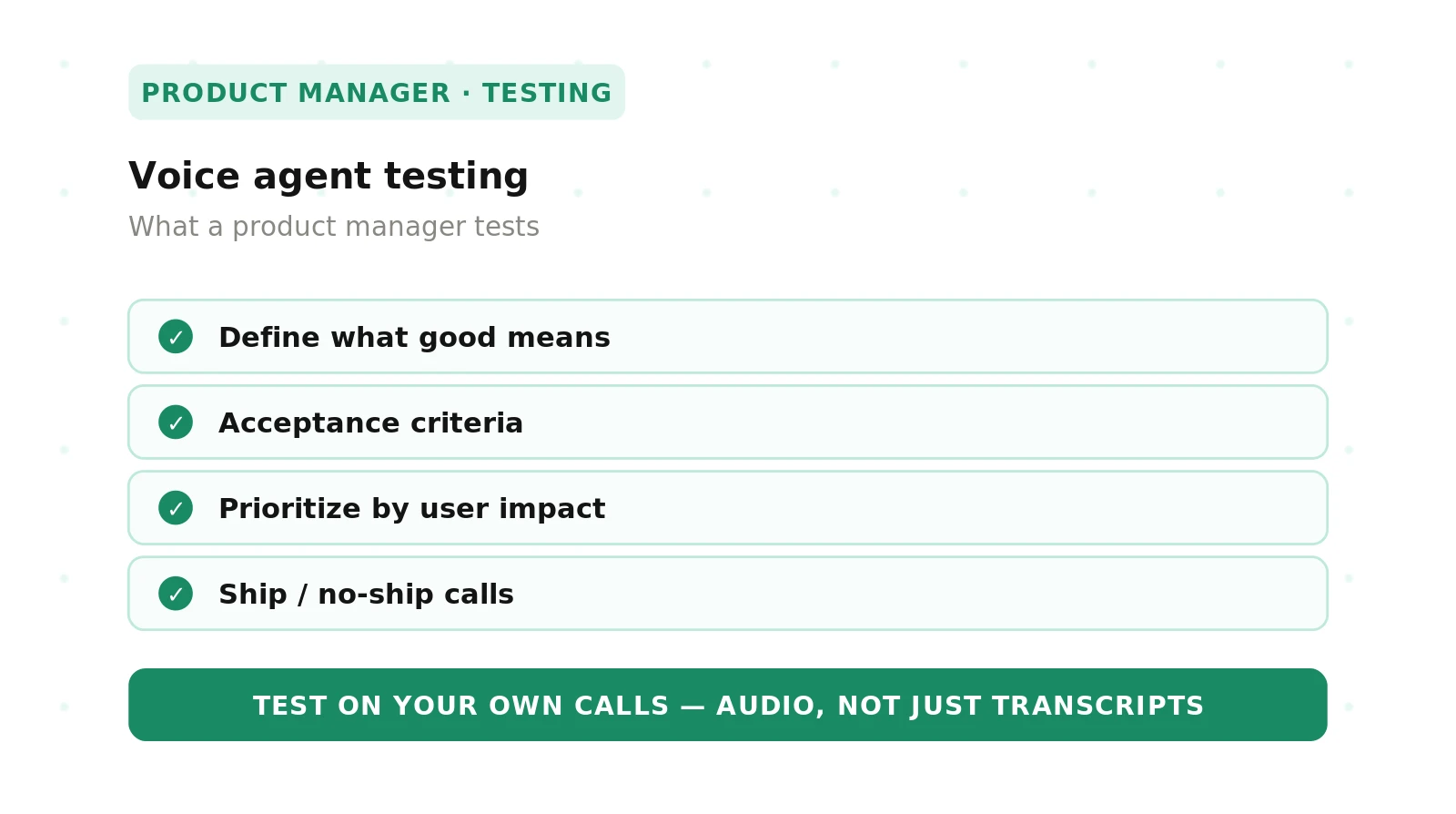
> Quick answer: Voice agent testing for product managers means defining what "good" looks like, task success, containment, and CSAT, then setting pass bars before launch. You prioritize flows by user impact, tie every test to a product outcome, and read independent eval results to make a confident ship or no-ship call.
Most voice agent projects fail at the definition stage, not the build stage. The model works in a demo. The team ships. Then real callers hit flows nobody scoped, and the metrics that looked fine turn out to measure the wrong thing.
The product manager owns that gap. Engineers own how the agent works. QA owns whether it behaves as specified. The PM owns whether "as specified" is the right target in the first place. That is a testing job, even when it does not look like one.
This post covers the PM lens on testing. You will define what good means, set acceptance criteria and pass bars, prioritize flows by user impact, and read eval results to make ship calls. For the broader mechanics, pair it with our guide to AI voice agent testing and the deeper voice agent evaluation pillar.
Why testing is a product management decision
Testing is often framed as a downstream engineering task. For voice agents, that framing loses money.
A voice agent touches revenue, cost, and customer experience at the same time. A change that raises containment can quietly lower satisfaction. A latency fix can break a script edge case. Only the PM sits across all three lenses, so only the PM can say which trade-off is acceptable.
Product management exists to connect what gets built to what the business needs. Applied to voice, that means owning the target before owning the result. If you do not define good, the team will define it for you, usually as "the demo passed."
The distinction between checking behavior and judging quality matters here. Our guide on testing vs evaluation for voice agents unpacks it. Testing asks whether the agent did what the spec said. Evaluation asks whether the spec was worth hitting.
Defining what "good" means
Before any test runs, write down the outcomes that matter. Three carry most of the weight for voice agents.
> Task success: the caller accomplished what they called to do. Booked the appointment, paid the bill, got the right answer. It is measured per intent, not per call.
> Containment: the share of calls the agent handled end to end with no human handoff. High containment cuts cost, but only counts when the task also succeeded.
> CSAT: customer satisfaction, usually a post-call rating or an inferred sentiment score. It catches the frustration that raw task counts miss.
Containment is the metric teams most often misread. A call that ends without a transfer is not automatically a win. The caller may have given up. Our guide on containment vs deflection explains why the difference decides whether the number is worth celebrating.
Each of these is a key performance indicator, which means it needs a target, not just a reading. A metric with no bar is a vanity number. For the full metric taxonomy, use the voice agent metrics scorecard.
Product goal, metric, and acceptance bar
The core PM artifact for testing is a table that maps each product goal to the metric that measures it and the bar the agent must clear. The bars below are illustrative. Yours come from your baseline and your business case, not from a benchmark.
| Product goal | Metric | Example acceptance bar |
|---|---|---|
| Resolve the caller's request | Task success rate on top intents | Clears the bar on the highest-volume intents |
| Reduce cost per contact | Containment with verified success | High, with no drop in task success |
| Keep callers satisfied | CSAT or inferred sentiment | No worse than the human baseline |
| Escalate cleanly when needed | Escalation accuracy | Nearly all true escalations routed correctly |
| Avoid harmful or off-policy replies | Safety and compliance pass rate | Perfect on defined red lines |
Two rules keep this table honest. First, containment never stands alone; it is always paired with success, so the agent cannot win by stranding callers. Second, safety bars are absolute. A single failed red-line case blocks the release regardless of every other number.
Escalation deserves its own attention because it is where trust is won or lost. When the agent cannot help, handing off well matters more than trying harder. Our escalation guide covers what a clean handoff requires.
Setting acceptance criteria and pass bars before launch
Acceptance criteria are the conditions a release must meet to be considered done. For a voice agent, they are your contract with the build team and your defense in a launch review.
Write them before the agent is finished, not after. Bars set after you see results are not bars; they are rationalizations. This is the same discipline as a definition of done in agile work, applied to conversation quality instead of code.
Good acceptance criteria share four traits.
- Tied to an outcome. Each bar traces back to a product goal in the table above.
- Measurable. A number and a threshold, not "sounds natural."
- Baselined. Compared against the current channel, human or legacy IVR, so you know the change is an improvement.
- Scoped by segment. Broken out by intent, language, and caller type, because a strong average can hide a weak result on one critical flow.
Set the bars against your own data, not a vendor's demo reel. Testing an agent on your real call transcripts and audio is the only way to know it works for your callers. See benchmark voice agents on your own data for how to build that test set.
Prioritizing flows and edge cases by user impact
You cannot test everything before launch, and trying to will delay the launch past the point of value. The PM job is to rank, not to cover.
Prioritize by user impact, which is volume times cost of failure. A rare flow with catastrophic failure, a wrong medication instruction or a missed payment, outranks a common flow that fails gracefully. A high-volume flow that fails silently outranks a rare edge case nobody hits.
Build the priority list in three passes:
- Head flows. The handful of intents that cover most call volume. These get the tightest bars and the most test cases.
- Long-tail intents. Lower volume, but they still need a floor so the agent degrades gracefully instead of hallucinating.
- Adversarial and edge cases. Angry callers, accents, background noise, interruptions, out-of-scope requests. These reveal how the agent fails, which is what real users will find.
Deciding whether to judge those cases on transcript alone or on the audio matters more than teams expect. Prosody, talk-over, and silence do not show up in text. Our comparison of transcript vs audio evaluation shows when text is enough and when it hides the failure.
How to define and run acceptance testing as a PM
This is the repeatable loop. Run it before every launch and every model or prompt change.
1. Restate the product goals. List the outcomes this release must move, in one line each. If a goal has no metric, it is not testable yet, so fix that first.
2. Set the pass bars. For each goal, write the metric and the threshold, baselined against the current channel. Get sign-off from engineering and support before testing starts.
3. Assemble the test set. Pull real call cases across head flows, long-tail intents, and edge cases. Weight the set by volume so the score reflects real traffic, not a curated highlight reel.
4. Run the evaluation. Score every case against the criteria. Use consistent rubrics so two reviewers reach the same verdict. Keep the raw transcripts and audio attached to each score.
5. Read the results by segment. Break every metric down by intent, language, and caller type. Hunt for the flow that drags the average down, because that is the one your callers will hit.
6. Make the call. Compare each metric to its bar. Ship if all bars pass, hold if a critical one fails, and document the reason either way so the next release starts from evidence.
7. Re-run after every change. Treat it as regression testing. A prompt tweak or model upgrade can break a flow that passed last week, so the loop repeats.
When you compare two candidate agents or two versions, hold the test set constant. Running both against the same test cases is the only fair comparison, and it turns a subjective preference into a measured one.
Reading eval results to make a ship or no-ship call
A results dashboard is not a decision. The PM turns numbers into a verdict, and that takes judgment the metrics alone do not supply.
Start with the bars. Every acceptance criterion is pass or fail against its threshold. A single failed safety or escalation bar is a no-ship, full stop, no matter how strong the rest looks.
Then read the shape of the misses. An agent just below its task-success bar might ship if the misses are low-stakes and recoverable. The same score is a hold if the failures cluster on your highest-value intent. Averages lie; segments tell the truth.
Watch for metric conflicts. Containment up, CSAT down usually means the agent is trapping callers who wanted a human. That is a worse outcome than a lower containment number, even though the cost line looks better. This is where A/B testing against the current channel earns its keep, because it shows the net effect on real callers rather than a metric in isolation.
Finally, separate defects from tuning. A defect fails the spec and blocks the ship. A tuning opportunity is above the bar but improvable, so it belongs on the roadmap, not in the launch gate.
Where independent evaluation fits
Vendor-run tests answer whether the agent works on the vendor's cases. That is not the question a PM needs answered.
Evalgent is an independent, third-party evaluation platform for voice agents. It runs your acceptance criteria against your own call data and returns results scored to your bars, not a supplier's. Because the evaluation is independent, the pass or fail you take into a launch review carries weight that a self-reported number cannot. Our explainer on independent voice AI evaluation covers why that separation matters for a ship decision.
The practical payoff for a PM is a defensible ship call. When every metric traces to a product goal, every bar was set before results, and the scoring was independent, the launch decision stops being a debate and becomes evidence. Adjacent roles benefit from the same rigor; see the companion posts for QA leads, engineering managers, and founders.
Frequently asked questions
What metrics should a product manager track for voice agents?
Track task success, containment paired with verified success, CSAT, escalation accuracy, and a safety pass rate. Task success tells you the agent helped, containment tells you it did so without a human, and CSAT catches frustration the counts miss. Each needs a target bar, not just a reading, or it becomes a vanity metric.
How do I set acceptance criteria for a voice agent?
Write acceptance criteria before the agent is finished. Tie each bar to a product goal, make it a measurable threshold, baseline it against your current channel, and scope it by intent and caller type. Bars set after you see results are rationalizations, not criteria. Get engineering and support sign-off before testing begins.
How does a product manager make a ship or no-ship decision?
Compare each metric to its acceptance bar. A failed safety or escalation bar is an automatic no-ship. For other misses, read the shape by segment: low-stakes, recoverable failures may ship, while failures clustered on a high-value intent hold the release. Document the reasoning either way so the next launch starts from evidence.
What is the difference between task success and containment?
Task success measures whether the caller accomplished their goal. Containment measures whether the agent handled the call without a human handoff. They diverge when callers give up: a contained call is not a win if the task failed. Always pair containment with verified success so the agent cannot score by stranding callers.
How should I prioritize which voice agent flows to test?
Prioritize by user impact, which is call volume times cost of failure. Test head flows first with the tightest bars, give long-tail intents a floor so they degrade gracefully, and probe adversarial edge cases like accents, noise, and interruptions. A rare flow with catastrophic failure outranks a common flow that fails gracefully.
Who owns voice agent testing on a product team?
Engineers own how the agent works and QA owns whether it meets the spec, but the product manager owns whether the spec targets the right outcome. Defining good, setting pass bars, and making the ship call are product decisions. The PM sits across revenue, cost, and experience, so the PM sets the trade-off.
Should I set pass bars against a benchmark or my own data?
Set pass bars against your own baseline and business case, not a published benchmark or a vendor demo. A benchmark tells you how an agent scores on someone else's calls. Your bars should reflect your callers, your intents, and your current channel. Test on your real transcripts and audio to know it works for you.
How do I read voice agent evaluation results?
Start with the bars: each criterion is pass or fail against its threshold. Then read results by segment to find the flow dragging the average down. Watch for conflicts, like containment rising while CSAT falls, which signals trapped callers. Separate defects that block the ship from tuning opportunities that belong on the roadmap.
The bottom line
Voice agent testing for product managers is the work of defining what good means and setting the bars before results exist. Own the outcomes, tie every test to a product goal, and let independent evaluation turn your ship decision from a debate into evidence.
Ready to tie your tests to product outcomes? Book a demo to see how independent evaluation scores your agent against your own acceptance criteria.
Related Articles
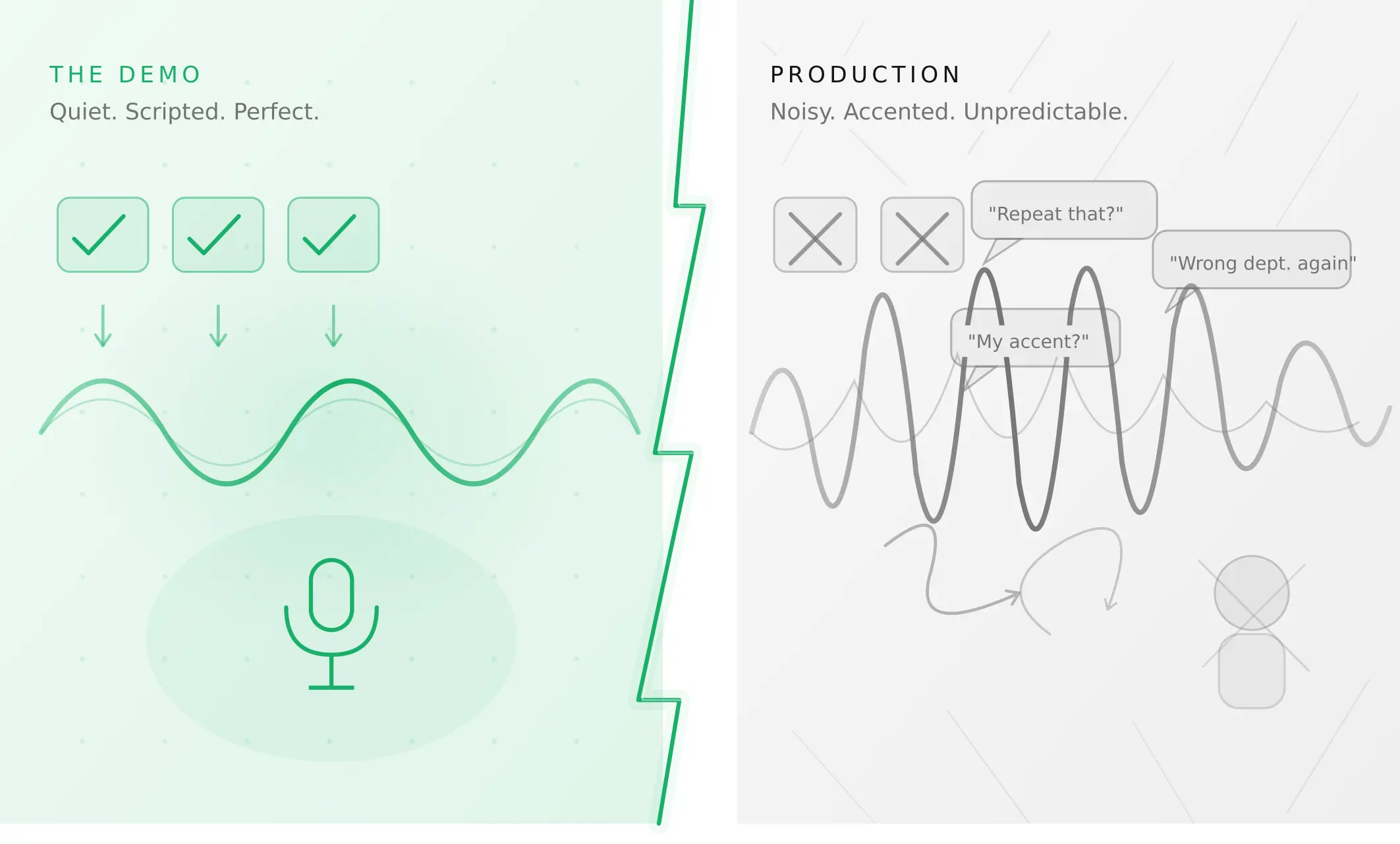
Why AI voice agents fail in production (and how to prevent it)
AI voice agents that ace demos still break in production. Learn the 5 root causes, how to test for each, and what production readiness actually means.
Read more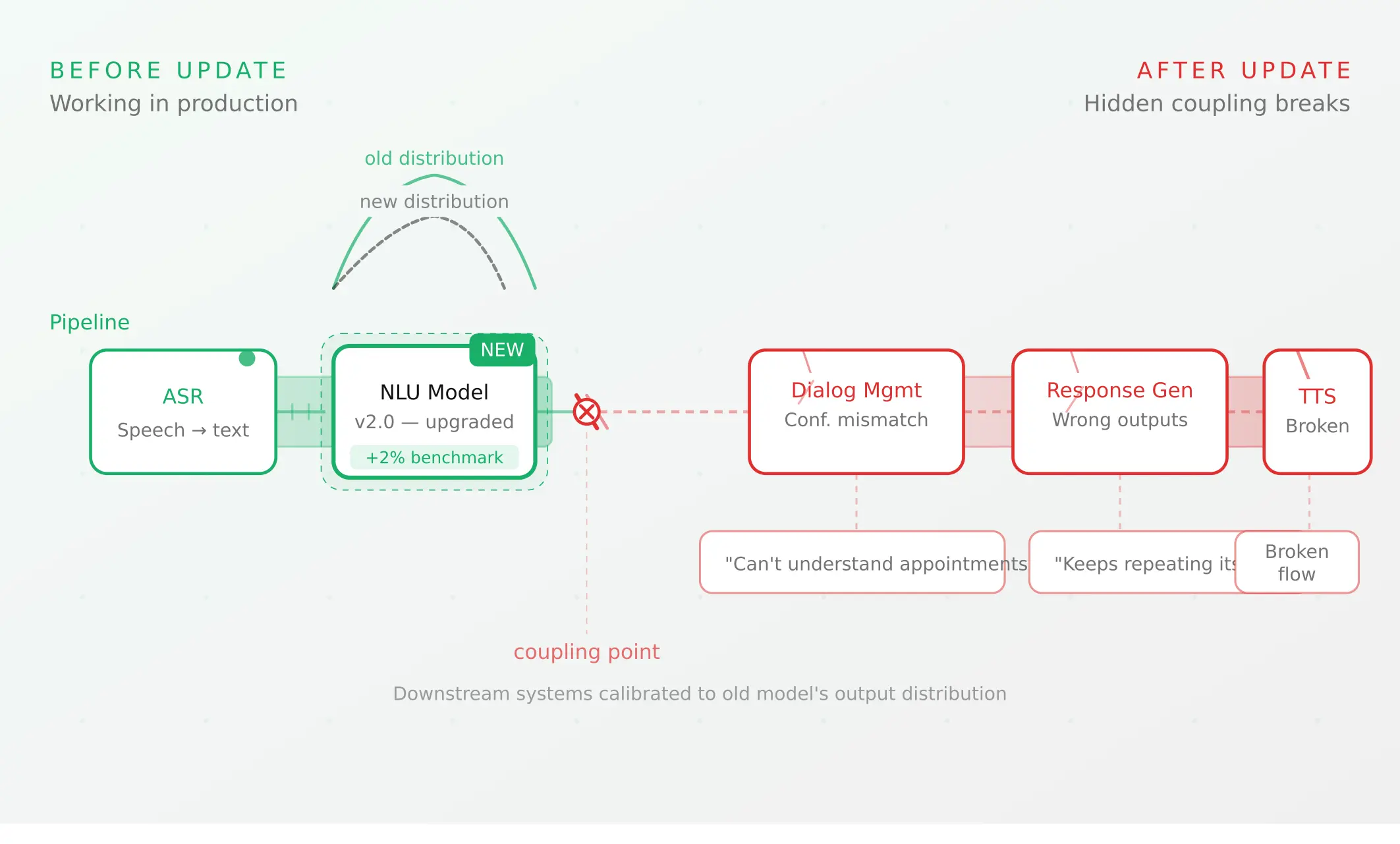
Voice agent regression testing: why LLM updates break production
LLM updates improve benchmarks but break voice agents in 5 predictable ways. How to detect and prevent regressions after every model or prompt change.
Read more