Containment vs deflection: what's the difference for voice agents?
On this page
Containment and deflection are the two numbers leadership loves, and they hide the same trap: both can look great while callers walk away unhappy. They sound like the same "the bot handled it" metric, but they measure slightly different things, and — more importantly — neither one means the caller's problem got solved. Optimizing them without watching resolution is how a voice agent racks up impressive dashboards and rising complaints at the same time. Evalgent measures the thing underneath both, and this guide draws the line.
Containment: the share of interactions a voice agent handles fully on its own, without transferring to a human.
Deflection: the share of interactions diverted away from a human or a costlier channel — often toward self-service.
Containment vs deflection: the core difference
The clearest split is what each one focuses on. Containment is about the agent keeping and finishing the interaction. Deflection is about diverting it away from a human or expensive channel.
| Dimension | Containment | Deflection |
|---|---|---|
| Focus | The agent handled it end to end | The interaction stayed off a human channel |
| Measured | Within the automated channel | As volume diverted from humans |
| Counts | Calls resolved without a transfer | Calls kept away from a live agent |
| Perspective | "Did the agent finish it?" | "Did we avoid a human touch?" |
| Shared blind spot | Says nothing about resolution | Says nothing about resolution |
Containment looks at the agent's side: did it carry the call to the end without handing off. Deflection looks at the channel's side: did this interaction avoid a human or a costlier route. In many voice deployments the two numbers move together, which is exactly why they get used interchangeably — but the emphasis differs, and the shared blind spot is what matters most.
Why they overlap and get confused
The overlap is real: a call the agent contains is usually also a call deflected from a human, so the two metrics rise and fall together. That is why teams treat them as one number and use whichever term their tooling prefers.
The confusion becomes a problem when either is treated as a measure of success on its own. Both count "the caller did not reach a human," and both are silent on whether the caller's issue was actually resolved. A high containment rate and a high deflection rate can describe an agent that solves problems beautifully — or one that frustrates callers into giving up. The numbers cannot tell the two apart, which is the heart of the trap.
The shared trap: neither means resolution
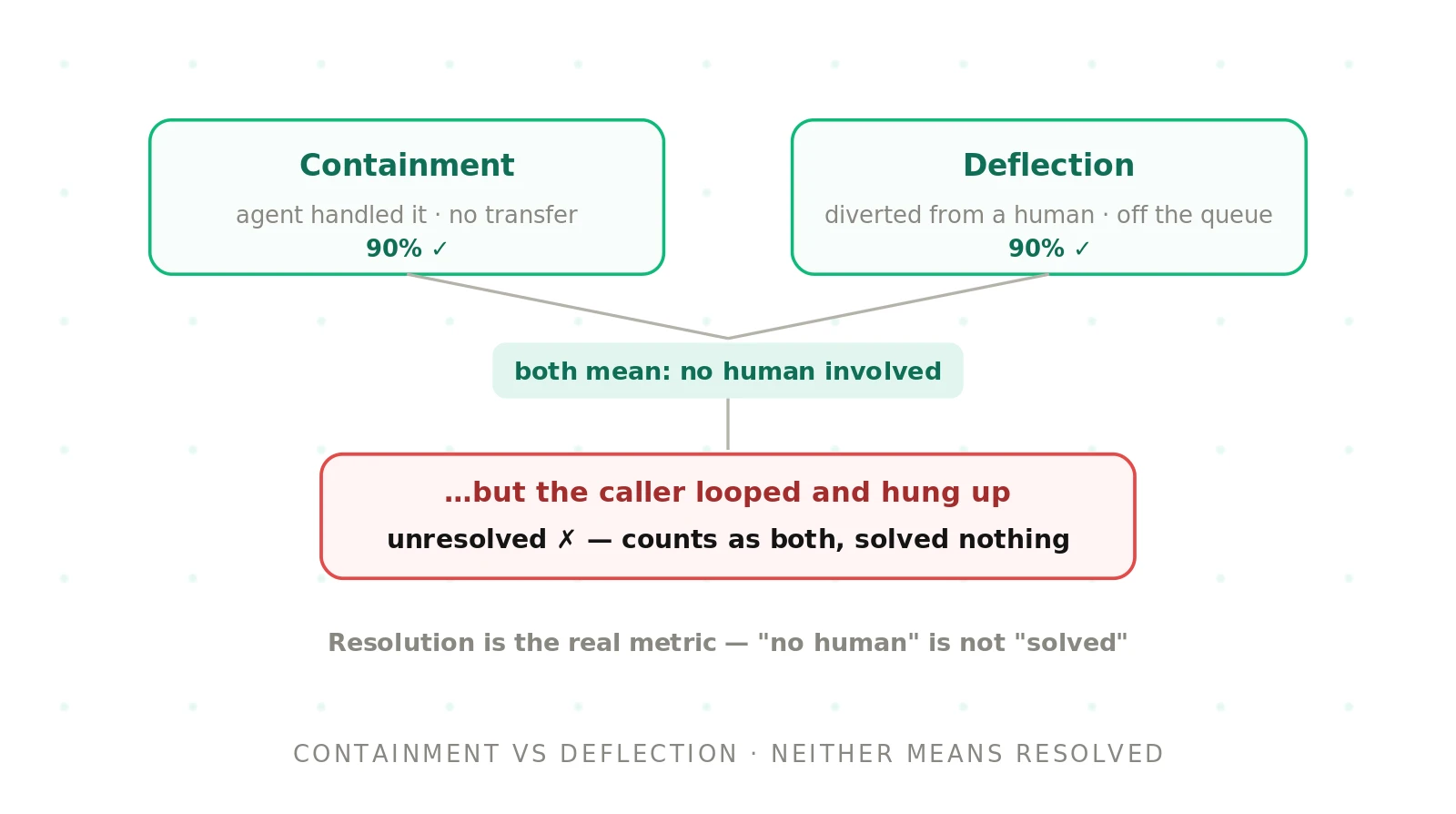
Here is the point that matters more than the definitions: containment and deflection both measure the absence of a human, not the presence of a solution. A call where the agent looped, the caller got frustrated, and they hung up counts as contained and deflected — no human was involved — while being a complete failure for the caller.
That makes both metrics gameable. You can inflate deflection by making it hard to reach a human, and inflate containment by never escalating, and your dashboard improves while your callers suffer. This is the same warning our customer support testing piece makes about containment: it only counts if the call was genuinely resolved. The honest version pairs containment and deflection with resolution and satisfaction, and treats an unresolved "contained" call — often a caller trapped in a repetition loop — as the failure it is.
How to measure containment and deflection honestly
Use the metrics, but never on their own.
1. Measure resolution, not just no-human — Track whether the caller's issue was actually solved, alongside containment and deflection.
2. Pair with satisfaction — Read the metrics next to sentiment or CSAT, so a frustrated caller cannot count as a win.
3. Separate resolved from abandoned — Distinguish a call the agent finished from one the caller gave up on; both can look "contained."
4. Check escalation accuracy — Confirm the agent hands off when it should, so containment is not inflated by trapping callers.
5. Do not add friction to deflect — Never raise deflection by making a human harder to reach; that is gaming, not improvement.
6. Gate on the real outcome — Use resolution as the metric that matters, with containment and deflection as context, not goals in themselves.
A worked example
A voice agent posts a 90% containment rate and a matching deflection rate — leadership is thrilled. Underneath, a chunk of those "contained" calls are people who asked a question the agent could not answer, got looped through the same clarification twice, and hung up in frustration. No human was involved, so the calls count as both contained and deflected. By the dashboard, a success; for the caller, a dead end. Only measuring resolution and escalation reveals that a slice of the 90% is trapped callers, not solved problems — which is why the two headline numbers cannot stand alone.
Containment, deflection, and Evalgent
Evalgent measures what containment and deflection leave out. Scenarios drive realistic calls, including the ones an agent cannot resolve, and Metrics track whether the caller's issue was actually solved — not just whether a human was avoided. Escalation accuracy is measured directly, so a high containment rate cannot hide callers who should have been handed off. Profiles vary caller type and difficulty, surfacing the calls where an agent is tempted to trap rather than resolve. Evaluations run the suite as automated batches before release, and Reviews let you replay a "contained" call to hear whether it ended in a solution or a hang-up.
The result is a containment and deflection story you can trust: the numbers in context, backed by the resolution they were always meant to stand in for. For the wider discipline, see the AI voice agent testing pillar and the escalation guide.
The bottom line
Containment is the agent handling a call itself; deflection is diverting it from a human or costly channel. They overlap and often move together, but both measure the absence of a human, not the presence of a solution.
Neither means the caller's issue was resolved. Read them alongside resolution and satisfaction, and treat a "contained" or "deflected" call that trapped the caller as the failure it is — because a rising dashboard and rising complaints can be the same agent.
Frequently asked questions
What is the difference between containment and deflection?
Containment is the share of calls a voice agent handles fully on its own, without transferring to a human. Deflection is the share diverted away from a human or a costlier channel, often toward self-service. Containment focuses on the agent finishing the interaction; deflection focuses on keeping it off human channels. They overlap, and both are silent on whether the issue was resolved.
Are containment and deflection the same thing?
They are closely related and often move together, since a call the agent contains is usually also deflected from a human. But the emphasis differs: containment measures the agent handling the call end to end, while deflection measures diverting volume away from human channels. More importantly, both share a blind spot — neither tells you whether the caller's problem was actually solved.
Does a high containment rate mean the agent is good?
Not by itself. Containment only counts calls that avoided a human, not calls that were resolved. An agent can post a high containment rate by never escalating, trapping callers who needed a person. A high rate is good only when those contained calls were genuinely resolved, so read containment alongside resolution and satisfaction rather than treating it as success on its own.
Can deflection be gamed?
Yes. You can inflate deflection by making it harder for callers to reach a human — burying the transfer option or looping them through self-service. That raises the metric while worsening the experience, since deflected does not mean resolved. Honest deflection comes from genuinely handling more issues in self-service, not from adding friction that forces callers to give up.
Why don't containment and deflection measure resolution?
Because both count the absence of a human, not the presence of a solution. A call where the caller looped, got frustrated, and hung up counts as contained and deflected, yet resolved nothing. The metrics measure whether a human was involved, which is a proxy for cost, not for outcome. Measuring resolution directly is the only way to know the issue was solved.
What should you measure instead of just containment and deflection?
Measure resolution — whether the caller's issue was actually solved — and pair it with satisfaction or sentiment. Track escalation accuracy so containment is not inflated by trapping callers, and separate calls the agent resolved from ones the caller abandoned. Use containment and deflection as context, but treat genuine resolution as the outcome that actually matters.
Is a contained call always a resolved call?
No. A contained call is one that did not reach a human, which is not the same as one that was resolved. Some contained calls end in a solution; others end in a frustrated hang-up. Treating containment as resolution hides the failures. To know a contained call succeeded, you have to measure whether the caller's issue was actually handled.
How do you test containment and deflection for a voice agent?
Run realistic scenarios, including issues the agent cannot resolve, and measure whether each call was actually resolved, not just whether a human was avoided. Assert the agent escalates when it should, so containment is not inflated by trapping callers. Read the numbers alongside sentiment, and gate on resolution, treating an unresolved contained call as a failure regardless of the dashboard.
Related guides
Testing vs evaluation for voice agents: what's the difference?
Testing and evaluation for voice agents are related but distinct: testing verifies behavior pass/fail, evaluation measures quality. Here's how they differ.
VAD vs endpointing: what's the difference in a voice agent?
VAD detects whether someone is speaking; endpointing decides when they've finished. Learn the difference and why confusing them cuts callers off.