Voice Agent Blast Radius: How One Failure Spreads
On this page
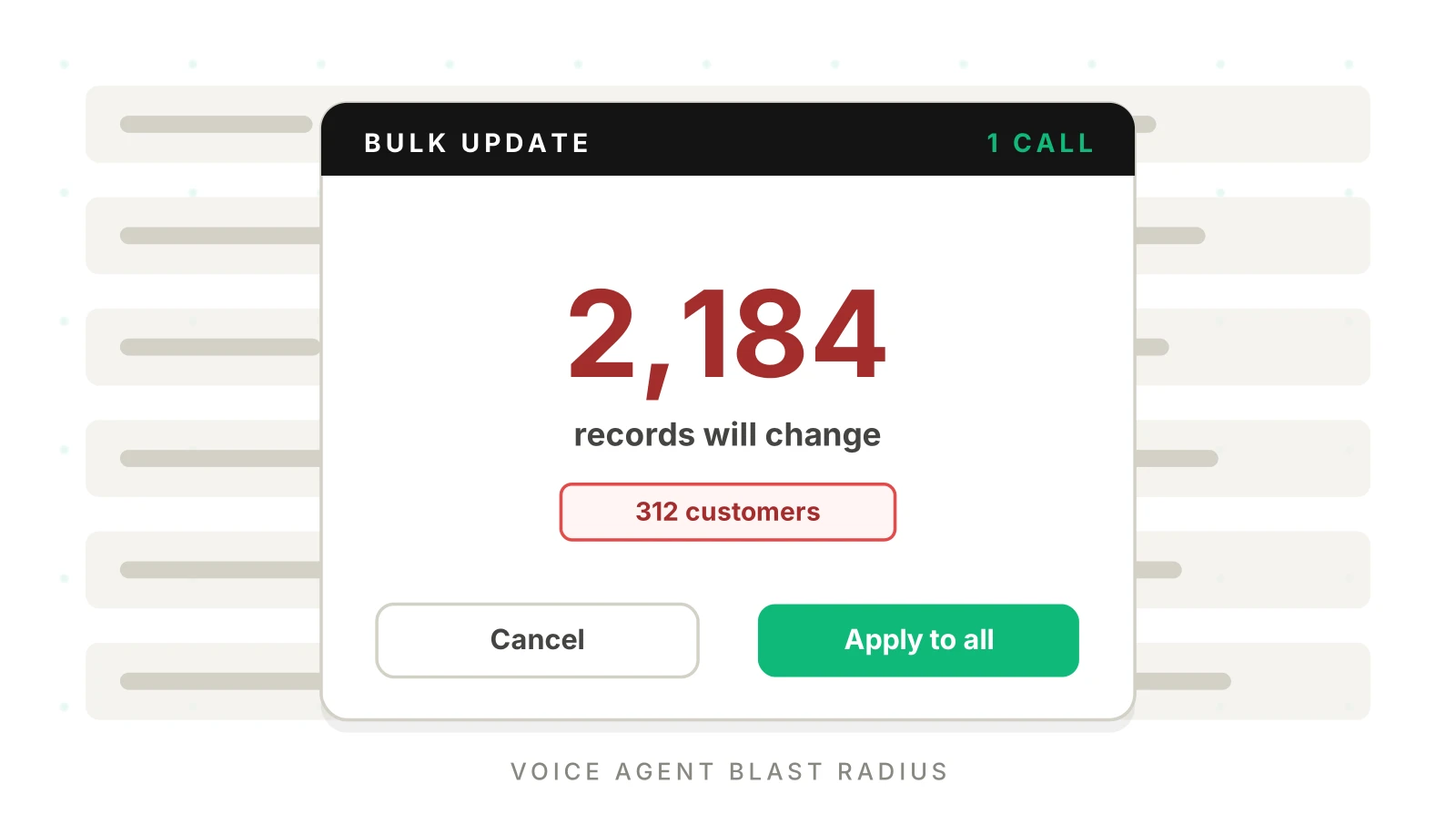
A voice agent used to be a phone menu with better manners. A wrong answer cost one call. Today the same agent writes bookings, tickets, payment plans and CRM notes. Its voice agent blast radius is no longer one conversation. It is every record the agent can write, across every customer who shares its prompt, tools and credentials. This guide defines the term, lists the multipliers that widen it, and gives a copyable scoring method. It is the first post in a series on the integrated voice agent: one wired into the product it lives in.
What blast radius means for a voice agent
Blast radius is an infrastructure term. AWS frames the same idea as "scope of impact" and tells teams to use bulkhead or cell-based architectures so a failure stays in a limited number of components. Its worked example is simple: with 10 cells serving 100 requests, a failure in one cell leaves 90% of requests unaffected. The same logic drives any AI agent blast radius, and voice adds callers who never wait.
Voice agent blast radius: the total set of customers, records, downstream systems and money that a single defect in the agent can change before someone notices and stops it.
Three ideas sit inside that definition.
- Reach. How many tenants, locations or accounts share the faulty component.
- Depth. How many records and systems each affected call writes to.
- Duration. How long the fault runs before detection and containment.
Reach times depth times duration is the damage. A bad call is a quality problem. A bad prompt that ships to 300 customers is an incident.
From surface feature to system actor
Early voice agents answered questions. Their output was audio, and audio is ephemeral. A mistake was heard once and forgotten.
Integrated agents are different. The call is the front door to a workflow: capture the request, call a tool, change a system of record, confirm to the caller, write back a summary. Each step leaves a durable artifact. A mis-heard digit becomes a wrong prescription number. A swapped AM/PM becomes a wrong appointment. Our posts on post-call write-back testing and alphanumeric capture cover how those errors form.
Two changes widen the radius.
1. Persistence. Errors now live in CRMs, POS tickets and billing systems. They outlast the call and get read by people and other software.
2. Shared components. The in-house team usually runs one prompt, one tool schema and one service credential for every customer. One edit reaches everyone at once.
Later in this series we cover agents that fill web forms and drive a browser while the caller talks. Those add a third change: the agent acts through a UI that can drift under it. This post stays on the foundation.
Nine multipliers that widen the radius
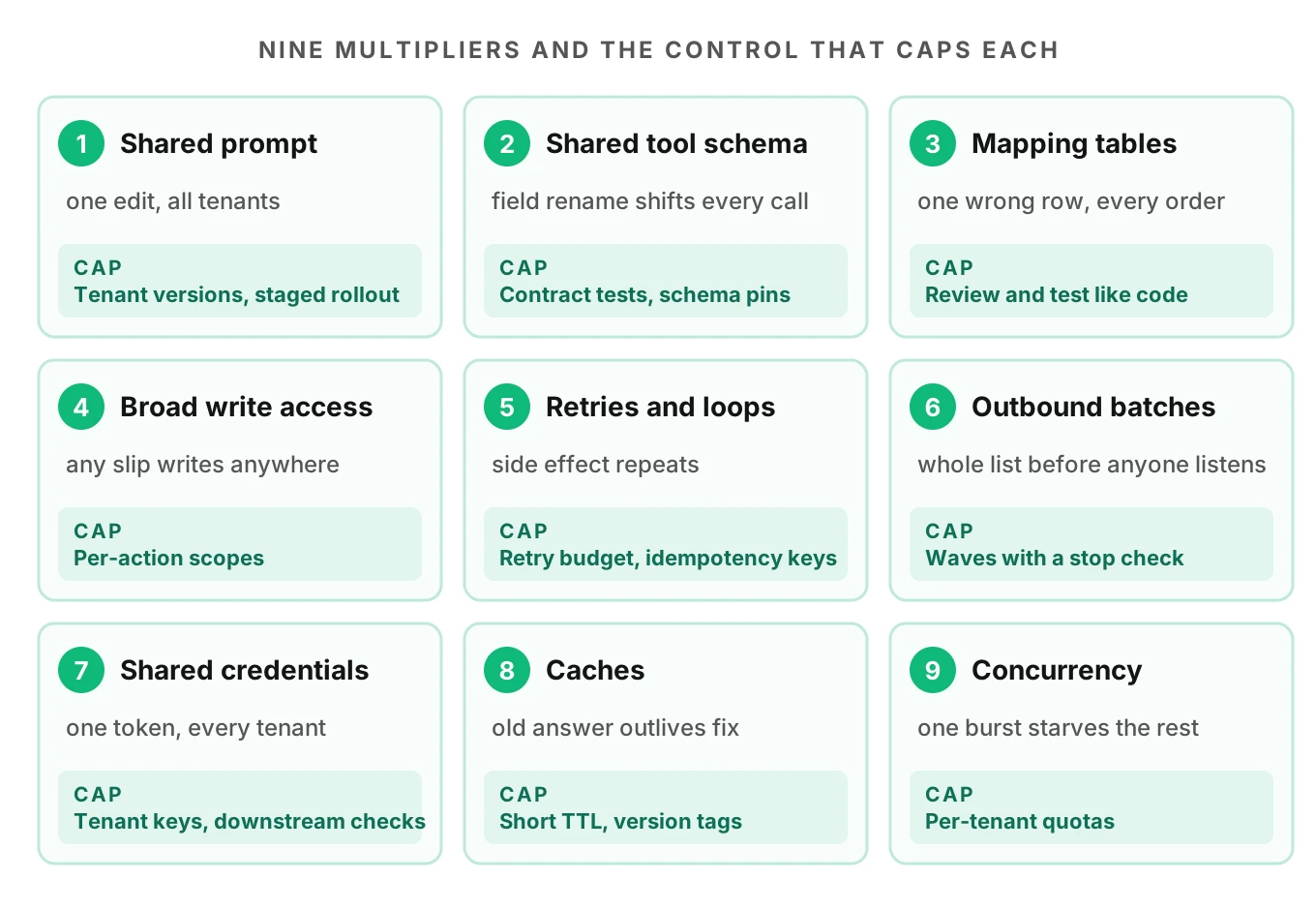
Most blast radius problems trace back to a small set of shared things. Each one is a multiplier. Find yours.
1. Shared prompt across tenants
One system prompt serves every restaurant, lender or store. A wording change to the confirmation step ships to all of them in one deploy. See shipping prompt changes safely for the versioning side. Containment: per-tenant prompt versions and a staged rollout.
2. Shared tool schema
A tool contract is a prompt in disguise. Rename a field, change an enum, and every call that uses the tool shifts. The MCP specification says tool annotations must be treated as untrusted unless they come from trusted servers. It also says tool lists can change over time. Containment: schema snapshots and contract tests, covered in our MCP server testing guide.
3. Shared mapping tables
Menu aliases, service codes and SKU synonyms translate speech into IDs. One wrong row, such as "large" mapped to the wrong size ID, corrupts every order that uses it. Mapping tables are data, so they bypass code review. Containment: review and test them like code.
4. Broad write permissions
If the agent can write any field on any record, any misunderstanding can write anywhere. OWASP names this class "excessive agency" and lists three root causes: excessive functionality, excessive permissions and excessive autonomy. Containment: narrow, per-action scopes. Our permissions post later in this series, voice agent permissions, goes deep.
5. Retries and loops
A retry that is safe once becomes a flood when layers stack. The Google SRE book warns that retries at multiple levels multiply load. Its example: three retries at each of three layers can produce 64 attempts on the database for one user action (each layer makes 4 attempts: the original plus 3 retries). In a voice agent, each attempt may also be a side effect, such as a charge or a booking. Containment: a retry budget and an idempotency key per side effect, covered in voice agent workflow testing.
6. Batch outbound campaigns
Inbound failures arrive one call at a time. A single outbound campaign fails in bulk. A wrong consent flag or script error runs across the whole list before anyone listens. Under the TCPA, a private plaintiff can sue for actual loss or $500 per violation of the autodialer and prerecorded-voice rules, whichever is greater, and a court may raise the award to up to three times that for willful or knowing violations. Hundreds of calls multiply fast. Containment: send in small waves with a stop check between them. See outbound voice agent testing. This is not legal advice.
7. Shared credentials
One service account for every tenant means one leaked or misused token reaches every tenant. It also means the audit log cannot say which customer an action belonged to. OWASP's mitigation is to run actions in the user's own authorization context, not a generic high-privilege account. Containment: per-tenant credentials and downstream authorization checks.
8. Caches
Caches keep old answers alive after a fix. A cached tool list, menu, price or policy can serve stale data for its whole time-to-live. The MCP spec supports caching of tool lists with a time-to-live, so a schema fix may not reach every client at once. Containment: short TTLs on anything that touches writes, and a version tag on every cached item.
9. Concurrency
Shared rate limits, shared telephony channels and shared LLM quotas mean one tenant's burst can starve the rest. The failure is not wrong data but dropped calls and dead air. We cover it in concurrency failure in voice agents. Containment: per-tenant quotas.
The blast radius table
Use this table as a template for voice agent failure containment. List each failure you can imagine, then fill the last two columns. The detection times are illustrative assumptions, not measurements.
| Failure | What it touches | Typical detection (illustrative) | Containment control |
|---|---|---|---|
| Prompt edit changes date phrasing | Bookings for every tenant | Days, when no-shows rise | Staged rollout, write-back diff check |
| Tool field renamed | Every call using the tool | Minutes if errors alert, days if silent | Contract tests, schema pinning |
| Wrong mapping row | All orders using that item | Hours to days | Mapping review, tenant-scoped data |
| Retry loop on payment tool | Charges for affected callers | Minutes, if charge alerts exist | Idempotency keys, retry budget |
| Wrong consent flag in campaign | Whole outbound list | Hours, after first complaints | Waves, pre-send suppression check |
| Over-broad service credential | Every record the credential can write | Weeks, often by audit | Per-action scopes, per-tenant keys |
| Stale cache after fix | All tenants until TTL expires | Hours | Short TTL, version tags |
The pattern matters more than the numbers. Silent failures, where the call sounds fine and the record is wrong, have the longest detection time. Our post on detecting silent tool failures explains why.
A scoring method you can copy
Score each failure on four factors, each from 1 to 5. Multiply them. This blast radius scoring method needs no tooling.
Blast radius score = C × R × V × T
| Score | C: customers exposed | R: records per customer | V: reversibility | T: time to detect |
|---|---|---|---|---|
| 1 | One caller | 1 | Auto-undo or idempotent | Under 5 minutes, alert fires |
| 2 | One customer account | 2 to 10 | One-click revert | Under 1 hour |
| 3 | Up to 10% of tenants | 11 to 100 | Manual fix with audit log | Same day |
| 4 | Up to half of tenants | 101 to 1,000 | Needs customer contact | Within a week |
| 5 | Nearly all tenants | Over 1,000 | Irreversible (money, messages, regulated calls) | Unknown, or reported by customers |
The maximum is 625. Treat the result as a lightweight voice agent risk assessment, not a certification. Our suggested tiers are below 40 for low, 40 to 149 for medium, 150 to 399 for high and 400 or more for critical. These cut-offs are a starting assumption. Tune them to your tolerance.
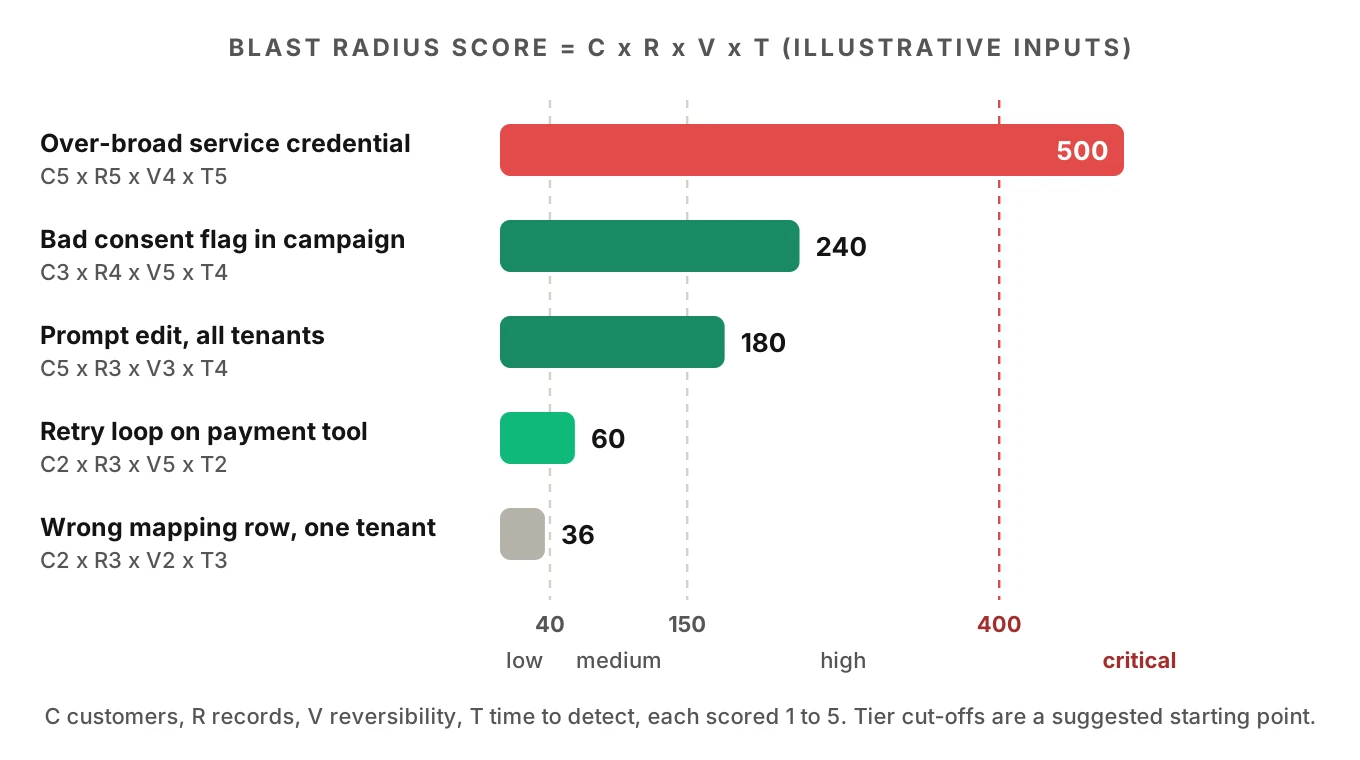
Here is the method as code. It is simplified.
from dataclasses import dataclass

@dataclass
class Failure:
    name: str
    c: int  # customers exposed, 1-5
    r: int  # records per customer, 1-5
    v: int  # reversibility, 1 (auto-undo) to 5 (irreversible)
    t: int  # time to detect, 1 (alert) to 5 (customer reports)

    def score(self) -> int:
        for x in (self.c, self.r, self.v, self.t):
            assert 1 <= x <= 5
        return self.c * self.r * self.v * self.t

    def tier(self) -> str:
        s = self.score()
        if s >= 400: return "critical"
        if s >= 150: return "high"
        if s >= 40:  return "medium"
        return "low"

failures = [
    Failure("prompt edit, all tenants", 5, 3, 3, 4),
    Failure("wrong mapping row, one tenant", 2, 3, 2, 3),
    Failure("bad consent flag in campaign", 3, 4, 5, 4),
    Failure("retry loop on payment tool", 2, 3, 5, 2),
    Failure("over-broad service credential", 5, 5, 4, 5),
]
for f in sorted(failures, key=lambda f: -f.score()):
    print(f"{f.score():>4}  {f.tier():<8}  {f.name}")
Worked example (illustrative inputs). The prompt edit scores 5 × 3 × 3 × 4 = 180, which is high. Reach is nearly every tenant. Fixing is manual. Nobody reads the records for days. The mapping row scores 2 × 3 × 2 × 3 = 36, which is low, because only one tenant is affected and a revert is one click.
Notice what moves the score most. Cutting T from 4 to 1 with an alert divides the score by four. Cutting C from 5 to 2 with a canary cuts it by more than half. Detection and reach are the cheapest levers.
How to map and shrink your voice agent's blast radius
These steps help you limit blast radius without a rewrite. Run them as a half-day workshop with the engineer who owns the agent, the person who owns the systems of record, and whoever handles customer escalations.
1. Inventory every write. List each tool, API and database field the agent can change. Include logs, CRM notes and SMS sends. Mark each as read, reversible write or irreversible write.
2. Inventory every shared component. For each of the nine multipliers, write down what is shared and by how many tenants.
3. Score the top 15 failures. Use the formula above. Do not argue over single points. Argue over the tier.
4. Pick a containment control for every high or critical item. Prefer controls that cut C or T. They are cheapest.
5. Cap the agent's authority. Give each tool the narrowest scope. Split read tools from write tools. Put irreversible actions behind a confirmation step or a second check.
6. Add rate limits and breakers. Add a per-tenant rate limit on writes per minute and a global circuit breaker that pauses writes when error rates spike.
7. Roll out in cells. Ship each prompt, schema or mapping change to a small slice first. Google's SRE workbook defines canarying as a partial, time-limited deployment of a change plus its evaluation. Its own example: a release that fails 20% of requests but reaches only 5% of traffic yields about a 1% overall error rate.
8. Test before every ship. Replay a scenario set that covers each high-score failure. Include noisy, accented and interrupted callers, because audio errors are what start the chain.
9. Verify the record, not the call. After each test or live call, diff what the caller said against what the system stored.
10. Re-score quarterly. New tools, tenants and integrations change the inputs.
Containment over time
Containment is a race between the fault and your detection. The chart below uses made-up numbers to show the shape. Without limits, damage grows until a person notices. With a canary, damage stops growing at the canary slice. With a canary plus a rate cap and a breaker, it flattens within the first hour.
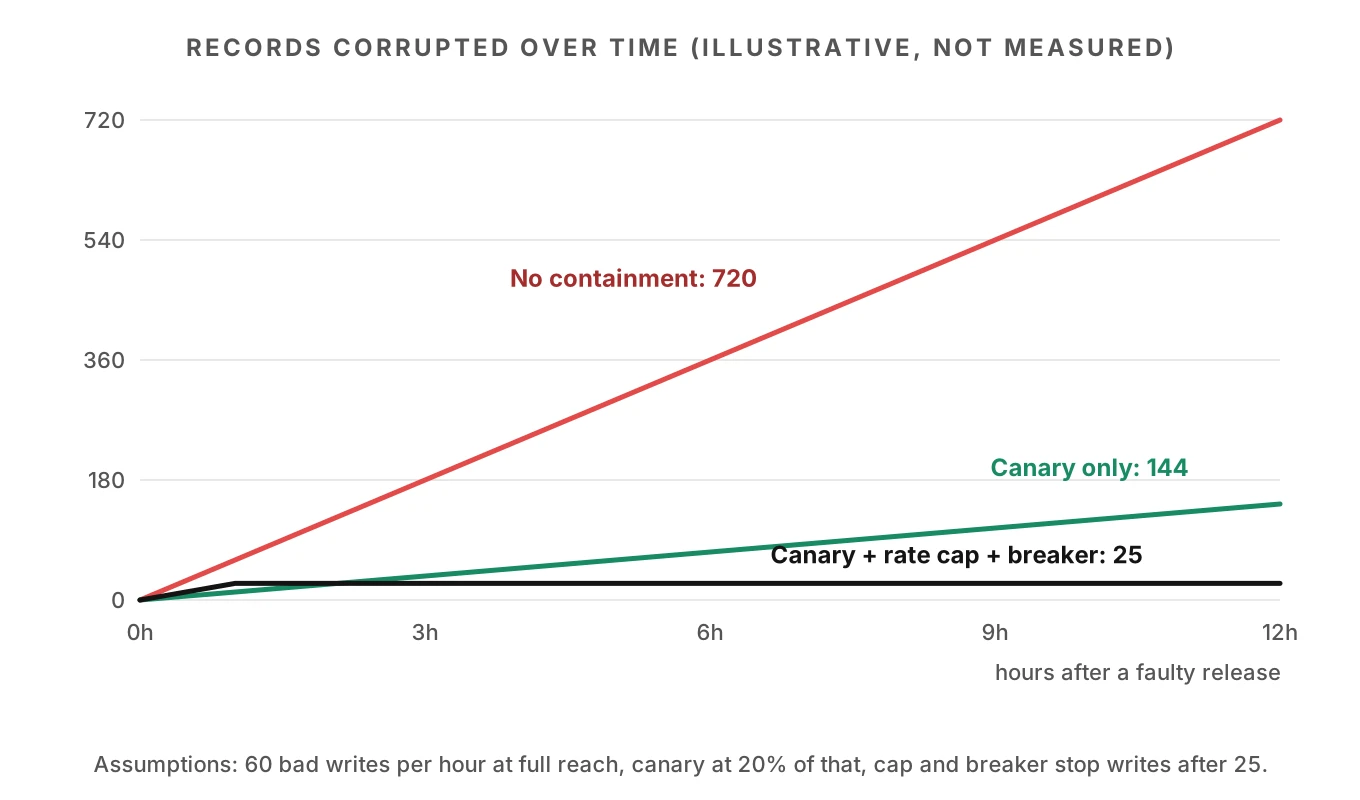
The lesson is not the specific numbers. It is that three cheap controls compound. A canary limits reach. A rate cap limits depth. A breaker limits duration.
What to test, and where Evalgent fits
Blast radius is a pre-release question and a live-monitoring question.
Before release, test the changes that hit shared components. Generate scenarios from the prompt and flows, so branches and hard constraints get covered. Run them across caller profiles with different accents, speech pace, interruptions and background noise. Judge from the audio, not just the transcript, since a transcript can hide a misheard digit. Evalgent's simulator calls the agent over phone, SIP or WebRTC and scores latency, instruction adherence, hallucination and custom metrics on every call. That makes a prompt or schema change testable before it reaches every tenant. See our guides to end-to-end testing, tool-calling test cases and tool call accuracy.
After release, watch production. Evalgent's production monitoring takes call recordings, transcribes them, maps them to scenarios and judges them. It flags tool-call failures, PII leakage, latency spikes and policy failures with fix recommendations. This is what turns T from 4 or 5 into 1 or 2. Our posts on monitoring voice agents in production and the production feedback loop show the loop. A staging environment helps, but it cannot replace a canary on real traffic.
Set a target too. A voice agent SLO with an error budget tells you when to stop shipping. Tie the budget to your tier: a high-scoring failure class should have a tight budget.
The series ahead
This post is the foundation. The next four go deeper on specific containment layers.
- Integration testing: contract and dependency tests at each boundary.
- Workflow testing: multi-step state, partial failures, retries.
- Rollback: undoing bookings, payments and claims.
- Permissions: what the agent may and may not write.
Later posts cover web-form filling, screen-state drift, browser control and kill switches with canaries. For worked industry cases, see the gym failed-payment calls, pharmacy refill line, dealership service scheduling, utility company agent and last-mile driver support. For the general failure picture, read why voice agents fail in production and our complete testing guide.
One caution. Knight Capital's August 2012 loss, which the firm put at about $440 million pre-tax, was not a voice failure. It shows what happens when one bad software installation meets a system that acts at machine speed. Voice agents act at phone speed, but the lesson carries over.
Frequently asked questions
What is voice agent blast radius?
It is the full set of customers, records, systems and money that one failure in the agent can affect before it is stopped. It combines reach (how many tenants share the faulty part), depth (how many records each call writes) and duration (how long until detection and containment).
How do you measure the blast radius of a voice agent?
Score each failure on four factors from 1 to 5: customers exposed, records per customer, reversibility and time to detect. Multiply them. A score of 400 or more is critical in the tiers suggested above. Tune the cut-offs to your own risk tolerance and revisit them every quarter.
What makes a voice agent failure spread to many customers?
Shared components. A single prompt, tool schema, mapping table, credential or cache serving every tenant means one change reaches all of them. Batch outbound campaigns, retries and shared rate limits widen it further. The more your agent shares across customers, the larger the radius.
How do you limit voice agent blast radius?
Cap each factor. Give each tenant its own prompt version and credentials, narrow write scopes, cap writes per minute, roll out changes to a small slice first, and alert on bad writes. Cutting reach and detection time is usually the cheapest first step.
Is blast radius the same as risk?
No. Risk usually weighs likelihood and impact. Blast radius is the impact side only: how far one failure can travel. Use it to rank which failures need containment first, then combine it with how likely each failure is.
Why are voice agent errors hard to detect?
The call can sound correct while the stored record is wrong. A swapped digit or AM/PM flips a field without any error. Without checks that diff the caller's words against the saved record, nobody sees the damage until a customer complains.
Does a staging environment shrink blast radius?
It helps you find defects before release, but it does not limit exposure when a defect escapes. Staging rarely matches real callers, data and volumes. A canary rollout on live traffic, with write limits, is what caps reach when something slips through.
Which controls should we build first?
Start with detection and reach. Add an alert on failed or odd writes, then stage every prompt, schema and mapping change to a small slice of tenants. Both cut the score quickly. Narrow permissions and idempotency keys come next, then breakers.
The bottom line
A voice agent wired into your product has a blast radius, and it grows with every shared prompt, tool, credential and permission. Score it, cap reach and detection time first, and test every change before it reaches all your customers.
Related Articles

How to automate voice agent testing: synthetic callers vs manual QA
Learn how ai test automation replaces manual QA for voice agents. Compare synthetic callers vs human testers, with a 5-step framework to scale without hiring.
Read more
AI Agent Testing vs Voice Agent Testing: What General Tools Miss for Voice
AI agent testing measures text outputs. Voice agent testing measures behaviour through an acoustic pipeline. Five failure categories general tools miss.
Read more