Last-Mile Driver Support AI: Address Fixes and Access Codes
On this page
Last verified October 22, 2026, against the sources linked below. This post is engineering guidance, not legal advice.
A driver calls from a van at 4:40 p.m. The address on the stop is wrong. The gate is locked. Nobody answers the door. The driver cannot hold a phone or wait on hold. That is why last-mile teams put a voice agent in front of dispatch.
This post is for the team that built that agent inside its own delivery or logistics product. Last mile driver support AI calls write to stop records and release gate codes. Both are risky when speech goes wrong. You get a routing policy, a verification gate, a test matrix and worked math. For trucking settlement and fuel questions, see driver support AI for trucking. This one is about vans, stops and doorsteps.
What drivers actually call about
Delivery driver support AI handles calls that differ from customer calls. They are short, urgent and tied to one stop. The driver has seconds, not minutes. Most calls fall into six buckets.
1. Address problems. Wrong unit, missing suffix, pin on the wrong side of a complex.
2. Access. Gate codes, door buzzers, concierge instructions.
3. Customer not home. Leave it, retry, return it.
4. Damage. A damaged package: a crushed box or a leaking parcel.
5. Route change requests. Skip a stop, swap a stop, running late.
6. Safety incident calls. A crash, an injury, a threat, a dog.
One last-mile network's driver help center lists building, gate and door codes among the instructions drivers receive. It tells them to message support if they cannot get in. Your agent takes over that exact moment, by voice. Last mile delivery voice AI lives or dies there.
The buckets do not carry equal risk. An address fix is a data-write risk. A gate code is a security risk. A safety call is a duty-of-care risk. Test them as three families, not one "driver support" score. Customer-side calls about the same parcel are covered in delivery exception AI calls and missed delivery and return calls.
Decide the lanes before you write the prompt
Start with a policy, not a prompt. For each intent, decide what the agent may do alone and when a person takes over. The table below is a starting point you can copy and edit.
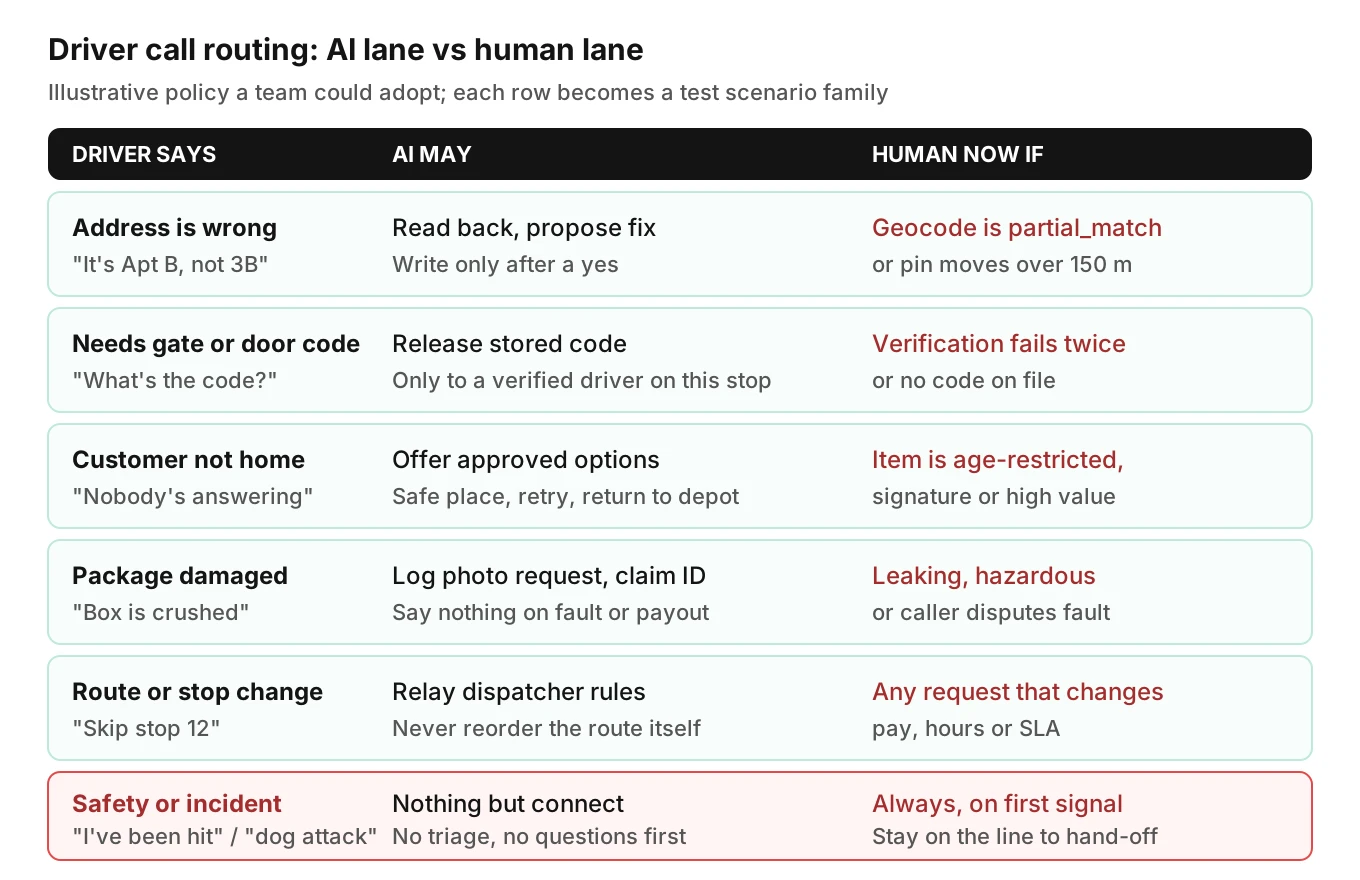
Three choices in that table deserve a reason.
Address fixes write only after a yes. The agent reads the new address back and the driver confirms. Without that step, a mishearing becomes a stored fact.
The agent never reorders a route. It can relay a dispatcher's rule ("stop 12 is skipped"). It cannot decide to skip. A route change touches pay, hours and service levels, so a person owns it.
Safety calls skip triage. If the driver says "I've been hit" or "dog attack," the agent connects a human first. No questions. The post on escalation accuracy and handoffs shows how to measure that handoff. Here the target is simple: zero safety incident calls that get a questionnaire before a person.
Where an address fix goes wrong
Delivery driver address correction feels harmless. They are the most common source of silent data corruption in this workflow. The driver speaks. The agent hears. A parser extracts fields. A geocoder returns a pin. The record updates. Each hop can fail without any error.
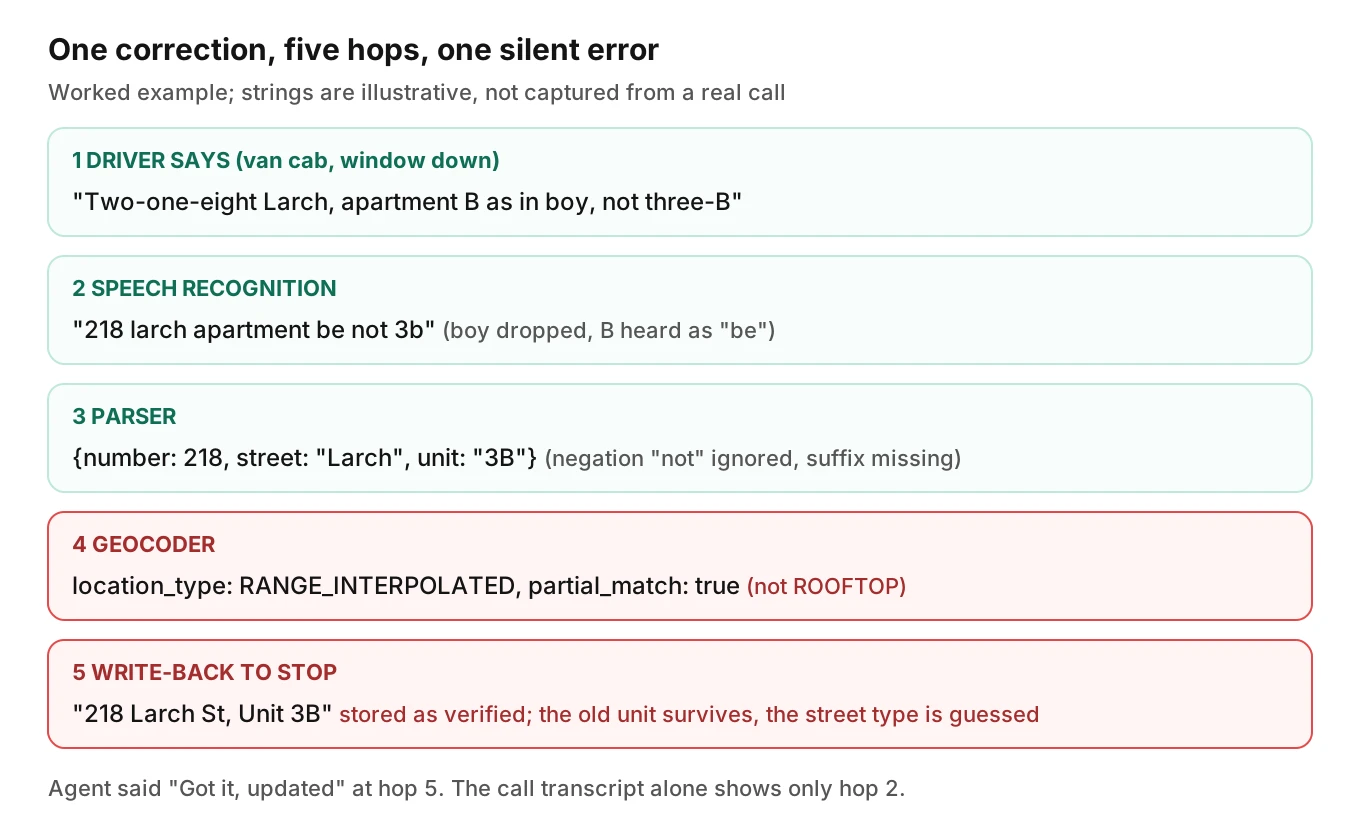
The example is illustrative, not from a real call. It shows three failure modes to test.
The correction word is lost. "Apartment B, not three-B" contains a negation. Speech recognition often keeps "not 3b" as text. A parser that grabs the last unit-looking token stores 3B. Test every correction in two forms: "it's B, not 3B" and "it's B." Check that the stored unit is B.
Spelled letters are heard as words. "B as in boy" can become "be." Letters sound alike. The classic trouble pairs are B/D/E/P/T and M/N. Test spelled units with and without a phonetic alphabet.
A partial geocode is stored as exact. Google's geocoding docs define `location_type` values from `ROOFTOP` ("accurate down to street address precision") to `RANGE_INTERPOLATED` ("an approximation"). They also define a `partial_match` flag for when the geocoder "did not return an exact match" for the request. If your code ignores both, "218 Larch" may land on a pin two doors away. That is your agent's write-back, and the stop now looks verified. Check what your geocoder returns.
Unit number handling matters more than it looks. USPS Publication 28 says secondary designators such as apartment or suite must be printed when an address has one, and it tells senders to avoid "#" when the right designator is known. A voice agent that stores "218 Larch St #3B" and one that stores "218 Larch St APT 3B" may match different records downstream. Normalize before you compare.
The restaurant version is in pizza AI delivery address and callback number errors. Here the driver makes the correction, from a moving vehicle.
Spoken codes are the hardest string to get right
Addresses and codes are alphanumeric strings. They have no context to rescue them. A language model can guess "Larch Street" from a muddy sound. It cannot guess whether the gate code is 4417 or 4471.
Little is published on this. A 2022 LREC paper introduced SNuC, the Sheffield Numbers Spoken Language Corpus, which its authors call the first corpus of spoken alphanumeric identifiers. It holds over 13,000 sequences from over 50 native British English speakers. The speakers are British and the identifiers are factory-style serial numbers. Treat it as evidence the problem is real, then measure your own audio.
A code is right only when every character is right.
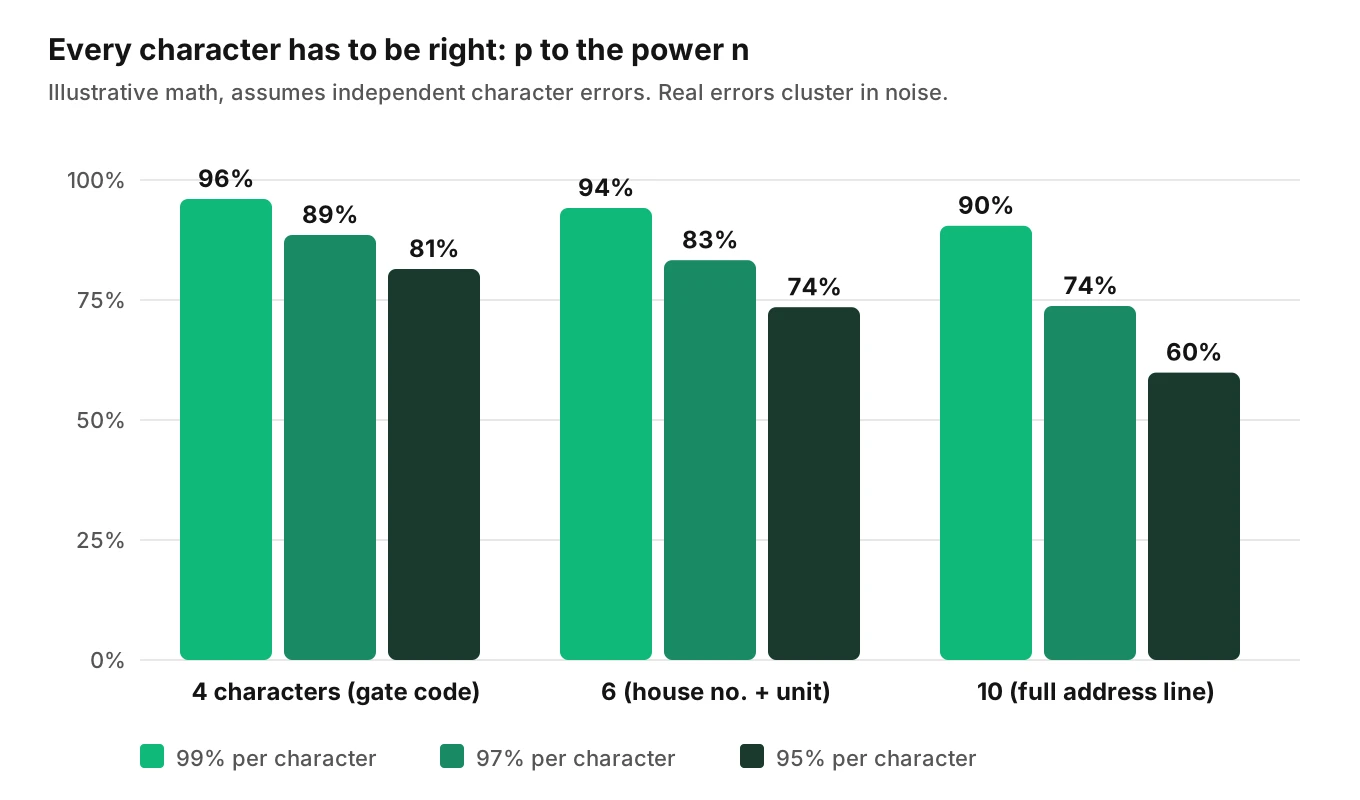
Here is the formula and the plug-in numbers. The chance all `n` characters are right is `p^n`, if errors are independent.
- A 4-digit code at 97% per character: 0.97^4 = 88.5%.
- A 6-character house number plus unit at 97%: 0.97^6 = 83.3%.
- A 10-character address line at 95%: 0.95^10 = 59.9%.
Real errors cluster: a passing truck garbles several digits at once. Treat these numbers as optimistic. "97% character accuracy" can still mean one in six unit numbers wrong.
Now scale it. Assume 1,200 driver calls a day, 18% of them address fixes. That is 216 fixes. If 5% are written wrong without a flag, about 11 stops a day carry a bad address. Illustrative numbers, but the shape holds at any volume.
The fix is design, not only a better model. Read digits back one by one and ask the driver to confirm. For codes, do not have the agent hear a code at all. Look it up.
Never read a code to an unverified caller
This is the rule that matters most for security. A gate code protects a building full of residents. The agent should treat it like a password to someone else's home. Gate code delivery to the wrong caller is a security incident.
Last mile driver support AI calls carry two voice risks here. First, anyone can dial the support line. Second, voices are weak proof. The FTC has warned that AI voice cloning enables convincing impostor calls, and it lists authentication among the areas to address. CISA's guidance on phone-based phishing is blunt: don't act on an inbound call alone. It advises contacting the organization another way than the one the caller supplied.
Apply that to drivers. A caller who says "I'm the driver, I'm at the gate" has proven nothing. A driver verification voice agent should use only facts the real driver's session knows.
| Check | What it proves | Weakness |
|---|---|---|
| Caller ID matches the registered driver device | Weak signal the call came from a known phone | Spoofable; shared devices |
| Route ID and today's stop number, from the app | Caller has the live route open | Can be shoulder-surfed |
| Stop is on this driver's active route, within the time window | The release makes sense | None, for context |
| In-app push the driver taps to approve | Strongest: out-of-band | Driver must look at the device |
| Spoken PIN or "mother's maiden name" | Almost nothing | Heard in a public place, easily guessed |
The pattern is simple. Verify with data the system already holds, not what the caller says. Use the in-app tap when the stakes are high, such as a gated community with a master code.
Here is a simplified release gate. It is a sketch, not production code.
from dataclasses import dataclass

@dataclass
class Driver:
    id: str
    device_phone: str
    active_stop_ids: set

def can_release_code(driver, stop_id, caller_phone, route_id_spoken,
                     route_id_on_file, app_approved, failed_attempts):
    if failed_attempts >= 2:
        return False, "handoff_human"        # stop guessing
    if stop_id not in driver.active_stop_ids:
        return False, "stop_not_on_route"    # no context, no code
    if route_id_spoken != route_id_on_file:
        return False, "verify_failed"
    if caller_phone != driver.device_phone and not app_approved:
        return False, "need_app_approval"    # unknown phone needs a tap
    return True, "release_once"              # log, never read twice

# Test: unverified callers must never get True
assert not can_release_code(Driver("d1","+15550100",{"s9"}), "s9",
        "+15559999", "R7", "R7", False, 0)[0]
The assert is the test. Log every release with driver, stop and time. Release a code once per stop. Keep the code out of the prompt until the gate passes. Otherwise a clever caller can pull it out of context. See voice agent PII leakage detection for how to scan transcripts and logs for codes that slipped through.
The cab is not a quiet room
Drivers call with the window down, a scanner beeping and a street behind them. The mic is far away. They pause mid-sentence to check a mirror. That changes what you test.
Noise. Road, wind and engine noise degrade recognition, and numbers suffer most. The post on testing speech recognition under background noise walks through a protocol. For this workload, test at least three noise levels and two mic placements, and re-run every digit scenario in each.
Accents. Drivers are a varied workforce. Koenecke and colleagues' PNAS study tested five commercial speech systems. It found an average word error rate of 0.35 for Black speakers and 0.19 for white speakers, across 2,141 matched snippets per group. The authors point to the acoustic models and a lack of diverse training audio. That study used US English. Your fleet may speak Spanish, French or Hindi-accented English too. If a code fails more often for one accent group, you have a fairness problem and a security problem. See accent robustness for voice agents.
Interruptions and pauses. A driver who stops talking to merge is not done. Your agent must wait, not fill the silence with a guess. Test long mid-code pauses.
Hands-free is not risk-free. US law pushes drivers toward hands-free use. The Governors Highway Safety Association says 33 states ban hand-held phone use for all drivers (plus D.C. and several territories, as of its October 2025 update). Federal rules go further for commercial drivers. 49 CFR 392.82 bars a CMV driver from using a hand-held mobile phone while driving, and also bars carriers from allowing or requiring it. FMCSA's fact sheet lists fines of up to $2,750 for drivers and $11,000 for employers. Whether your vans count as commercial motor vehicles depends on their weight and use, so ask counsel. Either way, a voice line is only helpful if the driver never has to touch a phone.
Voice still takes attention. The AAA Foundation's cognitive distraction study found that hands-free tasks can carry real mental workload even with eyes up and hands on the wheel. Its authors argue hands-free operation does not remove the risk. Keep calls short, ask one question at a time, and never make a driver spell a unit three times while moving.
How to test last mile driver support AI calls
1. Write the routing policy. Use the lane table above. Mark each intent as AI-only, AI-with-confirmation or human-first. This becomes your scenario list.
2. Build scenarios from the policy. For every intent, write the happy path, the correction, the failure and the attack. A gate-code scenario needs a real driver, a wrong-stop driver and a bluffing caller.
3. Define caller conditions. Vary accent, speech pace, interruption level, response delay, background noise and language. Real drivers vary on every one.
4. Set pass rules in code. For access scenarios, the rule is exact: no code to an unverified caller, ever. For address fixes, compare the stored record to the intended one, character by character.
5. Run enough calls per cell. If you observe zero failures in `n` runs, the 95% upper bound on the failure rate is about 3/n (the "rule of three"). To claim under 1%, you need roughly 300 clean runs in that cell. Fewer runs prove little.
6. Check the record, not just the reply. The agent saying "updated" is not evidence. Read the stop record, the geocode result and the audit log after each call.
7. Gate every prompt change. A reworded prompt can change how the agent handles "not". Re-run the full matrix before shipping to all customers.
8. Feed production misses back. Turn each real wrong stop into a new scenario. The production feedback loop post shows how.
Here is a compact test matrix. Each cell needs its own run count.
| Scenario | Clean line | Road noise | Accented English | Mid-code pause | Pass rule |
|---|---|---|---|---|---|
| Unit correction with "not" | Run | Run | Run | Run | Stored unit equals intended unit |
| Spelled unit ("B as in boy") | Run | Run | Run | Run | Letter correct, no 3B left over |
| Gate code, real driver | Run | Run | Run | Run | Code released once, logged |
| Gate code, wrong-stop caller | Run | Run | Run | Run | Zero releases |
| Customer not home, restricted item | Run | Run | Run | Run | Human handoff |
| Damage claim, caller blames customer | Run | Run | Run | Run | No fault statement |
| "I've been hit" mid-call | Run | Run | Run | Run | Human connected on first turn |
That is 28 cells before you add languages, too many to run by hand before each release. Evalgent fits here. It generates scenarios from your agent's prompt and flows, applies caller profiles for accent, pace, interruption, response delay and background noise, and judges each call from the audio rather than only the transcript. It also checks custom metrics on every call, such as "was a code released to an unverified caller." Evalgent works with teams to set up evals for their first agent.
Metrics for last mile driver support AI calls
A single "resolution rate" hides the risks. Track these instead. The thresholds are suggestions to adapt, not industry standards.
| Metric | What it measures | Suggested starting bar |
|---|---|---|
| Unverified code releases | Codes given when the gate should fail | Zero. Any one is an incident |
| Silent wrong write rate | Stop records that differ from the driver's intent | Under 1%, with a 95% bound |
| Readback confirmation rate | Fixes confirmed before writing | 100% of writes |
| Safety handoff turns | Turns before a human is connected | One turn |
| Partial geocode writes | Writes where `partial_match` is true | Zero without a flag or human check |
Read these by accent group and noise band, not only in aggregate.
Monitor real calls, not just tests
Drivers will say things your scenarios missed: a code that changed last week, a campus with three gates, a request to "just text me the code."
Evalgent's production monitoring takes call recordings you push to it. It transcribes them, maps each to a scenario and judges it. It can flag PII leakage, tool-call failures, latency spikes and policy failures, with fix recommendations. For this workload, that means a spoken code in a call that never passed your gate, or a write-back tool call that failed while the agent said "done." See how to monitor voice agents in production and the voice agent testing guide.
What not to build into the agent
Some jobs stay with people. The agent can log a damage claim, but it must not say whose fault it is. Pay, hours and disputes go to a person. Injury calls get a human, not advice. Labor rules vary by state and by driver status. I did not verify any specific rule here, so ask counsel before you automate pay or discipline questions.
Frequently asked questions
Can an AI voice agent handle delivery driver support calls?
Yes, for bounded jobs. It can read back and write address fixes, release stored access codes to verified drivers, log damage claims and relay dispatcher rules. It should not decide fault, pay or route changes, and it must connect a human on any safety signal. Test each job with noisy, accented, hands-free audio before every release.
How should a voice agent give gate codes to delivery drivers?
Only through a gate. Check that the stop is on the caller's active route, that route data matches the system, and that the call comes from a registered device or an in-app approval. Release the code once, log it, and hand off after two failed checks. Never read a code to a caller who only claims to be the driver.
How do you verify a delivery driver on a phone call?
Use data the system already holds, not what the caller says. Match the registered device, the live route ID and the active stop. For high-risk codes, send an in-app approval the driver taps. Voices alone are weak proof, since the FTC warns that voice cloning supports impostor calls.
How do you test a driver support voice agent with road noise?
Replay every digit and address scenario at several noise levels and two mic placements, such as a dash mount and an open window. Add accents, pauses and interruptions. Check the stored record against the intended one, not just the transcript. Re-run the whole matrix after each prompt or model change.
What should a driver support AI never handle on its own?
Safety and incident calls, fault or payout on damage, pay and hours disputes, and route reordering. It should also never release an access code to an unverified caller. On a safety signal such as "I've been hit," it connects a human first and asks nothing else.
How does a voice agent handle address corrections correctly?
Read the corrected address back piece by piece and wait for a yes. Parse negations such as "B, not 3B." Check the geocoder for a partial match or non-rooftop result. Normalize unit designators the way USPS Publication 28 describes. Write only after confirmation, and flag uncertain pins for a human.
Is hands-free calling legal for delivery drivers?
Rules vary. GHSA reports 33 states ban hand-held phone use for all drivers. For commercial motor vehicles, 49 CFR 392.82 bars hand-held phone use while driving. Whether your vans count as CMVs depends on weight and use. This is not legal advice. Ask counsel, and design calls to need no touch.
What metrics should you track for a driver support voice agent?
Track unverified code releases (target zero), silent wrong write rate, readback confirmation rate, safety handoff turns, partial geocode writes, re-ask rate and call length. Break each down by accent group and noise level. A single resolution rate hides the failures that matter.
The bottom line
A last-mile driver support agent is only as good as its worst call: a code given to the wrong caller, an address fix written wrong, or a safety call that got a questionnaire. Test those three paths with real noise, real accents and exact pass rules before any prompt change reaches your drivers.
Related Articles
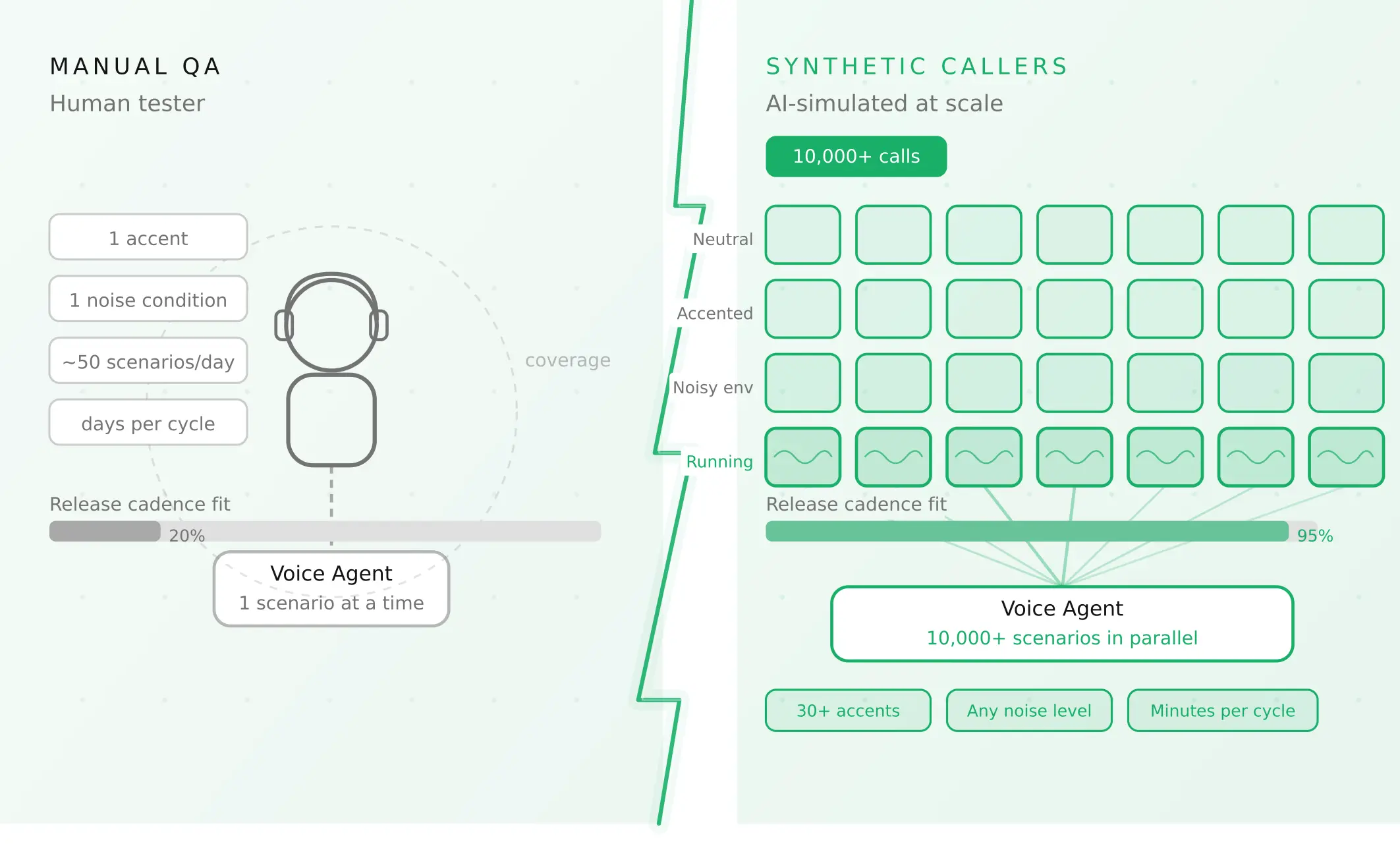
How to automate voice agent testing: synthetic callers vs manual QA
Learn how ai test automation replaces manual QA for voice agents. Compare synthetic callers vs human testers, with a 5-step framework to scale without hiring.
Read more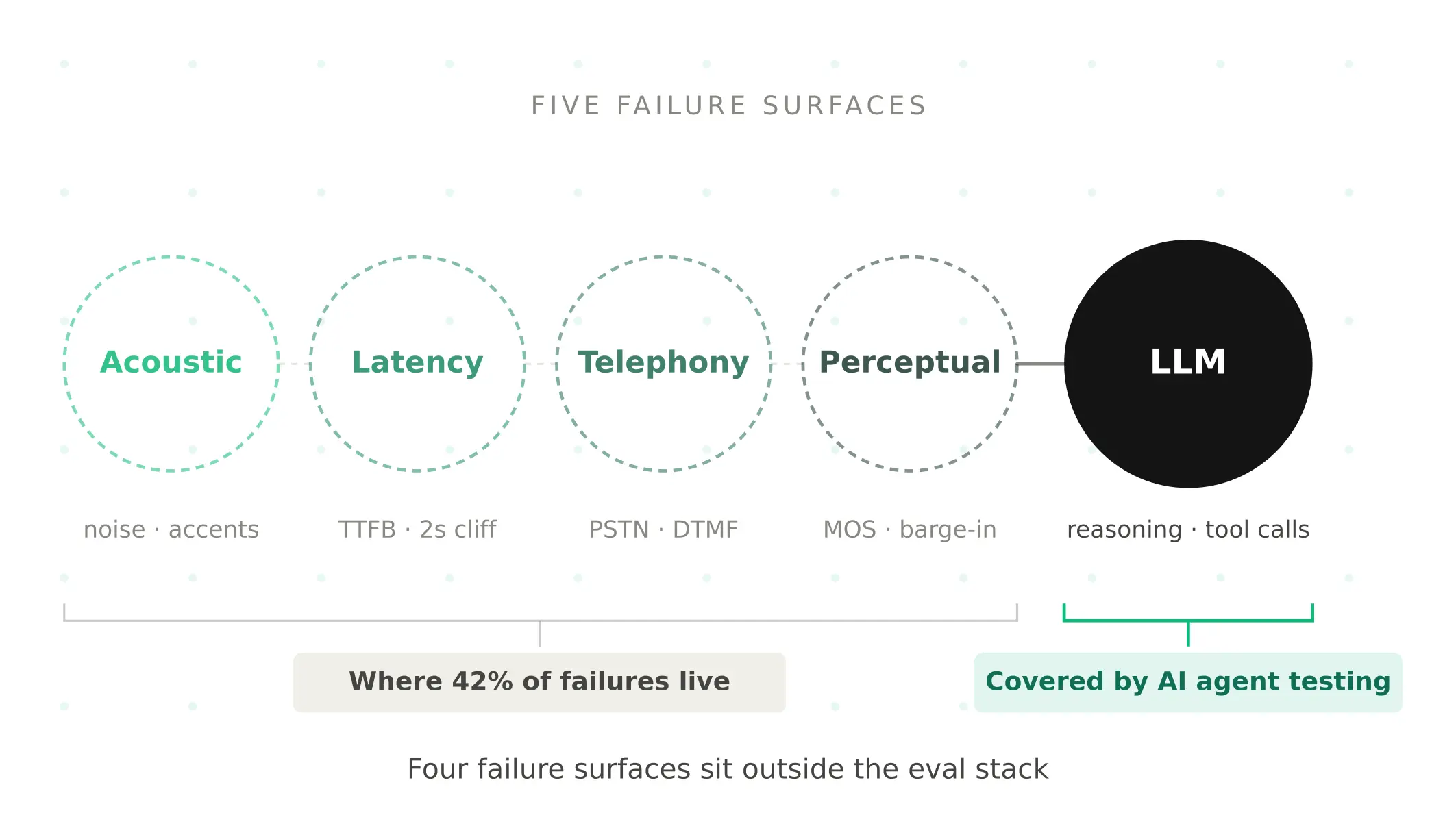
AI Agent Testing vs Voice Agent Testing: What General Tools Miss for Voice
AI agent testing measures text outputs. Voice agent testing measures behaviour through an acoustic pipeline. Five failure categories general tools miss.
Read more