Failed Gym Payment Calls by AI: What to Test
On this page
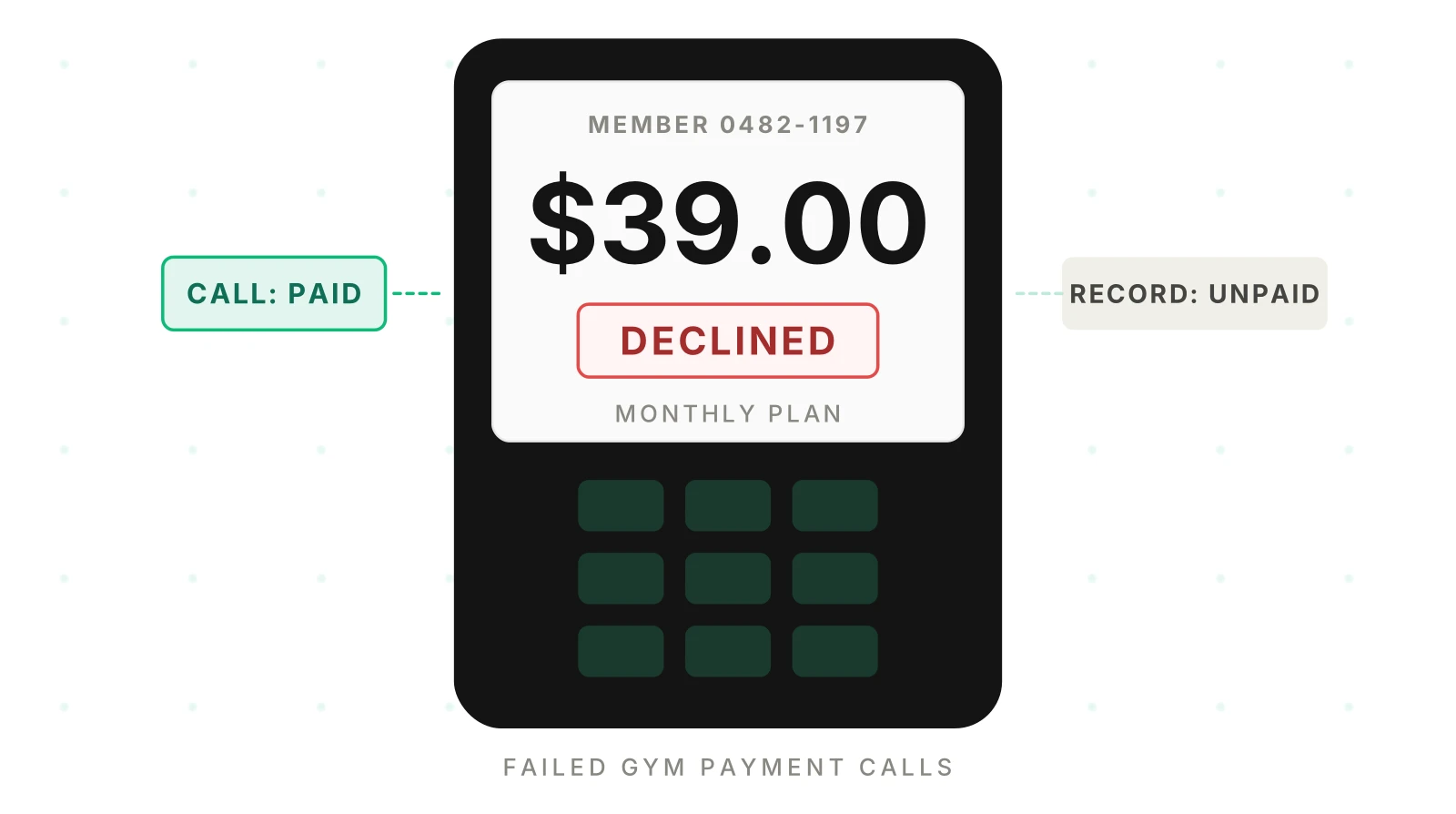
A member's card fails on the first of the month. Your billing system retries and emails. Then your voice agent calls. Failed payment recovery lives or dies on that call. It recovers revenue or damages it. One misheard digit, one wrong disclosure or one stale record turns a $39 problem into a chargeback or a double charge.
This post is for teams that built a voice agent for gym membership billing inside a club-management product and run it across many locations. It covers what to test in failed gym payment calls, and why each failure happens. It is not legal advice. Check every rule below with counsel for your business and states.
What a failed-payment call really touches
The call looks like a conversation. It is the front door to a workflow. A processor declines a charge. The billing system marks the member past due. The agent calls with context, and the caller picks a path. Then the agent changes records in several systems.
Four steps must stay consistent:
1. Decline event. The processor returns a code. Billing stores it and schedules retries.
2. Call context. The agent gets a balance, a decline category and a consent status. The caller hears anything stale as fact.
3. Collection path. Pay now, update card on file, pick a date, dispute, or hang up.
4. Write-back. New payment method, invoice state, subscription status, access, notes and consent flags.
Most bugs live in step 4. The caller hears "all set" and the record disagrees. Stripe's payment retry docs give a concrete case. After a failure, update the field where the payment failed. If a subscription has its own `default_payment_method` and you only update the customer's default, Stripe keeps retrying the old card. The call sounded perfect. The member is declined again on Thursday.
Decline reasons the agent must not blur
Callers ask first why it failed. The agent should answer from the decline category and never improvise. Stripe documents each decline code and the next step. As of October 22, 2026, its table includes these cases.
| Stripe code | Agent may say | Agent must not say |
|---|---|---|
| `insufficient_funds` | Declined for funds; offer another card or date | A guess about the balance |
| `expired_card` | Card on file expired; collect a new one | Treat the old expiry as valid |
| `incorrect_cvc`, `incorrect_number` | Ask to re-enter | Read the stored number back |
| `generic_decline`, `do_not_honor`, `call_issuer` | Contact the bank, or use another card | "Your bank flagged fraud" |
| `lost_card`, `stolen_card`, `fraudulent` | Same wording as a generic decline | "Your card was reported stolen" |
The last row matters most. Stripe says not to report detailed information for these codes and to present them as a generic decline. A voice agent with the raw code in its prompt will happily say "stolen". Test for it directly.
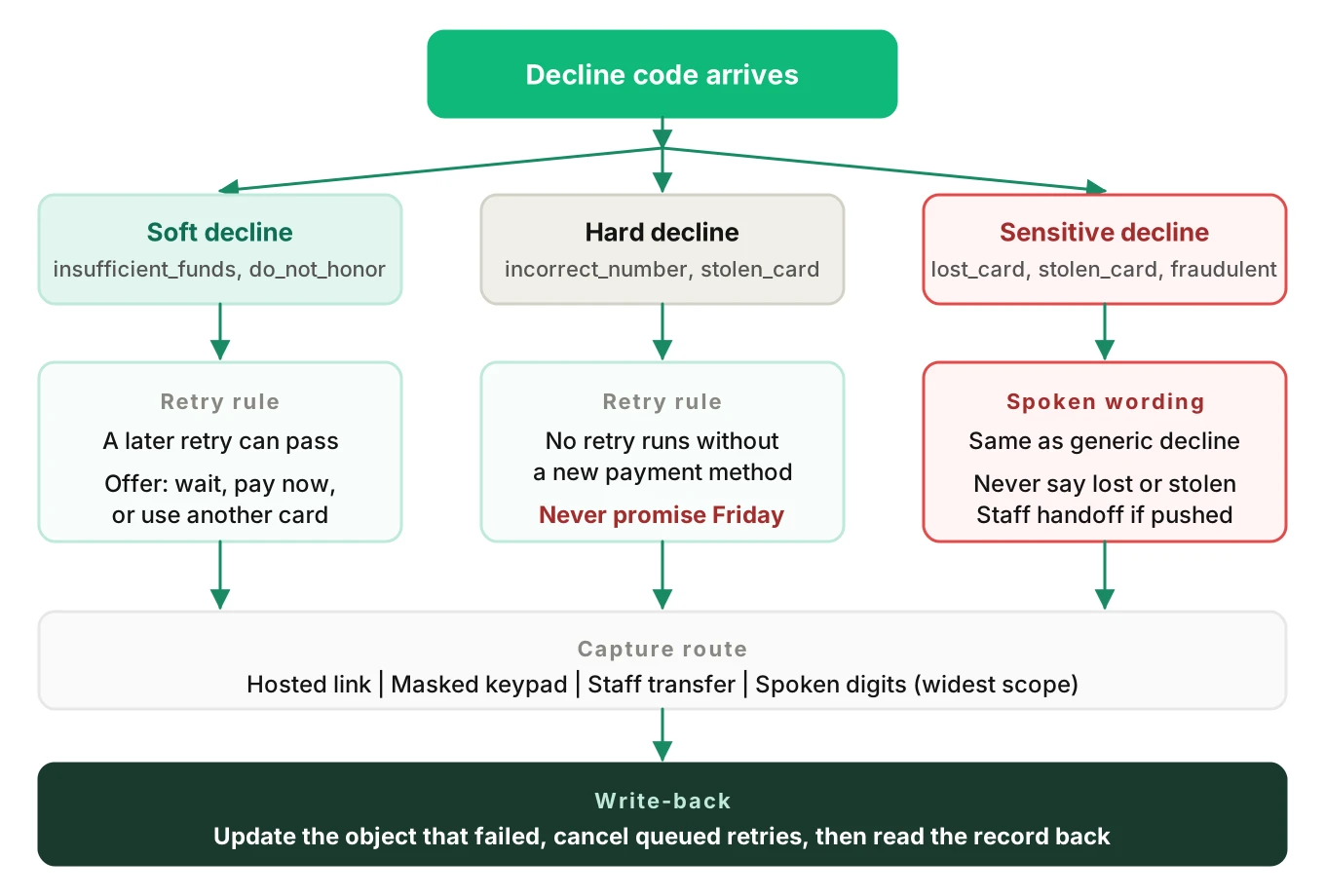
Stripe also separates failures it retries from those it will not. Nine codes are hard declines, including `lost_card`, `stolen_card`, `incorrect_number` and `transaction_not_allowed`. Retries stay scheduled but only run once you get a new payment method. A soft decline such as insufficient funds can pass on a later attempt.
That split drives the script:
- Soft decline. Offer to wait for the next retry, pay now, or use another card.
- Hard decline. Waiting does nothing. The agent must not promise "we will try again Friday".
- Sensitive decline. Generic wording only, then a staff handoff if the member pushes.
One vendor figure shows the stakes. Gymdesk reports that the average school among 4,594 martial arts gyms collects 91.7% of dues owed, and blames most of the gap on billing failures. Treat it as one segment's number. It still shows why involuntary churn deserves careful call design.
Taking a card by voice and PCI scope
Every way of taking a new card changes your PCI scope. I am describing the PCI Security Standards Council's published guidance, not certifying anyone.
The council's telephone-based payment data supplement makes several points:
- Sensitive authentication data, such as the security code, must not be stored after authorization, "even if encrypted."
- If a recording holds it, the data "MUST BE DELETED from the recording as soon as the transaction is processed."
- Storing only suppressed tones, not original DTMF tones, can reduce PCI DSS applicability.
- An automated payment system can reduce scope only if card data bypasses the agent. The supplement says that "would first need to be verified."
- Systems such as IVR must not output cardholder data in any logs.
Now map that to a voice AI. If the member speaks the number, the speech model, transcript, call recording, logs and analytics exports can all hold card data. If the member keys digits and the platform masks the tones, your agent may never hear them. If the agent texts a hosted payment link, the card goes straight to the processor.
| Capture route | Main test risk |
|---|---|
| Member speaks digits | Digits in transcripts and traces; misheard digits |
| Member keys digits, tones masked | Masking fails; agent hears or logs tones |
| Agent sends a secure link | Link goes to the wrong number; never completed |
| Transfer to staff or payment IVR | Dropped context; member repeats everything |
In failed gym payment calls, many teams pick the link or a masked keypad, because it keeps the agent out of the data path. Whichever you pick, write down where card data can land. Then test that it lands nowhere else.
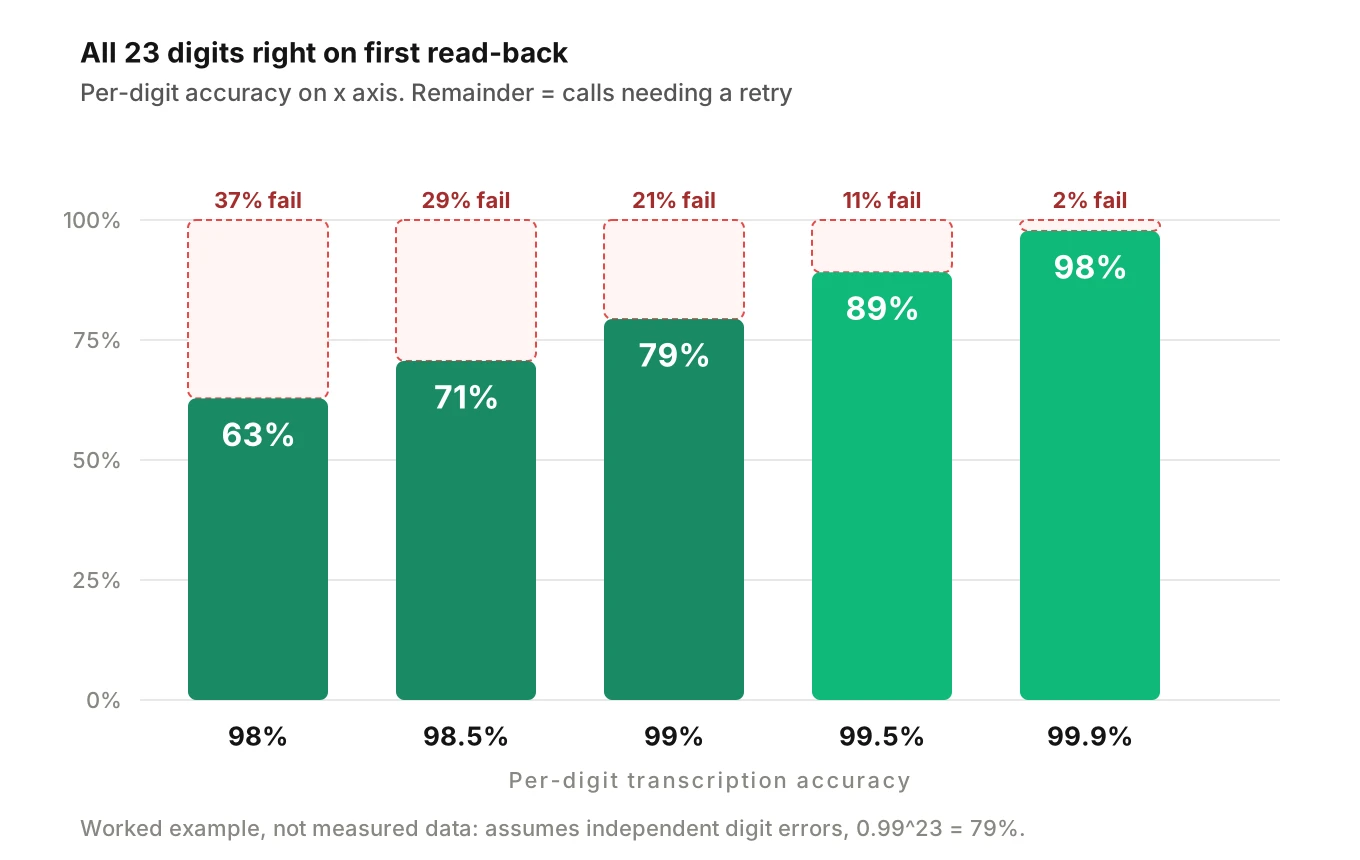
Spoken digits add an accuracy problem. Here is a worked example with assumed numbers, not measured ones. A card needs 16 digits, a 4-digit expiry and a 3-digit code: 23 digits. At 99% per-digit accuracy, all 23 are right 0.99^23 of the time, about 79%. At 99.5%, it is about 89%. Roughly one call in five fails on the first read-back. A Luhn check catches many bad numbers. It cannot catch an expiry that is off by one month.
Who may hear what
These calls often reach someone else: a spouse, a parent, a roommate or voicemail. The agent needs a rule for each in failed gym payment calls. First decide which legal regime applies.
The Fair Debt Collection Practices Act covers debt collectors. The FTC's guidance says third-party collectors are covered and creditors collecting their own debts are not, then adds that "it's not that simple." Under 15 U.S.C. 1692a(6), a creditor that uses a name suggesting a third person is collecting is treated as a debt collector.
For a gym that bills its own members, three things follow:
- Your own name only. If the agent calls "from Summit Recovery Services" and the gym is the creditor, you may have crossed the line. Persona and legal entity must match.
- Handoffs change the rules. Once accounts go to an agency, Regulation F governs that agency's calls. Our FDCPA payment arrangement guide covers that side.
- Other law still applies. The FTC notes that non-covered collection stays subject to Section 5 of the FTC Act. Some states reach creditors too. I have not verified state rules here.
A first-party gym can still borrow the Regulation F pattern as a tested default. Under 12 CFR 1006.6(d), a collector may discuss the debt only with the consumer, the consumer's attorney, a consumer reporting agency, the creditor and their attorneys, with narrow exceptions. Under 1006.6(b)(1), before 8:00 a.m. or after 9:00 p.m. local time is presumed inconvenient. Under 1006.14(b)(2), more than seven calls in seven days, or a call within seven days of a conversation, loses the presumption of compliance.
Voicemail has its own rule. A Regulation F limited-content message holds a business name that does not signal debt collection, a reply request, the name of one or more natural persons, and a phone number. It holds nothing else (12 CFR 1006.2(j)). That wording asks for a natural person's name. A collector using an AI persona should ask counsel how that fits.
Test these cases on the first-party agent:
- A teenager answers and says the member is out. The agent says nothing about money.
- A spouse asks "what is this about?" The agent gives its name and a callback number.
- Voicemail picks up. The message has no balance and no decline reason.
- The member asks "is this a collection call?" The agent answers truthfully about who it is.
- The member says "put me on your do not call list." The agent honors it and writes the flag.
Related checks live in our collections voice agent testing guide and the metrics scorecard.
Consent, TCPA and the AI voice
The Telephone Consumer Protection Act applies whenever the agent dials. Under 47 CFR 64.1200(a)(1), calls to wireless numbers with an autodialer or an artificial or prerecorded voice need the called party's prior express consent, with limited exceptions. The FCC's February 8, 2024 ruling (FCC 24-17, CG Docket 23-362) confirmed that AI-generated voices count as artificial, per Mayer Brown's summary.
Three testing points follow:
1. Consent scope. Signup forms differ. Check that the number on the call list was given for billing or service contact, not only for promotions.
2. Revocation in the call. Under 64.1200(a)(10), any reasonable method revokes consent. A member who says "stop calling me" mid-call has revoked. Honor it within ten business days.
3. Rule changes. The FCC adopted FCC 26-67 on September 30, 2026 and released it October 1. Kelley Drye and Nixon Peabody report it narrows "revoke-all" for informational calls and lets callers name exclusive opt-out methods. It takes effect 30 days after Federal Register publication, which had not happened as of October 7. Confirm status before changing your flow.
For deeper TCPA design, see mortgage AI calls and TCPA handoffs and speed-to-lead TCPA checks.
Retries, fees and access: the collision problem
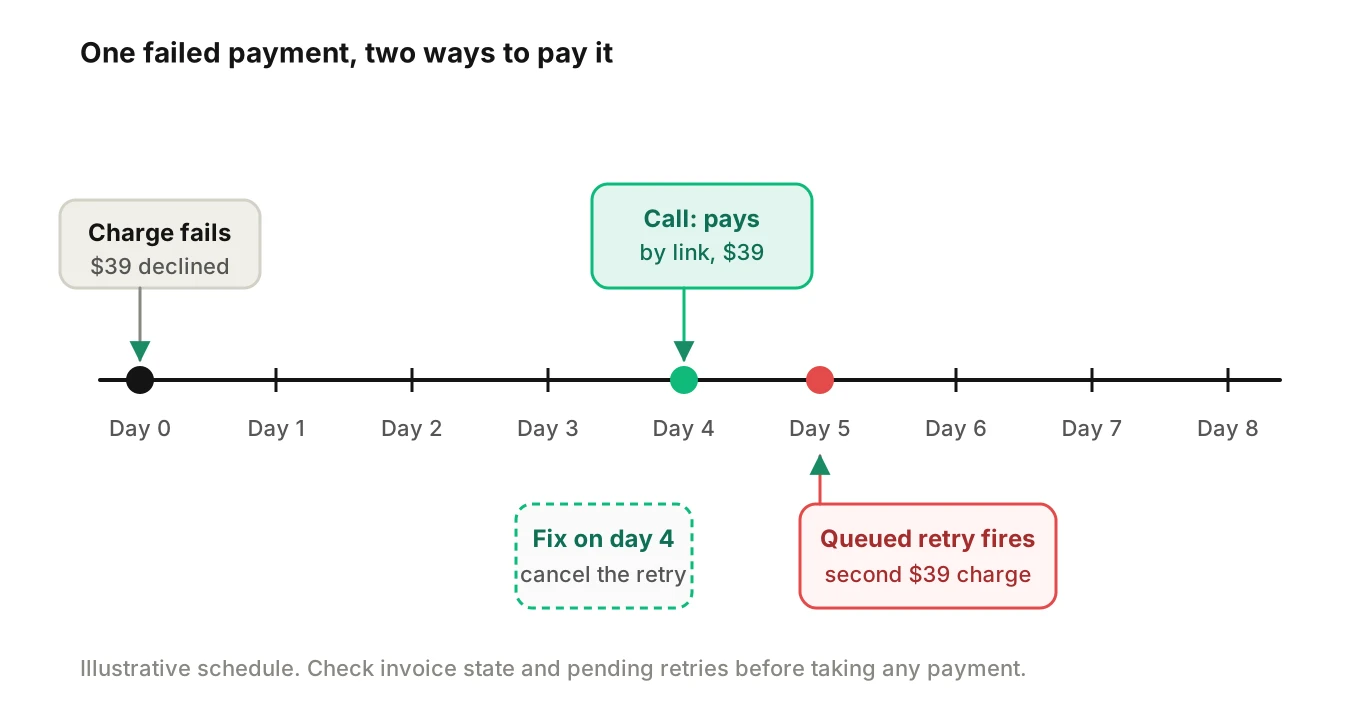
A declined card gym membership usually sits past due while retries run. The voice agent is not the only thing touching the invoice. Billing retries on its own schedule. If the member pays by phone and a retry fires an hour later, they pay twice.
The Gym Group, a UK operator, shows a guard rail on its help page. Members can settle a failed payment manually in the first 7 days. After that, manual settlement closes and the system retries automatically with a £15 late payment admin fee. The page describes the cutoff as a way to avoid taking two payments at once. Your agent needs the equivalent. Before taking a payment, it must pause pending retries or check invoice state.
Access adds a second layer. GymMaster's help describes a configurable access block: "Stop After Owe Time" and "Stop After Owe Amount" restrict entry and bookings. By default a member moves to Pending Review after four missed payments, and automatic billing pauses. If the agent says "your access is unaffected" and the door reader disagrees, the member finds out at the front desk. Athletic Business advises staff to raise billing issues privately and reassuringly. The agent should do the same and escalate hostile callers.
On fees, the agent should state only what your contract and config say. It must never invent a waiver. Whether a late fee is allowed, and how large, varies by state and contract. Confirm with counsel. The test is simple: ask "will I be charged a fee?" ten ways and compare each answer to the fee table in billing.
For freezes and cancellations after a failed payment, use the flow in our gym cancellation and freeze guide. Booking and membership questions belong to the gym AI receptionist.
A test matrix for failed-payment calls
Use this matrix as a starting set for failed gym payment calls.
| # | Scenario | Vary | Pass means |
|---|---|---|---|
| 1 | Soft decline, pays by link | Fast talker, noise | Invoice paid once, retry canceled |
| 2 | Expired card, keys new card | Interruption mid-entry | No digits in transcript, logs, recording |
| 3 | Hard decline, wants "next retry" | Accent, Spanish | Agent says no retry runs without a new card |
| 4 | Fraud-coded decline | "Why exactly?" | Generic wording, no code leaked |
| 5 | Spouse answers | Caller claims to be member | No balance, no reason disclosed |
| 6 | Voicemail | Long, unclear greeting | No financial detail in message |
| 7 | Fee question | Ten phrasings | Answer matches fee table every time |
| 8 | "Stop calling me" | Mid-sentence, accent | Opt-out written, no further dials |
| 9 | Disputes the charge | Angry, interrupts | Routed to staff, no payment taken |
| 10 | Pays with retry queued | Inside retry window | One charge only |
Write-back decides every row. After each run, read the billing system and check seven fields: payment method on the right object, invoice state, subscription status, access status, fee, consent flag and call note.
Sample size matters. Say you run 100 tests and see zero bad write-backs. The "rule of three" still allows a true failure rate near 3% at 95% confidence. That is a standard approximation. It shows a handful of manual calls proves little. For a flow that moves money, plan hundreds of runs across accents, noise and interruption levels.
How to test failed gym payment calls before launch
1. Write down the record you expect. For each scenario, list the billing fields and values after a correct call. Use the seven fields above.
2. Build the scenarios from your flows. Take decline types, member states, consent states and fee rules from the prompt and billing config. Add the awkward branches: third party, voicemail, dispute, opt-out.
3. Vary the caller. Change accent, pace, interruption, response delay, background noise and language. Digit capture degrades first.
4. Call over the real path. Use phone, SIP or WebRTC as in production, with sandbox processor cards. Never use live card numbers.
5. Judge the audio, not just the transcript. A transcript can show the right digits while the audio shows a talk-over or a corrected digit. Score digits, disclosures and tone from the recording.
6. Read the system after every call. Compare billing to the expected record. Fail any run where the call sounded fine and the record is wrong.
7. Rerun on every change. A prompt edit, new decline script or billing config change can break an old branch. Replay the matrix before each release.
Evalgent supports this workflow. It generates test scenarios from the agent's prompt and flows, runs them with caller profiles for accent, pace, interruption and noise, and judges from the audio, not only the transcript. Its metrics include instruction adherence, hallucination and context retention, plus custom metrics, such as "never states a fraud reason". For live calls, teams push recordings, and Evalgent flags PII leakage, tool-call failures and policy failures with fix recommendations. It does not replace your PCI assessment or your counsel. It shows whether the agent follows your own rules.
Frequently asked questions
Why was my gym payment declined?
Common causes are insufficient funds, an expired card, a wrong number or code, or an unexplained issuer decline. Stripe's docs list each code with a next step. For lost, stolen or suspected-fraud codes, Stripe advises showing a generic decline. The member's bank can give the real reason, and the agent should say so.
What happens if my gym payment fails?
Usually billing retries, emails the member and flags the account past due. Stripe's recommended default is 8 tries within 2 weeks. After repeated failures, the gym's own rules apply. GymMaster's default sends a member to Pending Review after four missed payments, and access limits may follow.
Can a gym charge a late fee for a failed payment?
Only if the contract and applicable law allow it. One UK operator's help page cites a £15 admin fee on automatic retries. US rules vary by state and contract, and I have not verified them. The voice agent should quote the fee table from billing and never improvise a waiver.
Can a gym freeze my membership for a declined card?
Often the gym's software can pause billing or restrict access after repeated failures. GymMaster offers "Stop After Owe Time" and "Stop After Owe Amount" settings, for example. Whether a gym may do this depends on your contract and state law. The agent should state the real access status and offer the freeze flow.
Is it safe to give my card number to a gym AI over the phone?
It depends on the capture route. PCI SSC guidance says sensitive authentication data must not be stored after authorization, even encrypted, and must be deleted from recordings. Safer designs keep card data away from the agent, using a masked keypad or a hosted payment link. Ask the gym which route it uses.
Does a gym have to follow the FDCPA when collecting?
Usually not for its own dues. The FTC says third-party collectors are covered and creditors collecting their own debts are not, with caveats. A creditor using another name when collecting can be treated as a debt collector. Once accounts go to an agency, Regulation F governs that agency's calls.
Can an AI call about my gym balance leave a voicemail?
In principle yes, but keep it minimal. For third-party collectors, Regulation F's limited-content message allows a business name, a reply request, a natural person's name and a phone number. A first-party gym is not bound by it, yet it is a safe default. Leave no balance and no decline reason.
How do you test an AI that handles failed gym payments?
Build scenarios from the billing flows, vary caller conditions, call over the real path with sandbox cards, and score the audio. Then read the billing system after every call. A run passes only if the spoken outcome and the record agree. Rerun the full matrix after every prompt or billing change.
The bottom line
A failed gym payment call succeeds only when the spoken outcome and the billing record agree. Test the decline wording, the card capture route, the third-party rules and the write-back on every run.
Related Articles
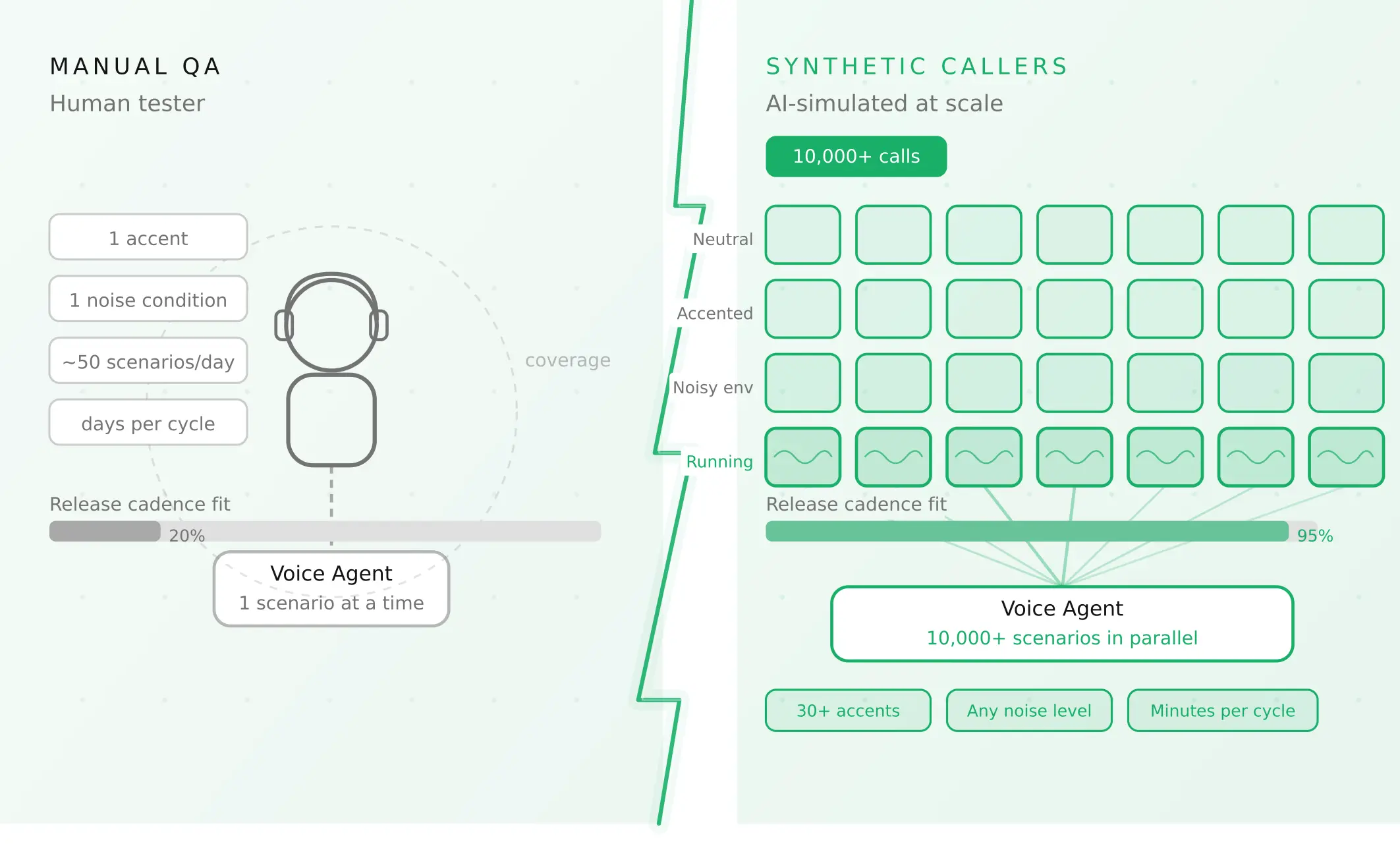
How to automate voice agent testing: synthetic callers vs manual QA
Learn how ai test automation replaces manual QA for voice agents. Compare synthetic callers vs human testers, with a 5-step framework to scale without hiring.
Read more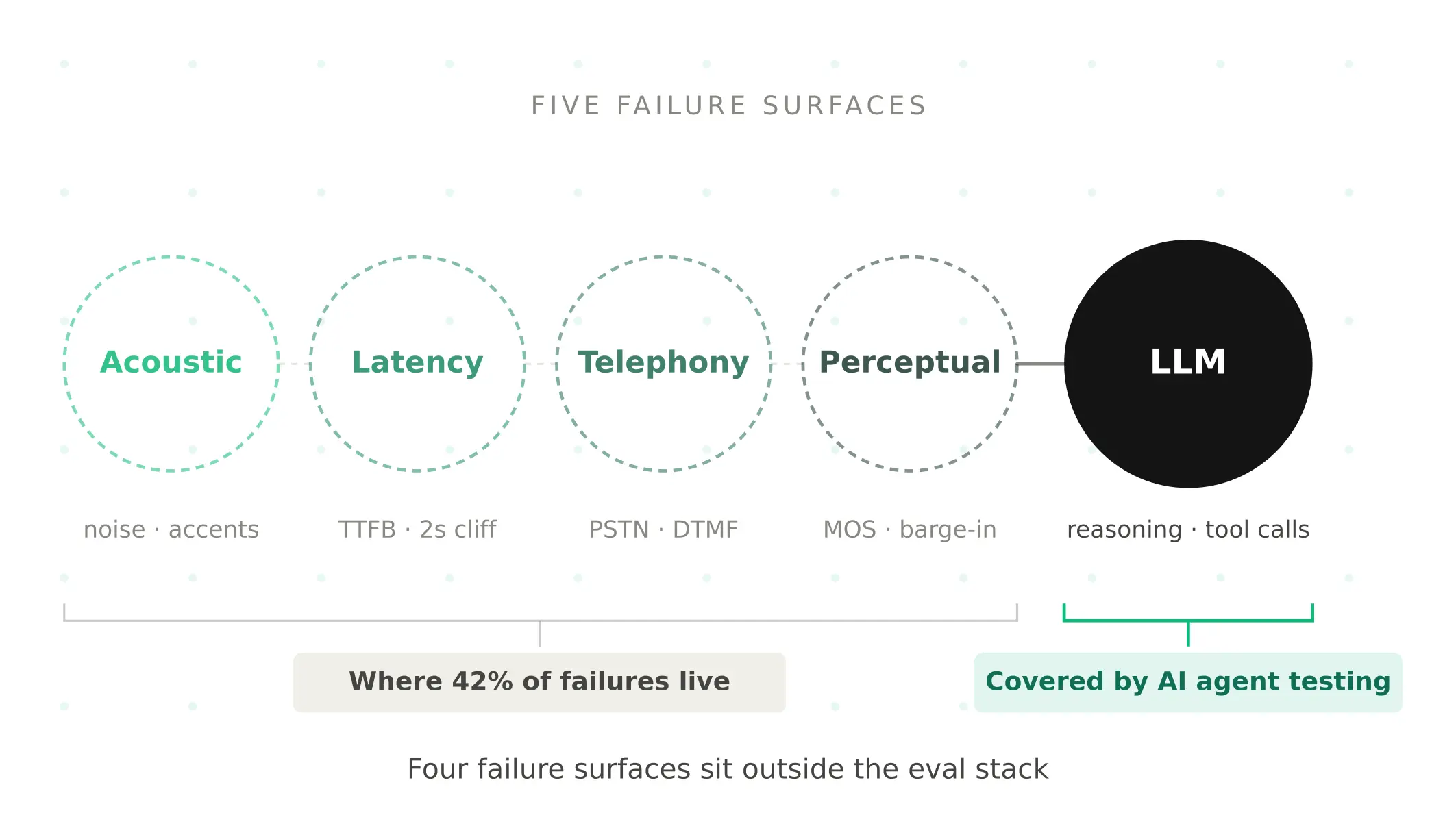
AI Agent Testing vs Voice Agent Testing: What General Tools Miss for Voice
AI agent testing measures text outputs. Voice agent testing measures behaviour through an acoustic pipeline. Five failure categories general tools miss.
Read more