Test your voice agent
Voice Agent End-to-End Testing: A Practical Guide
# Voice agent end-to-end testing: a practical guide
Quick answer
Voice agent end-to-end testing drives a full call through the live stack — telephony, speech-to-text, the language model, tools, and text-to-speech — then judges the final outcome and the audio, not component scores. It proves the whole call works, catching failures that clean unit tests on each part miss.
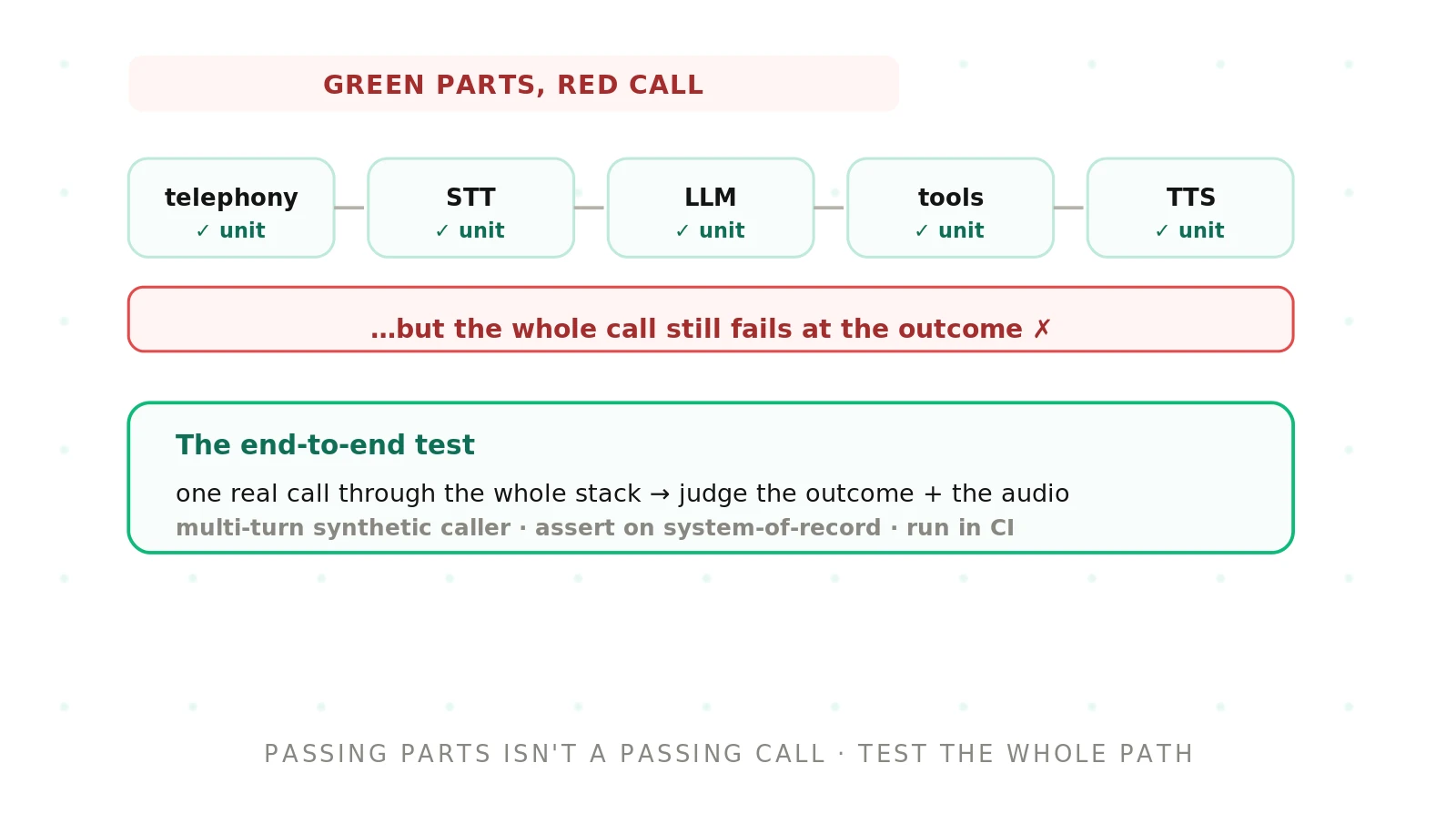
Most teams test their voice agent in pieces. They measure word error rate on the transcriber. They check that the model returns the right tool arguments. They rate the synthesized voice for naturalness. Each part passes. Then a real caller phones in, and the call falls apart.
That gap is the reason this post exists. A voice agent is a pipeline of components that hand data to each other under real timing. The pieces can each be correct while the assembled call is broken. End-to-end testing is the level that catches that. This guide covers what it means, why it differs from unit testing, how to build it, and how to run it in a pipeline.
What end-to-end testing means for a voice agent
> End-to-end test: a test that exercises a complete flow from the user's entry point to the final result, across every real component in between. It checks the system as a whole, not any single unit.
For a voice agent, the entry point is audio on a phone line. The final result is an outcome: a booked appointment, a reset password, a routed escalation. An end-to-end test drives audio in and reads the outcome out. Everything between runs live.
That "everything between" is a long chain. Telephony carries the audio. Speech-to-text turns it into words. The language model plans a response and decides on tool calls. Tools hit real or staged systems. Text-to-speech renders the reply. Then it loops for the next turn. This is system testing applied to a real-time audio system.
The idea has a long lineage in systems design. The end-to-end principle argues that correctness is best verified at the endpoints, not inside each intermediate hop. A voice call follows the same logic. The only place you learn whether the caller got helped is at the ends of the call.
End-to-end differs from evaluation, though the two overlap. Testing asks a pass or fail question against known scenarios. Evaluation scores quality across a distribution of calls. Our testing vs evaluation guide draws the line in detail. This post is about the test.
Why passing unit tests does not mean the call works
Unit tests are essential. They are also blind to the seams between components. Most production voice failures live in those seams.
Consider a few real patterns. The transcriber scores a low word error rate on clean audio. On a call, it drops the final digit of an account number. The model plans a correct tool call. But it fires it a beat late, after the caller has already started the next sentence. The synthesized voice sounds natural in isolation. On the line, it talks over a caller who tried to interrupt.
Each of these passes its own unit test. Each breaks the call. The failure is not in a component. It is in how the components combine under timing, barge-in, and messy input.
Timing is the sharpest example. A voice call is a real-time conversation. Latency that looks fine on paper stacks up across the pipeline. Speech-to-text finalization, model planning, tool round-trips, and speech synthesis all add delay. No single stage is slow. The sum feels sluggish, and callers start talking over the agent.
Then there are silent failures. A tool times out, and the agent invents a plausible answer instead of retrying. The call sounds fine. The system of record never updated. These failures leave no error in the transcript, which is why they escape component checks. Our post on detecting silent tool failures goes deep on catching them.
This is why integration testing and full end-to-end testing sit above unit tests. Integration checks that two components talk correctly. End-to-end checks that the whole call reaches the right outcome. Neither replaces unit tests. They catch what unit tests structurally cannot see.
Test levels compared: unit, integration, and end-to-end
Each level buys you something different. Each has a blind spot. The table below maps the three levels for a voice agent, following the standard hierarchy in software testing.
| Test level | What it checks | What it misses | Voice agent example |
|---|---|---|---|
| Unit | One component in isolation, with mocked inputs | Timing between stages, real audio, cross-component state | Word error rate on a clean clip; tool-argument formatting |
| Integration | Two or three components exchanging data correctly | The full-call outcome; audio quality; multi-turn state drift | Transcript feeds the model; model output triggers the right tool |
| End-to-end | The whole call from audio in to outcome out, live | Fine-grained root cause inside one component | A caller reschedules, and the calendar and confirmation both update |
Read the table as a workflow, not a ranking. Unit tests give fast, precise signals on one part. Integration tests confirm the handoffs. End-to-end tests confirm the caller actually got what they needed. You want all three. The mistake is stopping at the first two and assuming the call works.
Notice the "what it misses" column for end-to-end. A failing end-to-end test tells you the call broke, not exactly where. That is a feature, not a flaw. It catches problems no narrower test would surface. You then drop to component logs and unit tests to localize the cause.
What an end-to-end test actually asserts
A weak end-to-end test only checks the transcript. Real calls need three assertion layers. Assert on all three, or you will miss whole classes of failure.
Outcome. Did the call achieve its goal? For a booking agent, an appointment exists at the right time. For a support agent, the ticket is resolved or escalated correctly. This is the primary assertion. Everything else supports it.
System of record. Did the backing systems actually change? An agent can say "you're all set" while the database never updated. So the test must read the real record after the call. Check the calendar entry, the CRM field, the payment status. This assertion catches silent tool failures that the audio hides.
Audio and conversation quality. Was the call usable as a call? Here you check latency per turn, whether the agent handled interruptions, whether it repeated itself, and whether the synthesized speech was intelligible. These are the things a transcript cannot show. A call can reach the right outcome and still be painful to sit through.
Structured tool calls sit underneath all three. If the model calls the wrong function, or passes a malformed argument, the outcome fails downstream. Our tool calling guide covers how to assert on those calls. For a broader metric set, see our voice agent evaluation framework.
How to build end-to-end voice agent tests
Here is a practical sequence for building a suite from scratch. It uses synthetic callers to drive the audio and structured assertions to judge the result. Follow it in order.
1. Pick outcomes worth testing. List the top call intents your agent handles. Rank them by volume and by cost of failure. Start with the five that matter most. Each becomes a scenario.
2. Write multi-turn scripts, not single prompts. Real calls have several turns. Script the caller's goal, their opening line, and how they respond to the agent. Include the messy paths: interruptions, corrections, and background noise. A one-turn script only tests the greeting.
3. Drive the call with synthetic callers. Use programmatic callers that speak audio into the live telephony path. This exercises the real stack, not a text shortcut. Our post on synthetic callers for voice agent testing explains how to build them and vary voices, accents, and noise.
4. Run against the full live stack. Point the test at a staging deployment wired to the real components. Use sandboxed tool endpoints that mirror production behavior. If you mock the pipeline, you are back to integration testing.
5. Assert on outcome, system of record, and audio. After each call, check the goal, read the backing system, and score the audio. Fail the test if any layer fails. Log per-turn latency so you catch slow-drift regressions early.
6. Seed known failure cases. Add scenarios you have already seen break in production. A caller who talks over the agent. A tool that times out. A caller who changes their mind mid-call. These become your regression guards.
7. Set clear pass thresholds. Define what "pass" means per scenario before you run. An exact outcome match. A latency ceiling per turn. A cap on repeated phrases. Vague thresholds produce flaky suites nobody trusts.
8. Review failures and refine. Group failures by pattern, not by single call. Fix the root cause, then keep the failing scenario as a permanent test. Over time the suite becomes a map of how your agent breaks.
For the wider testing picture around this suite, our AI voice agent testing overview sets the context.
Running end-to-end tests in CI
A suite you run by hand once a month will not protect you. The value comes from running it automatically on every meaningful change. This is standard test automation practice, applied to voice.
Wire the suite into your build pipeline. On each prompt change, model swap, or tool update, the pipeline places calls and checks the outcomes. A failing scenario blocks the release. This is continuous integration for a voice agent, and it turns testing from an event into a habit.
Keep a stable scenario set as your regression testing baseline. When you change a prompt to fix one intent, the baseline confirms you did not break three others. Voice agents are especially prone to this. A prompt tweak that helps refunds can quietly hurt escalations.
Run the suite on a schedule too, not only on change. Upstream models and telephony carriers shift under you. A nightly run catches drift you did not cause. Track outcome pass rate and per-turn latency over time, so slow regressions show up before a caller does.
Two practical cautions. Keep the suite fast enough that people wait for it. Parallelize calls and cap scenario count per run. And guard against flakiness. A test that fails at random trains the team to ignore red builds, which defeats the point.
Where an independent evaluator fits
Building this in-house is doable. It is also a lot of infrastructure to own: synthetic callers, a live staging stack, assertion tooling, and a results pipeline. Many teams want the coverage without building the harness.
That is the gap Evalgent fills. As an independent, third-party evaluator, Evalgent drives real end-to-end calls through your live stack and judges outcome, system of record, and audio. Independence matters because a vendor grading its own agent can pick flattering metrics. A third party benchmarks on your scenarios and your data. See our case for independent voice AI evaluation and how to benchmark voice agents on your own data.
The point is not to outsource judgment. It is to get a clean, repeatable end-to-end signal you can trust, without staffing a test team to maintain it.
Frequently asked questions
What is voice agent end-to-end testing?
Voice agent end-to-end testing drives a complete call through the live stack — telephony, speech-to-text, the model, tools, and text-to-speech — and judges the final outcome and audio. It verifies the whole call works, rather than scoring each component alone. The result is a pass or fail against a known scenario.
How is end-to-end testing different from unit testing a voice agent?
Unit testing checks one component in isolation with mocked inputs. End-to-end testing runs every real component together under live timing. Unit tests catch bugs inside a part. End-to-end tests catch failures in the seams between parts, like latency stacking or a tool that succeeds while the record never updates.
Why do voice agents pass unit tests but still fail real calls?
Because most voice failures live between components, not inside them. A transcriber can score well yet drop a digit on a live call. A model can plan a correct tool call yet fire it a beat too late. Timing, interruptions, and messy audio combine in ways that no isolated unit test observes.
What should an end-to-end voice agent test assert on?
Assert on three layers. First, the outcome: did the call achieve its goal? Second, the system of record: did the backing systems actually change? Third, audio and conversation quality: latency per turn, interruption handling, and intelligibility. Checking only the transcript misses silent tool failures and audio problems that break real calls.
How do synthetic callers help with end-to-end testing?
Synthetic callers speak scripted audio into the live telephony path, so the test exercises the real stack rather than a text shortcut. They let you run many multi-turn scenarios repeatably, vary accents and background noise, and seed known failure cases. This makes end-to-end coverage scalable without staffing manual test calls.
Can end-to-end voice agent tests run in CI?
Yes. Wire the suite into your build pipeline so each prompt change, model swap, or tool update triggers real calls and outcome checks. A failing scenario blocks the release. Also run on a schedule to catch upstream drift from model and carrier changes. Keep runs fast and stable so teams trust the results.
What does end-to-end testing miss?
End-to-end testing tells you a call broke, but not exactly where inside a component. It trades fine-grained root cause for full-call coverage. Once a scenario fails, you drop to component logs and unit tests to localize the cause. That is why teams keep unit, integration, and end-to-end tests together rather than choosing one.
How many end-to-end scenarios does a voice agent need?
Start with the five highest-volume, highest-cost intents, then add scenarios as you learn how your agent breaks. Cover the messy paths: interruptions, corrections, noise, and tool timeouts. Grow the set with every real production failure you find. Quality of scenarios matters more than raw count, so prune flaky or redundant tests.
The bottom line
End-to-end testing is the only level that proves a voice call works from audio in to outcome out. Unit and integration tests narrow the search, but the full-pipeline test ships real confidence.
Ready to see your agent tested on real end-to-end calls? Book a demo and we will run your top scenarios through the whole stack.
Related Articles
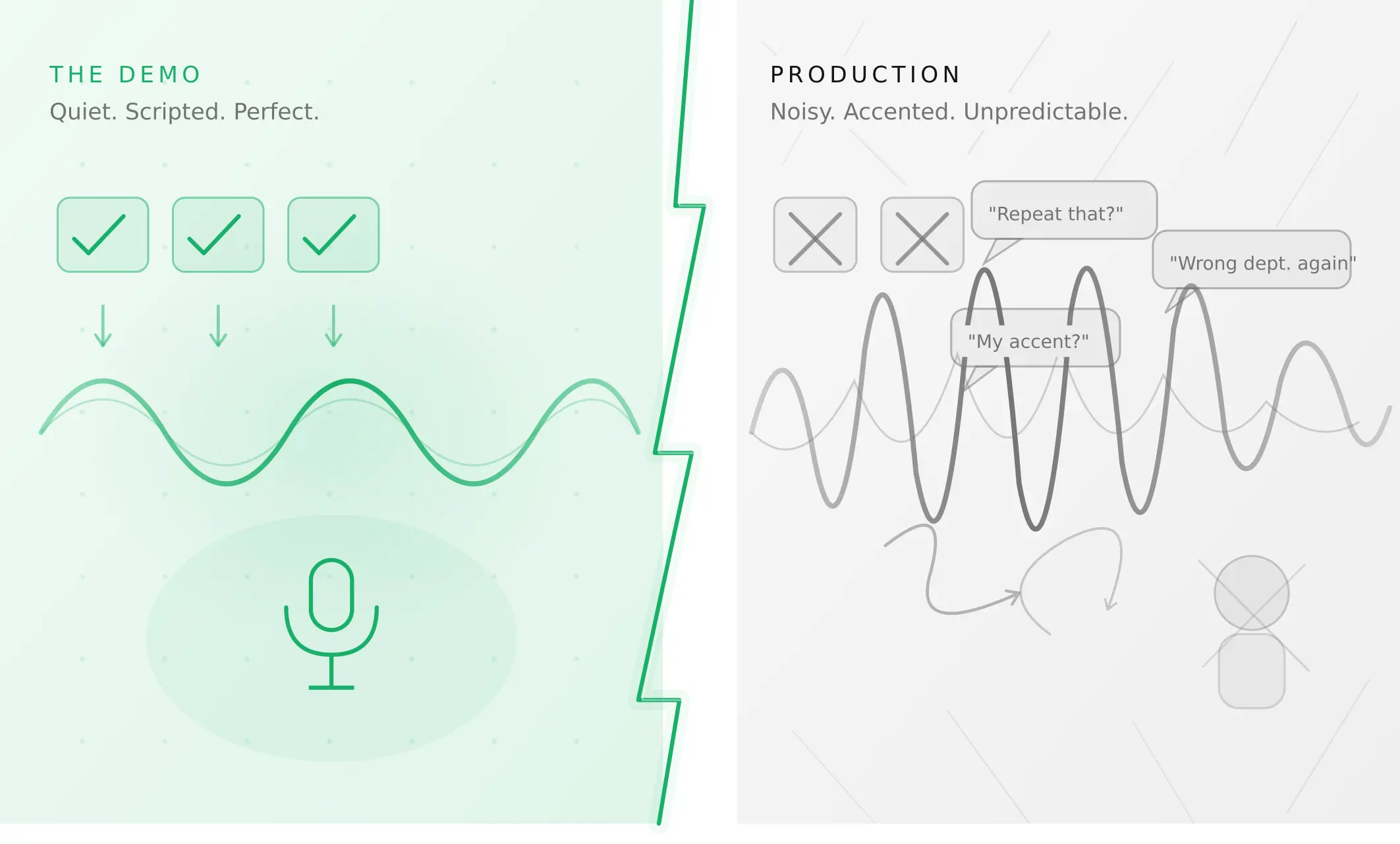
Why AI voice agents fail in production (and how to prevent it)
AI voice agents that ace demos still break in production. Learn the 5 root causes, how to test for each, and what production readiness actually means.
Read more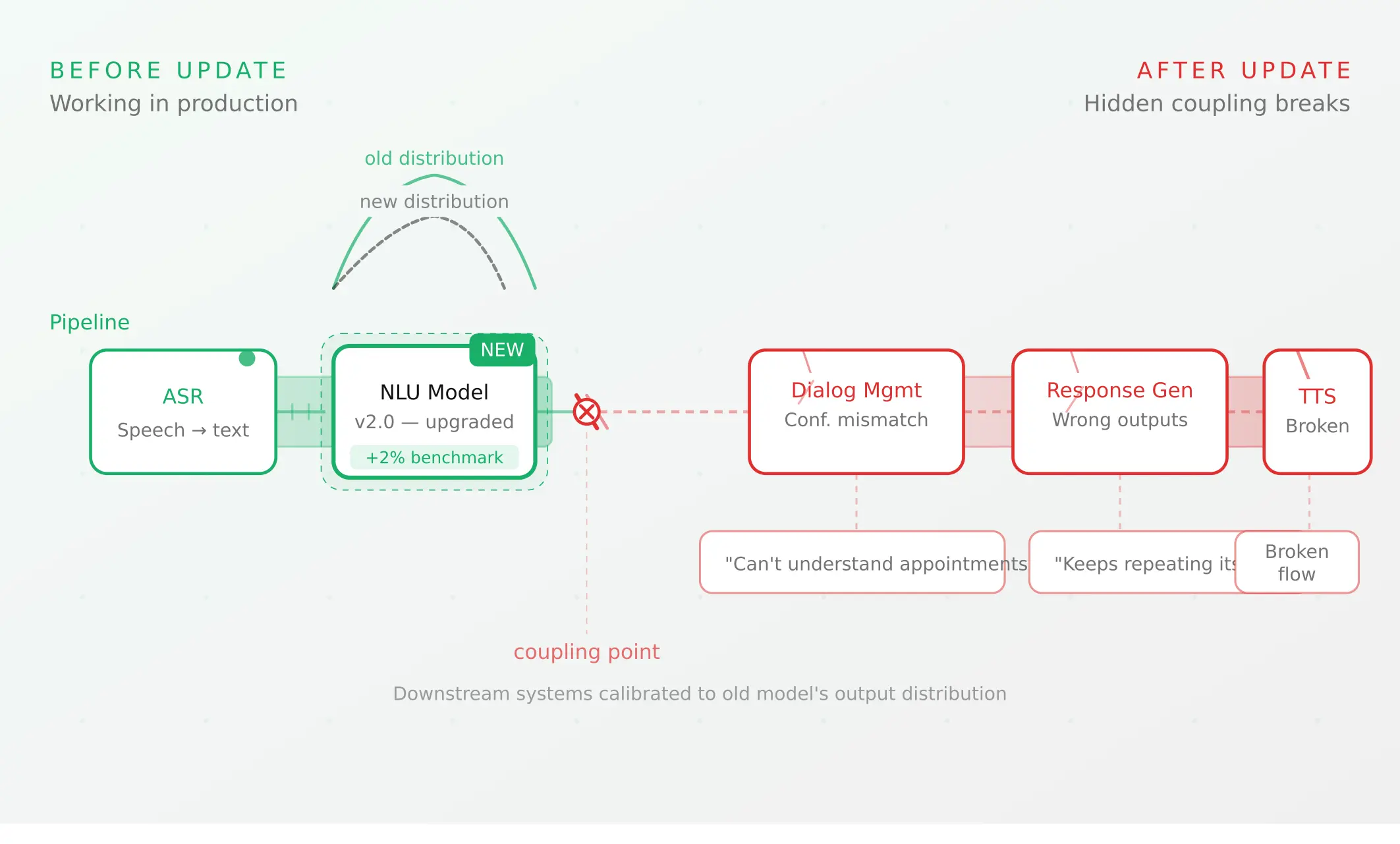
Voice agent regression testing: why LLM updates break production
LLM updates improve benchmarks but break voice agents in 5 predictable ways. How to detect and prevent regressions after every model or prompt change.
Read more