Utility Company AI Voice Agent: Outage and Billing Calls
On this page
Most voice agents book a slot or look up an order. An AI voice agent for utilities does something harder. Its callers are often scared, cold or angry, and some of them are describing a hazard. The same power outage hotline carries a billing question, a flickering light and a gas smell.
This post is for the engineer or product lead who built that agent and owns it. It is live, and every prompt change reaches real households. We cover what the agent must never do, where the stored record goes wrong, and how to test both. Rules vary by state and utility. Nothing here is legal or safety advice, and your safety and compliance teams own the scripts.
Why utility calls are different from other service calls
A restaurant order that goes wrong costs a pizza. A utility call that goes wrong can leave a downed line unreported or a medical customer without power. The agent has to know which kind of call it is on within seconds.
The call is the front door to a workflow. The caller speaks, the agent captures facts, a system action runs, and a record is written. Speech errors do not stay in the transcript. They land in an outage management ticket, an account note or a payment-plan record, where crews, billing staff and regulators read them.
Who is calling matters too. Your utility company AI voice agent hears tenants, owners and neighbours alike. A tenant may not be on the account. A shop owner may have three meters. A neighbour may report a line that is not theirs.
Utility calls also arrive in waves. EIA reports that the average U.S. customer was without power about 11 hours in 2024, nearly twice the prior decade's average, and that major events drove 80% of those hours. In a storm, call volume spikes just as hard cases multiply. Test for the storm day, not the quiet Tuesday.
The same record-level thinking applies to HOA balance calls and billing support agents.
The emergency gate comes before everything
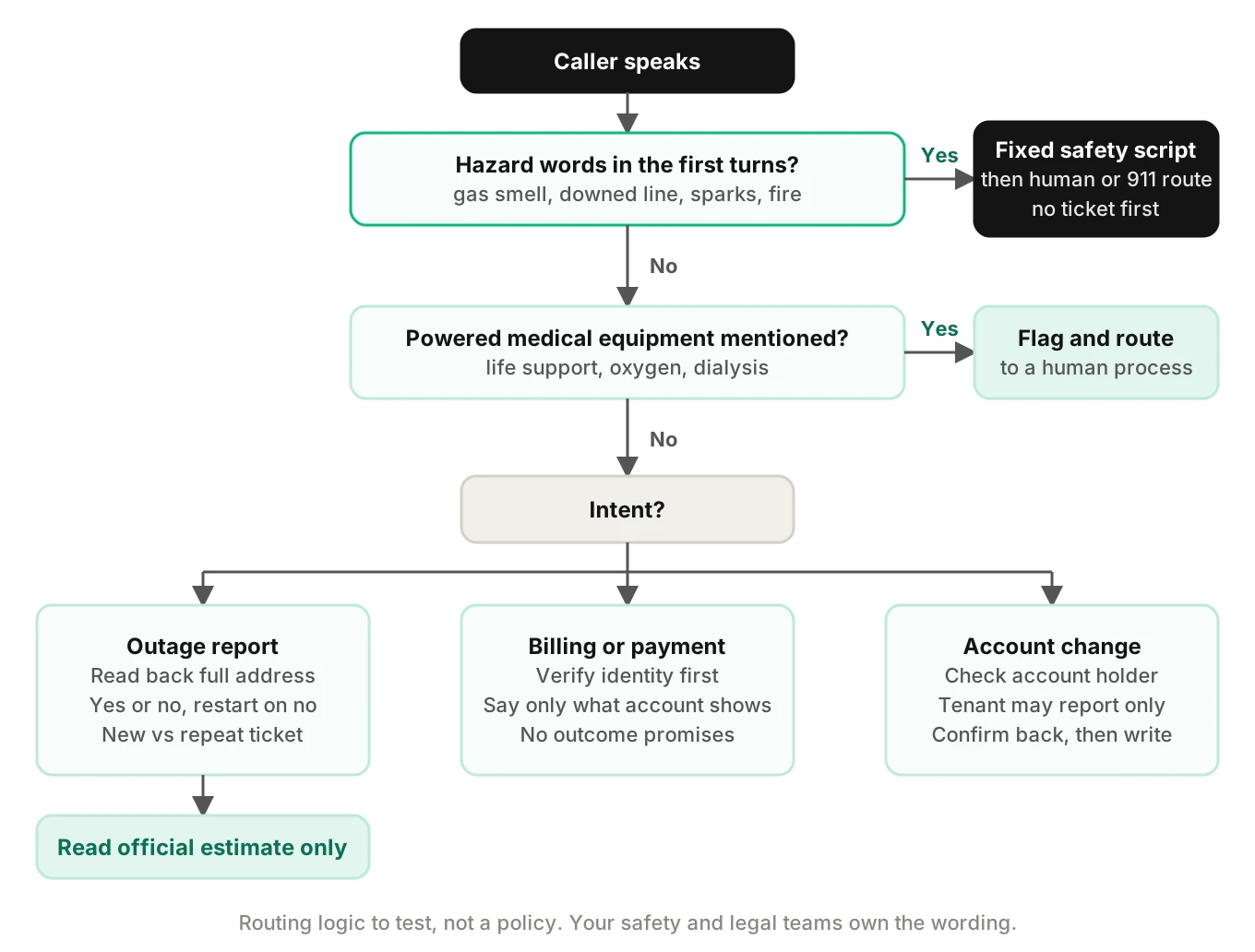
A utility company AI voice agent has two call types that must never become a ticket first. A downed or sparking power line and a smell of gas are safety events. The agent's first move is a short, fixed script, not a form.
What do public sources say? PHMSA, the federal pipeline safety agency, tells people who smell gas to leave the area. It says not to use a phone or cell phone near the leak, not to flip light switches or garage door openers, and not to start an engine. It says to call 911 from a safe distance, such as a neighbour's home. The Indiana Utility Regulatory Commission says much the same. It adds that callers should not open windows to air out the house and should also contact the gas provider's emergency number.
For power lines, Puget Sound Energy's public guidance says to assume any downed line is energized and stay at least 35 feet away. It says to call 911 or the utility, never touch or move the line, and never try to rescue a person or pet near it. That 35-foot figure is one utility's published number. Use your own utility's guidance in your script.
There is a tension here. PHMSA says not to use a phone in the leak area, yet your caller is on one. Your safety team should decide the exact wording, such as leaving the building first and calling from outside. The agent should deliver it the same way every time.
What the emergency gate has to get right
- Trigger on meaning, not on one phrase. Callers say "rotten egg smell", "hissing near the meter", "wire in the road" or "transformer popped". Test all of them.
- Never hide the gate behind identity checks. Do not ask for an account number before the safety script. Collect it afterwards, if at all.
- Do not create a normal ticket as the only output. The event needs a human or a dispatch route, as your own procedure defines.
- Handle interruption. A frightened caller will talk over the script. The agent must listen, then repeat the key instruction. See interruption testing.
- Do not drift. A model update must not turn a fixed script into a paraphrase. See shipping prompt changes safely.
The cost of a miss is asymmetric. A false alarm sends a human to a harmless call. A missed hazard gets no second chance. Tune the gate for recall and count false alarms separately. Our posts on emergency plumbing triage and vacation rental emergencies cover the same idea in other trades.
Outage reports: the address is the whole record
Once the safety gate clears, most calls are utility outage reporting. The agent's job is narrow. Identify the service location, decide whether this is a new outage or a known one, and write the right ticket.
PSE&G, for one, lets customers report an outage with an account number and ZIP code. Whatever key your system uses, the agent hears speech and must turn it into that key. Every spoken-to-key step is a place to be wrong.
| Field | How speech breaks it | What it breaks downstream |
|---|---|---|
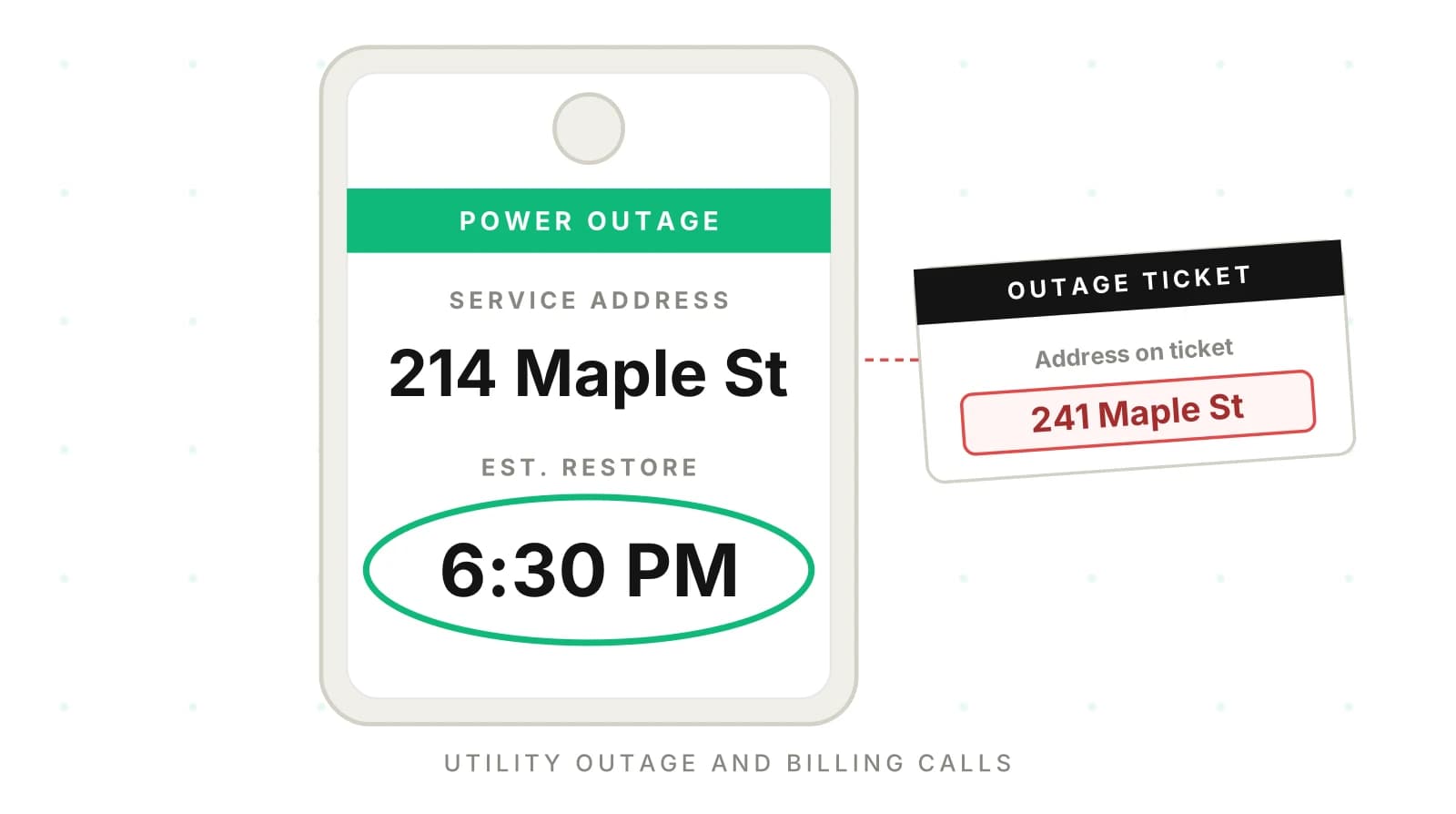
| Service address | "Fifteen" vs "fifty", "Maple Court" vs "Maple Street" | Crew sent to the wrong block |
| Premise or meter | Caller has two meters, gives one | Partial restoration marked complete |
| Account number | One digit transposed | Outage logged on a stranger's account |
| Callback number | Voicemail or a different phone than the one on file | Restoration text goes to the wrong person |
| Duplicate vs new | "Still out" heard as "out" | Phantom second ticket, or a real outage merged away |
The duplicate problem needs its own test set. When one transformer fails, hundreds of people call, and the outage system groups the calls to find the cause. A wrong address distorts that grouping. A caller who says "my lights are still out after the crew left" may have a new fault. Filed as a repeat, it never reaches a crew.
For address capture, the agent should read back the full service address, ask for a yes or no, and treat a no as a restart. Digit and street-name confusion gets worse on cell lines and in noise, so run noise tests and accent tests on the address step specifically. A similar readback issue appears in pizza delivery address errors.
Restoration times: read the estimate, never invent one
The most dangerous sentence a friendly agent can say is "your power will be back by six". Any restoration time estimate is an estimate, and utilities say so.
NYSEG says restoration times "may change as our crews evaluate the cause and extent of damage". It separates a global estimate for the whole service area from a local one for a specific location. NYSEG also uses an "assessing" status when damage has not been evaluated, which means no time has been set. PSE&G says its system-generated estimate is based on historical data and typically ranges from two to eight hours. After major weather it says a global estimate comes within 24 hours after the weather leaves the territory, and individual estimates follow within 48, 72 or 96 hours, depending on how long the outage is expected to last.
Those facts shape the agent's rules.
1. Read only the official field. The agent quotes the estimate from the outage system for that premise. It does not compute one or round it into something friendlier.
2. Label it as an estimate and say it may change. Every time.
3. Handle the empty state. If the system says "assessing" or has no estimate, the agent says so. It must not fill the gap with a typical value.
4. Respect the level. A global estimate is not a local one. The agent should say which it is reading.
5. Never promise a time on a hazard call. The emergency script comes first.
A subtle failure: the system returns a stale estimate that has passed, and the agent reads "6:30 PM" at 7:10 PM. Test with a mock that returns a past time. The same "promise the system did not make" pattern shows up in WISMO order-status calls.
Billing, disconnection and payment arrangements
Utility billing calls are quieter, but the exposure is real. The agent can explain a bill and set up a payment plan. It must not promise that service will stay on.
Utility disconnection rules differ by state. Two public sources show how much. Pennsylvania's current PUC fact sheet (February 2026) describes a 10-day notice before shutoff, with the utility then having up to 60 days to act. It says service will not be shut off when a medical certificate from a licensed physician, physician assistant or nurse practitioner certifies that shutoff would harm a seriously ill person, for an initial period of up to 30 days. The bill is still owed. The sheet says the utility must offer one payment arrangement and may have to offer another. A customer who breaks a PUC-established arrangement generally cannot get PUC help again.
A California PUC fact sheet (dated 2017) describes a different sequence, so check current tariffs. It lists a 15-day written notice and a 48-hour disconnection notice. Medical baseline and life-support customers get an in-person visit, with a door hanger if no one is home. A final outbound call on the day of disconnection offers a pay plan. It also says no disconnection occurs while a complaint is pending at the CPUC.
You cannot hard-code one story. The agent needs the customer's jurisdiction and account status, and should say only what the system supports.
Billing rules to write into the agent's policy
- State what the account shows. Do not promise outcomes such as "we won't shut you off".
- When a caller says someone at home depends on powered medical equipment, stop the billing flow and route to a human or the utility's medical-certificate process.
- Offer only payment arrangements the system lists as available for that account.
- Confirm any promised date and amount back to the caller, and write both to the record.
- Do not read a full balance or account details to someone who has not passed your verification step. See PII handling.
For collections-style calls, see our payment arrangement audit. A utility billing its own customers is not always a debt collector, so ask counsel which rules apply.
Medical equipment, tenants and other special cases
Four caller types need explicit tests.
Medical equipment customers. Public sources show that utilities keep special handling for them, such as in-person visits before disconnection in California. The agent should not try to judge medical need. It should flag the mention and route it. Test that a passing phrase like "my dad's oxygen machine" in the middle of a billing call triggers the route.
Tenants. A tenant can report an outage, since it is a physical event. A tenant usually cannot change a payment arrangement or stop service unless they are the account holder. The agent should separate "report" actions from "account change" actions and verify identity for the second kind.
Small-business and third-party callers. A shop may have several meters. A neighbour may report a premise that is not theirs. The agent should confirm the location and meter, and never read account details back to a third party.
Six silent errors and what each one breaks
None of these show up as a crash. The call ends politely, the caller thanks the agent, and the record is wrong.
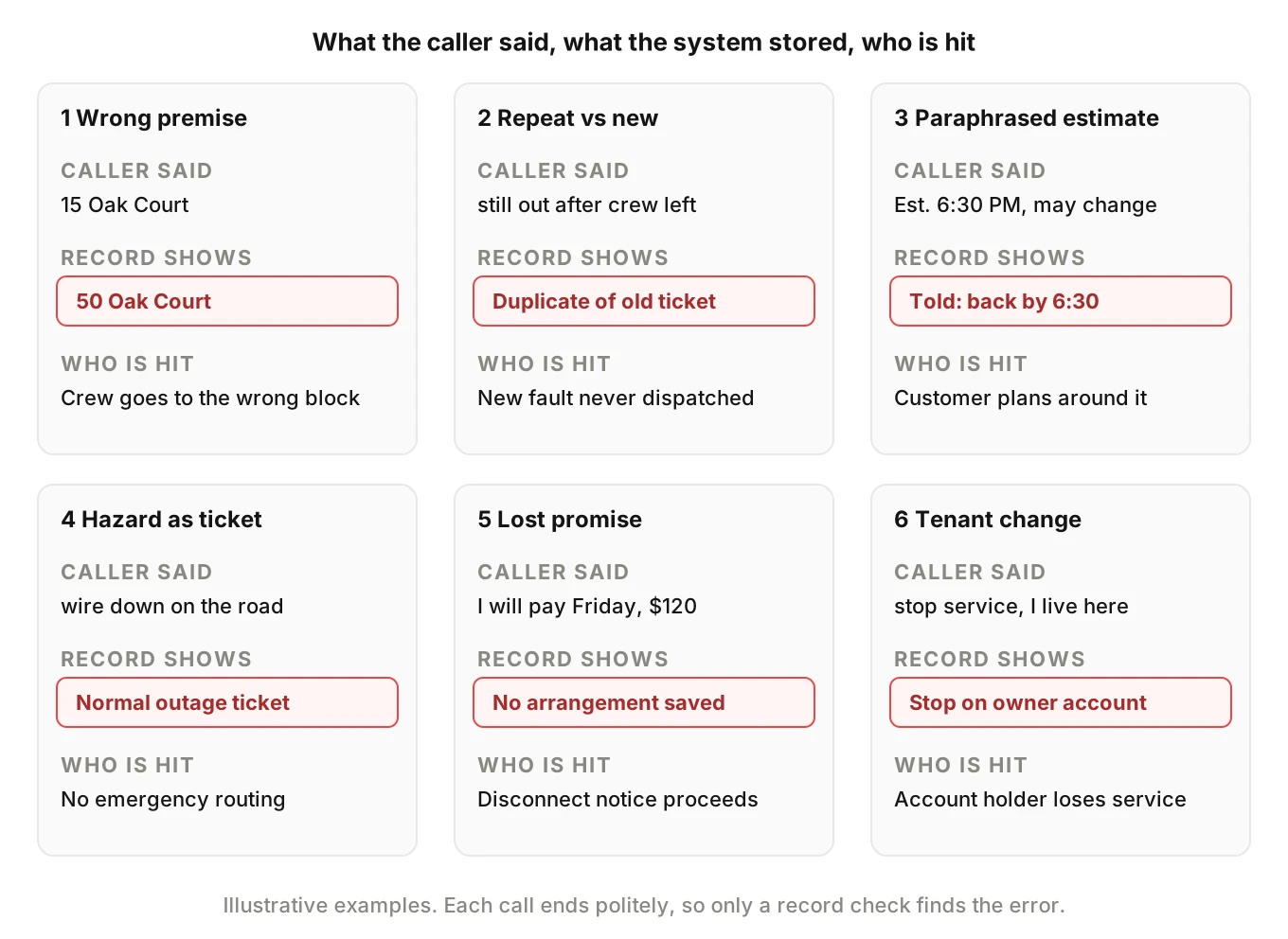
A transcript review catches only some of them. If the agent hears "fifteen" and says "fifteen" back, the transcript looks clean. The record may say 50. That is the gap between what was said and what was stored.
Worked example: what a small error rate does in a storm
This is an illustrative assumption, not utility data. Suppose a storm brings 4,000 outage calls in one day. Suppose 2% are filed against the wrong premise.
- 4,000 × 2% = 80 outages on the wrong record.
- If a third of those callers also hear an invented estimate, about 27 households carry a bad promise too.
The numbers are made up. The shape is not. A rate that looks tiny on a normal day becomes a cleanup queue when your staff are busiest.
How to test a utility company AI voice agent
A few manual calls will not do. You need scripted calls that cover hazards, addresses and account states, plus checks against the stored record.
1. Write the policy as a checklist. List the emergency script, the allowed estimate sources, the billing statements the agent may make, and the routes for medical and tenant cases. Pull these from your own prompt and flows.
2. Build scenarios from that checklist. Cover each emergency phrasing, each outage type, new vs repeat, each billing state and each special caller. Include wrong-address and wrong-account attempts.
3. Vary the caller. Use accents, fast and slow speech, interruptions, delays, background noise such as wind or a generator, and Spanish where your customers call in Spanish.
4. Run over the real line. Call through your phone path, so codecs, latency and barge-in behave as they do in production.
5. Check the write-back, not just the call. After each run, read the ticket, the premise, the account note and the payment-plan entry. Compare them to the facts the scripted caller gave.
6. Set hard gates. Emergency routing must pass every run. Wrong-premise writes, invented estimates and unsupported promises must be zero in the release suite.
7. Re-run on every change. A prompt edit, a model update or a new outage-system field can all break a working path.
8. Sample production calls. Review a slice of live calls each week for address mismatches and estimate wording. See monitoring voice agents in production.
How many calls prove an emergency gate works
Statistics sets a limit on what a clean run can prove. The rule of three) says that if an event never occurs in n trials, the 95% upper bound on its rate is about 3/n. Ten clean emergency calls only show the miss rate is below roughly 30%. A hundred show below 3%. You need about 300 clean calls to claim under 1%.
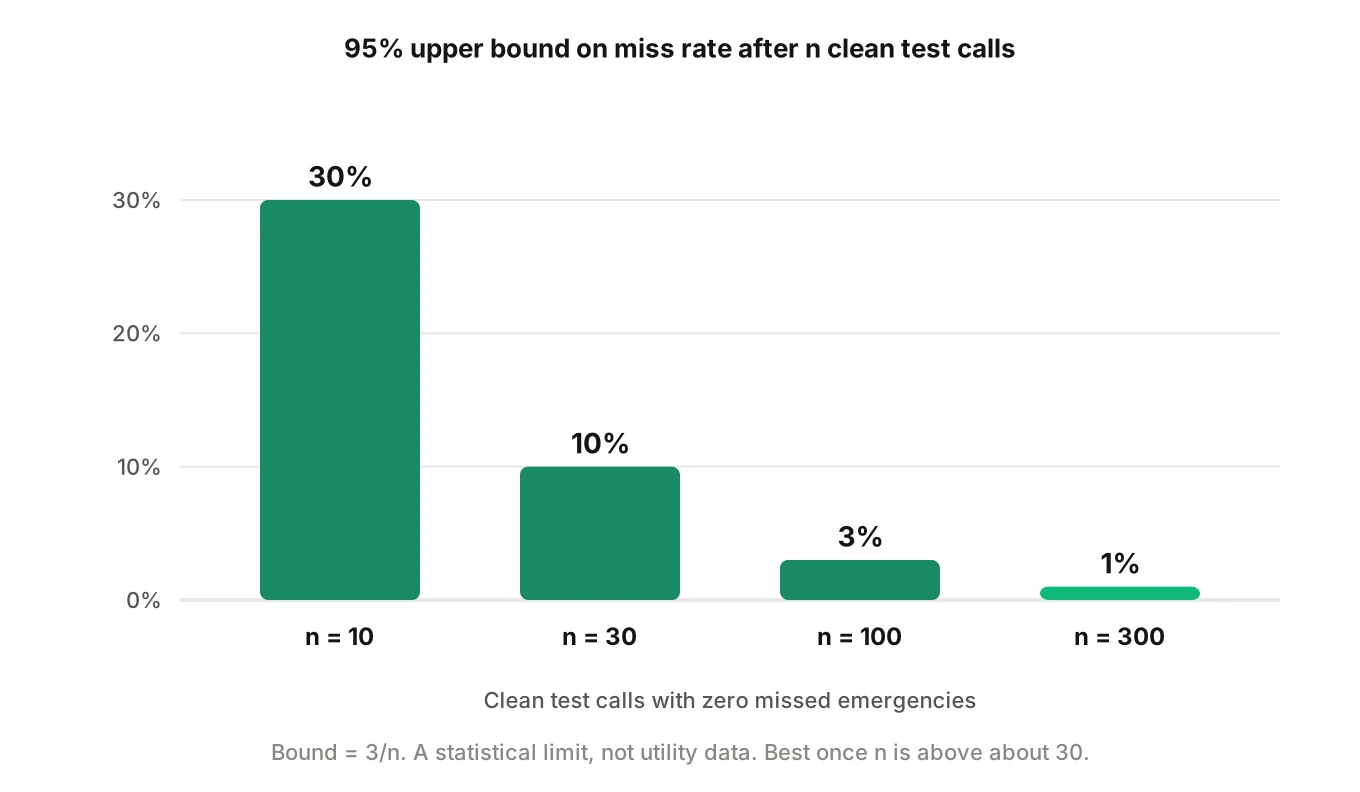
That is why you vary phrasing and callers across many simulated calls. Each variation is another trial. Treat the result as a bound, not a promise. The rule works best once n is above about 30.
Where Evalgent fits
Evalgent's thesis is that most tools judge voice agents from transcripts, and the referee is deaf. Here the audio matters, because "fifteen" and "fifty" are a hearing problem. Evalgent generates scenarios from your agent's prompt and flows. It simulates callers with set accents, pace, interruption levels and background noise over PSTN, SIP or WebRTC. It judges from the audio with evidence, runs custom metrics on every call, and supports human review. Evalgent works with teams to set up evals for their first agent. For live traffic, you push recordings, which are transcribed, mapped to scenarios and judged, with flags for PII leakage, tool-call failures, latency spikes and policy failures. For general method, see our guide to AI voice agent testing and policy test cases for regulated agents.
Frequently asked questions
Can an AI voice agent take power outage reports?
Yes, for the narrow job of capturing the service location, confirming it and filing or joining an outage ticket. It must route gas smells, downed lines and sparking equipment to an emergency script first. Test address readback under noise and accents, and check the stored ticket, since a clean transcript can hide a wrong premise.
What should a utility AI agent do when a caller reports a downed power line?
Follow your utility's safety script before any ticket. Public guidance, such as Puget Sound Energy's, says to treat any downed line as energized, stay at least 35 feet away, never touch it and call 911 or the utility. Your safety team should approve the exact words, and the agent should deliver them identically on every call.
How does AI handle a gas leak call for a utility?
It should not handle it as a ticket. PHMSA says to leave the area, avoid phones, switches and engines near the leak, and call 911 from a safe distance. The agent should give one fixed instruction, route to a human or emergency line, and never ask for account details first.
How do you test an outage reporting voice agent?
Script calls for each outage type, address and special caller. Add accents, noise and interruptions, call over the real phone path, and compare the stored ticket, premise and account note to what the scripted caller said. Gate releases on zero wrong-premise writes and every emergency call routed correctly.
Can an AI voice agent give estimated restoration times?
Only the official estimate from your outage system, labelled as an estimate that may change. Utilities such as NYSEG say times change as crews assess damage and use statuses like "assessing" when none is set. The agent should never compute or soften a time, and it should say so when no estimate exists.
How should AI handle utility disconnection and payment arrangement calls?
State only what the account shows, offer only arrangements the system lists, and confirm the date and amount back. Never promise that service stays on. Notice periods and medical protections differ by state, as Pennsylvania and California sources show, so key the agent's statements to the customer's jurisdiction and have counsel review them.
What happens when a caller reports an outage at the wrong address?
A crew or grouping system may act on the wrong premise, and the real fault can look smaller. The caller may also receive restoration texts for a stranger's address. Prevent it with a full-address readback, a yes or no confirmation and a restart on any no. Then test it with noisy, accented calls.
How do you handle medical equipment customers on a utility AI phone line?
Do not make the agent judge medical need. Detect mentions of powered medical equipment, stop the normal flow and route to a human or your medical-certificate process. Public sources show special handling exists, such as certificates in Pennsylvania and in-person visits in California. Test a passing mention inside a billing call.
The bottom line
A utility company AI voice agent earns trust by getting the hazard call, the address and the estimate right before it does anything clever. Test the stored record on every change, because a polite call can still leave the wrong premise, the wrong promise or a missed emergency behind.
Related Articles
How to automate voice agent testing: synthetic callers vs manual QA
Learn how ai test automation replaces manual QA for voice agents. Compare synthetic callers vs human testers, with a 5-step framework to scale without hiring.
Read more
AI Agent Testing vs Voice Agent Testing: What General Tools Miss for Voice
AI agent testing measures text outputs. Voice agent testing measures behaviour through an acoustic pipeline. Five failure categories general tools miss.
Read more