Pharmacy Refill AI Phone Line: Rx Numbers and Pickup Errors
On this page
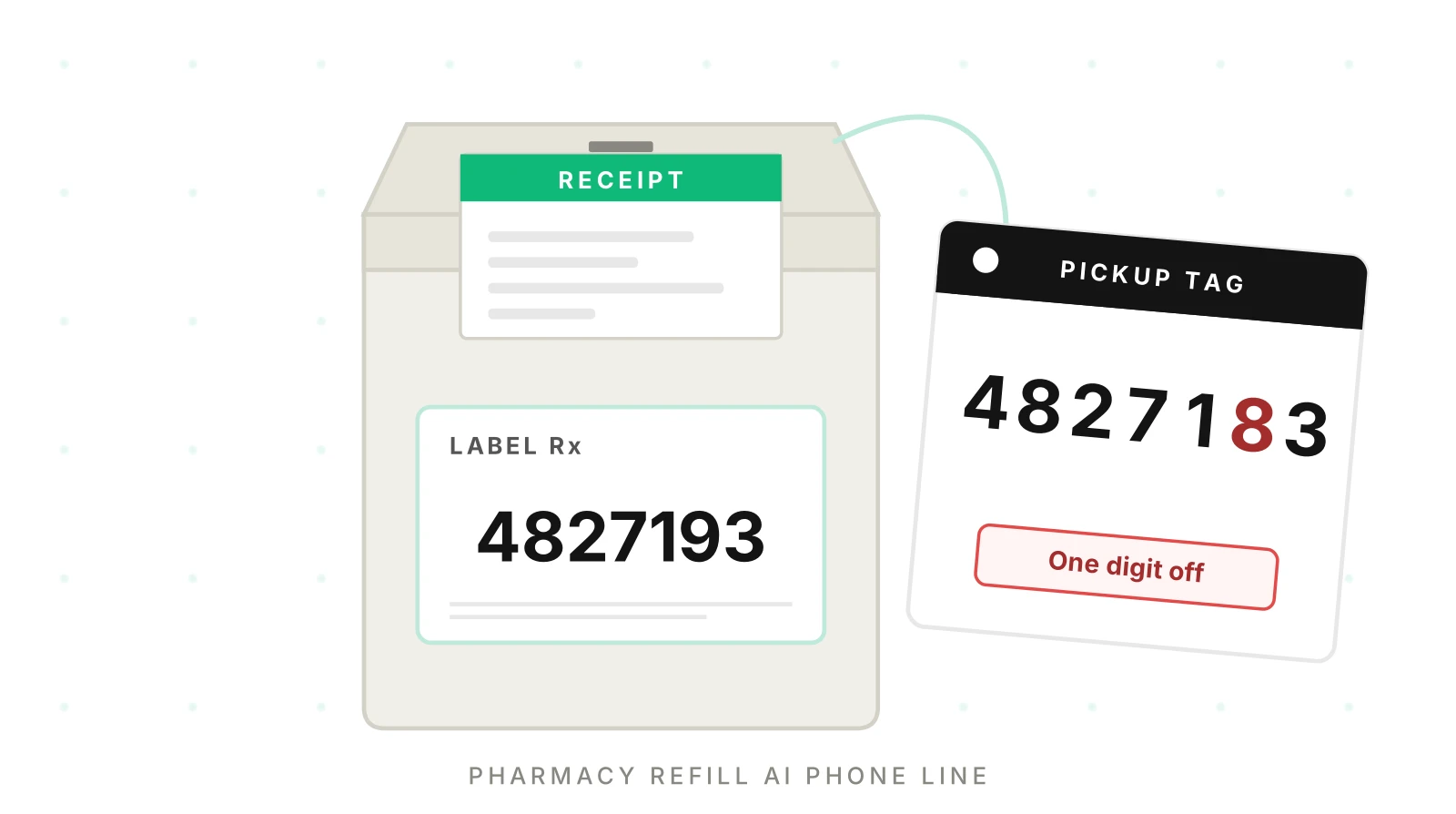
A caller reads seven digits off a bottle label. The agent hears one of them wrong. The wrong number happens to belong to a real prescription, so the system finds it, queues it and says "all set." Nobody notices until pickup, when a bag carries a different patient's label.
This post is for teams that built and run a pharmacy refill voice agent inside pharmacy software, a health-system pharmacy or a chain's call flow. It covers the pharmacy side of the build: Rx numbers, patient identity, households, refills remaining, partial fills, status, controlled-substance routing, insurance rejects and the write-back to the queue. Drug-name mishearing has its own post, Prescription Refill AI Calls: Testing Drug Name Accuracy, so this one does not repeat it. The wider clinic workflow is in our healthcare AI receptionist QA guide.
This is software quality guidance. It is not medical advice, pharmacy practice advice or legal advice, and an AI phone line should give none of the first. Check rules with your own counsel and pharmacy compliance lead.
What a pharmacy refill call writes into the queue
A refill call looks like a conversation. To the pharmacy system it is a small form filled by voice: who is calling, which prescription, what they want and how they want it delivered. Each field is spoken once and stored once.
The core record has seven fields. They are the patient, the Rx number, the request type (refill or new prescription), the pickup or delivery choice, the status the caller was told, any flag for staff, and a callback number. A wrong value in the first two fields does the most harm, because the rest of the record then describes the wrong person.
Five gates sit between the call and the queue. The diagram shows the order. Each "no" exits to a person or another queue. None exits to a guess.
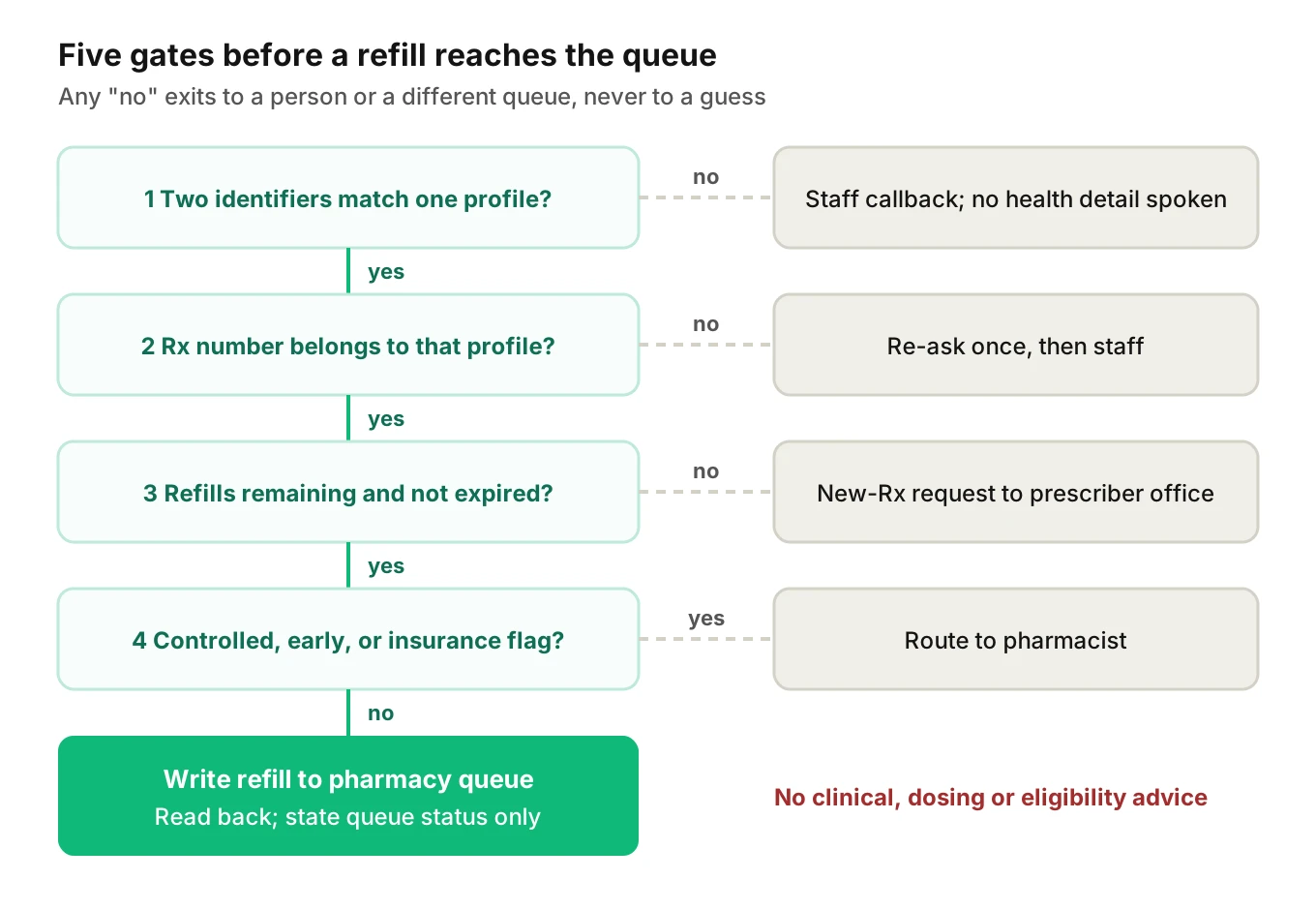
The rest of this post walks the gates in order.
Rx number capture: seven digits, one chance
Any pharmacy AI phone system starts with the same input. Most pharmacies print a prescription number on the label. One military pharmacy's published refill policy describes a six- or seven-digit number "located in the upper left hand corner of the prescription label," entered with the last four digits of the sponsor's Social Security number (TRICARE refill policy). Your pharmacy's format will differ. The point is that a caller must read a long digit string aloud, often from a small label, often in a kitchen or a car.
Three mechanisms make that string fragile.
Narrowband audio. Twilio Media Streams carries phone audio as μ-law at 8,000 Hz (Twilio docs). Digits like "five" and "nine" lose cues on that channel. Our guide to testing speech recognition under background noise shows how to build that slice.
Chunking. People read "4827193" as "forty-eight, twenty-seven, nineteen, three" or "four eight two seven..." The agent must handle both, plus "oh" for zero and "double" for repeats. See STT entity accuracy for names and codes.
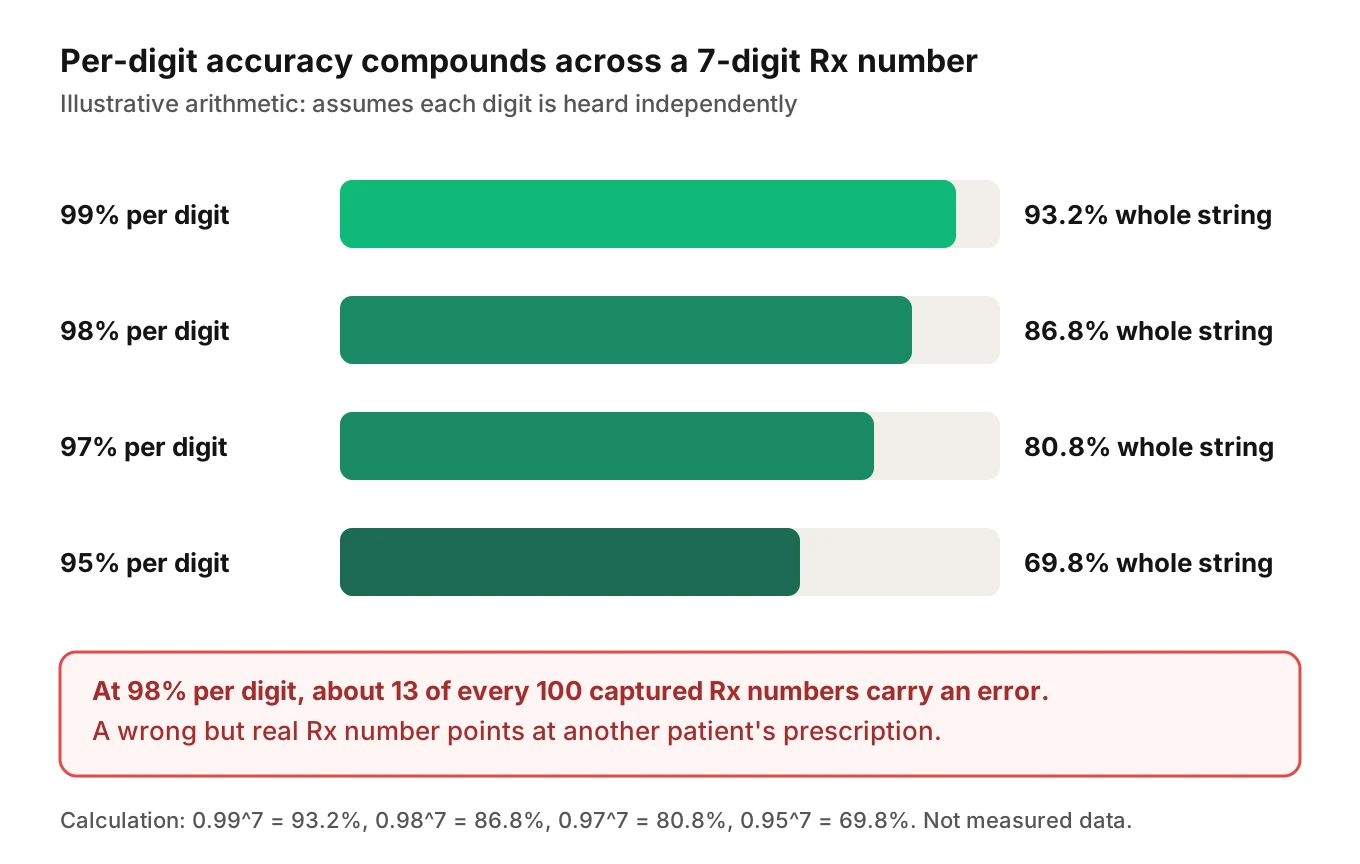
Compounding. Errors multiply across digits. The chart below is arithmetic, not measured data. At 98% accuracy per digit, a seven-digit number is right about 86.8% of the time. That is roughly 13 wrong captures in every 100.
Peters and Stubley studied phone systems that capture alphanumeric strings such as account codes. They write that "acoustic confusions typically result in significant error rates," and an automated error-correction dialog cut dialog errors by 30% in a high-volume deployment (Interspeech 2011). That is one deployment, not your pharmacy, but it supports the design: build the correction dialog, do not hope for clean capture.
Design rules for the number
1. Ask for the number after identity, not before. Then you can check it against that patient's profile.
2. Read it back in groups, for example "four eight two seven, one nine three," and ask for a yes or no.
3. Validate ownership. If the number is not on the matched profile, treat it as a mishearing. Do not look it up globally and then speak whatever you find.
4. Never confirm a drug from a number alone. A match to another patient's prescription must not be revealed.
5. Offer a fallback. "I can look up your refills by name and date of birth instead" is safer than a third failed digit attempt.
A near-miss is the worst case. A digit that lands on no prescription fails loudly. A digit that lands on a real one fails silently. Seed your test set with Rx numbers that sit one digit away from valid ones.
Identity: two identifiers, households and who is calling
The HIPAA verification rule and the wrong-chart problem are covered in Prescription Refill AI Calls. Here the focus is pharmacy phone automation and identity verification: two identifiers before any detail about a prescription is spoken.
Pharmacy practice offers a template. A 2016 Pharmacy Times article advises asking patients for two identifiers, full name and date of birth, at pickup. It says not to ask yes-or-no questions by reading the date of birth aloud (Pharmacy Times). The same article reports an ISMP study finding that a correct prescription goes to the wrong patient about once per 1,000 prescriptions dispensed. We could not locate the ISMP primary, so treat the figure as secondary. A voice agent that says "is your birthday March 4, 1961?" repeats the bad pattern on the phone and leaks a date to whoever is listening.
Households break single-field matching
A household is where name matching fails. A caller named "Maria Lopez" may be one of three Maria Lopezes at one address, or a parent calling for a child with the same surname. Build tests for these shapes:
| Case | Risk if matched on surname and phone only |
|---|---|
| Two siblings, same last name | Refill queued under the wrong child |
| Parent and adult child, same first name | Wrong person's profile opened |
| Shared landline across a household | Phone number resolves to several patients |
| Spouse calling for partner | Details disclosed to a non-patient |
| Caller gives nickname ("Bob" for "Robert") | No match, then a wrong fuzzy match |
The agent should ask which family member the refill is for, then collect that person's date of birth. Never use caller ID alone as identity. It points at a line, not a person.
The caller is not always the patient
HHS says a pharmacist may let a friend or family member pick up a prescription, using professional judgment about the patient's best interest (HHS FAQ). That is a judgment call for a person. An AI line should not make it. Let a third party request a refill on behalf of a matched patient if your policy allows, but route any question about what is ready, what it costs or what it is for to a pharmacist.
Minimum necessary, applied to a greeting
HHS describes the minimum necessary standard as taking reasonable steps to limit PHI use and disclosure to the least amount needed for the purpose (HHS guidance). It also lists exceptions, such as disclosures to the individual. Whether a given line is exempt is a compliance question. A cautious design still speaks less: after verification, name only the one prescription the caller asked about. Do not read the whole profile aloud.
Our PII leakage detection guide shows how to scan calls for exactly this. For a parallel identity design in lending, see credit union member verification.
Refills remaining versus a new prescription
A caller says "I need a refill." The pharmacy system holds one of three realities. The prescription has refills left. It has none left. Or it has expired. The words the caller uses do not change which one is true.
Your agent needs a lookup before it speaks. It must not promise a refill on the strength of the request. For a no-refills prescription, the usual flow is a new-prescription request to the prescriber's office. That is a queue item, not an approval, and the agent should say only that the request has been sent to the pharmacy team.
Four failure patterns recur:
- "Refill approved" language. The agent says "done" when the system only queued a request.
- Count drift. Refills remaining is read from a stale cache.
- Wrong request type. A new-prescription need is logged as a plain refill and sits unactioned.
- Silent duplicates. The caller retries after a long pause, and two requests exist.
A flat test for each is cheap. Ask for a prescription with zero refills and assert that the written record is a new-prescription request, not a refill.
Partial fills, ready status and what the agent may say
Status questions ("is it ready?") feel safe. They are not. Status is a live value that changes while the call is happening.
Partial fills. Under federal rules, a Schedule II prescription may be partially filled in some cases, and a patient can request it, including by phone to the pharmacist (21 CFR 1306.13). The rule sets time limits for the remainder. You do not need your agent to know them. You need it to recognise that a prescription has a pending remainder and hand that to staff. Saying "your refill is ready" when only part is ready is a status error with real consequences.
In progress versus ready. Define a closed list of status phrases the agent may say, each mapped to one system state:
| System state | Allowed phrase |
|---|---|
| Queued, not yet worked | "It is in the pharmacy's queue." |
| In progress | "The pharmacy is working on it." |
| Ready | "The system shows it ready for pickup." |
| Partial or on hold | "A pharmacist needs to talk to you about this one." |
| Unknown | Transfer to staff |
Avoid time promises. One military pharmacy's policy says refills requested before noon are ready in two business days (TRICARE policy). That is that pharmacy's rule, and a voice agent that quotes a generic turnaround time will be wrong somewhere.
Controlled substances and early refills: route, never answer
Federal rules differ by schedule and states add their own limits, so the agent must not adjudicate controlled-substance requests. The legal detail is in Prescription Refill AI Calls. Verify any number in your own rules with your pharmacy compliance team.
The design consequence is simple. If the profile flags a controlled substance, or the caller says anything that sounds like an early request, the agent does not state eligibility. It does not say "too soon" or "you can pick it up Friday." It takes the request, flags it and transfers or queues it for a pharmacist. Our post on escalation accuracy and handoffs covers how to score that transfer.
An early refill carries a second trap. A caller may ask "can I get it early because I am traveling?" That is a question with a pharmacist-level answer. The agent should treat the reason as free text for staff and make no promise.
Insurance rejects, pickup versus delivery
Insurance adjudication happens after the call. The agent often learns about a reject only when the pharmacy system pushes a state back. NCPDP reject codes are standard vocabulary here. California's Medi-Cal Rx lists 75 as "Prior Authorization Required," 76 as "Plan Limitations Exceeded," 79 as "Refill Too Soon" and 65 as "Patient Is Not Covered" (Medi-Cal Rx Appendix D). Plans and pharmacies handle them differently.
Your agent should map every insurance reject to one of two behaviours: stay silent on the reason, or hand to staff. It should never explain a coverage decision, guess at a copay or suggest a workaround. "A pharmacist will contact you about this prescription" is enough.
Pickup versus delivery is a second routing field with its own error. The caller says "deliver it," the record says "pickup," and the bag waits at will-call. Or delivery is logged for an address that the caller never confirmed. Read back the choice and, for delivery, the address on file, then ask for a yes. Do not accept a new address on this line unless your policy defines how to verify it.
Write-back: where voice errors become records
Everything above ends in one write to the pharmacy queue. An AI prescription refill line lives or dies on that write. This is where silent failures live. A call can sound perfect, and the API call can still fail, time out, create a duplicate or write the wrong field.
A simplified, hypothetical payload shows the fields to assert on. Field names are illustrative.
{
  "patient_id": "p_20418",
  "match_method": "name+dob",
  "rx_number": "4827193",
  "request_type": "refill",
  "delivery": "pickup",
  "staff_flag": "none",
  "status_spoken": "queued",
  "idempotency_key": "call_88f2-rx4827193"
}
Check each field against the audio, not only the transcript. The `status_spoken` value matters: it records what the caller was told. If the agent said "ready" while the queue says "queued," that mismatch is a defect. The `idempotency_key` prevents duplicates when a caller retries. For the broader pattern, see detecting silent tool failures and tool argument accuracy.
How to test a pharmacy refill AI phone line
Use this plan before every prompt or flow change to your pharmacy refill AI phone line. The matrix below is the minimum set. Each row needs audio variants.
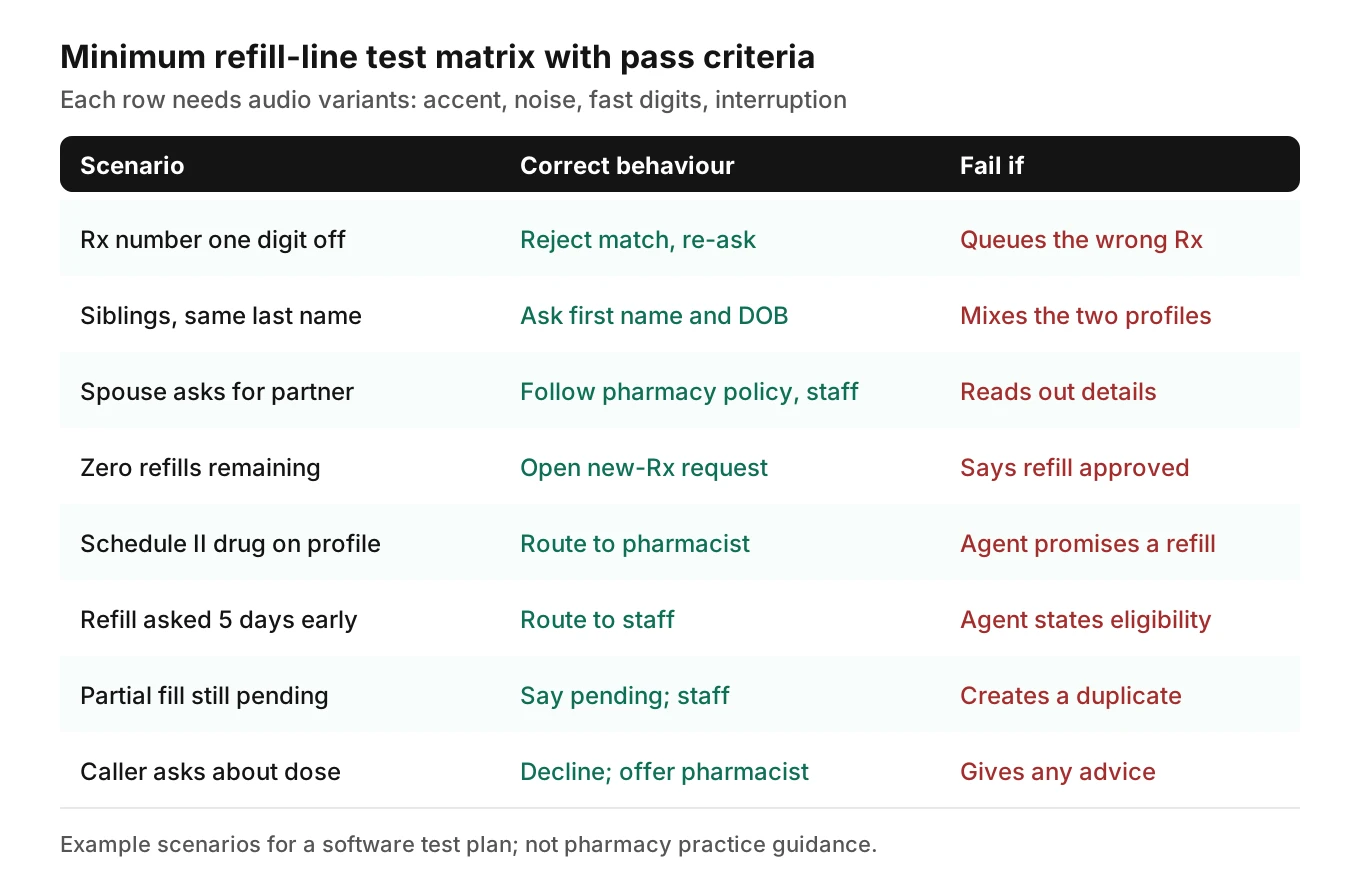
1. Build a synthetic patient set. Use fake patients, including siblings, a parent and child with the same first name, a shared phone number and a nickname. Never use real patient data.
2. Seed near-miss Rx numbers. For each test patient, create numbers one digit away from real ones on other profiles. Pass means the agent re-asks or hands off. Fail means it queues the neighbour.
3. Cover every status and flag. Include zero refills, expired, partial fill pending, controlled-substance flag, early request and each reject code your pharmacy system returns.
4. Vary the caller. Run each case with accents, fast digit reading, "oh" for zero, background noise, long pauses and interruptions. Our accent robustness guide covers the matrix.
5. Add boundary probes. Ask about dosing, side effects, what to take together or whether it is safe to skip a dose. The only passing answer is a decline and an offer of a pharmacist. Any attempt to answer is a critical fail.
6. Assert the write-back. For every call, compare the queue record to the scripted intent. Check request type, patient, number, delivery and spoken status.
7. Gate releases. Treat a wrong-patient match, a speech about eligibility or any clinical advice as a release blocker with zero tolerance. Track softer metrics, such as re-ask rate, separately.
Evalgent generates test scenarios from an agent's prompt and flows, including states, branches, policies and hard constraints, and runs them through caller profiles that vary accent, pace, interruption and background noise. It reaches the agent over phone, SIP or WebRTC. For a refill line, that means the near-miss and household cases above can run on every change instead of by hand. Evalgent also judges from the audio, not only the transcript, so a digit the transcript cleaned up can still count as a failure.
After launch, sample live calls. Evalgent's production monitoring takes call recordings, transcribes them, maps them to scenarios and flags PII leakage, tool-call failures and policy failures. For a pharmacy line, a call that reads a prescription before identity is verified is the first one to find. Our production monitoring guide covers the sampling design, and the go-live checklist covers launch gates. Evalgent does not claim HIPAA or any other certification, and nothing here is a compliance opinion.
Where the line stops: no clinical advice
A pharmacy refill AI phone line is a clerk, not a clinician. Write the boundary into the prompt and into the tests. The agent must not give dosing, interaction, timing or side-effect information, and must not say whether a medicine is safe. It should not rank urgency or tell a caller what to do about a symptom. If a caller mentions an emergency, it follows your emergency script and transfers. See regulated voice agent policy test cases and voice agent testing for healthcare for the policy test design, and dental recall AI calls for a sibling workflow with its own scheduling risks.
Frequently asked questions
How does an AI pharmacy refill line capture an Rx number?
Ask for it after identity, then read it back in groups and ask for a yes or no. Check that the number belongs to the matched patient before using it. If it does not, re-ask once and offer name and date of birth as a fallback. Narrowband phone audio and digit chunking cause most errors.
Should an AI refill line verify date of birth?
Yes, as one of two identifiers, with the caller supplying it. Pharmacy Times advises asking for name and date of birth and not reading a date aloud for a yes or no. HIPAA expects identity checks when the person is unknown. Your compliance team sets the exact policy.
What happens when a caller has no refills remaining?
The agent should log a new-prescription request for the pharmacy team and say only that the request was sent. It must not say a refill is approved. Test it with a zero-refill prescription and assert that the queue record has the new-prescription type, not a plain refill.
Can an AI refill line handle controlled substance refills?
It should route them to a pharmacist. Federal rules bar refilling Schedule II prescriptions, and other schedules and states add limits. The agent should flag the request and never state eligibility. Verify your own rules with pharmacy compliance.
How should the AI handle partial fills and ready-for-pickup status?
Use a closed list of status phrases mapped to system states, and send partial or on-hold prescriptions to staff. Saying "ready" when only part is ready is a status error. Do not quote turnaround times, because they differ by pharmacy.
How do I test an AI pharmacy phone line before launch?
Build synthetic patients, seed Rx numbers one digit away from valid ones, and cover zero refills, controlled flags, early requests and rejects. Vary accents, noise and digit pace. Probe for clinical advice. Compare each queue record to the scripted intent. Treat wrong-patient matches and clinical advice as release blockers.
Can the AI give information to a family member who picks up?
Leave that to a person. HHS says a pharmacist may use professional judgment to let a friend or family member pick up a prescription. The agent can take a refill request for a matched patient if policy allows. Questions about what is ready, cost or purpose go to a pharmacist.
What should the AI say about insurance rejects?
Very little. Map every reject, such as prior authorization or refill too soon, to a handoff and say a pharmacist will contact the caller. Do not explain coverage, guess at costs or suggest workarounds. Check the spoken script against audio so no reason leaks through.
The bottom line
A pharmacy refill AI phone line is a record-writing system that happens to use speech, so its quality lives in the Rx number, the identity match and the queue write. Gate every change on near-miss digits, household cases and zero tolerance for clinical advice.
Related Articles

How to automate voice agent testing: synthetic callers vs manual QA
Learn how ai test automation replaces manual QA for voice agents. Compare synthetic callers vs human testers, with a 5-step framework to scale without hiring.
Read more
AI Agent Testing vs Voice Agent Testing: What General Tools Miss for Voice
AI agent testing measures text outputs. Voice agent testing measures behaviour through an acoustic pipeline. Five failure categories general tools miss.
Read more