AI Agent Testing vs Voice Agent Testing: What General Tools Miss for Voice
On this page
For text and chat agents, the standard evaluation stack works. Run prompt evals, score outputs with an LLM judge, verify tool calls, track hallucination rate, and ship. The frameworks are mature and the tooling is converging fast.
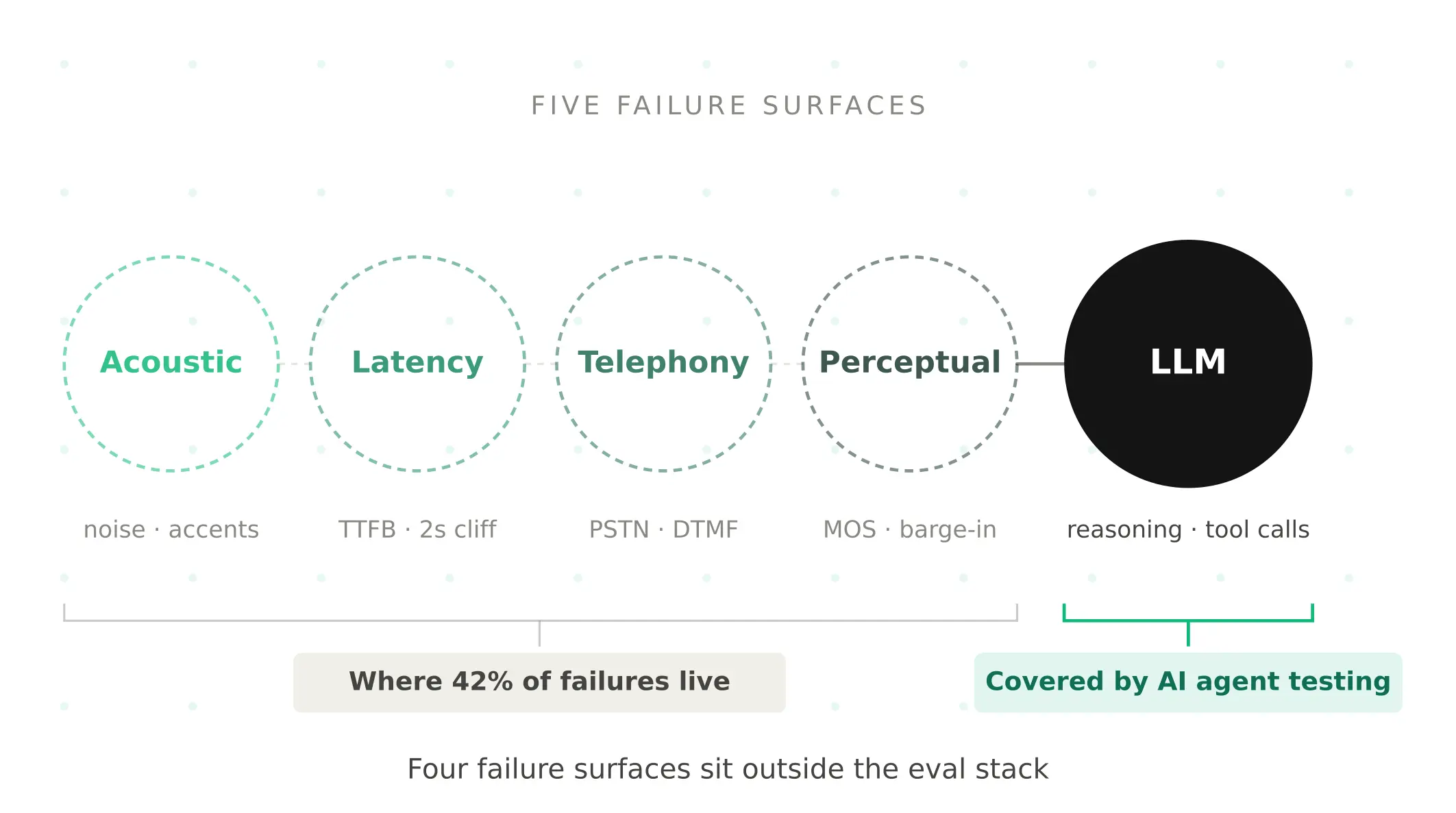
For voice agents, that same stack misses around 40% of production failures. Hamming AI has analysed over 4 million voice agent calls. Their data shows roughly 42% of production failures are voice-specific — acoustic, latency, telephony, or perceptual issues no transcript-level evaluation can detect.
This post is for teams who built a voice agent on top of a Vapi, Retell, LiveKit, or in-house stack. They plugged in their general AI agent testing tools and watched users complain anyway. The gap is real and it's structural. Below: what general agent testing actually covers, the five voice-specific failure categories it can't see, a side-by-side comparison, and an eight-step pre-launch checklist for voice agents at scale.
What does AI agent testing cover?
AI agent testing is the umbrella term for evaluating whether a language-model-driven agent does the right thing under the right conditions. The mature parts of the discipline focus on what the agent reasons, generates, and triggers downstream. Text, chat, and voice agents all start here.
A typical agent testing stack covers several things. Prompt evals against a golden dataset. LLM-as-judge scoring against rubrics. Tool call success verification. Hallucination detection. Latency budgets at the LLM layer. Regression detection after prompt or model changes. Vendors like Braintrust, LangSmith, and Arize position themselves here. For text agents — internal copilots, code assistants, search wrappers, document Q&A — this stack is largely sufficient. The agent's surface area is text in, text out, plus a known set of tool calls. Every dimension of that surface is observable in the transcript and the structured logs.
The discipline of LLM as judge — using a frontier model to score conversations against a written rubric — is the dominant scoring approach in this category. Most ai evaluation tools and ai testing tools default to it because it's cheap, fast, and produces a number.
The trouble starts when the agent's input and output stop being text.
What does voice agent testing cover that AI agent testing doesn't?
Voice agent testing adds four dimensions that have no analogue in text: acoustic conditions, real-time latency, telephony transport, and perceptual audio quality. It also amplifies a fifth dimension that text testing handles badly: error compounding across a multi-stage pipeline.
A voice agent is not a language model with a microphone bolted on. It's a pipeline — typically speech-to-text (STT) → LLM → text-to-speech (TTS) — running over telephony or WebRTC, often with a voice activity detector and turn-taking model layered on top. Each stage has its own failure modes. Failures compound in ways that transcript-level evaluation cannot detect. A caller hears a 4-second pause, gets cut off mid-sentence, or hangs up because the agent's voice clipped a key word — and the transcript shows a clean, successful conversation. The general ai agent testing stack scores it as a pass.
Voice agent testing — also called voice ai testing or conversational ai testing in some vendor docs — exists specifically to close that gap. The next section breaks down what it has to cover.
The five voice-specific failure categories general AI testing tools miss
1. Acoustic failures
Real callers do not call from a soundproof booth. They call from kitchens, cars, open-plan offices, train platforms, and street corners. Their accents span dozens of regional varieties. They cough, restart sentences, say "umm," and overlap the agent's speech.
Clean-audio benchmarks for speech-to-text models can be 2 to 66 times worse when the audio includes overlapping speech, background noise, or non-native accents. None of that variability is visible in a transcript, because the transcript is already the ASR's best guess at what was said. If the ASR misheard "fifty" as "fifteen," the LLM judge has no way to know — and your downstream business logic just processed the wrong amount. This is the most common category of silent failure in production voice agents, and it is structurally invisible to general llm evaluation.
Testing for acoustic failure voice agent testing requires synthesised callers — with controllable noise levels, accent distributions, speech pace, and disfluency rate. Critically, those parameters must be applied to the agent under test, not just to the ASR in isolation.
2. Real-time and latency failures
In a text agent, a 200 ms increase in response time is invisible. In a voice agent, it is the difference between a natural conversation and a broken one. Research on conversational interfaces, including ACM CUI 2025 studies on response delay, shows significant engagement degradation above the two-second mark. Callers repeat themselves. They hang up. They lose trust in the system's competence.
Industry P95 time-to-first-byte (TTFB) for voice agents sits between 1.4 and 1.7 seconds — uncomfortably close to that two-second engagement cliff. Sub-300 ms feels human. The challenge is that latency degrades unevenly. A prompt change might add 400 ms at the LLM layer. A TTS configuration tweak might add 200 ms more. The agent that passed every functional test in staging becomes unusable on a real call.
General ai testing tools rarely measure end-to-end latency at the call level. They measure LLM inference time. The TTS, transport, and barge-in components — all of which add latency — are outside their scope.
3. Telephony failures
PSTN, SIP, and WebRTC are not interchangeable. A voice agent that performs well on a WebRTC test call can fail on a real phone call. The reason: PSTN codecs (typically 8 kHz μ-law or A-law) discard frequencies the ASR was trained on. DTMF input detection, call transfer logic, and dropped-connection handling all introduce failure modes that don't exist in browser-based testing.
For agents deployed via Twilio, Telnyx, or Plivo, telephony-layer testing has to verify codec compatibility, dial-pad input recognition, ring/no-answer handling, and warm transfer parameters. This is operational infrastructure that general ai evaluation tools were not built to touch.
4. Perceptual and TTS failures
A transcript can be perfect and the agent can still sound bad. TTS regression — voice clipping, unnatural pacing, mispronounced product names, lost prosody on numbers and dates — degrades user trust in ways the transcript never captures.
Mean Opinion Score (MOS) is the industry-standard perceptual measure for synthesised speech. Production-quality voice agents target MOS 4.0 or higher; human speech sits around 4.5–4.8. A voice configuration change that drops MOS from 4.3 to 3.8 will not break any functional test, but it will quietly increase repeat-utterance rate and call abandonment. Barge-in handling — the agent stopping mid-sentence when the caller starts speaking — is the perceptual failure mode that breaks user trust fastest. None of this surfaces in LLM-as-judge transcript scoring.
5. Compounding failures
The five failure categories above do not occur in isolation. They cascade.
A noisy environment lowers ASR confidence. Lower ASR confidence produces a noisy transcript. A noisy transcript causes the LLM to misclassify intent. Misclassified intent triggers the wrong tool call. The wrong tool call produces a confident, fluent, completely incorrect confirmation — which the TTS synthesises with perfect prosody and the LLM judge scores as a successful conversation. Five layers of failure, zero visibility.
This compounding pattern is what makes voice agents fail in production at rates that surprise teams who tested them as text agents. Each stage looks fine in isolation. The interaction is where users get hurt.
Why general AI testing tools miss 40% of voice agent failures
Hamming AI's analysis of 4 million-plus voice agent calls puts a number on the gap: general llm evaluation and llm testing tools miss approximately 40% of voice agent production failures, and 42% of failures are voice-specific issues no text-based eval can detect.
This is not a vendor flaw. It's a category mismatch. General ai agent evaluation tools are excellent at the surface they were built for: text in, text out, structured tool calls, deterministic outputs. They were not built to instrument an STT pipeline, measure perceptual audio quality, or simulate a caller speaking Hinglish at 1.4× pace from a moving car.
The gap shows up the same way every time. Functional tests pass in CI. Demo calls sound great. Production launch goes live. Within a week, the agent's task completion rate sits at 70–85% (the range for optimised production voice agents) when the team expected 95% based on staging numbers. Call recordings reveal interrupted callers, mispronounced names, 3-second pauses, and silent ASR failures. The team adds more LLM-as-judge runs and prompt tweaks. The numbers don't move.
The reason the numbers don't move is that the failures aren't in the LLM. They're in the layers around it that the eval stack can't see.
AI agent testing vs voice agent testing: side-by-side comparison
This table summarises the differences that determine which testing approach a team needs. Use it as a quick decision aid when scoping evaluation infrastructure.
| Dimension | AI agent testing | Voice agent testing |
|---|---|---|
| Primary input | Text prompts | Synthesised speech through ASR |
| Latency budget | Seconds to minutes acceptable | Sub-second TTFB; ~2s engagement cliff |
| Judge | LLM-as-judge on text output | Telemetry + LLM judge on transcript + audio + downstream state |
| Environment | Clean text input | Noise, accents, codecs, PSTN, WebRTC |
| Failure surface | Reasoning, hallucination, tool call | All of those + acoustic + perceptual + compounding |
| Regression trigger | Prompt or model change | Prompt, model, voice config, TTS version, telephony provider |
| Verification | Transcript accuracy | Transcript + audio quality + downstream state + timing |
| Sample size | Single-run often acceptable | Multi-run required for statistical reliability |
| Typical tools | Braintrust, LangSmith, Arize | Evalgent, Hamming, Coval, Cekura |
| Production target | 95%+ accuracy on golden set | 70–85% task completion; 75–88% containment |
The most important row in that table is the last operational one: regression triggers. Text agents regress when prompts or models change. Voice agents regress when any layer changes — including ones that didn't exist in the text-agent world (TTS version, voice ID, telephony provider, codec). Voice agent regression testing has to cover all of them.
What voice-specific evaluation actually requires
Closing the 40% gap requires three things general agent testing tools were not built to provide.
Synthetic callers that simulate real callers, not ideal callers. A general AI testing tool feeds prompts to a model. A voice evaluation platform feeds simulated humans to a complete voice pipeline. That means controllable parameters for speech pace, background noise, accent, interruption timing, emotional register, language and code-switching, latency, and voice gender. Evalgent's caller profiles configure eight behavioural parameters per synthetic caller, letting teams stress one dimension at a time to find the breaking point.
Outcome verification, not transcript scoring. A voice agent saying "your appointment is booked for Thursday at 2 PM" is not the same as the appointment actually being in the calendar. End-to-end evaluation has to verify the downstream state — did the API call succeed, did the booking record appear, did the SMS confirmation send, did the transfer execute. Evidence-backed scoring is the operational version of this: every pass or fail has audio, transcript, and tool-state evidence behind it.
Statistical reliability, not one-run pass/fail. A text agent that gets the right answer once is reliable. A voice agent that gets the right answer once is lucky. Voice agents have non-deterministic interaction dynamics — interruptions, background events, ASR variability — so the same scenario run twice can produce different outcomes. Real reliability is the success rate across multiple runs of the same scenario × profile combination. Evalgent's scenario success rate (SSR) is built on this principle: run each test 3, 5, or 10 times, and pass the test only if the success rate clears the threshold.
Three pillars sit underneath all of this. Functional testing validates that the agent completes scenarios end-to-end. Behavioural testing stress-tests the agent against real human behaviour patterns. Limit testing pushes conditions until reliability drops below threshold, mapping the failure boundaries explicitly. General agent evaluation tools cover something resembling the first pillar. The second and third are voice-native.
How to test voice agents at scale: 8-step pre-launch checklist
This checklist is what to run before any voice agent — built on Vapi, Retell, LiveKit, Pipecat, ElevenLabs Conversational AI, or in-house — goes live. It's the voice agent testing checklist before production we use with teams shipping into BFSI, healthcare, customer support, and outbound sales. Treat it as the minimum viable pre-launch gate.
1. Define scenarios with explicit objectives and success conditions. One scenario per objective. Refund flow, balance inquiry, appointment booking, cancellation, escalation — each gets its own success criteria, not a generic "did the conversation complete."
2. Configure caller profiles across all eight behavioural parameters. At minimum: clean baseline, 65 dB noise, accent variant matching your user base, fast-pace impatient caller, and interruption-heavy caller. More if your user base is acoustically diverse.
3. Set both telemetry and LLM-based metrics with thresholds. Telemetry covers response latency, call duration, silence ratio, interruption count. LLM-based metrics cover tone consistency, knowledge accuracy, instruction adherence. Each needs an explicit threshold — not "agent should sound professional," but "tone consistency ≥ 4 on a 1–5 scale."
4. Run the full scenarios × profiles matrix with at least 3 runs per cell. A 12-scenario × 5-profile matrix at 3 runs each is 180 calls. A scenario passes only if its SSR clears the threshold across all profiles.
5. Verify tool-call outcomes against downstream state, not just transcript. For every tool call, confirm the webhook received the expected parameters, returned a success response, and the downstream record (booking, transfer, transaction) actually exists.
6. Stress-test one parameter at a time to find breaking points. Lock all profile parameters to baseline, then vary one — noise from 45 dB to 75 dB, or interruption level from None to High. The reliability curve across that axis is the agent's behavioural limit for that dimension.
7. Establish a regression baseline before any prompt or model change. Lock the golden scenario suite results before the change. After the change, re-run and compare. SSR drop of more than 5 points on any critical scenario is a regression.
8. Monitor production for drift after launch. Pre-launch evaluation is necessary but not sufficient. Track scenario reliability, latency P95, and emerging failure patterns on real production traffic continuously after deployment.
This is the operational pattern Evalgent runs against. Steps 1–7 are pre-deployment evaluation. Step 8 is post-deployment monitoring. The handoff between them — same scenarios, same metrics, same evaluation framework applied in two phases — is what separates voice agent evaluation from one-time QA.
When you can use general AI testing tools, and when you can't
The honest answer is that general agent testing tools are fine — even excellent — for some parts of a voice agent build. They become insufficient when the surface area of failure extends beyond text.
Use general llm evaluation tools and llm testing platforms when you're iterating on the LLM's reasoning in isolation. Prompt regression testing, hallucination detection on a fixed dataset, structured output validation, and tool-schema verification all live cleanly in the text-agent eval world. Use ai test automation pipelines and ai testing platform infrastructure when you need CI-grade unit tests on the LLM layer. These are real wins and voice-specific evaluation does not replace them.
You need voice-specific evaluation — voice agent testing tools comparison done properly — when you ship the agent end-to-end. Once the LLM is wired to STT, TTS, and telephony, the failure surface stops being text and starts being a real-time pipeline. At that point general ai evaluation tools are necessary but not sufficient. Pair them. Run text-level prompt evals in your CI pipeline. Run voice-level pre-launch evaluation through a voice agent testing platform before every release.
For most teams, the pattern that works is straightforward. Keep prompt-level testing in your existing agent testing stack. Add a voice-native evaluation layer for everything downstream of the LLM. The two layers don't compete — they cover different parts of the production failure surface.
Summary
AI agent testing scores the words. Voice agent testing scores the experience. The gap is structural, around 40%, and only closes when synthetic callers, end-to-end outcome verification, and statistical reliability replace transcript-only LLM-as-judge scoring for everything downstream of the language model.
Frequently asked questions
How is voice agent testing different from ai agent testing?
AI agent testing scores text inputs, text outputs, and tool calls. Voice agent testing adds four dimensions: speech-to-text accuracy, sub-second real-time latency, telephony transport, and perceptual audio quality. The voice version tests a pipeline, not a model. That pipeline introduces failure modes text testing cannot detect.
What do general ai testing tools miss for voice agents?
What general ai testing tools miss for voice agents is approximately 40% of production failures, per Hamming AI's analysis of 4 million-plus calls. The misses cluster in five categories: acoustic conditions, real-time latency above the two-second engagement cliff, telephony failures, perceptual TTS regression, and compounding errors across STT, LLM, and TTS layers.
Why llm evaluation fails for voice agents
Why llm evaluation fails for voice agents is straightforward: it scores transcripts, not experience. A transcript is what the ASR thought the caller said, not what the caller said. It captures no timing, no audio quality, no downstream state. An LLM-as-judge can return a 95% score for a call where the caller hung up frustrated at second 12.
What is the voice agent testing checklist before production?
The voice agent testing checklist before production has eight steps. Define scenarios with explicit success conditions. Configure caller profiles across acoustic and behavioural dimensions. Set telemetry and LLM-based metrics with thresholds. Run scenarios × profiles with three runs per cell. Verify tool calls against downstream state. Stress-test parameters individually. Establish a regression baseline. Monitor production for drift.
What is acoustic failure voice agent testing?
Acoustic failure voice agent testing is the practice of evaluating a voice agent under controlled acoustic conditions — background noise levels, accent distributions, speech pace, and disfluency rate — to detect failures the ASR introduces before the transcript is generated. Clean-audio speech-to-text benchmarks can be 2 to 66 times worse with overlapping speech or noise. Acoustic testing exposes this degradation before real users experience it.
How to test voice agents at scale?
Testing voice agents at scale requires synthetic callers, a scenarios × profiles matrix, statistical reliability through multiple runs, evidence-backed scoring, and continuous monitoring after launch. A typical pre-launch run is 12 scenarios across 5 profiles at 3 runs each — 180 calls — gated on scenario success rate clearing a defined threshold across all profiles.
How does voice agent vs text agent evaluation differ in practice?
Voice agent vs text agent evaluation differs operationally in three ways. Text evaluation is single-run pass/fail; voice evaluation needs multi-run SSR scoring because pipeline outcomes are non-deterministic. Text evaluation scores transcripts; voice evaluation scores transcripts plus audio plus downstream state plus timing. Text regresses on prompt or model change; voice also regresses on TTS, voice config, codec, and telephony provider.
What should a voice agent testing tools comparison cover?
A voice agent testing tools comparison should cover five dimensions. Whether the tool runs synthetic callers against the full pipeline or only the LLM. Whether it supports configurable acoustic and behavioural parameters. Whether it verifies tool-call outcomes against downstream state. Whether it produces statistical reliability scores across runs. Whether it spans pre-deployment evaluation and post-deployment monitoring with the same scenario library.
Related Articles
How to automate voice agent testing: synthetic callers vs manual QA
Learn how ai test automation replaces manual QA for voice agents. Compare synthetic callers vs human testers, with a 5-step framework to scale without hiring.
Read more
Why Production Voice Agents Are Becoming Graphs, Not Prompts
Graph-based voice agents externalise control flow that prompt-based agents trust the LLM to handle. Why this is the architecture winning production deployments.
Read more