Call Tagging Taxonomy for Voice Agents: Intent, Outcome and Failure Reason
On this page
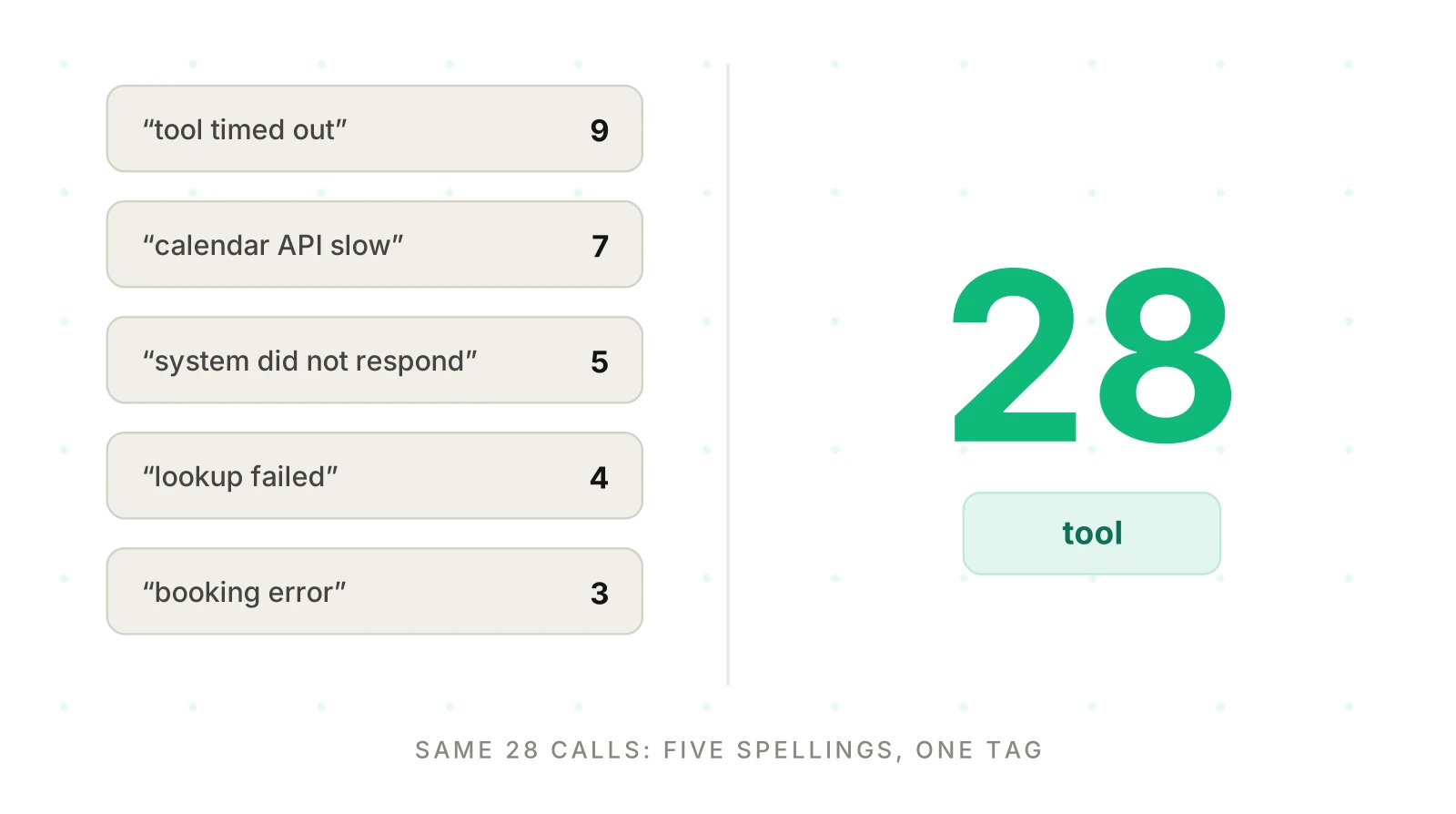
A team exports 400 failed calls. The reason column holds "tool timed out," "calendar API slow," "no response," "lookup failed" and "long pause." All five can be one fault. Nobody can count them or rank them.
Voice agent call tagging fixes that. It turns each call into a few controlled values you can count and slice. This post is a vendor-neutral design: three tag families, a 12-value failure reason list with evidence, tag sources, an agreement check and versioning. Examples are illustrative.
Voice agent root cause analysis covers trace evidence. Clustering failures groups failed calls into causes. The event schema and logging post list record fields. This post sits before clustering: label design, label source and label quality.
Why free-text reasons do not aggregate
A judge or reviewer writes a sentence per failed call. It is fast, and it breaks every count.
Take 40 failed calls from an imagined booking agent.
| Free-text reason | Calls |
|---|---|
| Tool timed out | 9 |
| Calendar API slow | 7 |
| Agent waited too long | 6 |
| System did not respond | 5 |
| Lookup failed | 4 |
| Long pause | 4 |
| Booking error | 3 |
| Did not understand the date | 2 |
The biggest bucket looks like 9 of 40, or 22.5 percent. Group by what the traces show instead. Suppose 28 of the 40 trace to a tool span with an error: 70 percent. Ten calls ("waited too long", "long pause") need a trace. Two are STT. The check: 28 + 10 + 2 = 40.
Free text fails because one cause gets many spellings and one word such as "slow" covers many causes (latency is a symptom, not a layer). The fix is a controlled vocabulary: a short fixed list that gives the same value to the same cause. Group on the tag, not the note.
The three tag families: intent, outcome and failure reason
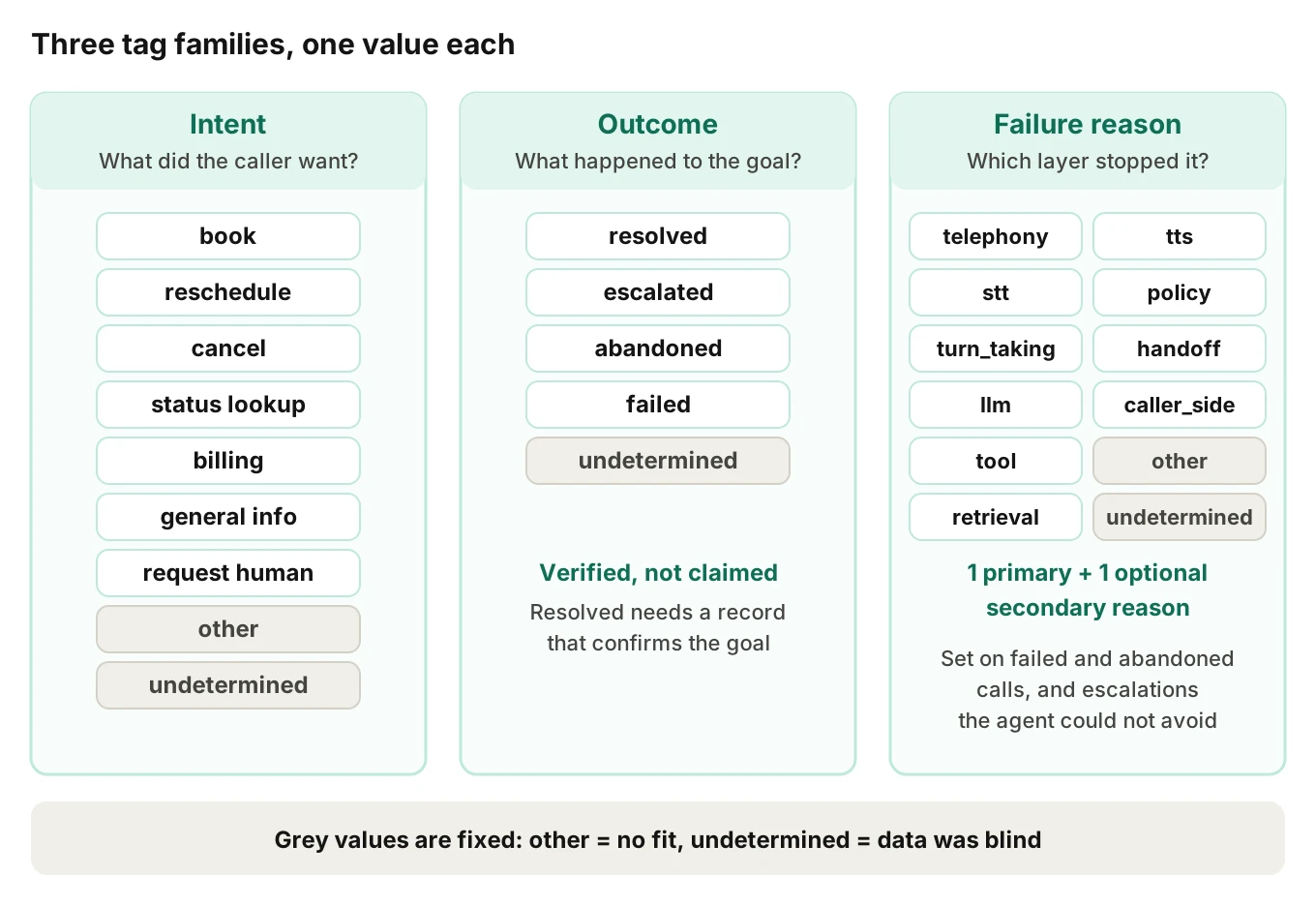
| Family | Question | Values | Required on |
|---|---|---|---|
| Intent | What did the caller want? | One, from about 8 to 12 | Every call |
| Outcome | What happened to that goal? | One of 5 | Every call |
| Failure reason | Which layer stopped the goal? | One primary, one optional secondary | Failed and abandoned calls, and escalations the agent could not avoid |
Intent: what the caller wanted
Intent is the caller's goal, not the agent's guess. A scheduling agent might use book, reschedule, cancel, status lookup, billing, general information, request for a human, other and undetermined. Tag the final intent. A mismatch with the agent's own goal (see state observability) is a finding.
Outcome: what happened to the goal
| Outcome | Rule |
|---|---|
| Resolved | The goal was reached and a record confirms it, such as a booking in the system of record |
| Escalated | The call reached a human or queue, and the transfer connected |
| Abandoned | The caller ended the call before the goal or a handoff |
| Failed | The call ended without the goal: an error, an agent hangup or a wrong record |
| Undetermined | The data cannot say whether the goal was met |
Outcome describes the goal. Failure reason explains why. An abandoned call is one where the caller left, and why is the reason, such as turn-taking. This matches the abandonment rate post. Count resolved only when something verifies it, as the resolution rate post argues.
A provider's status is not an outcome. Twilio's Call resource defines completed as "The call was answered and has ended normally." The caller may still have left unserved.
Design rules for a taxonomy that holds up
1. Mutually exclusive within a family. One intent, one outcome and one primary reason per call. If two values often fit, the definitions overlap.
2. One primary reason, plus an optional secondary. The primary is the first layer whose failure made the goal unreachable. The clustering post uses the same "first failing step" logic, because nearly every bad call ends in a hangup.
3. Tie each reason to a layer and write its evidence. A layer has an owner and a fix. A tag with no stated evidence is an opinion.
4. Keep a fixed other and a fixed undetermined. Other means a reviewer looked and nothing fits. Undetermined means the data was blind. Review both on a schedule, for example when together they pass a share you set, such as 10 percent.
5. Keep the list short. About 10 to 12 failure reasons works.
When two layers fail, use the earliest by time, unless a later failure alone would have stopped the call. Example: STT mishears a date at 22 seconds and a tool then fails on the wrong date. STT is primary, tool secondary.
An example failure reason taxonomy and its evidence
This list is a starting point, not a standard. The evidence column is what a rule or reviewer should see before applying the tag. Fields come from the call event schema and the span attributes post.
| Value | Evidence that would support it |
|---|---|
telephony | Setup not connected, provider status failed, busy or no-answer, SIP final response 4xx, 5xx or 6xx, media dropped mid-call |
stt | Transcriber span error, empty final transcript, low confidence on the value that later failed, caller correction after a read-back |
turn_taking | Overlapping speech, endpoint fired mid-utterance, agent kept talking after barge-in, long gap with no slow span |
llm | Answer contradicts state or policy while tools and retrieval were healthy, repeated question for a filled slot |
tool | Span error, timeout, empty result, retries, or the agent claiming success against an error result |
retrieval | Nothing returned, a low-scoring or stale chunk, an answer using content not in the retrieved set |
tts | Synthesis error, slow first byte, text sent to speech holding an unfilled template variable or raw URL |
policy | Required check skipped or failed, gated action taken without its check, required line absent |
handoff | Transfer requested but not connected, context not passed, a transfer loop, wrong destination |
caller_side | Hangup before the first agent response, voicemail, wrong number, no speech, and no failing agent layer |
other | A reviewer checked the evidence; a note says why nothing fits |
undetermined | No trace, missing tool result, no end state, no recording |
Notes on the awkward rows.
- Latency is not a value. A slow call goes to the layer whose span ran long. If no span explains it, tag
turn_takingorundetermined. caller_sideis a last resort. Use it only when no agent layer shows a fault.policyversusllm. A skipped check ispolicy. A check that ran while the model still erred isllm.- Provider end reasons are a hint, not a tag. Vapi's call ended reasons group values into classes such as pipeline errors, customer actions and transfer errors.
assistant-ended-calldoes not say whether the goal was met. - SIP classes help the telephony row. RFC 3261 defines 4xx as client error, 5xx as server error and 6xx as global failure.
OpenTelemetry's recording errors guidance says a failed span should set the error.type attribute, and successful operations should not. That gives rules a clean signal.
Tag sources: structured data, rules, judges and human review
Four sources can set a tag: structured data (exact, but only what the field says), a rule (auditable, blind to wording), an LLM judge (handles nuance, can drift) and human review (the reference, but slow).
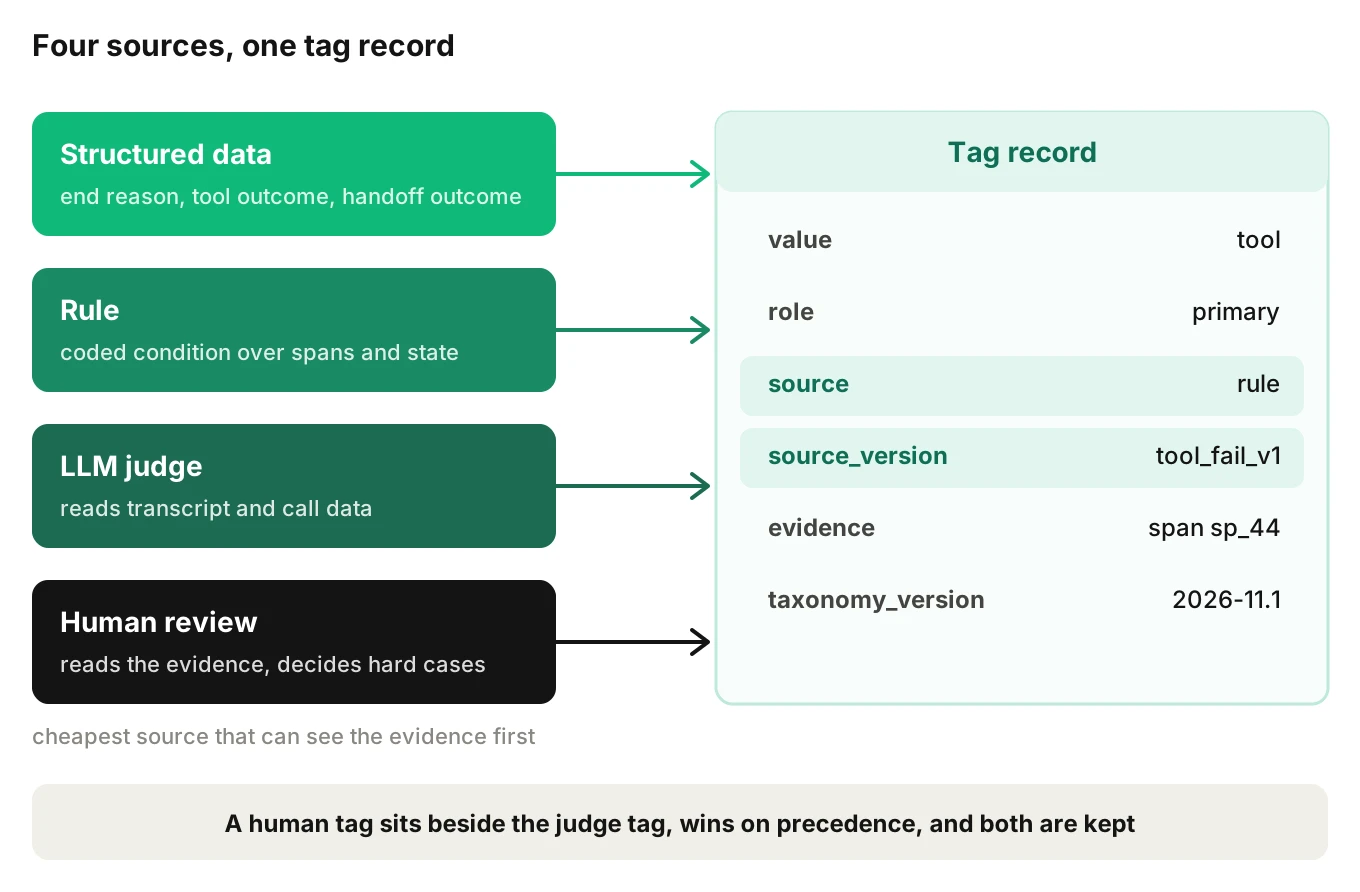
Use the cheapest source that can see the evidence: structured data, then rules, then a judge, with humans on samples. The limits of LLM judges are real, so never let a judge alone settle what a tool result can settle.
Label the source of every tag
Store which source set each tag, plus its version: rule ID, judge prompt version or reviewer. Without it you cannot tell whether a chart moved because the agent changed or a judge prompt did. Keep history, not one overwritten field. A human tag sits beside the judge tag and wins on precedence. A minimal record holds family, value, role, source, source version, evidence IDs and taxonomy version, and rejects values outside the taxonomy.
A worked tagging of five calls (illustrative)
These invented calls show how families, source and evidence fit.
| Call | Intent | Outcome | Primary | Secondary | Source and evidence |
|---|---|---|---|---|---|
| C1 | Reschedule | Failed | tool | llm | Rule: tool span errored. Judge: agent still said "all set." |
| C2 | Status lookup | Abandoned | turn_taking | none | Rule: three overlaps in 20 seconds, then caller hangup. |
| C3 | Billing | Escalated | retrieval | none | Rule: retrieval returned no usable chunk. Transfer connected. |
| C4 | Book | Resolved | not set | not set | Structured: booking found in the system of record. |
| C5 | Undetermined | Undetermined | undetermined | none | Rule: no trace linked, no tool results, no end state. |
C1 is the transcript trap: the transcript reads as success while the cause sits in a tool result (see tool call tracing). C2 separates outcome from reason (see turn-taking observability).
The primary reasons are tool 1, turn_taking 1, retrieval 1, undetermined 1 and one call with none, which sums to five. Five calls prove nothing about rates.
Measure tag agreement with Cohen's kappa
Two labelers must apply the taxonomy the same way. Raw percent agreement overstates that. Cohen's kappa corrects for chance. The scikit-learn documentation gives kappa = (p_o - p_e) / (1 - p_e). Here p_o is observed agreement and p_e is the agreement expected if both labelers assigned labels at random. 0.0 means no agreement beyond chance.
A worked example (illustrative)
Two labelers tag the primary reason on 100 failed calls. A is a rule-plus-judge pipeline. B is a human. The counts are invented.
| A (rows) \ B (columns) | stt | tool | turn_taking | llm | Row total |
|---|---|---|---|---|---|
| stt | 28 | 2 | 1 | 1 | 32 |
| tool | 3 | 22 | 0 | 3 | 28 |
| turn_taking | 2 | 0 | 14 | 4 | 20 |
| llm | 1 | 4 | 1 | 14 | 20 |
| Column total | 34 | 28 | 16 | 22 | 100 |
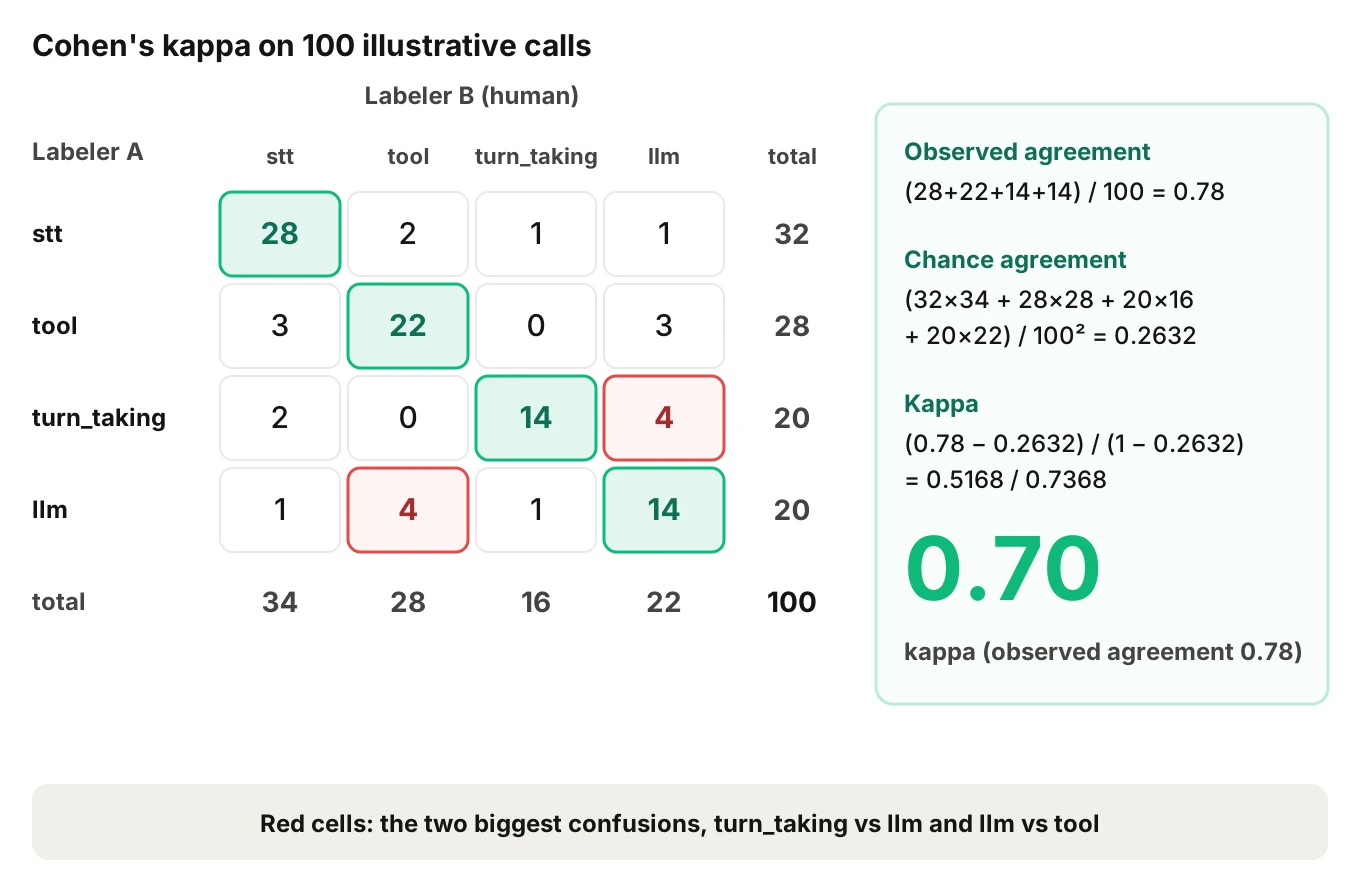
1. Observed agreement. The diagonal is 28 + 22 + 14 + 14 = 78. So p_o = 78 / 100 = 0.78.
2. Chance agreement. Multiply each row total by its column total: 32 × 34 = 1,088; 28 × 28 = 784; 20 × 16 = 320; 20 × 22 = 440. The sum is 2,632. Divide by 100 × 100: p_e = 0.2632.
3. Kappa. (0.78 - 0.2632) / (1 - 0.2632) = 0.5168 / 0.7368 = 0.7014. Round to 0.70.
The biggest confusions are turn_taking against llm and llm against tool. Per-value agreement (twice the diagonal over row plus column total) is lowest for llm at 0.67, so tighten that definition.
sklearn.metrics.cohen_kappa_score(labels_a, labels_b) returns the same 0.7014.
How to read the number
Cohen's suggested scale, as reported by McHugh in Biochemia Medica, reads 0.61 to 0.80 as substantial. McHugh argues that is too lenient for health research and says any kappa below 0.60 indicates inadequate agreement. Its confidence interval can also be very wide. Pick a bar and report the sample size. When one value dominates, kappa can be low even at high percent agreement, so sample for rare values.
Double-label a sample that covers rare values. Compare human to human first, then judge to human. Re-run after every taxonomy change, and keep a small golden set.
Kappa shows consistency, not truth.
Version the taxonomy
- Stamp every tag with a taxonomy version, and version rules and judge prompts too.
- Never reuse a value name for a new meaning. A trend across the change would be false.
- Classify each change. Adding a value is minor. Renaming, merging or splitting is major. Keep a crosswalk: a merge maps old values to the new one, a split needs a retagged sample.
Where a trend crosses a major change, show the break.
How tags feed clustering, postmortems and alerts
Tags are the first pass of the clustering routine. A pivot on failure reason and first failing step needs no model. Then cluster the free-text notes inside each group, and split by release, tool, provider and cohort.
The postmortem template asks for impact counts. Outcome and failure reason give them, and let you write "undetermined, 6 percent" instead of hiding blind spots. In the debugging runbook, the tag says which layer to open first. For alerting, tags are bounded values that suit metric labels. A call ID does not: the Prometheus naming guidance warns that every unique label combination is a new time series. See voice agent alerting.
Common traps in voice agent call tagging
- Too many tags, or tags that drift in meaning. Use a short list, written definitions, versioning and a periodic kappa check.
- Tagging from the transcript alone. The words do not show a tool result or a skipped check (C1). Pull the tool span first, and tag the first failing layer, not the hangup.
- No place to put doubt. Without undetermined, reviewers guess, and guesses look like facts.
- Tagging only failures. Tag resolved calls too, so rates have a denominator (sampling live calls).
How to build a voice agent call tagging taxonomy in seven steps
1. Read 100 failed calls - Write one sentence per call and group them by hand.
2. Pick values tied to layers - Name each group by the layer that owns the fix. Add other and undetermined on day one.
3. Write evidence for each value - A definition, the supporting evidence, one near-miss and the tie-break.
4. Define outcome with verification - State what counts as proof of resolved.
5. Assign a source to every value - Structured data, then rules, then a judge, with humans on samples. Store source and version.
6. Double-label and compute kappa - Compute it overall and per value. Fix weak definitions and re-run.
7. Stamp, publish and review - Add the taxonomy version to every tag and review other and undetermined on a schedule.
Where Evalgent fits
Evalgent is a testing, evaluation and monitoring platform for voice agents. The taxonomy here is a vendor-neutral design, not a product description.
At the outcome level, Evalgent Observe, which is launching, takes OpenTelemetry data from any stack. Traces explain why a call failed, failures are clustered into root causes, and where the data is blind the answer is "undetermined" with the coverage gap shown. Evalgent Monitor is live and flags production problems such as tool-call and policy failures, with fix recommendations. See testing vs monitoring vs observability and the observability checklist.
Testing can reuse the same list. Evalgent generates test scenarios from your agent's prompt and flows, so each failure reason can get a scenario meant to trigger it. You can book a demo.
Frequently asked questions
Why do free-text failure reasons not aggregate?
One cause splits into many strings, and one word such as "slow" covers many causes, so counts measure phrasing, not faults.
How many failure reasons should a taxonomy have?
Aim for about 10 to 12, including a fixed other and undetermined. Each value should map to a layer with an owner and a fix.
What are the primary and secondary failure reasons?
The primary reason is the first layer whose failure made the goal unreachable. The secondary is one optional contributing layer, such as the agent claiming success after a tool error.
What are the other and undetermined tags for?
Other means a reviewer read the evidence and nothing fits, a taxonomy gap. Undetermined means the data cannot support any value, a coverage gap. Review both regularly.
How do I measure tag agreement with Cohen's kappa?
Have two labelers tag one sample. Compute observed agreement p_o, chance agreement p_e from label totals, then (p_o - p_e) / (1 - p_e). McHugh calls a kappa below 0.60 inadequate.
How do I version a call tagging taxonomy?
Stamp each tag with a taxonomy version. Adding a value is minor. Renaming, merging or splitting is major. Never reuse a value name for a new meaning.
Can I tag a call from the transcript alone?
For intent, often yes. For failure reason, often no. The cause may sit in a tool result or a skipped check that the words never show. Use spans first, and tag undetermined when evidence is missing.
Who sets a call tag: a rule, an LLM judge or a person?
Use the cheapest source that can see the evidence. Structured fields and rules cover tool and handoff errors. A judge handles intent. People review samples. Store the source on each tag.
The bottom line
Voice agent call tagging works when each call carries three controlled tags, one value per family, a primary failure reason tied to the first failing layer, and a label for which source set each tag. Check agreement with Cohen's kappa, version the list, and keep other and undetermined visible so the counts stay honest.
Related Articles
How to automate voice agent testing: synthetic callers vs manual QA
Learn how ai test automation replaces manual QA for voice agents. Compare synthetic callers vs human testers, with a 5-step framework to scale without hiring.
Read more
AI Agent Testing vs Voice Agent Testing: What General Tools Miss for Voice
AI agent testing measures text outputs. Voice agent testing measures behaviour through an acoustic pipeline. Five failure categories general tools miss.
Read more