Test your voice agent
How to Measure Abandonment Rate for Voice Agents
# How to measure abandonment rate for voice agents
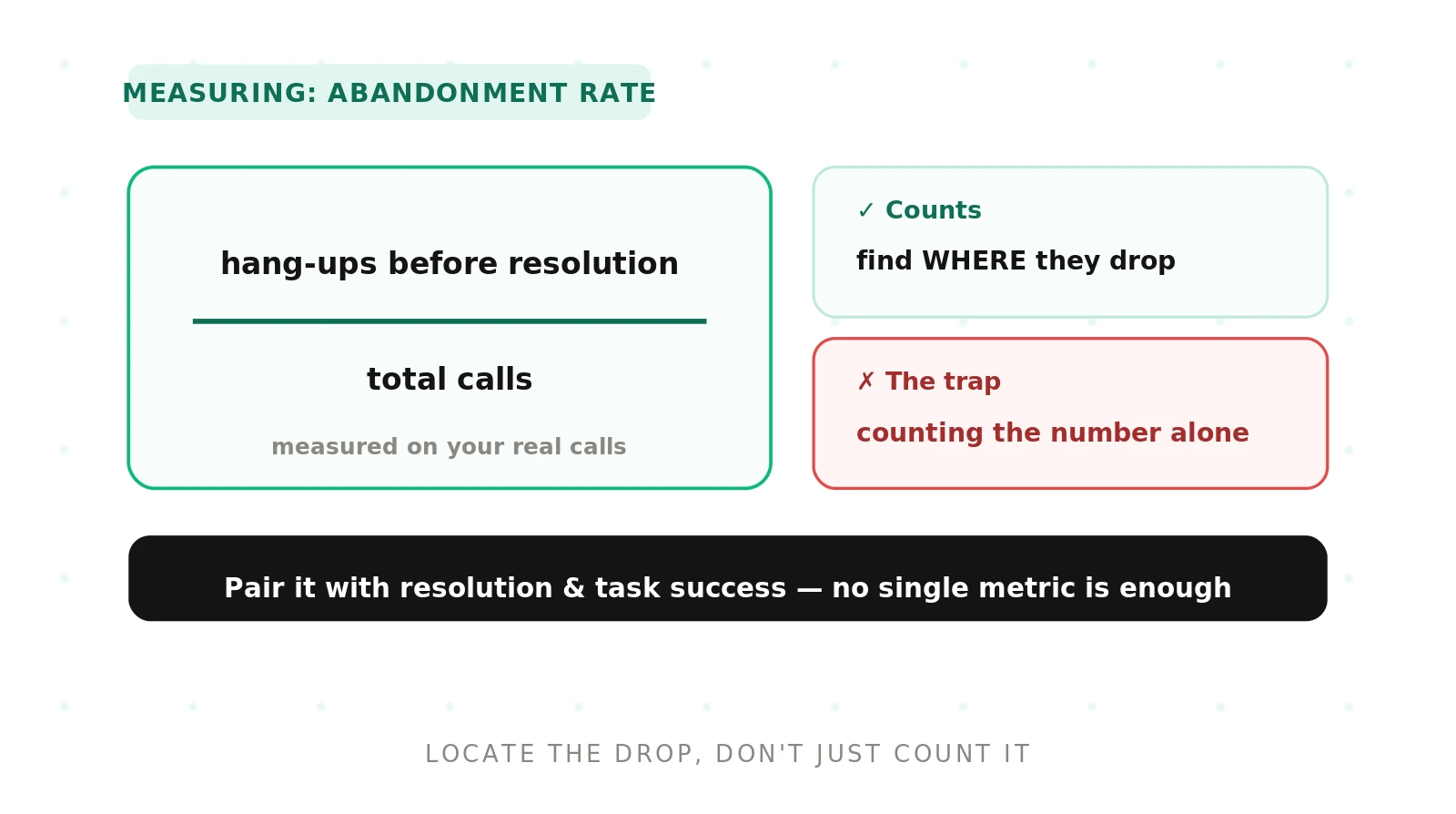
> Quick answer: Abandonment rate for voice agents is the share of calls where the caller hangs up before resolution or a human handoff. Measure it as abandoned calls divided by total calls. The useful step is locating where callers drop, so the number points to a fix.
Most teams track abandonment rate as one blunt percentage. That number tells you callers are leaving. It does not tell you where they leave, or why. So the metric sits on a dashboard and nothing changes.
This guide fixes that. It defines abandonment rate for voice agents in plain terms. It shows how to measure it correctly. Then it does the part that matters most: mapping the drop points in the call flow, so each abandoned call points to a specific cause you can act on.
Evalgent is an independent, third-party evaluator of AI voice agents. We measure abandonment on your own calls and tell you where and why callers hang up. The rest of this post is the method we use.
What abandonment rate means for a voice agent
> Abandonment rate: the percentage of calls that end before the caller reaches resolution or a human handoff. It is the caller giving up on the automated line before the job is done.
The concept comes from contact centers. In a traditional call centre, abandonment counts callers who hang up while waiting in a queue. The idea of abandonment rate transfers cleanly to voice agents, with one twist. A voice agent has no hold queue. The caller is talking to the agent the whole time. So abandonment happens inside the conversation, not before it.
Contact centers have studied this behavior for decades; the academic literature on call-center operations, such as the review by Gans, Koole, and Mandelbaum, models abandonment as a core service metric. That twist is the whole point. When a caller abandons a human queue, the cause is almost always wait time. When a caller abandons a voice agent, the cause could be silence, a slow reply, a repeated question, a menu they cannot escape, or a transfer that failed. The number is the same shape. The reasons are richer, and more fixable.
Abandonment is also a leading signal for other problems. A caller who hangs up in frustration is less likely to call back, and more likely to churn. It sits upstream of your churn rate and your cost per resolution. Treating abandonment as a core key performance indicator, not a vanity stat, is the first correction most teams need.
Healthy hang-ups versus failure-driven abandonment
Not every hang-up is a failure. This distinction is the one most abandonment reports miss.
A caller who dials, hears the greeting, realizes they called the wrong number, and hangs up in three seconds did not fail. Your agent did nothing wrong. A caller who gets their answer, says thanks, and hangs up before the agent finishes its closing line did not abandon in any meaningful sense either. They succeeded.
These are healthy early hang-ups. Lumping them into your abandonment rate inflates the number and hides the real problem. It also sends teams chasing ghosts.
Failure-driven abandonment is different. The caller wanted something, engaged with the agent, and then gave up because the agent stalled, looped, or blocked them. That is the abandonment worth measuring, worth alerting on, and worth fixing.
The practical rule: segment by call intent and elapsed time before you report. Strip out sub-five-second hang-ups with no intent captured. Strip out hang-ups that follow a confirmed resolution. What remains is the failure-driven rate, and it is a much smaller, much more honest number. An independent evaluation applies this segmentation consistently, so the figure means the same thing every week.
Why one abandonment number is not enough
A single abandonment percentage is a symptom, not a diagnosis. It behaves like a fever reading. It tells you something is wrong. It does not tell you what.
Consider two agents with an identical 12 percent abandonment rate (illustrative). In the first, callers drop during a four-second silence after they ask a hard question. In the second, callers drop when a transfer to billing fails and dumps them back to the main menu. Same number. Completely different fixes. One is a latency and fallback problem. The other is an integration problem.
If you only track the top-line rate, you cannot tell these apart. You optimize blind. This is why abandonment has to be measured against the call flow, not just the call total. The technique is borrowed from funnel analysis: break the call into stages, and measure where callers fall out of the funnel.
The stages of a typical voice-agent call look like this:
- Greeting and intent capture — the agent greets and understands what the caller wants.
- Information gathering — the agent asks for details, like an account number or a date.
- Processing and lookup — the agent calls a tool, database, or API to do the work.
- Resolution or handoff — the agent resolves the request or transfers to a human.
Abandonment at each stage means something different. A drop at intent capture points to comprehension or accent handling. A drop at processing points to slow tool calls or dead air. Locate the stage, and you have located the cause.
Where callers drop: the drop-point map
This is the table that turns abandonment from a number into an action list. Each row is a common drop point, the cause most likely behind it, and how you detect it in your call data.
| Drop point in the flow | Likely cause | How to detect it |
|---|---|---|
| Silence after a caller question | Slow tool call or model latency; no filler while processing | Measure gap between caller end-of-speech and agent response; flag gaps over ~1.5s |
| Mid-turn freeze, then hang-up | Dead air: a component stalls with no fallback firing | Detect turns with no agent audio past a timeout; correlate with hang-up timestamp |
| Same question asked twice or more | A loop: intent not captured, or a slot never fills | Count repeated agent prompts in one call; flag any prompt repeated 2+ times |
| Hang-up right after "let me transfer you" | Failed transfer: the handoff drops the call or misroutes | Track transfer attempts versus completed connections; log return-to-menu events |
| Drop during information gathering | Too many questions, or the agent misheard and re-asked | Count turns to reach resolution; flag calls exceeding your step budget |
| Hang-up seconds after greeting, no intent | Often a healthy early hang-up, not a failure | Check elapsed time and whether intent was captured; segment these out |
| Repeated "I didn't catch that" prompts | Speech recognition failing on accent, noise, or entities | Measure re-prompt rate; sample audio where confidence scores are low |
| Drop while on hold for a lookup | No progress cue; caller assumes the line is dead | Detect long processing gaps with no holding message played |
Read the table as a diagnosis path. Find the drop point in your data first. The likely cause narrows your investigation. The detection method tells you exactly what to measure to confirm it.
Three of these drop points cause most failure-driven abandonment we see. Long silence and dead air are covered in depth in our guide to dead air in voice agents. Slow responses trace back to latency, which we break down in the voice agent latency guide. Failed transfers are an escalation design problem, covered in our escalation guide.
How to measure abandonment rate and locate the drop points
Here is the end-to-end method, from a raw call log to a set of ranked, fixable drop points.
1. Define abandonment for your context. Decide what counts as abandoned. A working definition: the caller hangs up before a confirmed resolution or a completed human handoff. Write it down so everyone measures the same event.
2. Pull total and abandoned calls. Gather every call in the window. Count the abandoned ones by your definition. Divide abandoned by total for the raw rate. This is your starting percentage, before segmentation.
3. Strip out healthy early hang-ups. Remove sub-five-second hang-ups with no intent captured, and hang-ups after a confirmed resolution. What remains is the failure-driven abandonment rate. Report both numbers, and lead with the failure-driven one.
4. Tag each call with its final stage. Label where each abandoned call ended: greeting, intent capture, information gathering, processing, or handoff. This turns one rate into a per-stage breakdown.
5. Measure the signals at each stage. For each abandoned call, capture the response gap before the hang-up, the number of repeated prompts, whether a transfer was attempted, and the recognition confidence scores. These are the detection columns from the table above.
6. Rank drop points by volume and severity. Sort the stages by how many callers you lose there, weighted by intent value. A drop point that loses high-value callers ranks above a high-count, low-value one.
7. Confirm cause on sampled audio. Pull real recordings from the top drop points. Listen. Confirm the silence, the loop, or the failed transfer with your own ears before you assign the fix.
8. Re-measure after each change. Fix one drop point. Re-run the same measurement on new calls. Confirm the rate at that stage fell, and that you did not push the problem downstream.
Run this loop continuously, not once. Voice agents drift as prompts, models, and integrations change. Ongoing production monitoring keeps the drop-point map current instead of letting it go stale.
What each drop point is really telling you
The stage where callers abandon maps almost directly to the underlying failure. Reading that map is the skill.
A drop during a silence is a timing problem. The caller asked something, and the agent went quiet while a tool call ran. Beyond about a second and a half of dead air, callers assume the line died. The fix is a holding phrase, a faster lookup, or a fallback that speaks while it works.
A drop after repeated questions is a comprehension or state problem. The agent asked for the account number twice because it never stored the first answer, or never understood it. Callers read repetition as the agent being broken. The fix is in slot filling and recognition, not in the voice.
A drop after a transfer attempt is an integration problem. The handoff to a human failed, the call misrouted, or it looped back to the start. This one hurts most, because the caller had already given up on the agent and reached for a person. Failing them there is the last straw.
A drop during information gathering is often a design problem. The agent asks too many questions, or asks them in a confusing order. Callers abandon long flows even when nothing technically breaks. Cutting steps usually cuts abandonment here.
None of these causes are visible in the top-line rate. All of them are visible once you tie abandonment to the flow. This is the difference between a metric that decorates a slide and a metric that drives a sprint. Our voice agent metrics scorecard places abandonment alongside the other numbers that show whether an agent actually helps callers.
Why independent measurement changes the answer
A vendor grading its own abandonment rate has a conflict of interest. The definition can quietly shift to flatter the number. Healthy hang-ups get counted as engagement. Failed transfers get logged as successful containment. The rate looks fine while callers keep leaving.
An independent evaluator removes that incentive. We define abandonment once, apply it to every agent the same way, and measure it on your real calls, not a curated demo set. That consistency is what makes the number comparable across vendors and across releases.
We also do the part that is tedious to do in-house: sampling the audio behind each drop point and confirming the cause. It is one thing to see a spike at the transfer stage. It is another to hear ten real callers get dumped back to the menu. That evidence is what moves a fix from a maybe to a priority.
The broader case for a neutral third party sits in our overview of voice agent evaluation, and the method for testing on data that reflects your actual traffic is in our guide to benchmarking on your own data.
Frequently asked questions
What is abandonment rate for a voice agent?
Abandonment rate for a voice agent is the percentage of calls where the caller hangs up before reaching resolution or a human handoff. You calculate it as abandoned calls divided by total calls. Unlike a call center queue, abandonment happens inside the conversation, so the causes are silence, loops, slow replies, or failed transfers.
How do I calculate voice agent abandonment rate?
Count total calls in your window. Count the ones where the caller hung up before resolution or handoff. Divide abandoned calls by total calls, then multiply by 100 for a percentage. Report a raw rate and a failure-driven rate, since the raw number includes healthy early hang-ups that were never real failures.
What is a good abandonment rate for a voice agent?
There is no single benchmark, because it depends on call intent and complexity. The more useful target is your failure-driven rate, which strips out healthy hang-ups. Track it over time and drive it down per drop point. A falling failure-driven rate on your own traffic beats any published industry figure.
Why do callers hang up on voice agents?
Callers hang up for a few recurring reasons: long silence after a question, slow responses, the agent repeating a question it should have understood, a menu they cannot escape, or a transfer to a human that fails. Each reason maps to a specific stage in the call flow, which is where you locate and fix it.
How is abandonment different from containment?
Abandonment counts callers who gave up. Containment counts calls handled without a human. They can conflict. A call can be "contained" because the caller abandoned rather than reached a person, which looks like success but is a failure. Measuring both, and separating trapped callers from helped ones, prevents containment from hiding abandonment.
Where do most callers abandon a voice agent call?
Most failure-driven abandonment clusters at three points: during silences while a tool call runs, after the agent repeats a question in a loop, and right after a failed transfer to a human. Tagging each abandoned call with its final stage shows your own distribution, which is what should guide your fixes rather than averages.
How can I tell healthy hang-ups from real abandonment?
Segment by intent and elapsed time. A sub-five-second hang-up with no captured intent, or a hang-up after a confirmed resolution, is usually healthy. A hang-up after the caller engaged, then hit silence, a loop, or a failed transfer, is failure-driven. Report the failure-driven rate as your primary number and note the healthy portion separately.
Should a vendor measure its own abandonment rate?
A vendor can measure it, but the definition tends to drift toward flattering numbers. Independent measurement applies one consistent definition across every agent and release, on your real calls. It also samples the audio behind each drop point to confirm the cause. That neutrality is what makes abandonment comparable and trustworthy when you compare vendors.
The bottom line
Abandonment rate tells you callers are leaving, but only the drop point tells you why. Measure it on your own calls, split healthy hang-ups from failure-driven ones, and tie every abandoned call to the stage where it happened.
Evalgent is the independent evaluator that finds exactly where and why your callers abandon. Book a demo to see your drop-point map on your own calls.
Related Articles
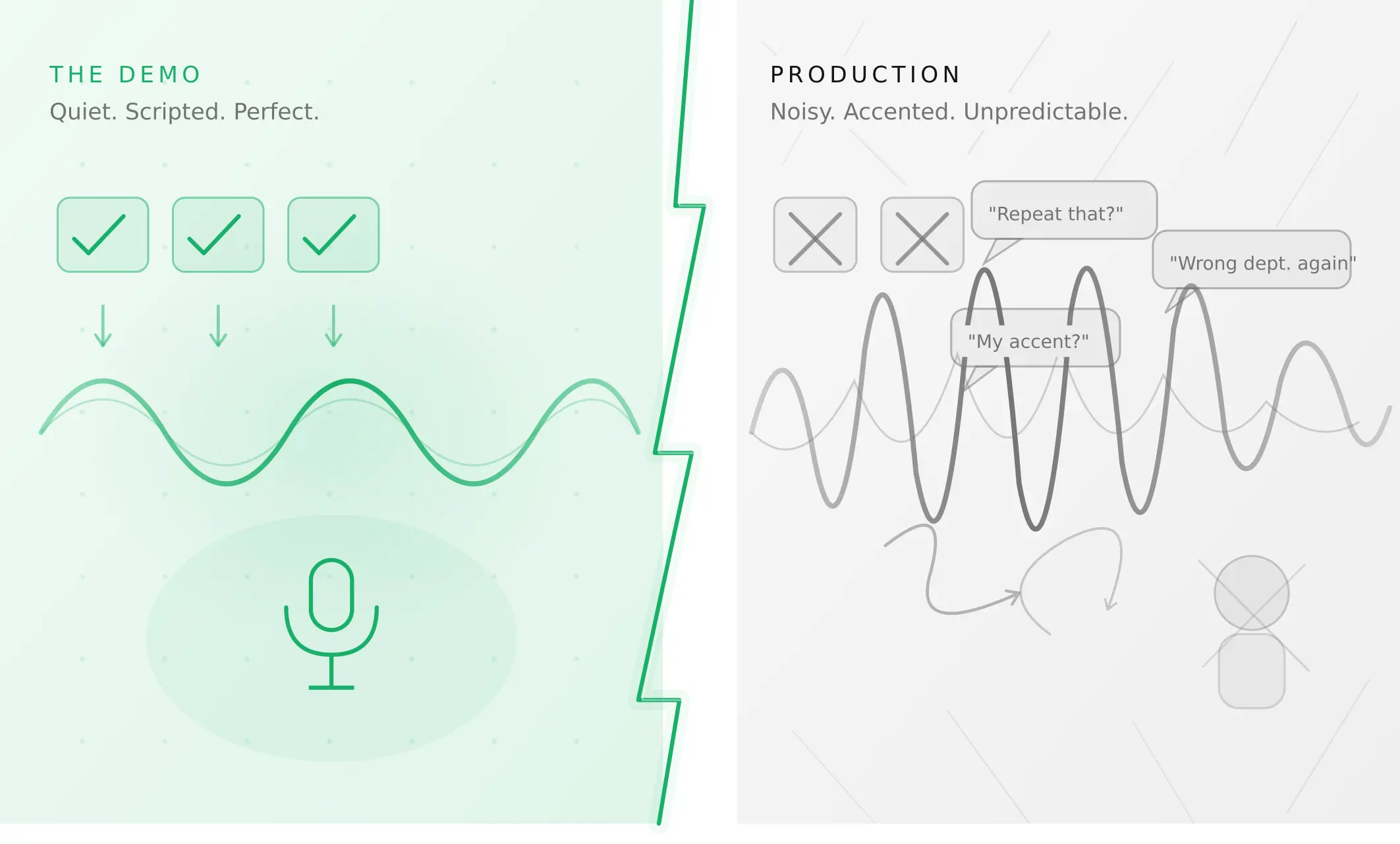
Why AI voice agents fail in production (and how to prevent it)
AI voice agents that ace demos still break in production. Learn the 5 root causes, how to test for each, and what production readiness actually means.
Read more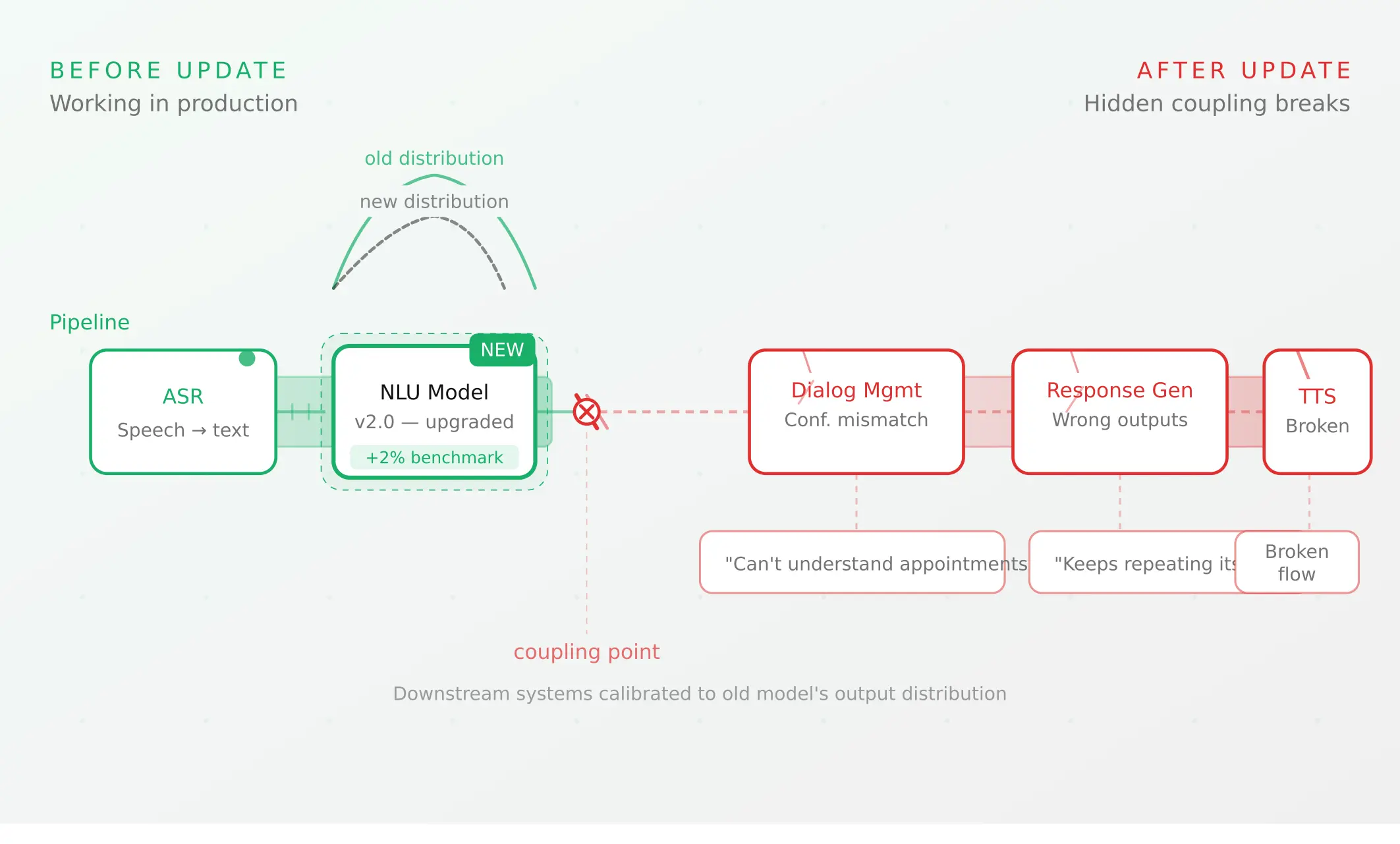
Voice agent regression testing: why LLM updates break production
LLM updates improve benchmarks but break voice agents in 5 predictable ways. How to detect and prevent regressions after every model or prompt change.
Read more