Good Call vs Bad Call: How to Diff Voice Agent Traces
On this page
A caller asks to move an appointment to "Thursday at three." One call ends with a new booking. Another ends with a hang-up after the agent says "I don't see any openings" three times. Same agent, same week, same intent. Why did the same agent pass one call and fail another? Teams that compare voice agent calls side by side tend to find out fast.
One call read alone rarely answers that. Two calls read side by side often do. This post covers the side-by-side step: pick the pair, line them up, and read the diff without chasing noise. It compares two calls of one agent. To compare agents or vendors, see how to compare voice agents on the same test cases.
It builds on the one-call routine in rooting out a bad call in 10 minutes. Here the second call becomes your control. Every number below comes from one made-up pair and one made-up set of 60 calls. They are illustrative, not measurements.
Why a pair beats a single trace
A trace shows what happened on one call. OpenTelemetry's trace documentation (as of November 23, 2026) calls a span "a unit of work or operation." It cannot tell you which parts of a call were unusual. A long tool span might be normal for that tool.
A good call supplies the reference. Google's SRE book describes troubleshooting as a loop: hypothesize potential causes and try to test them. What both calls share is less likely the cause. What differs is a candidate.
Voice agent trace comparison borrows from delta debugging research, which frames the same idea. Zeller and Hildebrandt say the method isolates the difference between a passing and a failing test case. That work controls inputs and re-runs tests. Production calls cannot be re-run, so a diff yields candidates, not proof.
Tools exist for the structural part. Jaeger 1.7 added trace comparison of the structure of two traces by grouping spans. A voice agent also needs words, slot values and flow state, which sit above the span tree.
Picking a comparable pair
Trace alignment and the diff both depend on the pair. Pick with rules, not by feel.
| Rule | Why it matters |
|---|---|
| Same intent | Different intents run different flows |
| Same release and prompt version | A release difference swamps everything else |
| Similar caller conditions | Line quality, language and channel change what the agent hears |
| One passes, one fails, by a written rule | The diff needs a clear outcome |
| Close in time | Provider and backend behaviour drift |
Add one working heuristic of ours, not a published method. Take several candidate good calls. Choose the one whose opening matches the bad call for the most turns. The later the two diverge, the less you must read.
Do not pick your best call ever, and write the pass rule first. A loose rule lets lucky calls in.
The illustrative pair
Call G passes. Call B fails. Both ran release r3.2 with prompt v12 and the same model, on English mobile phone calls. Both asked to reschedule an appointment. The pass rule is "a new slot is booked and the call ends in a terminal state."
In call B the caller says "Thursday at three," with no am or pm. A reviewer on the team listened to the recording and confirmed that. In call G the caller says "Thursday at three pm." Otherwise the calls look alike.
Align the traces: by turn index and by state, not by clock
Wall-clock alignment fails. The calls started at different times, and spans come from different processes. OpenTelemetry's trace API says start and end times are recorded when the API is called. It does not say separate machines agree on the time. Our post on timestamps and clock sync covers why. For a diff, compare durations inside each call.
Use two keys instead.
- Turn index. Turn 1 with turn 1. This works while both calls follow the same path. It fails once one call loops or skips.
- Flow state. Match
collect_timeturns withcollect_timeturns. This survives loops. It needs state events on the trace. See observing voice agent state.
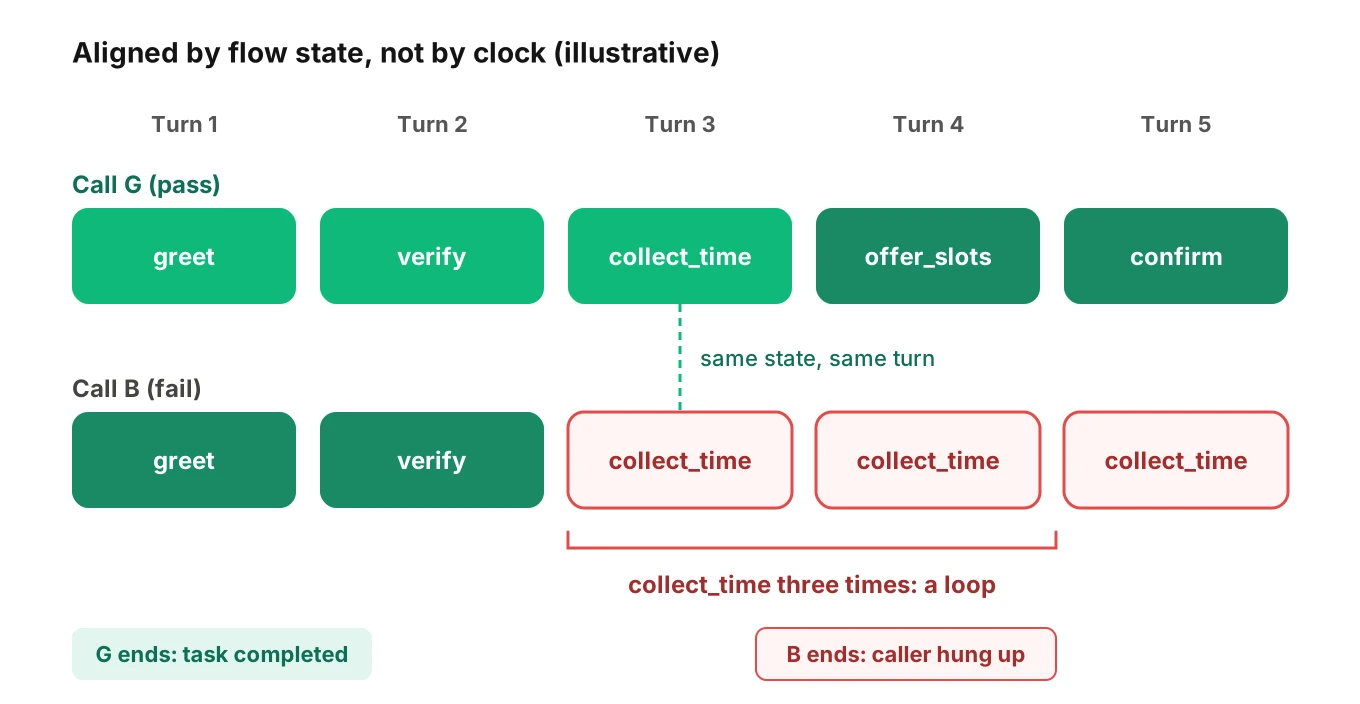
Both calls here have five agent turns. A count-only diff says "same length." The state sequences say otherwise.
// state per turn (illustrative)
G: greet, verify, collect_time, offer_slots, confirm       -> done
B: greet, verify, collect_time, collect_time, collect_time -> caller hung up
Equal turn counts hid a loop. Index alignment holds through turn 3. After that, align by state. Turn 4 of call B sits next to turn 3 of call G, because both are collect_time turns that called the same tool.
Diff layer by layer
Work down the stack in the order the call travels. At each layer, mark the cell same, different or missing. Do not interpret yet.
| Layer | Call G (pass) | Call B (fail) | Mark |
|---|---|---|---|
| Setup | r3.2, prompt v12, same model, mobile line | Same | Same |
| Response gap, turns 1 and 2 | 810, 880 ms | 830, 870 ms | Same |
Response gap, tool turn (collect_time) | 1,450 ms | 1,380 ms, 1,410 ms, 1,390 ms | Same |
| STT final, turn 3 | "thursday at three pm" | "thursday at three" | Different |
| LLM input, turn 3 | Prompt v12, history, turn 3 text | Same, but turn 3 text differs | Different (inherited) |
| LLM finish reason, turn 3 | tool_calls | tool_calls | Same |
| Tool args, turn 3 | time = "15:00" | time = "03:00" | Different |
| Tool result, turn 3 | 3 slots | 0 slots, status unset | Different |
| State and slots | collect_time, then offer_slots, then confirm; time "15:00" | collect_time three times; time "03:00" | Different |
| Handoff | None | None | Same |
| Call end reason | Task completed, terminal state | Caller hung up, collect_time | Different |
Call B's tool-turn gaps are 1,380, 1,410 and 1,390 ms. The largest distance from call G's 1,450 ms is 70 ms. Timing is a negative result. The SRE book says negative results should not be ignored or discounted. Write "timing ruled out."
OpenAI's API reference defines finish_reason as the reason the model stopped generating tokens, with values such as stop, length and tool_calls. Other providers use other names. A length value on a bad turn would mean a cut-off reply. Here both calls show tool_calls: same decision, different input.
Each layer has its own post: LLM observability, tool call tracing, STT observability, turn-taking events and handoff tracing.
Here is the tool span as a text diff.
// turn 3, tool span find_slots (illustrative)
  field       G (pass)        B (fail)
  day         "thu"           "thu"
- time        "15:00"         "03:00"
  result      3 slots         0 slots
  status      unset           unset
Both spans ended with status unset, which OpenTelemetry says means the operation completed without an error. An error filter would never surface call B's tool. Only the argument diff does. See silent tool failures.
Rules for reading a diff
A diff gives you a list of differences. Most are not causes. These rules sort them.
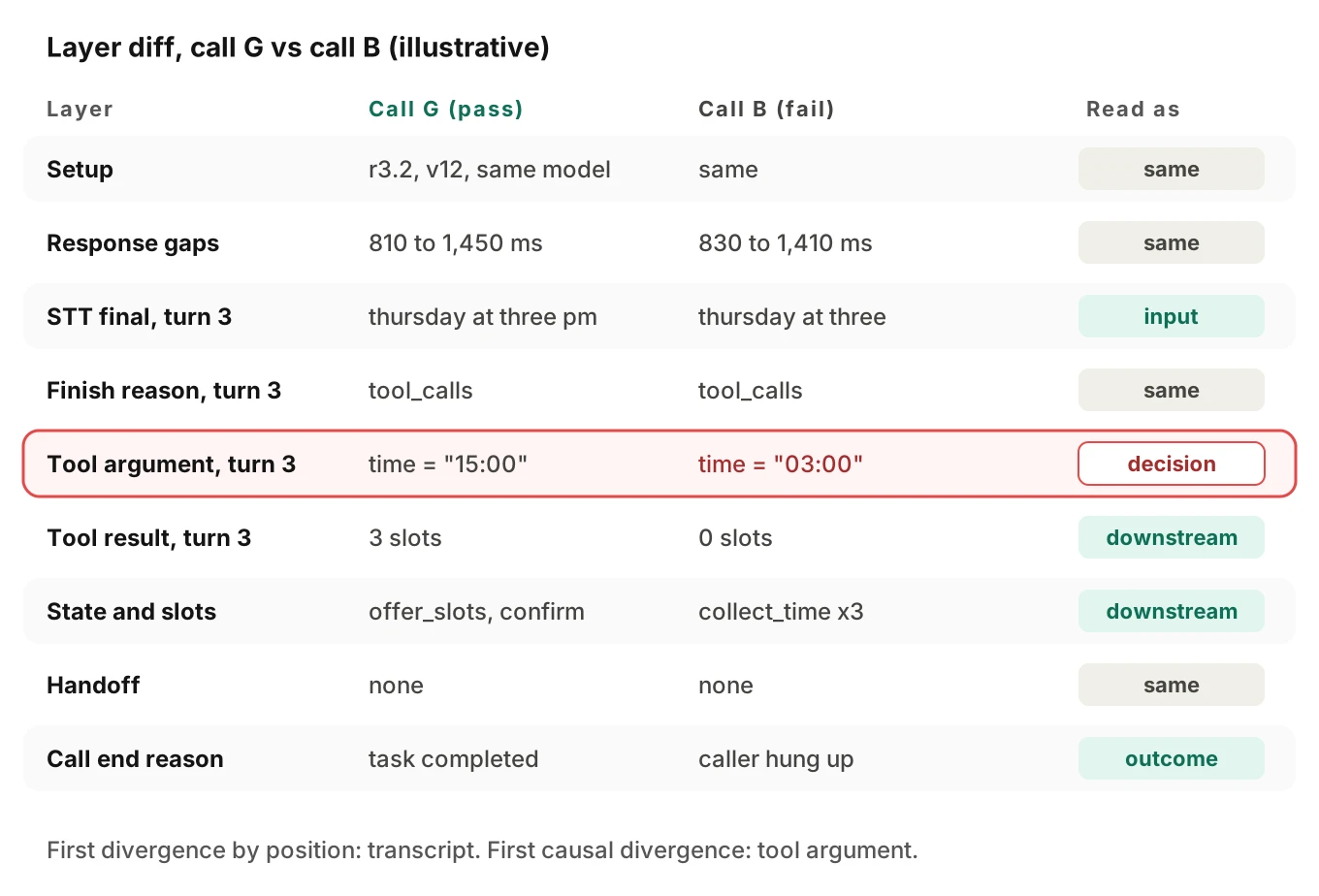
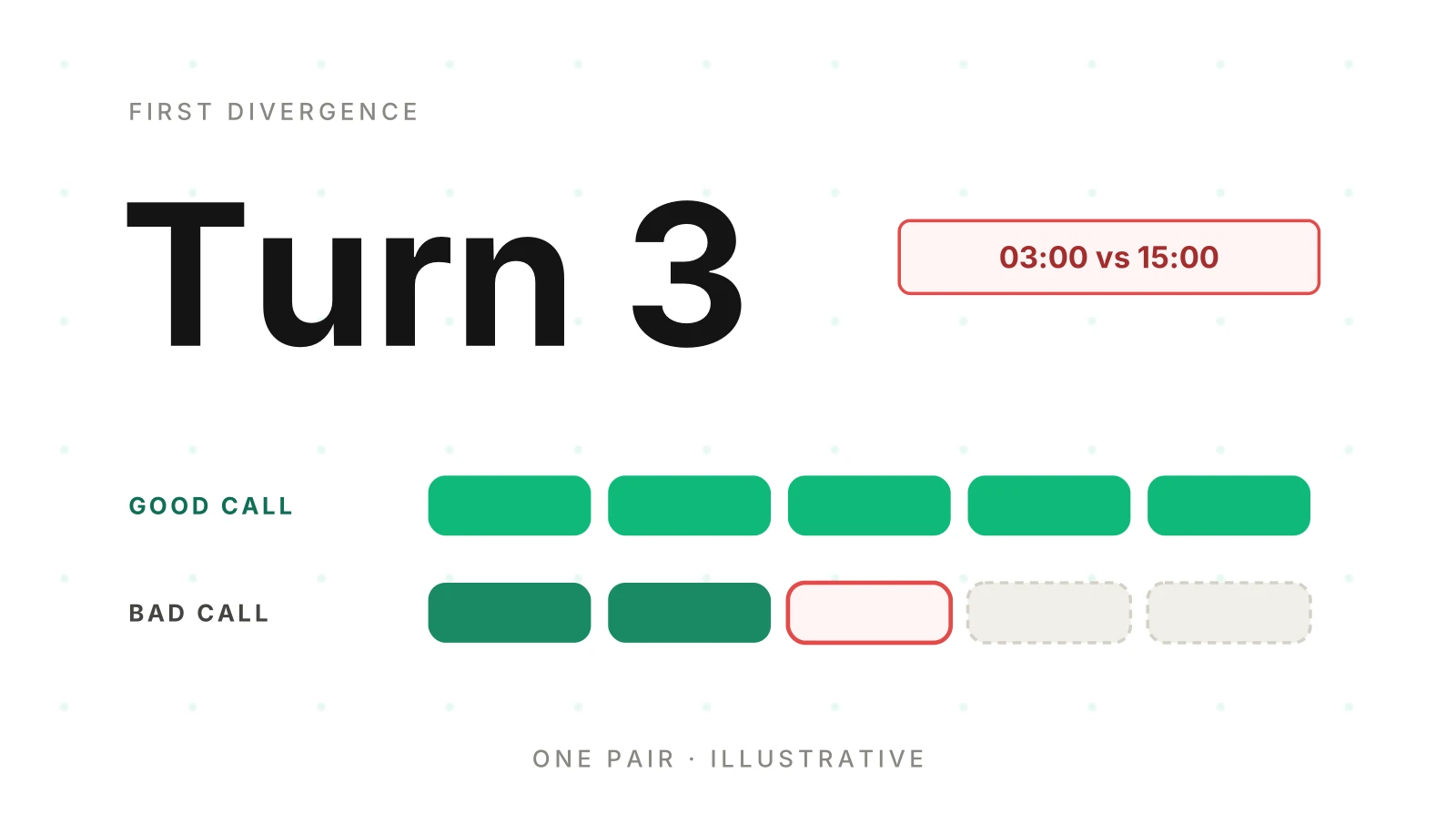
Rule 1: find the first divergence. A good call vs bad call diff is a search for it. Read in call order and stop at the earliest cell that differs. Everything later may just be fallout. Here the first difference is the turn 3 transcript.
Rule 2: ask whether it is an input or a decision. The caller's wording is an input. The tool argument is the agent's decision. The fault is the decision, made on an input the agent should have handled. The wording only explains why it was hard.
Rule 3: trace what changed downstream. Follow each different cell back to the one before it. Zero slots came from 03:00. The loop came from zero slots. The hang-up came from the loop. Our root cause post covers this join of trace and context.
Rule 4: separate noise from causal differences. The test is whether a value crosses a boundary. Does a later step consume it?
| Difference | Noise or causal | Test |
|---|---|---|
| Reply wording ("Sure" vs "Of course") | Noise | No later step reads it |
| Response gap inside the baseline range | Noise | Compare with many good calls |
| Transcript wording that changes a slot | Causal candidate | It changed a value a tool consumed |
| Tool argument | Causal candidate | The result depended on it |
| Call end reason | Outcome | It is the symptom, never the cause |
Rule 5: prefer the simpler explanation, and call it a hypothesis. The SRE book says all things being equal, we should prefer simpler explanations, and that correlation is not causation. One pair is one correlation.
Rule 6: ask what the good call never tested. Call G got "pm" from the caller, so it never shows how the agent behaves when pm is missing. A baseline fills that gap.
From one pair to a baseline of many good calls
One pair tells you what differed between two calls. It cannot say how often that difference matters. Move from a pair to a baseline of good calls and a distribution.
Take all calls on release r3.2 with the same intent: 60 in this illustrative set, 48 passing and 12 failing. Now ask one question of every call: did the caller give a time without am or pm?
| Group | Calls | Failed | Failure rate |
|---|---|---|---|
| Time without am or pm | 9 | 7 | 7 / 9 = 77.8% |
| Time with am or pm | 51 | 5 | 5 / 51 = 9.8% |
| All calls | 60 | 12 | 12 / 60 = 20.0% |
The totals add up: 7 + 5 = 12 failures and 9 + 51 = 60 calls. The hypothesis explains 7 of 12 failures, which is 58.3%. It does not explain the other five.
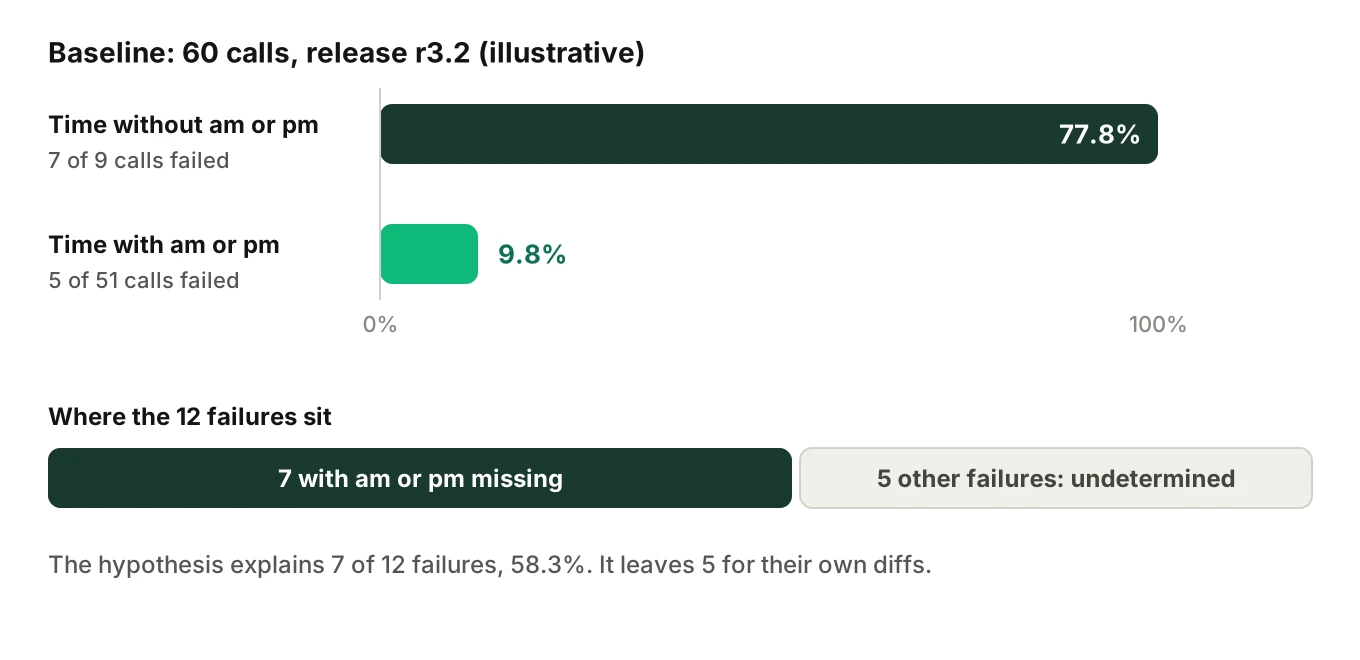
Look closer at the nine ambiguous calls. Two passed. In one the agent asked "am or pm?" In the other it guessed 15:00 and was right by luck. So the agent's behaviour here is inconsistent. That is a stronger finding than "call B was unlucky."
The baseline is also how you judge timing and any voice agent call comparison. Suppose the 48 passing calls show tool-turn gaps from 1,150 to 1,900 ms, with a median of 1,400 ms. Call B's 1,380 to 1,410 ms sits in the middle. Beware small samples: with 48 calls, a 95th percentile rests on only a few. Report the median and range, and the call count.
Use the pair rules again: same release, same intent, same period. Last month's calls are a different system. A canary release avoids this with a concurrent control. To group failures first, see how to cluster voice agent failures.
Common traps
- Different release. One config change shows up as a hundred differences. Check release, prompt version, model and tool config first.
- Different caller conditions. A noisy line or another language changes the transcript, and everything after it.
- Clock skew. Do not subtract timestamps from two systems. Compare durations inside each call.
- Sampled-out spans. OpenTelemetry defines a not-sampled trace as one not processed or exported. Tail sampling decides after seeing the spans, for cases like always sampling traces that contain an error. Google's Dapper paper lists sampling as a design choice. A missing span is not a missing event. See trace sampling for voice agents.
- Trusting the agent's own log. A log can record a request as a result. Check key facts against carrier or backend records. See logs vs what actually happened.
- One pair, one conclusion. Model output varies between calls. Test the cause on the baseline.
- Index alignment after a loop. Equal turn counts hide loops. Align by state.
What stays undetermined
A diff narrows things. It does not close them.
- Why the model chose 03:00. The trace shows the argument, not the reasoning. Two of the nine ambiguous calls passed, so the choice is not fixed.
- The other five failures. The am or pm hypothesis does not explain them.
- Anything the logs did not capture. If tool arguments were not recorded, the key cell is blank. Write "undetermined" and name the missing field. See what to log on every call and the span attribute list.
How to diff two voice agent calls in seven steps
1. Write the pass rule - Define what pass and fail mean in one sentence before you pick any call.
2. Pick the pair - Choose the same intent, release and prompt version, similar caller conditions, and the good call whose opening matches the bad call longest.
3. Align by turn and state - Match turn index while the paths agree. Switch to flow state when one call loops, skips or detours.
4. Fill the layer diff - Mark timing, transcript, model input, finish reason, tool arguments and results, state and slots, handoff and end reason as same, different or missing.
5. Find the first divergence - Read in call order. Separate inputs from decisions. Follow each later difference back to the value that caused it.
6. Test against a baseline - Pull many good calls from the same release and intent. Split by the suspect feature and compare failure rates and ranges.
7. Write the verdict - Record cause, evidence and the open questions. If a layer was blind, write "undetermined."
Where Evalgent fits
Evalgent is a testing, evaluation and monitoring platform for voice agents. Evalgent Monitor is live. It flags problems in production calls, such as tool-call failures and latency spikes, with fix recommendations. Flagged calls are good candidates for the bad side of a pair.
Evalgent Observe, which is launching, ingests OpenTelemetry data from any stack. Traces explain why a call failed, and failures are clustered into root causes, so the baseline question ("how many calls share this?") starts from a group. It gives no verdict without evidence in the data you send. Where data is blind, it says "undetermined" and shows the coverage gap. Evalgent never sits in the media path.
Once a diff names a suspect, write a test. Evalgent generates test scenarios from your agent's prompt and flows, and callers carry a profile with seven parameters, such as speech pace and response delay. Reviews replay a test call with audio and transcript together and show exact tool payloads. You could book a demo to see how a time without am or pm runs against your agent. For the wider picture, see voice agent observability.
Frequently asked questions
How do I compare two voice agent calls?
Pick a passing and a failing call with the same intent and release. Align them by turn index and flow state. Then compare voice agent calls layer by layer: timing, transcript, model input, tool arguments and results, state, handoff and end reason. Read from the first divergence forward, then test your suspect on many other calls.
Which good call should I compare a bad call to?
Choose a call with the same intent, release, prompt version and similar caller conditions, from the same period. Among those, take the one whose opening turns match the bad call for the longest. A later divergence leaves a smaller diff.
Why align by state and not by timestamp?
Spans from different processes carry different clocks, and two calls start at different times. Turn index and flow state depend on neither. State alignment also survives loops, where turn counts match while paths differ. Compare durations inside each call.
How do I tell noise from a real cause in a diff?
Ask whether a later step consumes the difference. Reply wording that nothing reads is noise, and so is a response gap inside the range of many good calls. A transcript change that alters a slot, or a different tool argument, is a causal candidate. Call end reason is an outcome.
Is one good call and one bad call enough?
No. One pair gives a hypothesis. Test it against many calls from the same release and intent, split by the suspect feature. In this post's illustrative set, 7 of 9 calls failed with the feature and 5 of 51 without.
What if the good and bad calls ran different releases?
Do not diff them yet. A release can change prompt, model, tool configuration and speech settings together, which buries the cause. Find a pair on one release and prompt version. If none exists, compare release groups and say the pair was not like for like.
What should I do when the logs do not show a layer?
Mark the cell missing and write "undetermined" with the field you lack, such as tool arguments or state events. Do not guess it from the layers around it. Then log that field on every call, so the next diff can fill it in.
Can I diff voice agent traces without a tool?
Yes. Export per-turn timing, transcripts, tool arguments, state and end reason for both calls and line them up in two columns. A tool saves time and helps build the baseline. The method depends on the data, so log it first.
The bottom line
To compare voice agent calls well, choose a like-for-like pair, align by state, and read from the first divergence forward. Then test your suspect on a baseline of many good calls, and write "undetermined" where the data is blind.
Related Articles
How to automate voice agent testing: synthetic callers vs manual QA
Learn how ai test automation replaces manual QA for voice agents. Compare synthetic callers vs human testers, with a 5-step framework to scale without hiring.
Read more
AI Agent Testing vs Voice Agent Testing: What General Tools Miss for Voice
AI agent testing measures text outputs. Voice agent testing measures behaviour through an acoustic pipeline. Five failure categories general tools miss.
Read more