Voice Agent Logs vs What Actually Happened: Where the Agent's Own Account Goes Wrong
On this page
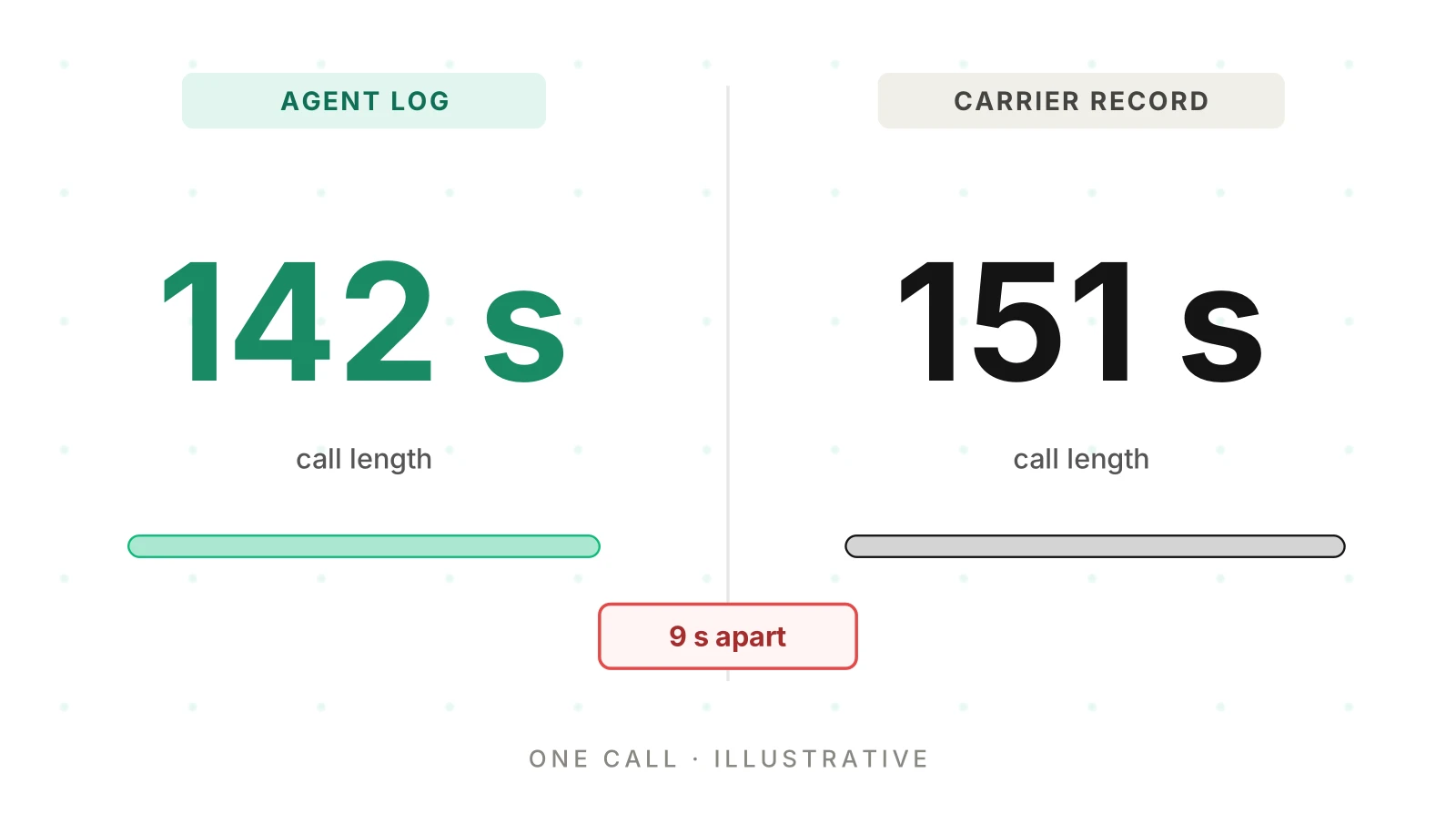
A caller says "Thursday afternoon." The agent says "You are booked for Thursday morning," and its log shows book_slot: success. The booking system has no record of the slot. The carrier shows a call that lasted nine seconds longer than the agent thinks.
Which record is right? The usual habit is to trust the agent's own log, because it is the most detailed one you have. That habit is the problem. The agent is a party to the call, and it wrote its own account.
This post is about voice agent logs accuracy. It shows where the agent's account drifts from what happened, which independent records can check it, and how to say "undetermined" when none can. It uses illustrative numbers only and makes no benchmark claims. Provider facts are from the docs we read, as of November 21, 2026.
The agent's own log is one witness, not the record
Two neighbouring posts assume the evidence is sound. Voice agent logs accuracy is the missing step. Our 10-minute debugging runbook tells you how to read a call. Our root cause analysis post tells you how to group failures into causes. This post asks the earlier question: is the evidence true?
The idea comes from monitoring practice. Google's SRE book defines black-box monitoring as "testing externally visible behavior as a user would see it." It defines white-box monitoring as metrics exposed by the internals of the system. An agent's log is white-box. It tells you what the agent believed. Carrier and downstream records sit closer to what actually happened outside the agent.
Neither kind is wrong by nature. The same chapter says monitoring should answer two questions: what is broken, and why. A log written by the suspect can help with why. It should not be the only witness to what.
Seven ways the agent's account drifts from reality
Each pattern comes from how logs get written. The table pairs each with the record that can check it.
| Pattern | What the agent log says | How reality can differ | Independent record |
|---|---|---|---|
| Requested, not completed | Action logged at the request | The provider never finished it | Provider log, delivery status |
| Transcript is STT output | The caller said X | The recognizer guessed X | None among these records |
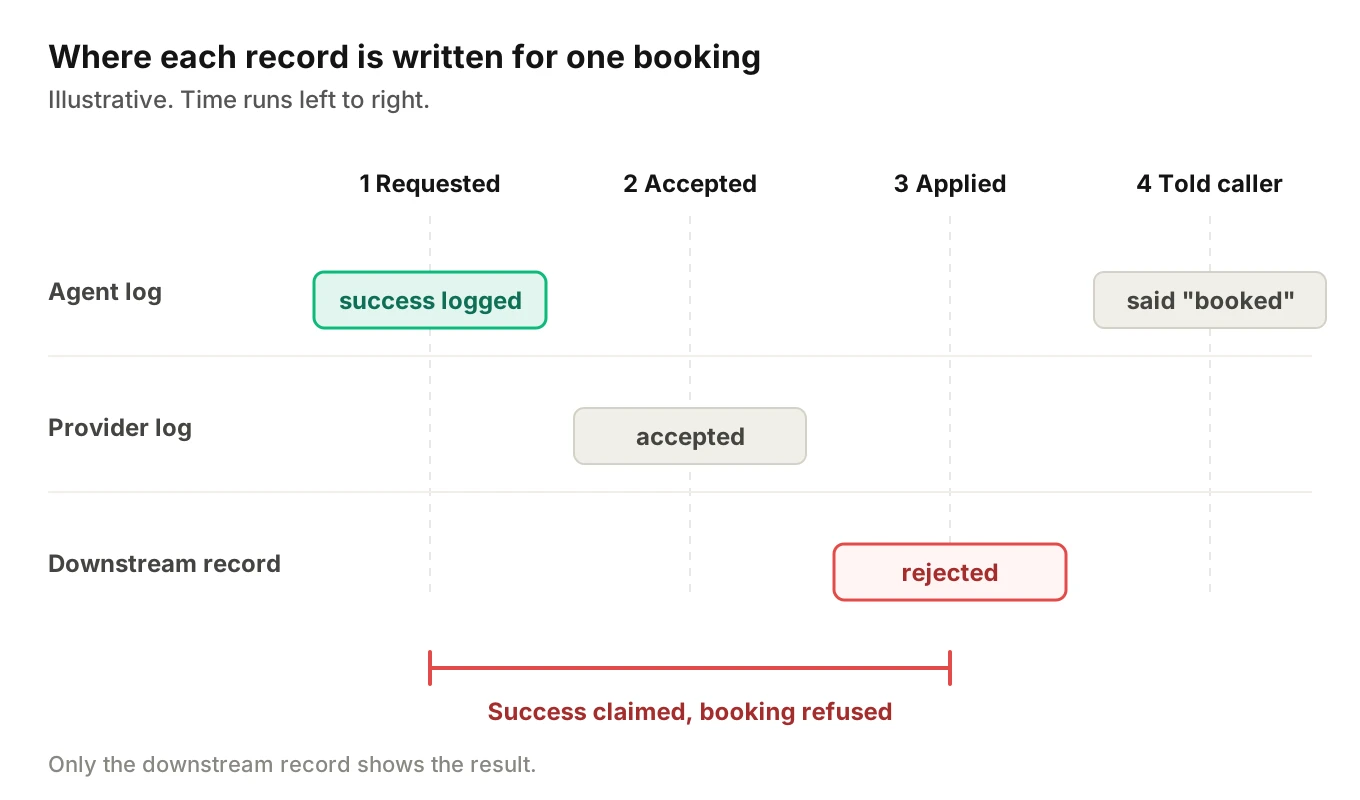
| Tool success, downstream rejection | Tool returned success | The system of record refused it | Downstream record |
| Call end and disposition | Ended at T, resolved | Carrier shows another duration or status | Telephony call record |
| Clocks | Event at time T | Another system stamped another time | Provider timestamps |
| Dropped or reordered events | Order of arrival is the order of events | Events arrived late or never | Sequence numbers |
| Sampled or truncated logging | No line means nothing happened | The line was dropped or cut | Records versus calls count |
Logged when requested, not when completed
Most voice agent call logs record an action when the agent issues it. The line says "sent" or "ended." It cannot say "done," because done happens later, somewhere else.
Twilio's Media Streams documentation shows the shape of this. Audio your app sends is buffered and played in the order received. To learn that playback finished, you send a mark message after the audio. Twilio sends the mark back when that audio ends. A clear message empties buffered audio and also causes marks to come back.
So "spoke the confirmation" often means "queued the confirmation." A mark proves the buffer drained or was cleared, not that the caller heard the whole sentence. Log both the send and the mark, and treat the gap as data.
The same pattern covers texts, emails and hangups. "SMS sent" usually means "SMS accepted by the API." Delivery is a later fact, as the Twilio 30034 post shows.
Voice agent transcript accuracy: the transcript is the recognizer's account
A transcript reads like a record of the call. Voice agent transcript accuracy is bounded by a speech-to-text model's output, not the audio. Deepgram's documentation describes interim results as a "preliminary transcript, may change." A final transcript covers one audio segment, and the speaker may not have paused yet. Check what your log stored: an interim, one final, or all finals joined. Deepgram advises appending each final to a buffer. A log that keeps one fragment misstates the utterance.
The deeper limit is plain. No telephony, provider or downstream record holds the caller's actual words. The only independent witness is the recording, which a person must play. This post does not cover audio review; see transcript versus audio in evaluation. Here, a claim about what the caller said is usually undetermined.
Tool "success" while the downstream system said no
A tool wrapper logs success when the call returns or no exception is raised. The downstream system may have accepted the request and rejected the booking afterwards. It may even return an error body with a success code.
OpenTelemetry's documentation says a span status of Unset "means that the operation it tracked successfully completed without an error." That describes the operation, not the business result. A clean span is silence, not proof. See silent tool failures and post-call write-back testing. The habit is the same: ask the system of record.
The call is logged as ended, the carrier disagrees
Your agent decides when the call ended from its own events: a hangup request, a closed socket, a finished session. The carrier counts its own way, in what telephony people call call detail records.
On Twilio call duration vs agent logs, the Call resource defines duration as "the length of the call in seconds" and leaves it empty for busy, failed, unanswered or ongoing calls. Its completed status means the call was answered and ended normally, with a connection made and audio transferred. It says nothing about whether the caller's goal was met.
"Completed" at the carrier and "resolved" in the agent's log are different call disposition claims. Only the first has a carrier witness.
Compare like with like. Twilio's Voice Insights call summary reports duration from initiation to end and connect_duration from answer to end. Its documentation says a partial summary is available within ten minutes, and a complete one may take up to half an hour. An early audit reads incomplete data.
Clocks, and events that arrive out of order
Every system stamps events with its own clock. OpenTelemetry's log data model separates Timestamp, when the event occurred by the origin clock, from ObservedTimestamp, when the collection system observed it. The first may be missing if the source time is unknown. The two can differ.
Arrival order is a second trap. Twilio's status callbacks carry a SequenceNumber that starts at 0. The Call resource page says there is "no guarantee they will arrive in the same order." A handler that keeps the last callback it received can end a call in the wrong state.
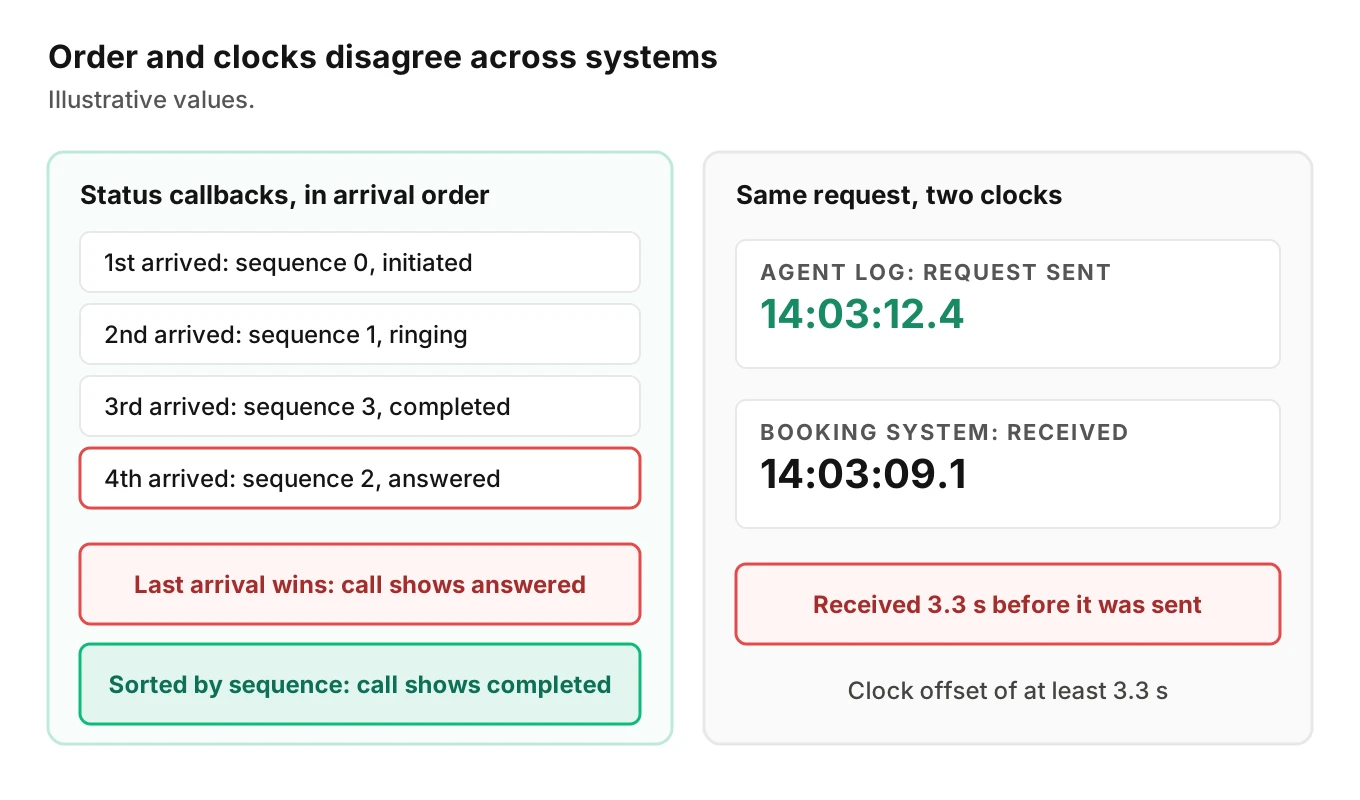
The fixes are cheap. Sort by sequence number, not arrival. Store both timestamps where a system gives you both. Measure the offset on a known event before trusting any ordering across systems. A record that precedes its own request signals a clock offset, not a time machine.
Logging that is sampled, truncated or dropped
Absence of a log line proves nothing when the pipeline may have dropped it, and voice agent logs accuracy suffers most there. OpenTelemetry's sampling guide says head sampling decides at the start of a trace. Its stated downside is that you cannot make a decision based on data in the entire trace, so you cannot ensure that traces containing errors are kept. Tail sampling decides after most spans are available.
Truncation is similar. The OpenTelemetry common specification has an attribute value length limit, default infinity, past which SDKs must truncate strings. Its attribute count limit, default 128, discards extra attributes. A long tool payload can be cut with no error.
The test is a count. Compare records to calls, since voice agent logs accuracy includes completeness. If the carrier shows 1,000 calls and your traces hold 940, 60 calls have no agent account. Those calls are not clean. They are blind. Review sampling is a separate question; see sampling live calls.
What each independent source can and cannot witness
An independent source is one written by a different system, triggered by a different event, with no shared code path to the agent's log. A record your own agent writes to the database is the agent's log in another place. It is not independent.
| Source | What it can witness | What it cannot witness | Watch for |
|---|---|---|---|
| Carrier or telephony call record (Twilio Call resource, Voice Insights summary) | Whether the call connected, its status, duration in seconds, timestamps | What was said, whether the task succeeded | Empty duration on unanswered calls; partial summaries early |
| Status callbacks | State changes as the carrier saw them | A guaranteed order | Sort by SequenceNumber; late or missing callbacks |
| STT provider log or dashboard | What the recognizer returned and when | What the caller said | Interim versus final text |
| Messaging or email provider | Whether a message was accepted, delivered or failed | That the caller read it | Accepted is not delivered |
| Downstream system of record | Whether the booking, ticket or update exists | Why the agent said what it said | Its own clock and validation rules |
One call, reconciled
This reconciliation table is illustrative. The call, the numbers and the systems are invented to show the method.
An agent reschedules deliveries. For one call it logged the following. The call ended at 142 seconds. book_slot returned success. An SMS confirmation was sent. The outcome was "resolved." The transcript reads "Thursday afternoon." The tool request left at 14:03:12.4 by the agent clock.
| Claim | Agent's account | Independent record | Verdict |
|---|---|---|---|
| Call was answered | Session started | Twilio status completed, duration 151 s (non-empty) | Confirmed |
| Call length | Ended at 142 s | Twilio duration 151 s, a 9 s difference | Contradicted |
| Booking made | book_slot success | Booking system: write rejected, slot already held | Contradicted |
| Text confirmation | SMS sent | SMS provider log: delivery failed | Contradicted |
| Outcome "resolved" | Resolved | Carrier says completed, which does not cover resolution; booking system shows no booking | Contradicted |
| Caller's words | Transcript says "Thursday afternoon" | No telephony, provider or downstream record | Undetermined |
| Order of events | Tool request sent 14:03:12.4 | Booking system received 14:03:09.1 | Undetermined: clock offset of at least 3.3 s |
The arithmetic: 151 minus 142 is 9 seconds. 14:03:12.4 minus 14:03:09.1 is 3.3 seconds. Of seven claims, one is confirmed, four are contradicted and two are undetermined.
The nine-second gap has no known cause. The agent may have logged a hangup request while the carrier leg stayed open. Without playback marks or a carrier hangup event, that stays a hypothesis.
The booking row is the one that matters. The caller left believing something that the record says is false, and the agent's log hid it.
When no independent source exists, say undetermined
Some claims have no witness among your records. What the caller said is the standing example. Pretending otherwise turns a gap into a false verdict.
Use three verdicts, and only three.
- Confirmed: an independent record agrees with the claim.
- Contradicted: an independent record disagrees. Say which.
- Undetermined: no independent record covers the claim, or the records conflict and nothing breaks the tie.
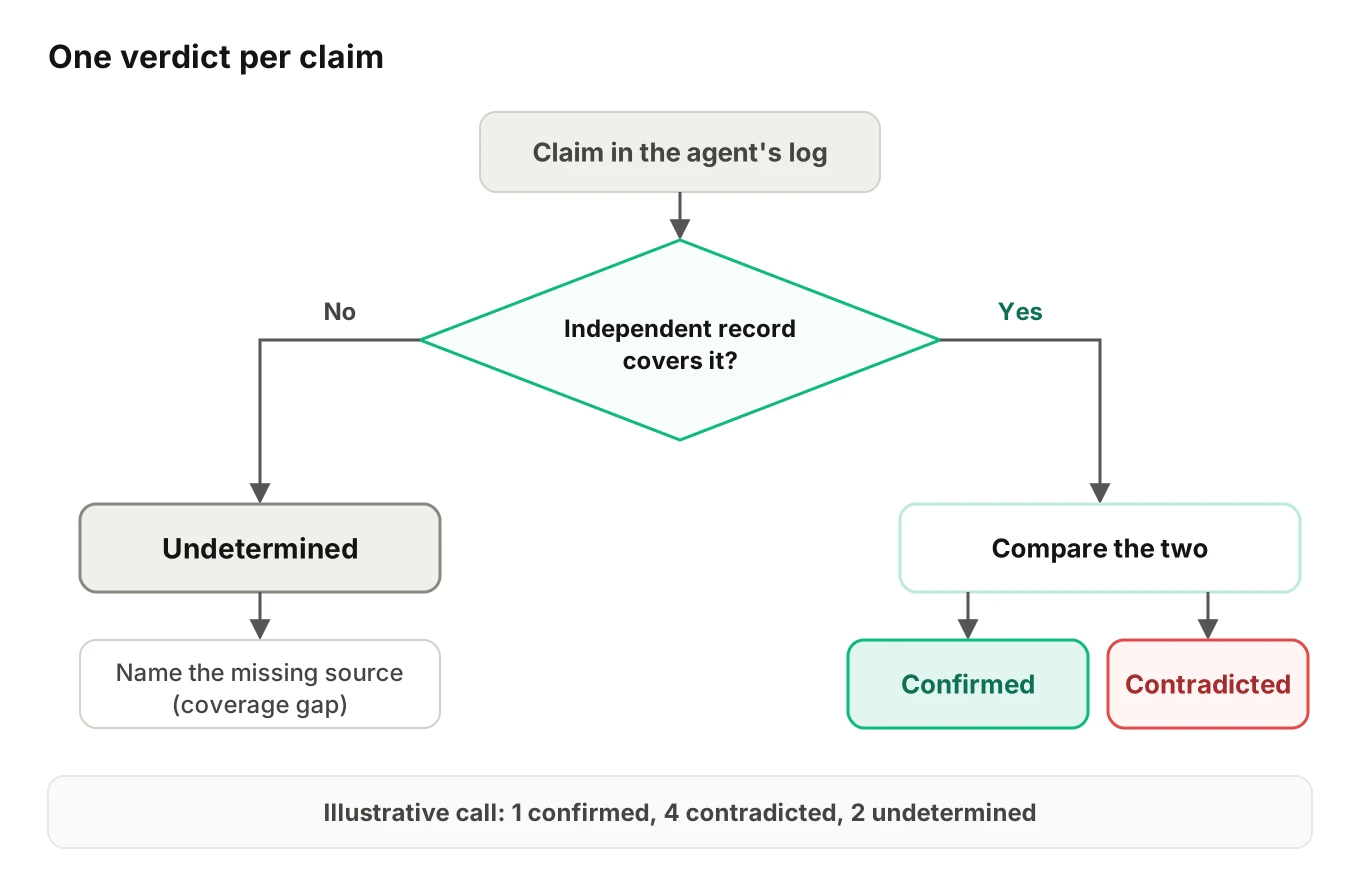
An undetermined verdict should name the missing source. That list is your coverage gap, and it is a to-do list for logging. Keep it as a short record per claim.
CLAIM LEDGER ENTRY
Claim:      Caller asked for Thursday afternoon
Agent says: Transcript turn 6
Source:     none among telephony, provider or downstream records
Verdict:    UNDETERMINED
Missing:    Playable recording reviewed by a person, or a scripted test caller
Next step:  Add the call to the review queue; do not change the prompt on this evidence
Evalgent Observe, which is launching, follows the same rule at the product level. A verdict needs evidence from the data you supply. Where that data is blind, it says "undetermined," and the coverage gap is shown, not hidden. Observe works from the traces and call data you send it, through OpenTelemetry plus an upload path for call details.
In a test, the problem shrinks. You scripted the caller, so you know what was said. Evalgent Reviews show the exact tool payloads of a test call, which makes the "requested versus completed" check concrete before launch.
How to reconcile voice agent logs against independent records
Run this routine after any complaint, and on a schedule for a small random set.
1. List the claims — Write down what the agent's log asserts: call length, answered, each tool result, each message sent, outcome. One line per claim.
2. Map each claim to a witness — For every claim, name the independent record that could confirm it. Use carrier records, provider logs and downstream records. If you find none, write "none" now.
3. Pull the records late enough — Wait for partial data to complete. Twilio's summary can take up to half an hour, and its Call resource warns a recording may not be accessible when the status callback fires. Retry before concluding anything is missing.
4. Normalize before comparing — Convert to one unit and one clock. Compare duration with duration, and connect time with connect time. Sort events by sequence number, not arrival. Measure the clock offset on a known event.
5. Assign a verdict per claim — Mark confirmed, contradicted or undetermined. For each contradiction, name the record that disagrees. For each undetermined, name the missing source.
6. Count and fix the blind spots — Compare record counts to calls. Then change logging so the next audit finds fewer undetermined rows.
Change your logging so the next audit is easier
Most contradictions are cheap to prevent if the log keeps the right facts. What to log on every call has the full field list. Five habits matter here.
- Log request and result as two events. "Requested" at send. "Completed" or "failed" when the other side answers.
- Store provider identifiers. Keep the carrier call ID, message ID and downstream record ID, so you can fetch the independent record. See call ID correlation and tracing a call end to end.
- Keep raw and final text. Store interim and final transcripts with their flags.
- Keep both times. Store the origin time and the time your pipeline saw the event.
- Log the log's own gaps. Record sampling decisions, truncation and dropped counts, so absence can be told from silence.
With these in place, why voice agents fail in production is easier to read, because each layer has a witness. For the wider frame, see what is voice agent observability.
Where Evalgent fits
Evalgent is a testing, evaluation and monitoring platform for voice agents. Its production call monitoring flags problems such as tool-call failures and latency spikes, with fix recommendations. Observe is aimed at the explanation step: it traces each failure to the step or handoff that caused it, and clusters failures into root causes. Evalgent does not sit in the media path, so nothing touches live audio or slows a call.
You can run the routine above with a spreadsheet and the carrier's records. To talk through evidence-backed verdicts for your own agent, book a demo.
Frequently asked questions
Are voice agent logs reliable?
Partly. They are reliable about what the agent decided and requested. They are weak about what completed, what the caller said and what the carrier recorded. Treat the log as one witness. Check completion claims against provider and downstream records, and mark claims with no independent source as undetermined.
How do I verify voice agent actions?
Pair each action with an independent record. A booking needs a record in the booking system. A text needs a delivery status from the messaging provider. A call needs a carrier call record. Compare after the action, retry for records that arrive late, and keep the provider ID on the agent's log.
Is the voice agent transcript accurate?
A transcript is the speech recognizer's output, not a recording of the caller's words. An interim transcript can change, and a final transcript is the recognizer's best account of a segment. No telephony or downstream record holds the actual words. Claims about what was said are usually undetermined without a person reviewing audio.
Why is Twilio call duration different from my agent's log?
They measure different things. Twilio's duration is the length of the call in seconds as the carrier counts it. Your agent may log the hangup request, the socket close or the session end. Voice Insights also separates total duration from connect duration. Compare matching measures before calling a difference an error.
What does Twilio's completed status mean for the agent's outcome?
It means the call was answered and ended normally, with a connection made and audio transferred. It does not say the caller's goal was met. "Completed" at the carrier and "resolved" in the agent's log are separate claims. Check resolution against the downstream system of record.
Why does a tool call show success but the booking failed?
Tool success usually means the request returned without an exception. The downstream system may have rejected the booking afterwards, or returned an error inside a success response. In OpenTelemetry, an unset span status means only that the operation finished without an error. Verify the result in the system of record.
Can status callbacks arrive out of order?
Yes. Twilio's Call resource documentation says there is no guarantee that status callbacks arrive in the order they were sent. Each carries a sequence number starting at 0. Sort by that number, not arrival time, so a late "answered" callback does not overwrite "completed."
How do I handle claims I cannot verify?
Mark them undetermined and name the source that is missing. Do not guess a verdict from the agent's own log. Add the missing source to your logging plan, such as playback confirmations or a scripted test caller. Track the share of undetermined claims as a measure of your blind spots.
The bottom line
The agent's log shows what the agent decided and asked for, not what the carrier, the provider and the downstream system recorded. Check each claim against an independent record, and write "undetermined" when none exists.
Related Articles

How to automate voice agent testing: synthetic callers vs manual QA
Learn how ai test automation replaces manual QA for voice agents. Compare synthetic callers vs human testers, with a 5-step framework to scale without hiring.
Read more
AI Agent Testing vs Voice Agent Testing: What General Tools Miss for Voice
AI agent testing measures text outputs. Voice agent testing measures behaviour through an acoustic pipeline. Five failure categories general tools miss.
Read more