Voice Agent Gave a Wrong Answer: Retrieval, Prompt or Model?
On this page
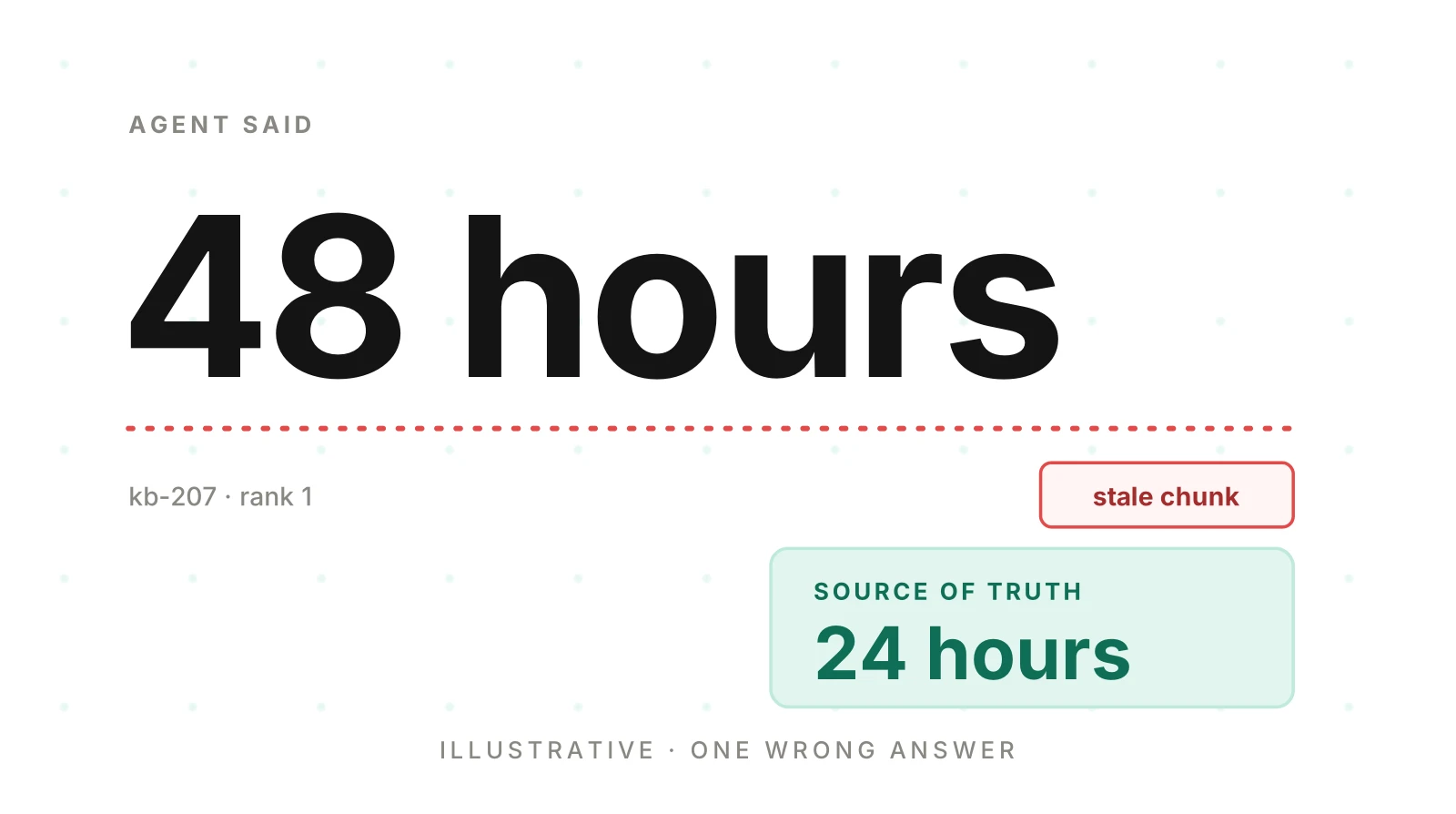
A caller asks how late they can cancel a visit without a fee. The agent says "forty-eight hours." Your policy says twenty-four. Everyone agrees it is wrong. Nobody agrees whose fault it is.
The wrong sentence is the last link in a chain, and each link can be checked on the trace. This post gives the triage order for a voice agent wrong answer debug, with the evidence, fix and test for each branch. Facts are as of November 23, 2026, and every worked example is illustrative.
Neighbours cover other angles. Hallucination rate counts wrong answers across calls. Grounding tests work before launch. RAG observability records the retrieval span. Debugging a bad call is a general runbook. This post asks one thing: the content was wrong, so which layer put it there?
Step 0: confirm the answer was wrong, and against what
Do not debug a complaint. Debug a verified error. Name the source of truth first. It is the system of record, the approved policy text on the call date, or a named owner. A policy changed on Monday does not make a Friday call wrong.
Then sort the error against what the model was given. The survey by Ji et al. defines intrinsic hallucination as output that contradicts the source content, and extrinsic as output that cannot be verified from it. That gives a head start:
- Contradicts the prompt text: look at branches 5 to 7. The right text was there.
- Goes beyond the prompt text: look at branches 1 to 4. It may never have arrived.
- Repeats wrong prompt text faithfully: the fault is upstream, in retrieval, content or a tool.
Sorting needs the prompt text, or chunk IDs in order. If you cannot see what the model saw, that is your first finding.
The evidence packet for one turn
Keep one record per turn. It holds the transcript segments used, state and intent, the retrieval query with chunk IDs, scores and knowledge base version, and what reached the prompt, in order. Add the prompt version, tool arguments and results, the model requested and the model that responded, and the text sent to speech.
OpenTelemetry's GenAI conventions cover part of this and are marked Development as of November 23, 2026. The retrieval span lists documents and query text as opt-in, with a sensitive-data warning. The inference span lists request and response model, and makes input messages opt-in. Mask text before storing it. See LLM observability.
The eight branches, in order
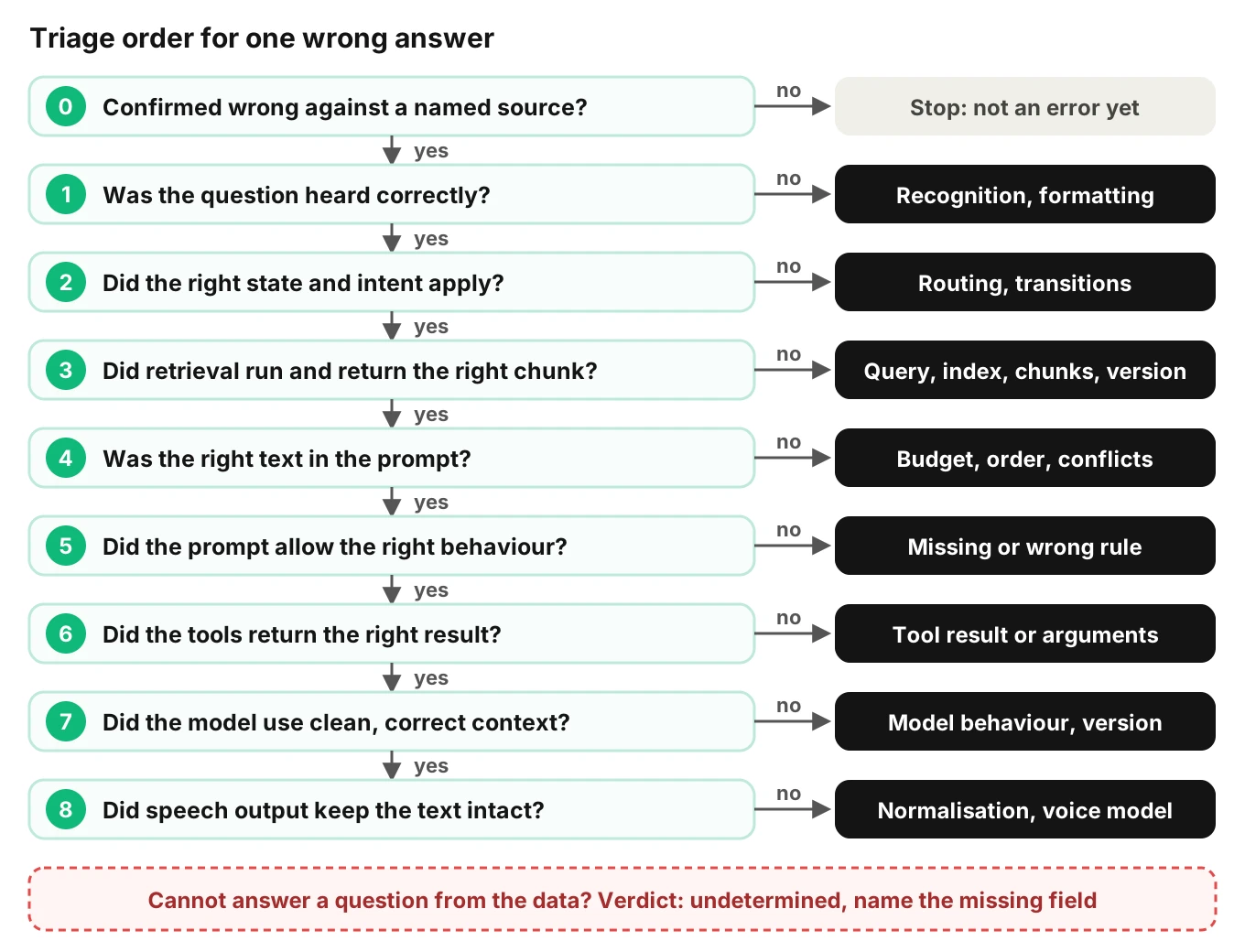
Work top to bottom in any voice agent wrong answer debug. Stop at the first branch that explains the error, then confirm the fix changes the answer. A wrong transcript poisons every branch after it.
1. Was the question heard correctly?
Trace evidence. Compare the final transcript with the caller's words. Check whether the agent acted on an interim segment that later changed, as in STT observability. Formatting matters too. Deepgram's smart format page says capabilities vary by model and language, and covers dates, times, currency and phone numbers for English only.
Fix direction. Tune recognition inputs and endpointing. Add a read-back for names and numbers, as in alphanumeric capture.
Test to add. A scripted caller says a confusable pair, such as "Alaska" and "Alabama". Assert on the transcript too.
2. Did the right state and intent apply?
Trace evidence. Read the flow node, intent label and slots for that turn. A policy question handled inside a booking node can pull the wrong scope. See state observability.
Fix direction. Fix the routing or transition, not the answer text.
Test to add. Five paraphrases of one question, one expected node, one asked mid-flow. Memory tests cover carry-over.
3. Was retrieval run, and did it return the right chunk?
First ask whether it ran. A factual claim with no retrieval span means the agent answered from memory, or routing skipped the tool. Then read the query as sent. A rewrite can drop a constraint, and a recognition error can land inside it.
If the right chunk is missing, one of five things failed:
- Query: the searched words do not match the question.
- Index: the document was never ingested, or an old copy remains.
- Chunking: the answer sits in a table or heading cut away from its text.
- Content: the chunk is retrieved and is itself wrong.
- Version: the chunk was right last month.
In the original RAG paper, Lewis et al. pair a pre-trained seq2seq model (parametric memory) with a dense Wikipedia index (non-parametric memory). Their abstract calls provenance and updating knowledge open problems. An answer comes from retrieved passages or model weights, and only a stored chunk ID says which.
Fix direction. Fix the rewrite, re-ingest, re-chunk, correct the content, or retire the old version.
Test to add. A golden question with the expected chunk ID. Assert it appears in the top results and no retired version does.
4. Was the right text in the prompt?
Retrieved is not the same as shown. A token budget can drop the third chunk, and a template can truncate a long result. If two chunks disagree, or one disagrees with a rule, the model must pick.
Position is a documented effect. Liu et al. found performance is often highest when relevant information is at the beginning or end of the input and degrades when it is in the middle, even for explicitly long-context models. They tested multi-document question answering and key-value retrieval, not voice agents, so treat it as a reason to check.
Advice differs by provider. Anthropic's long context guidance puts long documents above the query. OpenAI's prompt guide puts retrieved context near the end. Test your order.
Trace evidence. Chunk IDs placed in the prompt, their order, token counts and rendered instructions.
Fix direction. Retrieve less, deduplicate, and put the decisive chunk first. Resolve conflicts in the source. See long-call context bloat.
Test to add. Place the correct chunk first, middle and last among distractors. Assert the same answer each time.
5. Did the prompt allow or forbid the behaviour?
Sometimes the model did what it was told. "Always answer the caller" invites a guess. A ban on transfers removes the safe exit.
Anthropic's reduce hallucinations page lists permission to say "I don't know" as a basic technique, and says such techniques reduce hallucinations but do not eliminate them.
Trace evidence. The prompt version in force and its lines on unknown answers, scope and escalation.
Fix direction. Write the fallback: what to say and when to transfer. Narrow the scope. See prompt engineering.
Test to add. A question the knowledge base cannot answer, passing if the agent says it cannot confirm or transfers. Compare versions as in prompt comparison.
6. Did a tool return a wrong or empty result?
Many wrong answers are correct readings of wrong data: an empty list, a stale record, the wrong customer, or an error the agent talked over. Wrong arguments make a tool answer another question.
Trace evidence. Arguments, raw result, error type and the next sentence spoken. See tool-call tracing, silent tool failures and tool-argument accuracy.
Fix direction. Handle empty and error results explicitly. Validate arguments.
Test to add. Force empty, error, stale and wrong-record results, and assert the agent says it cannot confirm. In pre-launch runs, Evalgent Reviews show the exact tool payloads beside the audio and transcript.
7. Did the model ignore good context?
Reach this branch by elimination. The right chunk was in the prompt, early, with no conflict. The prompt allowed the right behaviour and the tool was clean, yet the answer contradicts the text.
The Ji et al. survey lists parametric knowledge bias among the contributors: models can favour what they memorised over the input they were given.
Trace evidence. The model requested, the model that responded, and whether either changed since the last good run. OpenAI's guide recommends pinning production applications to specific model snapshots and running evaluations across versions.
Fix direction. Shorten the context. Ask the model to quote supporting text first, a technique on Anthropic's page for long documents. Pin the version and keep a regression suite, as in model update regression testing.
Test to add. Replay the exact prompt several times on old and new versions. One failed replay proves little.
8. Did speech output change what was said?
If the model text was right and the caller heard something else, check the text sent to speech. Numbers, dates, currency and abbreviations are the usual suspects.
ElevenLabs' best practices page says normalisation is on by default. A smaller model reads "$1,000,000" as "one thousand thousand dollars"; a larger one says "one million dollars". It lists phone numbers, currencies, dates, times and addresses as problem items, and says to state the format you want.
Trace evidence. The text sent to speech beside the model output. If they match and the caller heard a different value, suspect speech output. The spoken form itself needs a recording and a person listening. See TTS observability.
Fix direction. Expand numbers and dates into spoken words before synthesis, and state the format in the prompt.
Test to add. A fixed list of dates, prices and phone numbers, with a reviewer recording what was said.
Symptom to first suspect
Use this table when a report arrives as a symptom. It names where to look first, not the cause.
| Symptom | First suspect | Evidence that confirms it |
|---|---|---|
| Wrong name, number or place | 1. Recognition | Transcript differs from the caller's words |
| Answer fits another topic | 2. State or intent | Node or intent does not match the question |
| Confident answer, no retrieval span | 3. Retrieval skipped | Factual claim with no span |
| Answer matches an old policy | 3. Index or version | Chunk carries a retired version |
| Right chunk retrieved, not used | 4. Prompt context | Chunk missing from the prompt, or buried |
| Agent guessed, did not say "I don't know" | 5. Prompt rules | No fallback rule |
| Answer disagrees with the account record | 6. Tool result | Result stale, empty or wrong record |
| Answer contradicts a clean prompt | 7. Model | Right text early, no conflict, still ignored |
| Right text, wrong value heard | 8. Speech output | Text sent to speech is correct |
A worked example with the verdict path
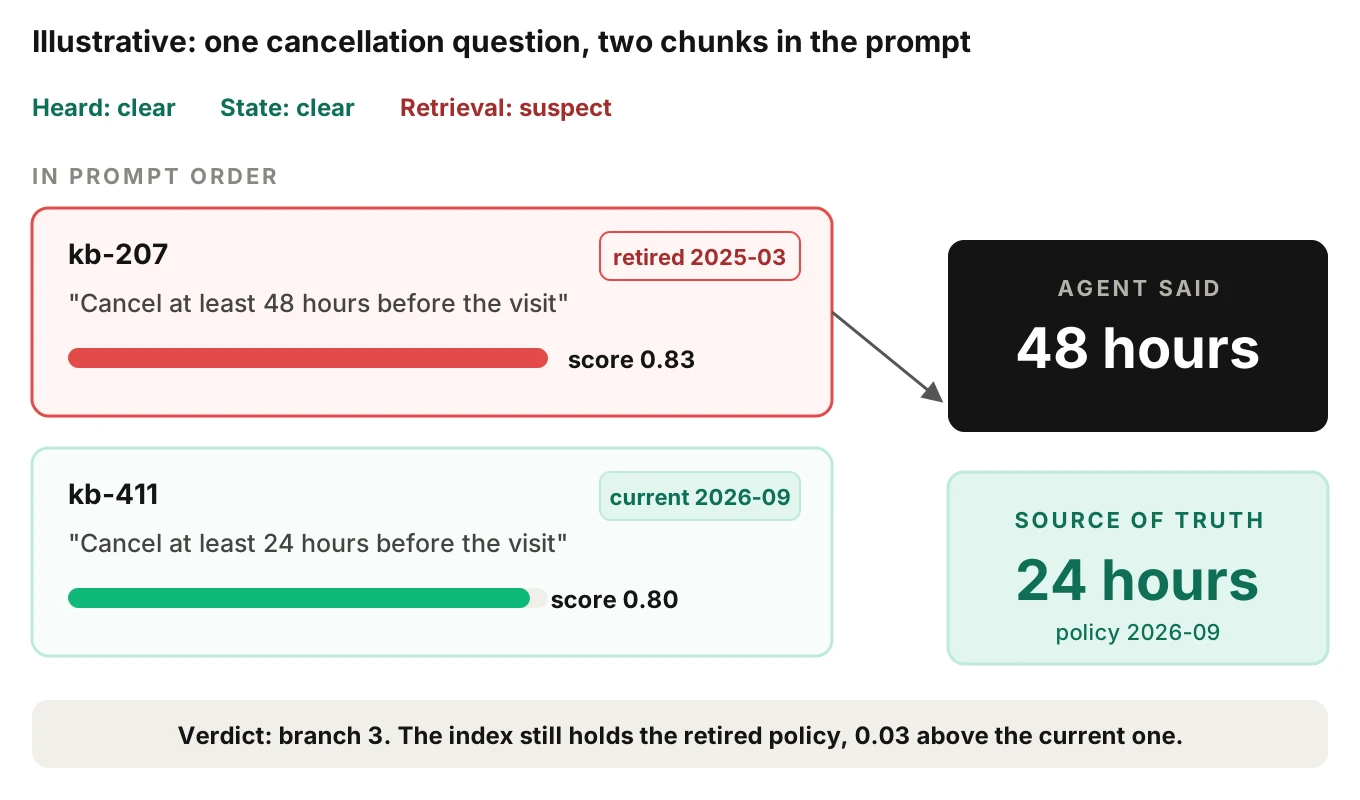
This voice agent wrong answer debug example is illustrative. A clinic's agent said a caller could cancel up to 48 hours before a visit without a fee. The approved policy, current since September 2026, says 24 hours. The policy owner confirms the agent was wrong.
| Branch | What the trace shows | Result |
|---|---|---|
| 0. Wrong? | Policy page, version 2026-09, says 24 hours | Confirmed |
| 1. Heard? | Transcript matches; a reviewer played the recording | Clear |
| 2. State? | Node faq, intent cancellation_policy | Clear |
| 3. Retrieval | Ran. kb-207 (version 2025-03, "48 hours") scored 0.83. kb-411 (version 2026-09, "24 hours") scored 0.80 | Suspect |
| 4. Prompt | Both chunks placed, higher score first | Contributing |
| 5. Prompt rules | No rule on which version wins | Contributing |
| 7. Model | Answer is faithful to the first chunk | Clear |
| 8. Speech | Text sent to speech says "forty-eight hours" | Clear |
No tool ran on this turn, so branch 6 does not apply. The first branch that explains the error is 3. The index still holds the retired 2025-03 policy, and it outranks the current one by 0.03. Branches 4 and 5 let the conflict through but did not create it. The answer was faithful to the context, and the context was wrong.
The fix: retire the old document, re-ingest, add a version filter, then replay the call. If the answer says 24 hours, the verdict stands. If not, move to branch 4. The test: a golden question expecting kb-411 and "24 hours", and no retired version in the top results.
When the answer is undetermined
Some wrong answers cannot be traced to a cause. The honest verdict is "undetermined", with the missing field named. A guess sends the fix to the wrong layer.
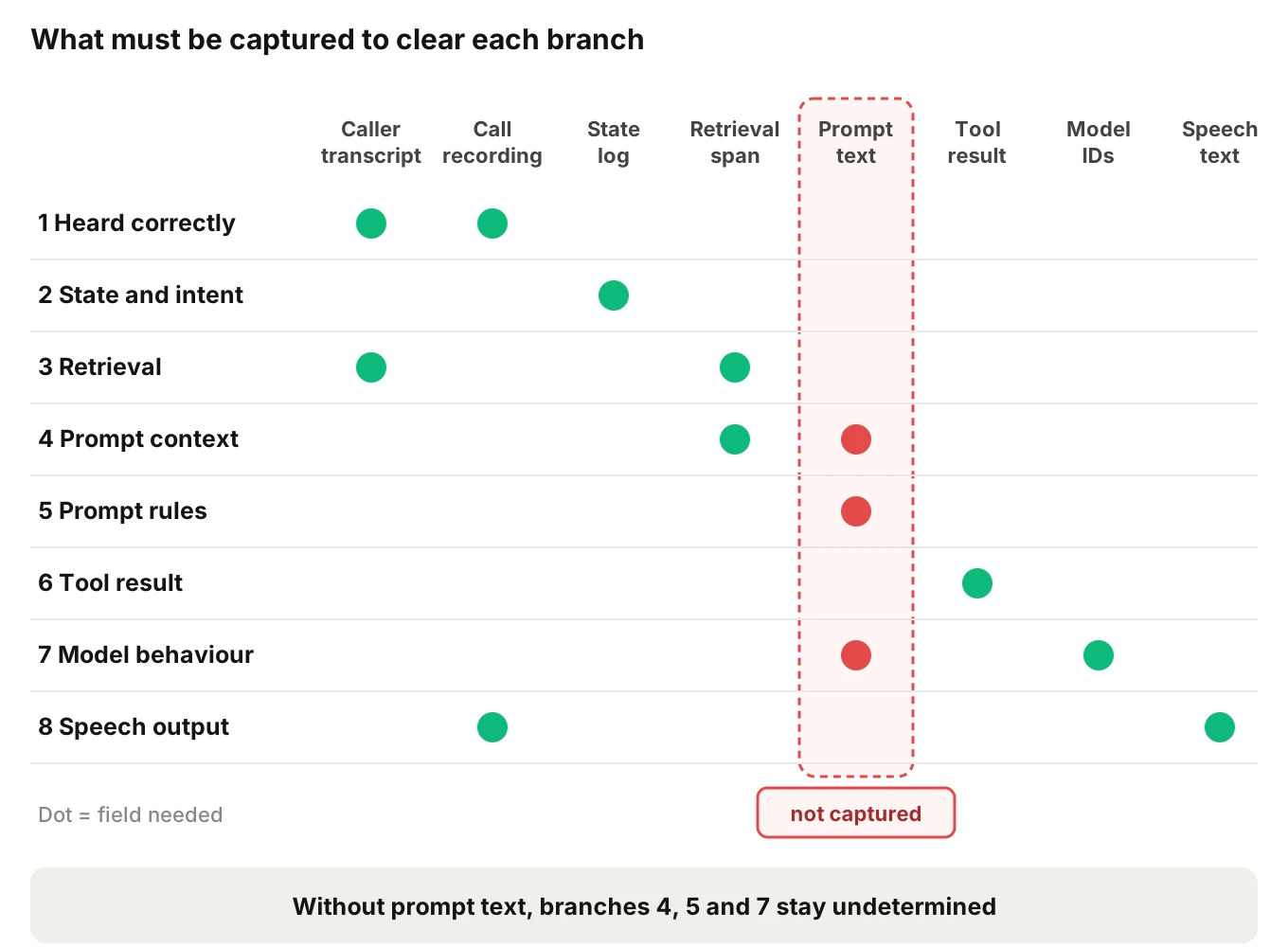
Each branch needs evidence before you can clear it:
- Heard: the transcript and, to be sure, the recording.
- State: a state log.
- Retrieval: a retrieval span. No span means "did not run" or "not instrumented", and you cannot tell which.
- Prompt context and rules: the prompt text, or chunk IDs with order.
- Tool: arguments and the raw result.
- Model: identifiers and a replay. It is ruled in by elimination, so every earlier gap weakens it.
- Speech output: the text sent to speech and a recording.
Two cases need care. A transcript is recognizer output, not the caller's words, as logs versus what happened explains. And an answer that matches the knowledge base can still be wrong, so only the policy owner clears the content. Write the gap as a result, such as "Undetermined: prompt text not captured, branches 4, 5 and 7 open."
How to triage one wrong answer
Use the same order for every voice agent wrong answer debug.
1. Confirm the error - Name the source of truth and its version on the call date.
2. Pull the evidence packet - Get transcript, state, retrieval, prompt, tool, model and speech text for that turn.
3. Sort the error - Does it contradict the prompt text, go beyond it, or repeat wrong text?
4. Walk the branches - Stop at the first that explains the error. Note every branch you cannot clear.
5. Check the fix by replay - Replay the turn and confirm the answer changes.
6. Add the test - Write the case from the branch: golden question, position swap, forced tool failure or number list.
7. Write the verdict - One line: branch, evidence, fix, test. Or "undetermined" with the missing field.
8. Check for siblings - See whether other calls share the cause, as in root cause analysis.
Where Evalgent fits
Evalgent Observe, which is launching, works from the traces and call data you send, in OpenTelemetry format from any stack. It traces each failure to the step or handoff that caused it, groups failures into root causes, and says "undetermined" where your data is blind. It never sits in the media path.
Evalgent Monitor, which is live, flags problems such as tool-call failures, latency spikes and policy failures in production calls, with fix recommendations. To walk through a wrong answer in your own traces, you can book a demo.
Frequently asked questions
How do you debug a voice agent wrong answer?
Confirm the answer was wrong against a named source and its version on the call date. Then check the transcript, state, retrieval, prompt, tool results, model and speech output in order. Stop at the first branch that explains the error, and verify the fix by replay.
How do you tell retrieval from prompt from model?
Look at what reached the prompt. If the right text never arrived, suspect retrieval or the token budget. If it arrived but the prompt allowed a guess, suspect the prompt. If it arrived, nothing conflicted and the prompt allowed the right behaviour, suspect the model, by elimination.
What should a trace capture to debug a wrong answer?
Capture transcript segments, state, the retrieval query with chunk IDs and scores, prompt contents or chunk IDs in order, tool arguments and results, model identifiers, and the text sent to speech. Mask text first, because queries and messages can hold personal data.
Why is the answer wrong when retrieval returned the right chunk?
The chunk may not have reached the prompt, or it sat mid-block. Liu et al. found models often do best with relevant information at the start or end of the input. A conflicting chunk or rule can also win. Check the rendered prompt before blaming the model.
Is a wrong answer always a hallucination?
No. Ji et al. separate output that contradicts its source from output that cannot be verified from it. An answer can also faithfully repeat a stale chunk or a wrong tool result, which is a data fault. Classify the error first.
Can the text-to-speech step cause a wrong answer?
Yes, for numbers, dates, currency and abbreviations. ElevenLabs documents that normalisation depends on the model and lists dates and currencies as problem items. Compare the model output with the text sent to speech, then have a person listen to the recording.
When should you call a verdict undetermined?
Call it undetermined when a field you need was not captured, such as the prompt text, retrieval span, tool result or recording. Name the missing field and the branches it leaves open. That tells the team what to log next.
What test should you add after fixing a wrong answer?
Add one test matched to the branch. Retrieval gets a golden question with the expected chunk. Prompts get an unanswerable question expecting a fallback. Tools get a forced empty result. Speech gets a fixed list of numbers and dates.
The bottom line
A wrong answer is a chain, and the fastest fix starts by confirming the error and then walking the chain in order, from what was heard to what was said. Where the trace cannot clear a branch, write "undetermined" and name the missing field.
Related Articles
How to automate voice agent testing: synthetic callers vs manual QA
Learn how ai test automation replaces manual QA for voice agents. Compare synthetic callers vs human testers, with a 5-step framework to scale without hiring.
Read more
AI Agent Testing vs Voice Agent Testing: What General Tools Miss for Voice
AI agent testing measures text outputs. Voice agent testing measures behaviour through an acoustic pipeline. Five failure categories general tools miss.
Read more