Test your voice agent
Prompt Engineering for AI Voice Agents in 2026
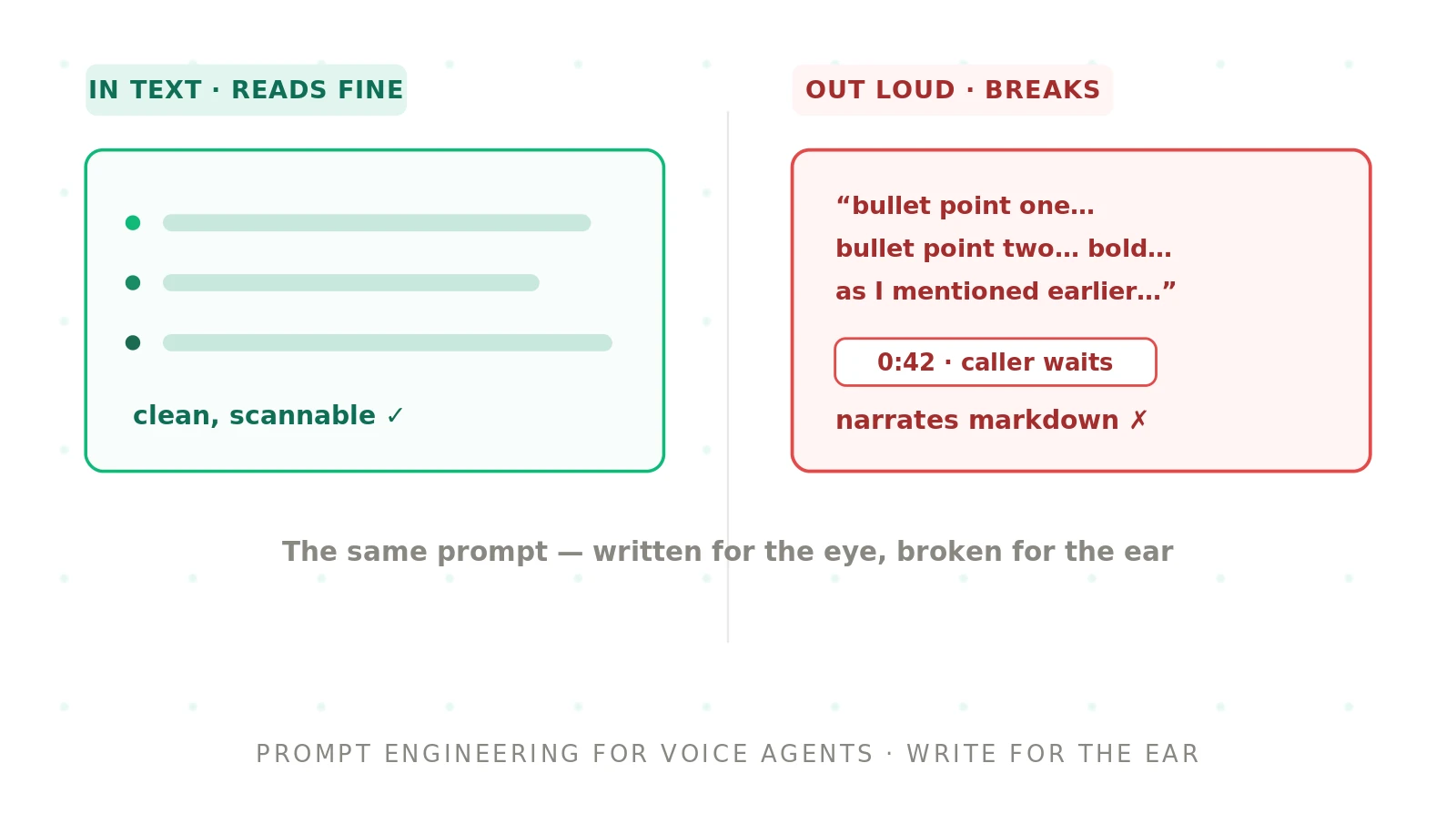
The prompt that makes a chatbot excellent will make a voice agent frustrating. Ask a language model to "be thorough and format your answer clearly," and a chat window rewards you with bullet points and bold headers. A voice agent reads that same instruction and starts saying "bullet point one" out loud, in a forty-second monologue the caller cannot skim, interrupt cleanly, or escape. Prompt engineering for voice is not chatbot prompting with a microphone attached. It is a different discipline, shaped by three constraints text never has: the output is heard, the clock is running, and the caller can talk back mid-sentence.
This guide covers what changes in 2026. Why prompting a voice agent differs from prompting a chatbot, the anatomy of a system prompt that holds up on real calls, how to write for the ear and the latency budget, how to encode turn-taking and recovery, and a step-by-step loop for iterating a prompt against actual conversations. It sits alongside our AI voice agent testing pillar, because a voice prompt is only as good as the calls you test it on.
Why prompting a voice agent is different
Prompt engineering as a field grew up around text, and most of its best-known advice assumes a reader who can scan, scroll, and re-read. A voice agent breaks all three assumptions. The differences are not cosmetic — they change what a good prompt has to say.
The output is spoken. There is no formatting, no bullet list, no way to skim. Everything the model writes gets read aloud, so a prompt that invites structure or length produces speech that feels endless. The channel is real-time. Every extra clause the agent says, and every extra moment it spends composing, is dead air the caller sits through — and callers feel delay acutely, which is why the ITU-T G.114 telephony standard puts the comfortable one-way limit at 150ms. And the conversation is full-duplex: the caller can interrupt, go quiet, or answer a question you have not finished asking. A chatbot prompt never has to say what to do when the user talks over you, because in text they cannot.
The anatomy of a voice agent system prompt
A durable voice prompt is not a paragraph of vibes; it is a structured document with predictable sections. Organizing it this way — a pattern our prompt comparison work leans on — makes it testable and easy to revise one part without breaking the rest.
Identity and role. Who the agent is, the single job it exists to do, and the boundary of that job.
Spoken style. How it should sound — pace, warmth, sentence length, and an explicit instruction that output is spoken, so no markdown, lists, or headers.
Conversational rules. How to open, how to confirm, when to ask one question at a time, and how to handle interruptions and silence.
Knowledge and grounding. What the agent knows, what it must look up with a tool, and the rule that it never invents facts it cannot ground.
Tools and actions. Which tools exist, when to call each, and what to say while a call is in flight so the line does not go silent.
Guardrails and escalation. What is out of scope, how to refuse, and the exact conditions for handing off to a human — the distinction our guardrails vs evals guide draws.
Recovery. What to do when it mishears, when the caller is confused, or when a tool fails.
Keeping these sections separate is what lets you evolve the prompt safely. When calls reveal a problem with escalation, you edit the escalation section, not a wall of prose where every instruction is entangled with every other.
Writing for the ear, not the eye
The single biggest shift is that your agent's words are heard. That has concrete consequences for the prompt.
Tell the model, explicitly, that its output is spoken aloud and must contain no formatting — no bullet points, no numbered lists, no bold, no headers. Instruct it to speak in short, complete sentences, and to offer information in small pieces the caller can respond to, rather than one long block. Numbers, dates, and identifiers need spoken forms: "fifteen dollars," not "$15"; "March third," not "3/3." Spell out how to read back a confirmation number or a phone number in digestible groups. These are the details that separate an agent that sounds human from one that sounds like a screen reader.
The same principle governs length. A written answer can be long because the reader controls the pace. A spoken answer cannot, so the prompt should push the agent toward brevity by default and detail only on request — a rule that also protects the caller from the endless-monologue failure mode.
Prompting for latency and brevity
Brevity is not only a style choice for a voice agent; it is a latency strategy. The longer the reply the model generates, the longer the caller waits and the more dead air creeps into the turn, the problem our dead air guide covers. A prompt that demands concise answers produces faster-feeling conversations, independent of any model change.
Encode this directly. Cap the default answer length, tell the agent to lead with the answer before any caveat, and forbid throat-clearing preambles like "That's a great question." Where a task needs the model to reason, keep that reasoning internal rather than spoken, so the caller hears the conclusion, not the working. The model choice matters too — our best LLM for voice agents guide covers the speed side — but a disciplined prompt is the cheapest latency win available.
Prompting turn-taking, interruptions, and recovery
This is the section chatbot prompts do not have, and the one that most separates a voice agent that feels natural from one that feels broken. The prompt has to tell the agent how to share the floor.
Spell out interruption behavior: when the caller starts speaking, the agent stops and listens rather than talking over them — the barge-in case. Tell it how to handle silence: a short pause is thinking time, not a cue to repeat the question, which prevents the interruption-versus-context confusion where an agent loses the thread. Give it recovery language for mishearing — confirm rather than guess on anything that matters, like a name or an amount, since a misheard entity corrupts the whole task. And define escalation precisely: the conditions under which it stops trying and hands to a human, per the escalation guide. These behaviors are why voice agents fail in production when the prompt ignores them.
Text prompt vs voice prompt
The contrast makes the discipline concrete.
| Dimension | Text/chatbot prompt | Voice agent prompt |
|---|---|---|
| Output format | Markdown, lists, length OK | Spoken only — no formatting, brief |
| Pacing | Reader controls it | Agent controls it — latency matters |
| Turn-taking | Not applicable | Must define interruptions and silence |
| Numbers/dates | Written forms fine | Spoken forms required |
| Recovery | Re-read the message | Confirm, re-ask, or escalate by voice |
| Success test | Reads well | Sounds right and resolves the call |
How to iterate on a voice agent prompt
A voice prompt is never right on the first try; it is refined against calls. This loop, aligned with modern agent design practice, is how the good ones get built.
1. Start from a structured draft — Write the prompt in the sections above rather than one block, so each behavior has a home you can edit.
2. Run it on realistic calls — Test against real scenarios and caller profiles, including interruptions, noise, and out-of-scope requests, not just the happy path.
3. Listen to the failures — Replay the calls that went wrong and trace each failure to the prompt section responsible.
4. Change one section at a time — Edit the specific rule that failed, so you can attribute the improvement rather than guessing.
5. Re-run the same suite — Confirm the change fixed the failure without regressing another behavior, gating on the result.
6. Watch production — Sample live calls for new failure modes the test set missed, and feed them back into the suite.
Common prompt engineering mistakes
The mistakes repeat. Asking for "thorough" or "detailed" answers, which produces monologues no caller will sit through. Leaving formatting instructions in, so the agent narrates markdown. Forgetting to specify spoken forms for numbers and dates. Saying nothing about interruptions, so the agent talks over callers or freezes. Stuffing every rule into one paragraph, so no change is safe. Over-constraining the agent into robotic scripts that cannot handle a caller who goes off-script. And treating the prompt as done at launch rather than iterating it against the calls it actually gets. Each one is visible the moment you listen to a real conversation — which is exactly why you have to.
What's new in prompt engineering for voice in 2026
Two shifts stand out. First, speech-to-speech models — which take audio in and emit audio out without a separate text step — have made prompting more about conversational behavior and tone and less about text formatting, because there is less text in the middle to shape. The prompt now governs how the agent sounds and paces itself more directly. Second, the prompt-and-evaluate loop has tightened: teams treat the system prompt as a versioned artifact tested on every change, rather than a string someone edits in production. Provider guidance has matured with it — vendor playbooks like OpenAI's voice agents guide and structured prompt engineering documentation now treat voice as a first-class case, and industry surveys such as Deepgram's State of Voice AI report track how quickly production deployments are growing. The through-line: the prompt is now engineered and tested like code, not tuned by feel.
Prompt engineering and Evalgent
Evalgent is where a voice prompt gets proven. It runs realistic conversations against your agent, over real audio, so you can hear how a prompt change actually sounds rather than guessing from the text. Scenarios reproduce the calls that expose prompt weaknesses — interruptions, out-of-scope asks, confused callers. Profiles vary accent, pace, and line quality, so a prompt tuned on clean speech cannot hide behind it. Metrics measure whether the change helped: brevity, task success, escalation accuracy, and latency, against thresholds you set. Evaluations run the whole suite on every prompt revision so a fix to one behavior cannot silently break another, and Reviews let your team replay any call to hear exactly where the prompt held or failed.
The result is prompt engineering you can trust: every revision heard on real calls, measured against outcomes, and gated before it ships.
The bottom line
Prompt engineering for voice agents is writing for the ear, the clock, and the interruption. It is not chatbot prompting with a microphone — the output is heard, latency is part of the experience, and the caller can talk back.
Structure the prompt into sections you can test and revise, write for spoken output and brevity, define turn-taking and recovery explicitly, and refine the whole thing against real calls rather than your intuition. The best voice prompts in 2026 are not the cleverest ones — they are the ones that were heard, measured, and rewritten until the call worked.
Frequently asked questions
What is prompt engineering for voice agents?
Prompt engineering for voice agents is the practice of writing and refining the system prompt for an AI agent that speaks and listens in real time. It defines the agent's role, spoken style, conversational rules, tool use, guardrails, and escalation. Unlike chatbot prompting, it must account for spoken output, tight latency, and callers who interrupt, and it is tuned against real calls.
How is prompting a voice agent different from prompting a chatbot?
Three things change. Output is heard, not read, so formatting and length that work in text become an unskippable monologue in voice. Latency matters, so brevity is a performance strategy, not just style. And the conversation is full-duplex, so the prompt must define what happens when a caller interrupts or goes silent — situations a text prompt never faces.
What should a voice agent system prompt include?
A durable voice prompt has clear sections: identity and role, spoken style, conversational rules, knowledge and grounding, tools and actions, guardrails and escalation, and recovery. Separating them lets you test and revise one behavior without breaking the rest. Each section should be explicit — especially that output is spoken, so the agent avoids lists, headers, and long blocks.
How do you make a voice agent sound more natural?
Tell the model its output is spoken and must contain no formatting, and instruct it to use short, complete sentences delivered in small pieces. Specify spoken forms for numbers and dates, like "fifteen dollars" rather than "$15." Define interruption and silence handling so it shares the floor, and keep answers brief by default, offering detail only when the caller asks.
How do you reduce latency with prompting?
Latency is partly a prompting problem. A shorter reply is generated and spoken faster, so cap default answer length, tell the agent to lead with the answer before caveats, and forbid filler preambles. Keep any reasoning internal rather than spoken. These prompt-level rules cut perceived delay without changing the model, though model choice still affects raw speed.
How do you handle interruptions in a voice agent prompt?
Specify the behavior directly: when the caller starts speaking, the agent stops and listens rather than talking over them. Treat a short silence as thinking time, not a cue to repeat the question. On anything important, like a name or amount, tell the agent to confirm rather than guess, since a misheard detail corrupts the task. Define when to escalate if recovery fails.
How do you test a voice agent prompt?
Run the prompt against realistic scenarios and varied caller profiles, including interruptions, noise, and out-of-scope requests, and listen to the calls that fail. Trace each failure to the prompt section responsible, change one section at a time, and re-run the same suite to confirm the fix without regressions. Then sample live calls for new failure modes and feed them back.
Does prompt engineering still matter with speech-to-speech models?
Yes, but the focus shifts. Speech-to-speech models take audio in and emit audio out without a separate text step, so prompting governs conversational behavior, tone, and pacing more than text formatting. You still define role, brevity, turn-taking, tools, and escalation. The prompt matters as much as ever — it just shapes how the agent sounds and behaves rather than how its text is structured.
Related Articles
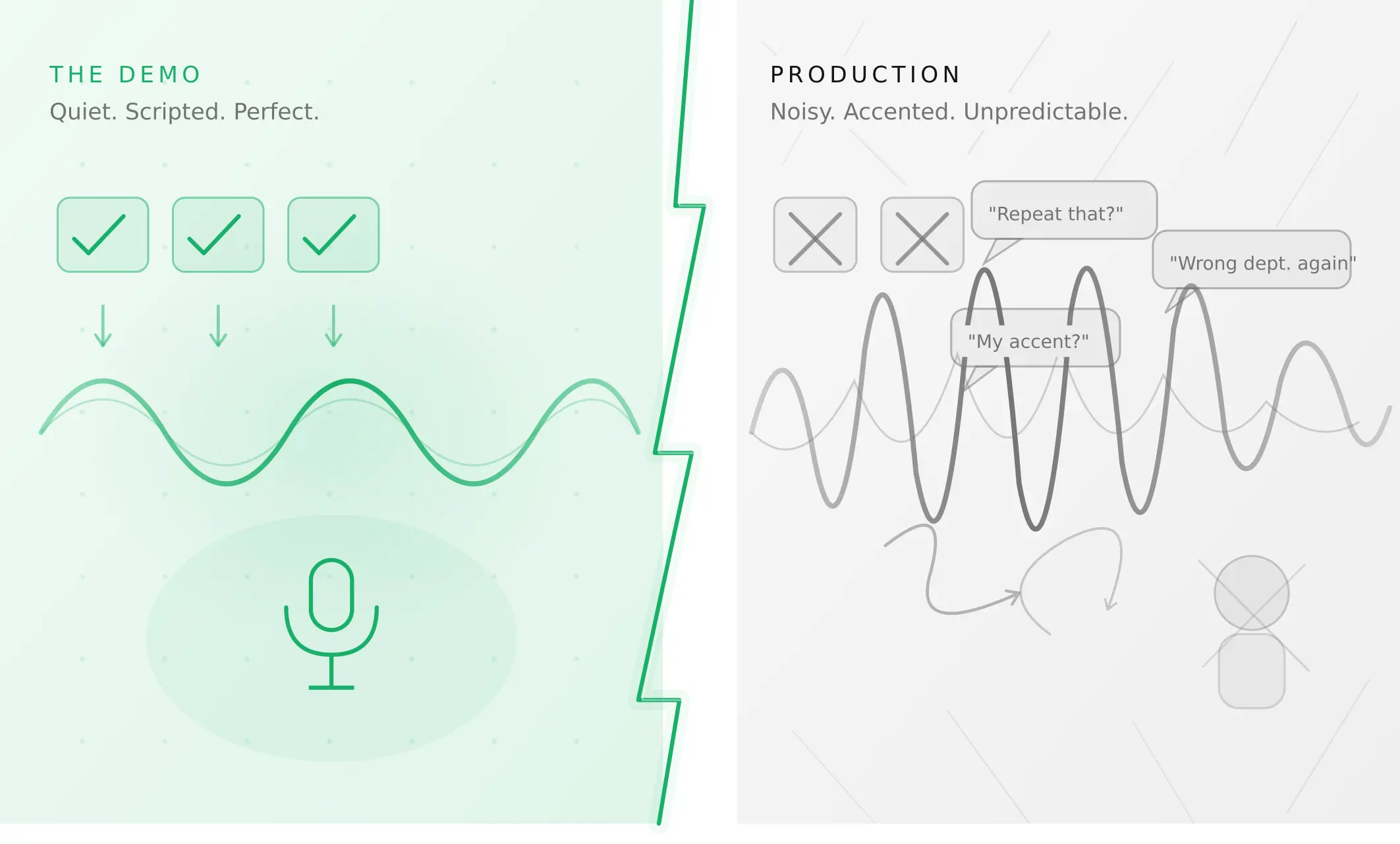
Why AI voice agents fail in production (and how to prevent it)
AI voice agents that ace demos still break in production. Learn the 5 root causes, how to test for each, and what production readiness actually means.
Read more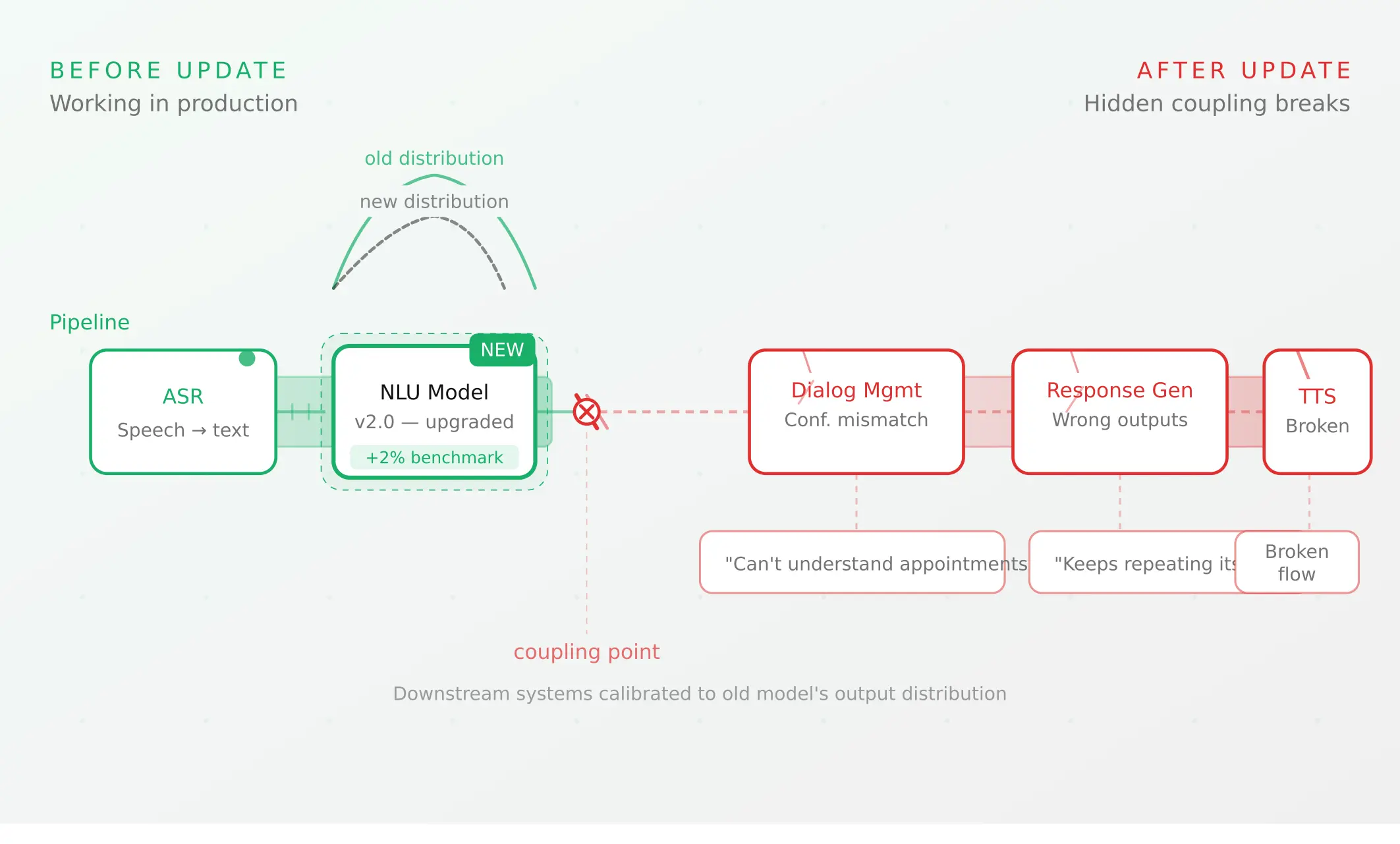
Voice agent regression testing: why LLM updates break production
LLM updates improve benchmarks but break voice agents in 5 predictable ways. How to detect and prevent regressions after every model or prompt change.
Read more