Voice agent prompt comparison: how to test prompt changes side by side
On this page
Prompts are the most-edited part of a voice agent and the easiest to break. A small wording change to fix one flow can degrade three others, and you rarely notice until callers do. Prompt comparison makes every change measurable: run the old and new prompt on identical calls and read the difference. This guide covers the method, the metrics, and the tooling.
Evalgent runs this comparison offline, so we will be concrete about how it works. First, the concept.
What is voice agent prompt comparison?
Voice agent prompt comparison: running two versions of a prompt against the same set of calls, changing nothing else, and measuring which version performs better.
The idea borrows from A/B testing, applied to the prompt. You treat the current prompt as the control and the edited prompt as the variant. Both run against an identical scenario set, so any difference in results comes from the prompt, not the calls.
This matters because prompts are deceptively fragile. A change that reads as an improvement can shift how the model handles an edge case you were not thinking about. Comparison replaces "this reads better" with "this measurably performs better."
How do you compare two voice agent prompts?
The structure is a clean, repeatable experiment. Keep everything constant except the prompt.
1. Set the control and variant: the current prompt and the edited one.
2. Fix the model and scenarios: same model, same calls, via synthetic callers.
3. Run both prompts: execute the identical scenario set against each.
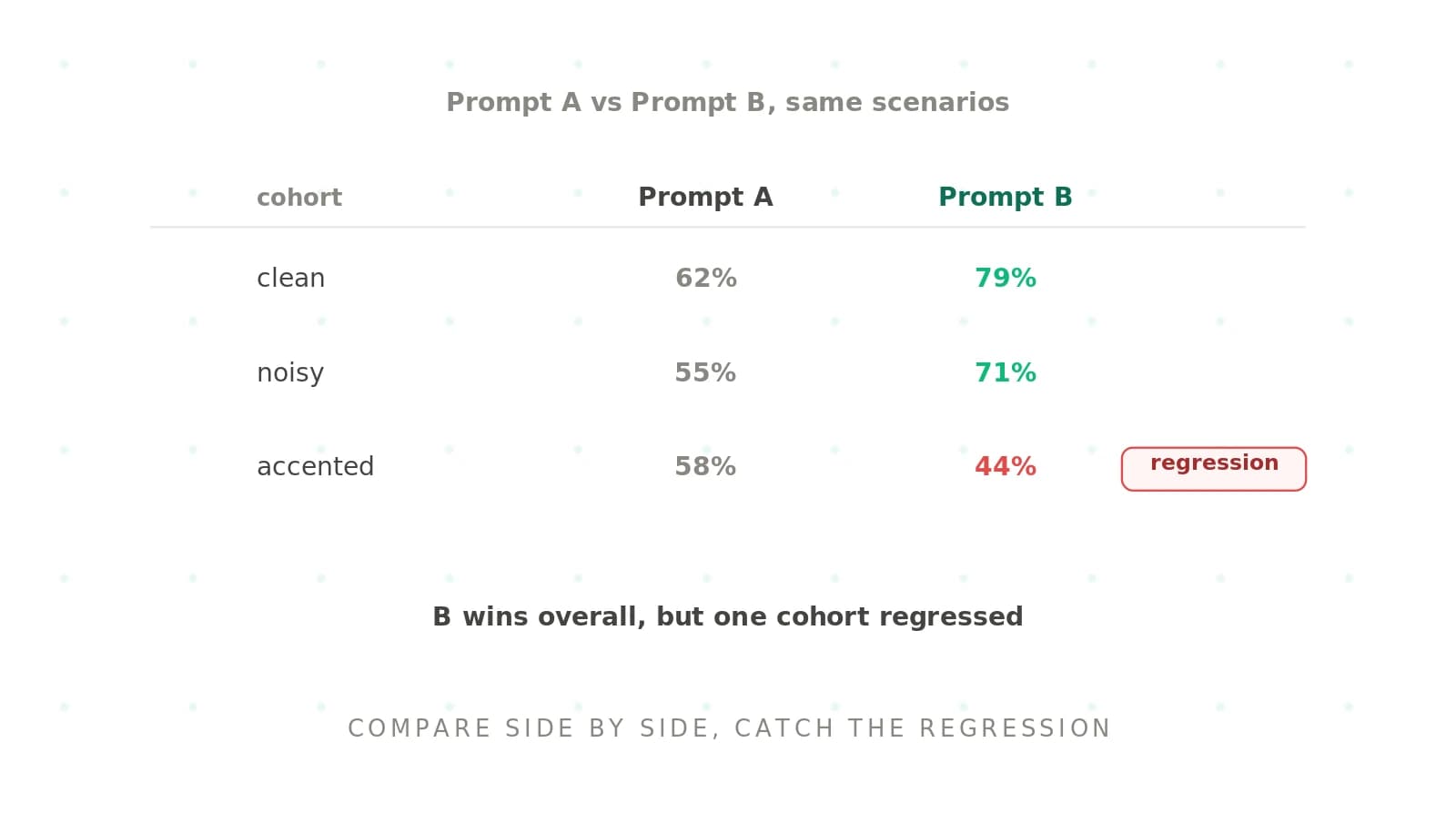
4. Compare metrics: task completion, adherence, and latency, per cohort.
5. Read the diff: where did the variant win, and where did it regress?
6. Decide: promote the variant only if it wins without breaking anything.
Because the model and calls are fixed, the comparison isolates the prompt. This is the difference between hoping a prompt edit helped and knowing it did. The prompt that reads best and the prompt that performs best are often not the same one.
What tooling supports side-by-side prompt comparison?
The tooling has to do three things: hold the calls constant, run both prompts, and show the results side by side. Manual calling cannot do this reliably, because no human runs the exact same hundred calls twice.
Good side-by-side prompt comparison tooling replays an identical scenario set against each prompt version and reports the metrics together, so the diff is obvious. It should split results per cohort, surface regressions as prominently as gains, and let you listen to the specific calls where the prompts diverged. Without that, prompt testing stays subjective. You end up trusting whoever argues hardest, not the calls. Good tooling replaces that argument with a table of results both prompts earned on the same scenarios. The best LLM for voice agents guide covers the same tooling logic applied to models.
How do you catch voice agent prompt regressions?
Regressions are the real reason to compare. A prompt edit that lifts your target flow can silently break an unrelated one, and averages hide it. Comparison catches it by running the full scenario set, not just the flow you were editing.
Keep a stable regression suite of scenarios that never changes. Run it against both prompt versions on every edit. If the variant improves the target metric but drops on the regression suite, that is not an improvement, it is a trade you probably did not intend. This is the same discipline used for model-update regressions, applied to the prompt.
Prompt comparison vs A/B testing
These are close cousins, and the distinction is scope. A/B testing is the general method of comparing two versions. Prompt comparison is that method applied specifically to the prompt, with the model and everything else held constant.
You can run prompt comparison offline, against synthetic calls, or online, splitting live traffic. Offline is usually better for prompts, because you get a controlled result fast, without exposing real callers to a possibly worse prompt. For the broader technique across prompts, models, and voices, see our guide to A/B testing voice agents.
What metrics matter for prompt comparison?
Choose the deciding metric before you run, or you will rationalise whichever number looks good after. For most voice agents, a few metrics carry the decision.
- Task completion: did the caller reach their goal? Usually the primary metric.
- Instruction adherence: did the prompt keep the agent on policy and on script?
- Latency: longer prompts can slow the first response; watch for it.
- Escalation accuracy: did required hand-offs still fire?
- Per-cohort splits: did the winning prompt win across accents, or only on easy calls?
Read them together. A prompt that lifts completion but weakens adherence may fail a compliance check that matters more than the completion gain. Rank the metrics before you run, so a close call has a clear tiebreaker.
How do you version voice agent prompts?
Comparison is only trustworthy if you know exactly what changed. Voice agent prompt versioning means tracking each prompt as a distinct, labelled version, so every comparison references a specific control and variant.
Keep prompts in version control, tag each one, and record which version passed which tests. When you compare, reference the versions by tag, not by memory. This gives you an audit trail: you can see which prompt version is in production, what it beat, and roll back cleanly if a later change regresses. Anthropic's prompt engineering guidance is a good reference for writing the prompts you then compare.
Building prompt comparison into your release process
Make comparison the default, not a special event. Every time you compare voice agent prompts, you learn something. Skip it, and you ship on hope.
A few habits make prompt testing voice agents dependable. Keep a fixed holdout set of scenarios. Never tune against it. It measures honest generalisation, not overfitting. Run prompt regression testing on every edit. Then an unrelated flow cannot break unnoticed. Treat prompt evaluation voice agents as a gate, not a report. A prompt that fails the gate does not ship.
Tie each comparison to a decision. Did the variant win? Promote it. Did it regress? Reject it. Was it a wash? Iterate. There is no fourth option that quietly ships an unmeasured prompt.
Scale changes the math. A small team can compare prompts by hand, badly. A growing one cannot. Automated comparison turns a slow, subjective chore into a fast, repeatable step. That speed is what makes the discipline stick. A test nobody runs protects nobody.
The payoff compounds. Each comparison adds to a record of what works. Over months, that record is worth more than any single prompt. New teammates inherit the knowledge instead of relearning it. When something regresses, you have the history to find what changed.
Keep the scenarios honest. If they do not reflect real callers, a winning prompt can still lose in production. Refresh them from real call patterns. Re-run old comparisons when your traffic shifts. The prompt that won last quarter may not win on this quarter's calls.
Comparing prompts with Evalgent
Evalgent is built to run this comparison before release. It holds the calls constant and runs each prompt version against them. Scenarios define the fixed call set. Profiles vary caller accents and behaviour so results split per cohort. Metrics score task completion, adherence, and latency with custom thresholds. Evaluations run the identical batch against control and variant, and Reviews let your team hear the exact calls where the two prompts diverged.
The result is a side-by-side verdict with a clear winner, produced offline instead of on live callers. You change the prompt, re-run the same calls, and promote the version only if it wins without regressing. For the wider discipline, see the ai voice agent testing pillar. Prompt engineering gets you a candidate. Comparison tells you whether to ship it. One writes the prompt; the other proves it earns its place in production.
Frequently asked questions
What is voice agent prompt comparison?
Voice agent prompt comparison is running two versions of a prompt against the same set of calls and measuring which performs better. You keep the model and scenarios constant and change only the prompt, so any difference in results comes from the prompt. It turns a subjective "this reads better" edit into a measured decision about task completion and adherence.
How do you compare two voice agent prompts?
Compare two voice agent prompts by setting the current prompt as control and the edited one as variant, fixing the model and scenario set, and running the identical calls against each. Then compare task completion, adherence, and latency per cohort, and read where the variant won or regressed. Synthetic callers keep the calls identical, which is what isolates the prompt.
What tooling supports side-by-side prompt comparison?
Side-by-side prompt comparison needs tooling that replays an identical scenario set against each prompt version and reports the metrics together. It should split results per cohort, surface regressions as clearly as gains, and let you listen to the calls where the prompts diverged. Manual calling cannot do this, because no one runs the exact same calls twice against both prompts.
How do you test a voice agent prompt change?
Test a voice agent prompt change by comparing it against the current prompt on the same calls, not by spot-checking a few conversations. Run both versions through a fixed scenario set including a regression suite, then compare metrics per cohort. Promote the change only if it improves the target metric without dropping on the regressions. This catches the side effects a small edit can cause.
Prompt comparison vs A/B testing: what is the difference?
A/B testing is the general method of comparing two versions of anything; prompt comparison applies it specifically to the prompt, holding the model and everything else constant. Prompt comparison is usually run offline against synthetic calls, which gives a controlled result fast without exposing real callers to a possibly worse prompt. Both use the same core logic of one variable at a time.
How do you catch voice agent prompt regressions?
Catch prompt regressions by running a stable regression suite of scenarios against both prompt versions on every edit. A prompt change that improves your target flow can silently break an unrelated one, and averages hide it. If the variant improves the target metric but drops on the regression suite, treat that as a trade-off to reject, not an improvement to ship.
How do you version voice agent prompts?
Version voice agent prompts by keeping them in version control, tagging each distinct prompt, and recording which version passed which tests. When you compare, reference prompts by tag rather than memory. This gives an audit trail of what is in production, what it beat, and lets you roll back cleanly when a later change regresses. Versioning makes every comparison reproducible.
How do you evaluate a system prompt for a voice agent?
Evaluate a system prompt by running it against a representative scenario set and scoring task completion, adherence, and escalation accuracy per cohort, then comparing it to the current prompt. A system prompt evaluation is only meaningful against a baseline, so always compare rather than judging one prompt in isolation. Use synthetic callers so the evaluation runs on realistic, repeatable calls.
Conclusion
Prompt comparison turns prompt editing from guesswork into measurement. Run the old and new prompt on the same calls, hold everything else constant, and let the metrics, including regressions, decide.
Never promote a prompt on how it reads. Promote it because it beat the current one on the calls that matter, without breaking anything you were not watching.
Related Articles
How to automate voice agent testing: synthetic callers vs manual QA
Learn how ai test automation replaces manual QA for voice agents. Compare synthetic callers vs human testers, with a 5-step framework to scale without hiring.
Read more
AI Agent Testing vs Voice Agent Testing: What General Tools Miss for Voice
AI agent testing measures text outputs. Voice agent testing measures behaviour through an acoustic pipeline. Five failure categories general tools miss.
Read more