Test your voice agent
How to Measure Hallucination Rate for Voice Agents
# How to Measure Hallucination Rate for Voice Agents
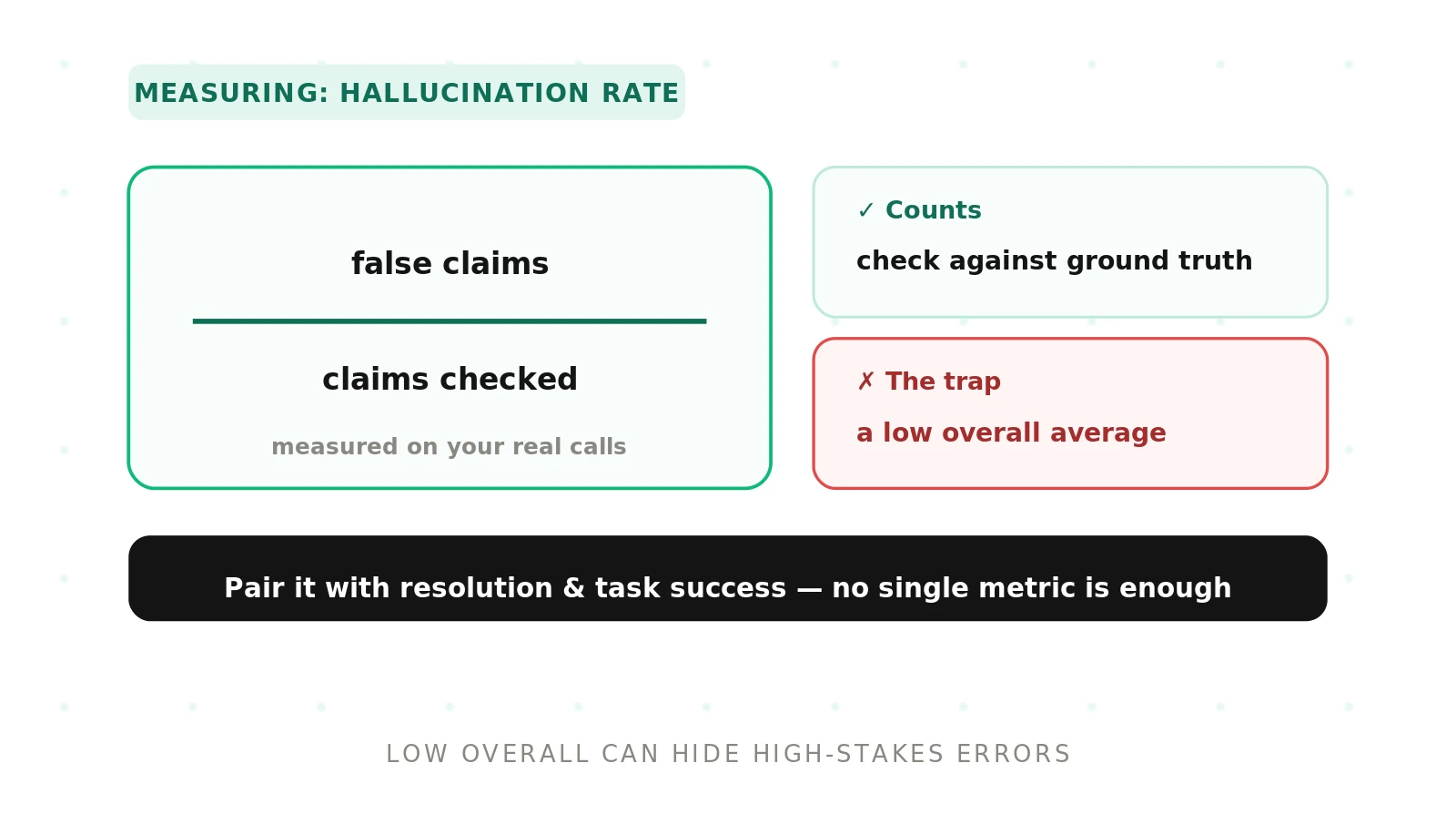
> Quick answer: Hallucination rate for voice agents is the share of checkable statements the agent gets wrong, measured against ground truth. Define what counts as false, pick a unit like per call or per claim, sample real calls, label each claim, and track the rate over time.
A voice agent that sounds confident is not the same as a voice agent that is correct. Callers cannot see a citation or hover over a source. They hear a fluent answer and act on it. When that answer is fabricated, the cost lands on the customer and on you.
This post is the measurement how-to. It shows how to turn "the agent sometimes makes things up" into a number you can report, defend, and reduce. If you want the causes of hallucination and qualitative test design, read our guide to hallucinations in voice agents. If you want to prove answers come from your knowledge base, read how to test knowledge grounding. Here, the focus is the rate itself.
What counts as a hallucination in a voice agent
A hallucination) is a confident statement that is false or unsupported. The research literature on hallucination in language generation draws the same line: fluent output is not the same as faithful output. For a voice agent, the definition has to be operational, not philosophical. You are going to label thousands of statements, so the rule needs to be something two people apply the same way.
> Hallucination (voice agent): a factual claim the agent states as true that contradicts ground truth or has no support in your approved sources. Tone, phrasing, and politeness do not matter; only the truth of the claim does.
Draw a line between a hallucination and other errors. A hallucination is a false claim. A refusal to answer is not a hallucination. A correct answer delivered rudely is not a hallucination. A transcription error that changes a word is a speech problem, not a reasoning problem, though it can trigger one. Keeping these separate stops your rate from becoming a catch-all for everything that annoyed a reviewer.
Three common types show up in production. Fabricated facts are invented details, like a store hour or a tracking status that does not exist. Wrong policy is a real rule stated incorrectly, like promising a refund window that your terms do not offer. Invented prices are numbers the agent generates rather than retrieves. Each type needs a different source of truth to check against, which is why classification matters before counting.
Why ground truth comes first
You cannot measure wrongness without a definition of right. Ground truth is the reference answer you compare the agent against. Without it, a reviewer is just guessing, and two reviewers will guess differently.
Ground truth for a voice agent usually comes from three places. The first is your system of record: order databases, account systems, pricing tables. These give exact answers for account-specific claims. The second is your policy and knowledge base: the documents the agent is supposed to draw from. The third is subject-matter experts for judgment calls that no document settles cleanly.
Store ground truth as structured, checkable entries, not prose. For every test scenario, record the question, the correct answer, the source, and the date it was verified. This turns fact-checking from an opinion into a lookup. It also lets you re-verify when policies change, so your reference does not quietly go stale while the agent stays the same.
Ground truth for account-specific claims is dynamic. A balance or a delivery date is only true at a moment in time. Capture the value the agent should have returned at the moment of the call, not the value today, or you will score correct answers as wrong.
The one thing to decide first: the unit
The most important choice in measuring hallucination rate is the denominator. The same set of calls can produce very different rates depending on what you divide by. Pick the unit before you label anything.
There are three practical units.
Per call is the share of calls that contain at least one hallucination. It is easy to explain to executives and maps to customer harm, since one false claim can ruin a call. It hides how many errors a bad call contained.
Per factual claim is the share of checkable statements that are false. This is the most precise unit and the one most comparable across agents, because it normalizes for how talkative an agent is. It requires you to extract and count every claim, which is more labeling work.
Per turn is the share of agent turns that contain a hallucination. It sits between the other two and is useful when your logging is turn-based. It can undercount turns that pack several claims into one long answer.
Most teams should report per factual claim as the primary metric and per call as a secondary, business-facing number. Per claim tells engineers where the model breaks. Per call tells leadership how often a customer was misled. Reporting both stops either from being gamed.
Comparison: hallucination types and how to detect each
Different hallucination types need different checks. A price is verified against a table; a policy claim needs a document match; a judgment call needs a human. Use this table to route each labeled claim to the right detection method. All examples below are illustrative.
| Hallucination type | Example (illustrative) | Source of truth | How to detect it |
|---|---|---|---|
| Fabricated fact | "Your package was delivered at 2pm." | System of record | Compare claim to database value at call time |
| Wrong policy | "You have 90 days to return this." | Policy or knowledge base | Match claim against the governing document clause |
| Invented price | "That plan is $19 a month." | Pricing table | Exact-match number to current price entry |
| Overconfident guess | "Yes, that's covered under your plan." | Account or policy data | Check whether support existed for the specific account |
| Unsupported inference | "Since you're a member, shipping is free." | Business rules | Verify the rule chain the agent implied is real |
| Stale fact | "We're open until 9pm today." | Live hours or calendar | Compare to the value valid on the call date |
How to measure hallucination rate for voice agents
Follow these steps in order. Each one feeds the next, and skipping the early ones makes the later numbers meaningless.
1. Write the labeling rule. Define a hallucination in one operational sentence, list the types you will track, and write two or three edge-case examples. This rule is what makes two reviewers agree.
2. Choose the unit. Decide on per factual claim as primary and per call as secondary. Fix the denominator now so every later number is comparable.
3. Assemble ground truth. Pull correct answers from your systems of record, policy documents, and experts. Store each as question, answer, source, and verification date.
4. Sample real calls. Draw a random sample) of production calls, then add a targeted sample of high-stakes calls. Random keeps the overall rate honest; targeted protects against rare, costly errors.
5. Extract every factual claim. For each sampled call, list the checkable statements the agent made. Ignore greetings, empathy, and questions back to the caller.
6. Label each claim against ground truth. Mark each claim true, false, or unverifiable. Record the type and the source you checked. Send genuine ambiguity to an expert.
7. Compute the rate. Divide false claims by total checkable claims for the per-claim rate. Divide calls with any hallucination by total calls for the per-call rate.
8. Segment by stakes and topic. Break the rate out by high-stakes claims, by intent, and by knowledge area. A safe overall number can hide a dangerous segment.
9. Report a confidence interval. State the sample size and the margin of error. A rate with no interval invites false precision, especially on small samples.
10. Re-run on a fixed schedule and after every change. Repeat the same sample and labeling process weekly and after each model or prompt update, so movement is a signal, not noise.
Sampling and labeling without fooling yourself
Sampling decides whether your rate reflects reality. A convenience sample of the calls you happened to notice will overstate or understate the truth in ways you cannot predict. Use a defined sampling) frame instead.
Combine two samples. A random sample of all calls gives an unbiased overall rate. A stratified sample that oversamples high-stakes intents, like billing or eligibility, gives enough volume to measure the segments that matter most. Report them separately so the oversampling does not distort the headline number.
Sample size drives your confidence interval. A rate measured on 50 calls has a wide margin; the same rate on 500 is far tighter. If you need to detect a change from 3 percent to 2 percent, a few dozen calls will never show it. Decide the smallest change you care about, then size the sample to see it.
Labeling quality decides everything downstream. Have two reviewers label an overlapping subset and measure their agreement. Low agreement means your rule is vague, not that reviewers are careless. Fix the rule, add examples, and relabel. This is also where an independent evaluator earns its keep: the team that built the agent tends to read ambiguous claims generously.
Decide upfront how audio factors in. Some hallucinations only appear when you hear the call, because the transcript smoothed over a hesitation or a hedge. For high-stakes segments, label from audio, not text alone. Our comparison of transcript versus audio evaluation covers when each is enough.
Why a low overall rate can hide a high-stakes problem
A single blended number is the most dangerous way to report hallucination rate. Imagine an agent with a 1 percent overall rate. That looks excellent. Now split it: the rate on hours-and-location questions is 0.2 percent, but the rate on refund-eligibility claims is 6 percent. The blended number is low only because most calls are low-stakes.
The harm of a hallucination is not evenly distributed. Getting a store's hours wrong is a minor annoyance. Telling a caller a medical or financial claim is covered when it is not can trigger a complaint, a chargeback, or a regulatory issue. A rate that averages these together buries the errors that actually cost you.
This is why segmentation is not optional. Always report the rate on your defined high-stakes claims separately, and hold that segment to a stricter threshold. A useful framing is that low-stakes claims can tolerate a small rate, while high-stakes claims should approach zero, and the two should never be summarized in the same figure. For how this fits a broader set of measures, see our voice agent metrics scorecard.
Connecting hallucination rate to precision and recall
Hallucination rate is closely tied to precision and recall, the standard measures for classification quality. Thinking in those terms sharpens what you are actually counting.
Treat "the agent should not have made this claim" as the condition you are detecting. Your labeling process is a detector. Precision asks: of the claims you flagged as hallucinations, how many really were? Recall asks: of all the real hallucinations in the sample, how many did you catch? A labeling process with poor recall will report a flattering, and wrong, low rate.
This matters because automated checks are seductive. An automated fact-checker that only catches obvious fabrications has high precision but low recall, so it underreports the true rate. When you use automation to scale labeling, measure its recall against a human-labeled gold set before you trust its numbers. Grounding your generated answers in retrieved sources, an approach known as retrieval-augmented generation, reduces hallucinations but does not remove them, so you still have to measure.
Tracking the rate over time and after model updates
A hallucination rate is only useful if you watch it move. A one-time audit tells you where you stand today; a tracked metric tells you whether you are getting better or worse, and warns you when something breaks.
Fix the method so the number is comparable across runs. Use the same unit, the same labeling rule, and a sample drawn the same way each period. If you change the rule, note the change and treat the before-and-after as different series. A rate that jumps because you redefined a hallucination is a measurement artifact, not a regression.
Model updates are the highest-risk moment. A provider's new model version can improve fluency while quietly changing what the agent claims. Re-run the full measurement immediately after any model, prompt, or knowledge-base change, and compare against the prior baseline. Benchmarking against your own data rather than a vendor's demo set is what makes this comparison meaningful.
Set thresholds and alerts, not just a dashboard. Define the overall and high-stakes rates you will not cross, and treat a breach as a release blocker. This is the difference between testing and evaluation: testing checks a build, while evaluation is the ongoing measurement that keeps the rate honest in production. For the wider practice, see our overview of voice agent evaluation.
Common mistakes that distort the rate
Counting unverifiable claims as correct inflates the score. If a claim cannot be checked against ground truth, mark it unverifiable and exclude it from the denominator, or you will paper over gaps in your reference data.
Measuring only on transcripts misses audio-only errors and speech-to-text artifacts that masquerade as hallucinations. Confirm on audio for high-stakes segments.
Letting the build team label their own agent introduces optimism bias. Ambiguous claims get read charitably. An outside reviewer, or at least a reviewer with no stake in the result, keeps the rate honest.
Reporting a rate with no sample size or interval invites overreaction to noise. A move from 2.0 to 2.4 percent on 100 calls is almost certainly within the margin. Always publish the interval.
Frequently asked questions
How do you measure hallucination rate for a voice agent?
Define what counts as a hallucination, choose a unit like per factual claim, and build ground truth from your systems and policies. Sample real calls, extract every checkable claim, and label each true or false against ground truth. Divide false claims by total claims, then report the rate with its sample size and confidence interval.
What counts as a hallucination in a voice agent?
A hallucination is a factual claim the agent states as true that contradicts ground truth or has no support in your approved sources. Fabricated facts, wrong policies, and invented prices all qualify. A refusal to answer, a rude tone, or a transcription slip is not a hallucination. Keeping these categories separate stops the rate from becoming a catch-all.
What is a good hallucination rate for a voice agent?
There is no universal number, because harm depends on the claim. A useful target is a low overall rate paired with a near-zero rate on high-stakes claims like eligibility, pricing, and policy. Judge the rate against your own baseline and against the cost of a single wrong answer, not against a vendor's headline figure.
How do you build ground truth to measure hallucinations?
Pull correct answers from three sources: systems of record for account facts, policy and knowledge documents for rules, and subject-matter experts for judgment calls. Store each entry as question, answer, source, and verification date. For account-specific claims, capture the value that was true at the moment of the call, since balances and delivery dates change over time.
Should you measure hallucination rate per call or per turn?
Measure per factual claim as your primary metric, because it normalizes for how talkative an agent is and compares cleanly across versions. Report per call as a secondary, business-facing number, since one false claim can harm a customer. Per turn is a reasonable middle option when your logging is turn-based but can undercount long, claim-dense answers.
How many calls do you need to measure hallucination rate?
Enough that your confidence interval is tight enough to act on. Fifty calls give a wide margin; several hundred give a usable one. Decide the smallest change you need to detect, then size the sample to see it. Add a targeted sample of high-stakes calls so rare but costly errors have enough volume to measure.
How do you track hallucination rate after a model update?
Re-run the full measurement immediately after any model, prompt, or knowledge-base change, using the same unit, rule, and sampling method as your baseline. Compare against the prior run and treat a breach of your threshold as a release blocker. Benchmark against your own data, not a demo set, so the comparison reflects real traffic.
Why can a low hallucination rate hide a high-risk problem?
A blended rate averages low-stakes and high-stakes claims together. An agent can post a 1 percent overall rate while getting refund eligibility wrong 6 percent of the time, because most calls are trivial questions. The harm is not evenly spread, so always report high-stakes segments separately and hold them to a stricter threshold.
The bottom line
Hallucination rate is only meaningful when you fix the definition, the unit, and the ground truth before you count. A low overall number means little until you segment it and hold high-stakes claims to a near-zero standard.
Ready to put a defensible number on how often your voice agent states something false? Book a demo and see how Evalgent, as an independent evaluator, measures and tracks hallucination rate against your own ground truth.
Related Articles
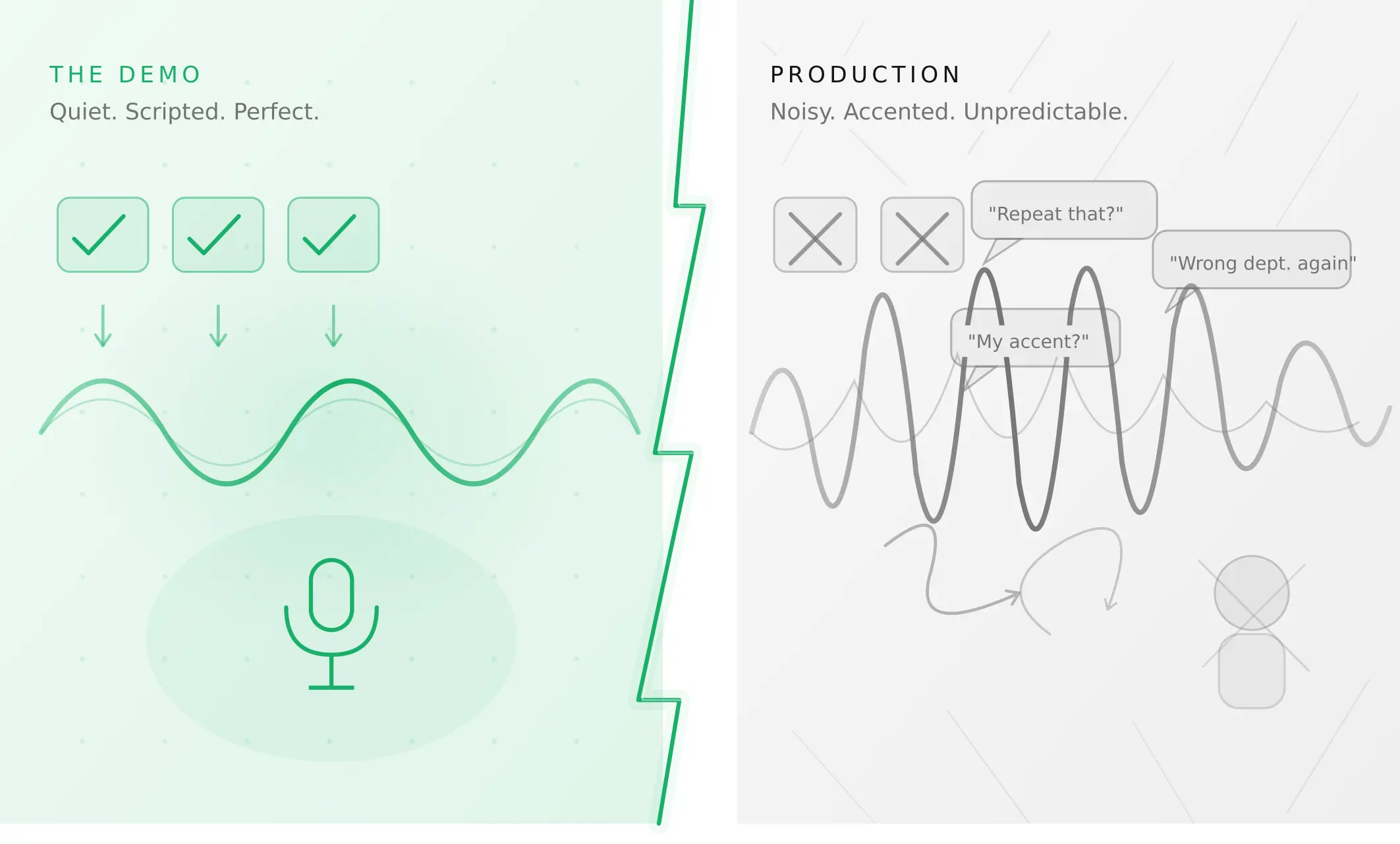
Why AI voice agents fail in production (and how to prevent it)
AI voice agents that ace demos still break in production. Learn the 5 root causes, how to test for each, and what production readiness actually means.
Read more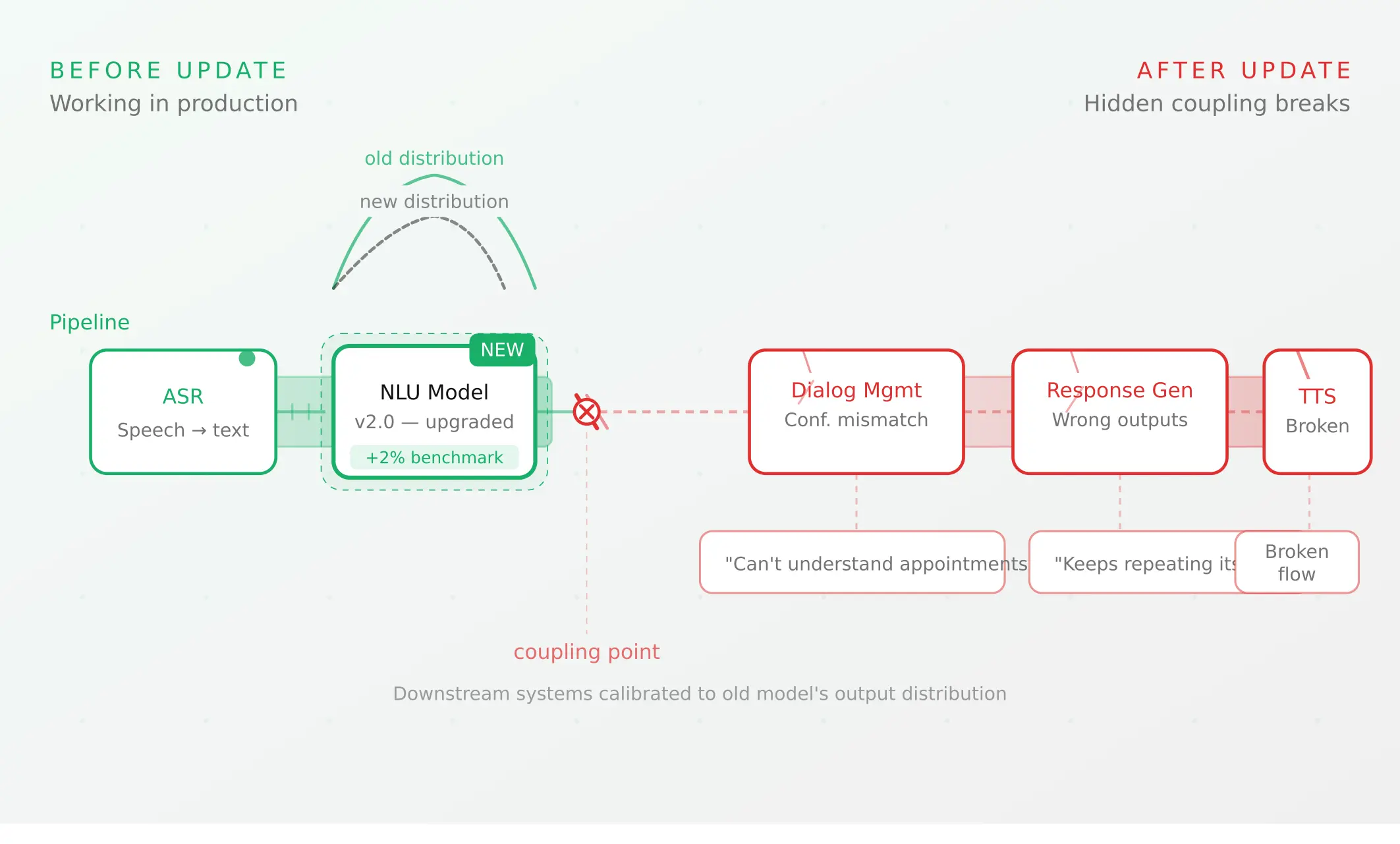
Voice agent regression testing: why LLM updates break production
LLM updates improve benchmarks but break voice agents in 5 predictable ways. How to detect and prevent regressions after every model or prompt change.
Read more