Barge-in vs turn-taking: what's the difference in a voice agent?
On this page
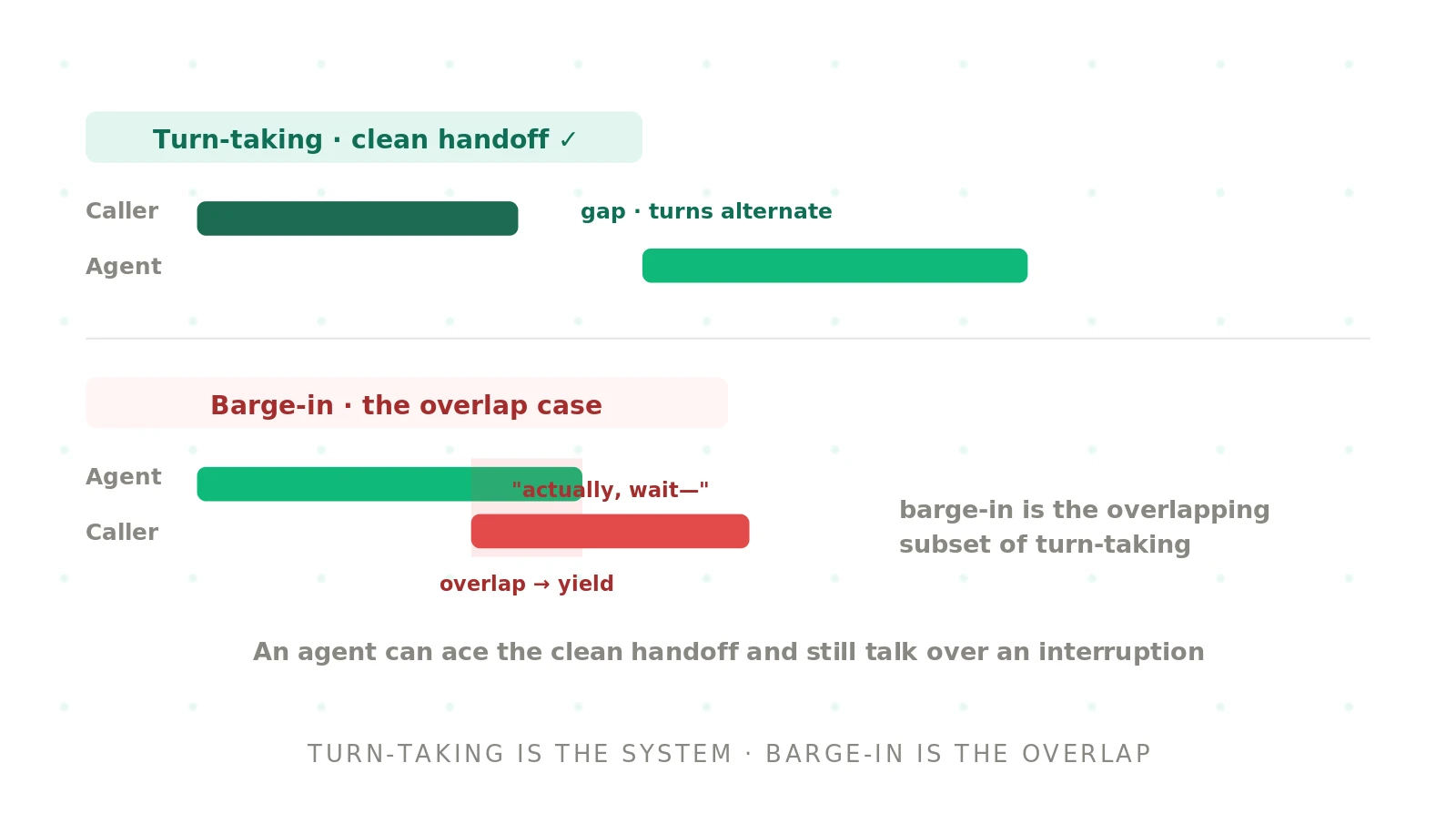
Barge-in and turn-taking get used as if they were the same thing, and it hides a real gap: an agent that takes turns smoothly can still fall apart the moment a caller interrupts. Turn-taking is the broad capability of alternating speech; barge-in is one difficult case inside it, where the turns overlap instead of alternating cleanly. Knowing that barge-in lives inside turn-taking — and is the part most likely to break — is what tells you where to look when the conversation feels off. Evalgent tests both, and this guide draws the line.
Turn-taking: the management of whose turn it is to speak — the handoff between caller and agent across the whole conversation.
Barge-in: the specific case where a caller starts speaking while the agent is still talking, requiring the agent to stop mid-turn.
Barge-in vs turn-taking: the core difference
The clearest way to separate them is scope. Turn-taking is the whole handoff system; barge-in is one case within it — the overlapping one.
| Dimension | Turn-taking | Barge-in |
|---|---|---|
| Scope | The whole handoff system | One case inside turn-taking |
| The situation | Turns alternate cleanly | Turns overlap |
| Core mechanism | Endpointing — detecting turn end | Yielding — stopping mid-speech |
| Failure | Cuts off or leaves gaps | Talks over the interrupting caller |
| Difficulty | The baseline | The hard case |
Turn-taking, in the clean case, is about detecting when the caller has finished so the agent can respond — that is endpointing. Barge-in is what happens when the caller does not wait for a clean handoff and starts speaking over the agent, so the agent has to yield in the middle of its own turn. One is orderly; the other is a collision.
How they relate
Barge-in is a subset of turn-taking, which is exactly why they blur. Good turn-taking has to handle both the clean handoff and the interruption, so barge-in is one of the cases turn-taking is responsible for. When people say an agent "handles turn-taking," they often mean only the clean case — the agent waits, then responds — without the overlap.
The clean case leans on endpointing: deciding when the caller's turn is over, which itself builds on voice-activity detection, a relationship our VAD vs endpointing guide covers. Barge-in leans on something different — the ability to listen while speaking and stop quickly, which usually means full-duplex audio. So the two halves of turn-taking rest on different machinery, and an agent can have one without the other.
Why the distinction matters
The reason to keep them separate is that an agent can pass clean turn-taking and still fail barge-in, and the two failures point at different fixes. A turn-taking failure in the clean case looks like cutting the caller off on a pause or leaving an awkward gap after they finish — an endpointing problem. A barge-in failure looks like the agent plowing ahead while the caller is trying to interrupt — a yielding problem, often from a half-duplex pipeline that cannot listen while it talks.
Test only the clean handoff and you will ship an agent that seems fine in a scripted demo and frustrates real callers the moment they cut in. Because interruptions are constant in real conversation, barge-in is not an edge case you can skip — it is the part of turn-taking most likely to break. Our barge-in guide covers that case in depth, and our endpointing guide covers the clean handoff.
How to get turn-taking and barge-in right
Build the clean handoff and the overlap case as two capabilities, and test both.
1. Detect the turn end — Use endpointing so the agent responds when the caller genuinely finishes, not on a pause.
2. Tune the clean handoff — Avoid both cutting off and long gaps, adapting to the caller's pace.
3. Enable listening while speaking — Use full-duplex audio so the agent can hear a caller who cuts in.
4. Yield fast on barge-in — Stop the agent's speech promptly when a real interruption is detected.
5. Distinguish backchannels — Keep talking through "mhmm" and "okay," which are not true interruptions.
6. Test both cases — Verify clean handoffs and interruptions separately, and diagnose failures by which one broke.
A worked example
Two moments on the same call. First, the caller finishes a sentence and pauses; the agent waits the right beat and responds. That is turn-taking working in the clean case — a good handoff via endpointing. Second, a minute later, the caller cuts in mid-response with "actually, wait—" while the agent is still talking. Now the agent has to stop instantly and listen. That is barge-in. An agent can ace the first moment and fail the second, talking over the caller because it cannot yield mid-turn. Same conversation, two different capabilities — which is the whole distinction.
Testing turn-taking and barge-in with Evalgent
Evalgent tests the whole handoff and the hard overlap case, separately. Scenarios include clean turns with natural pauses and deliberate interruptions where the caller cuts in mid-response, so both halves of turn-taking are exercised. Profiles vary caller pace, interruption style, and noise over real audio, since timing is where both cases show their cracks. Metrics track clean-handoff behavior — premature cutoffs and end-of-turn latency — separately from barge-in — whether the agent yielded and how fast — so a failure points at the right layer. Evaluations run the suite as automated batches before release, and Reviews let you replay a mistimed turn or a talk-over to hear exactly what happened.
The result is turn-taking that holds up in real conversation, not just a scripted demo: clean handoffs when the caller waits, and a clean yield when they do not. For full-duplex behavior, see full-duplex voice agents, and for the wider discipline the AI voice agent testing pillar.
The bottom line
Turn-taking is the whole system of managing whose turn it is to speak; barge-in is the specific overlapping case where the caller cuts in while the agent is talking. Barge-in lives inside turn-taking, and it is the part most likely to break.
Test them separately. An agent that handles clean handoffs can still talk over an interrupting caller, and only pulling the two apart tells you whether the problem is the handoff or the yield.
Frequently asked questions
What is the difference between barge-in and turn-taking?
Turn-taking is the whole system of managing whose turn it is to speak — the handoff between caller and agent across the conversation. Barge-in is the specific case where a caller starts talking while the agent is still speaking, requiring the agent to stop mid-turn. Barge-in is a subset of turn-taking: the hard, overlapping case rather than the clean handoff.
Is barge-in part of turn-taking?
Yes. Turn-taking covers both the clean case, where turns alternate and the agent responds after the caller finishes, and the overlap case, where the caller interrupts mid-response. Barge-in is that overlap case. Good turn-taking has to handle both, but people often mean only the clean handoff when they say an agent "does turn-taking," leaving barge-in untested.
Why can an agent handle turn-taking but not barge-in?
Because the two cases rest on different machinery. Clean turn-taking relies on endpointing — detecting when the caller has finished. Barge-in relies on listening while speaking and stopping fast, which usually needs full-duplex audio. An agent with good endpointing but a half-duplex pipeline handles clean handoffs yet cannot yield when a caller cuts in, so it talks over them.
What is barge-in in a voice agent?
Barge-in is when a caller starts speaking while the agent is still talking, and the agent is expected to stop and listen — the way a person yields when interrupted. It is the overlapping case of turn-taking. Without it, the agent plows ahead over the caller, which feels robotic and frustrates people trying to correct or redirect the conversation.
What is turn-taking in a voice agent?
Turn-taking is how a voice agent manages whose turn it is to speak — waiting for the caller to finish, then responding, and yielding when the caller interrupts. It spans the clean handoff, handled by endpointing, and the overlap case, handled by barge-in. Good turn-taking makes a call feel like a natural conversation rather than two parties talking past each other.
How do you test barge-in and turn-taking?
Test them as separate cases. For clean turn-taking, run scenarios with natural pauses and assert the agent responds at the real turn end without cutting off or leaving gaps. For barge-in, script interruptions where the caller cuts in mid-response and assert the agent stops promptly. Measure end-of-turn timing and yield speed separately, over real audio.
Is barge-in the same as interruption?
Effectively, yes. Barge-in is the technical term for a caller interrupting the agent while it is speaking, which is a specific turn-taking event. "Interruption" is the everyday word for the same thing. Both are distinct from context — whether the agent remembers what the caller said during the interruption — which is a separate capability from the turn-taking timing itself.
Does full-duplex improve turn-taking?
It mainly improves the barge-in case. Full-duplex audio lets the agent listen while it speaks, so it can detect and yield to a caller who cuts in — which a half-duplex pipeline cannot. It does not automatically fix the clean handoff, which still depends on endpointing. So full-duplex helps the overlap half of turn-taking most, and both halves still need testing.
Related guides
Testing vs evaluation for voice agents: what's the difference?
Testing and evaluation for voice agents are related but distinct: testing verifies behavior pass/fail, evaluation measures quality. Here's how they differ.
VAD vs endpointing: what's the difference in a voice agent?
VAD detects whether someone is speaking; endpointing decides when they've finished. Learn the difference and why confusing them cuts callers off.