Open door for builders.
Jev as a Judge: A Calibrated Alternative to LLM-as-a-Judge
# Jev as a judge: a calibrated alternative to LLM-as-a-judge
Quick answer
Jev as a judge is a System One model that scores voice-agent calls with typed, calibrated verdicts. It replaces the noisy LLM-as-a-judge pattern for scale and consistency. Same call, same score, every run. It gives a calibrated number, not prose, so keep an LLM or humans for explained rationale.
Most teams grade voice agents with an LLM-as-a-judge. That judge is slow, pricey, and inconsistent. A judge that scores the same call differently on reruns is broken. Jev fixes the consistency and cost problem. It does not explain itself, so it is a trade, not a free win.
Jev launched on September 15, 2026, in early access. TypeSafe AI calls it the first "System One Model." It is not a language model. You send it a state and questions. It returns decisions. This post covers jev as a judge for voice agents: what the judge pattern is, why a judge benefits from Jev, and how to build one you can trust.
What is the LLM-as-a-judge pattern?
LLM-as-a-judge is a well-known evaluation technique. You give a large language model a rubric and a transcript. The model reads both. It returns a score or a verdict, often with a written explanation.
> LLM-as-a-judge: an evaluation method where a language model scores another model's output against a rubric. The judge acts as a stand-in for a human grader at machine speed.
Teams use it because it scales past manual review. One human can grade maybe 40 calls a day. An LLM judge can grade thousands. That is the appeal.
The pattern has three known weaknesses for voice agents. First, the judge drifts. The same transcript can earn a 7 on one run and a 5 on the next. Second, the judge is costly per call. Grading every call gets expensive fast. Third, the judge can hallucinate a reason that sounds right but is wrong.
Our deeper look at LLM-as-judge limits covers why these failures matter for release gates. The short version: a judge you cannot reproduce is hard to defend. If a vendor disputes a score, "the model felt it was a 5" is not evidence.
Why a judge specifically benefits from Jev (jev as a judge)
A judge has one job. It must turn a call into a reliable verdict. Three properties make a judge trustworthy: consistency, calibration, and coverage. Jev is strong on all three.
Consistency comes first. Jev is deterministic. The same state produces the same score. There is no run-to-run drift. A judge that wobbles is not really a judge. It is a random number generator with a rubric. Determinism is what makes a verdict auditable. You can read more on determinism and why it anchors reproducible measurement.
Calibration comes second. Jev returns calibrated confidence with every decision. Higher confidence means higher accuracy, on average. So you learn which verdicts to trust. You gate on it. High-confidence scores pass through. Low-confidence scores go to a person. See calibration in statistics) for the underlying idea.
Coverage comes third. Jev costs $0.042 per million input tokens. Output is free. That is roughly 400x cheaper than an LLM on classification. So you stop sampling. You judge every call, not 2% of them. Speed helps too. Jev returns in 70 to 500 milliseconds, about 40 to 200x faster than an LLM judge.
Jev also cannot hallucinate a label. It has a 0% type-error rate. The schema constrains the output. A Score question can only return a valid level. A Choice question can only return one of your options. The judge cannot invent a category that does not exist.
There are three question types. A judge maps cleanly onto all three.
- Choice: pick 1 of up to 255 options. Use it for outcome labels, like "resolved," "escalated," or "abandoned."
- Score: an ordered level with a continuous score and a distribution. Use it for quality on a rubric, like empathy or clarity.
- Noul: a yes/no probability. Use it for pass/fail gates, like "followed the disclosure policy."
Each returns a probability and calibrated confidence. You can ask many questions about one state in a single call. So one judge pass can score outcome, quality, and every policy check at once. Our Jev voice agent metrics catalog maps common rubrics to these types.
Jev was trained with RLCD. It complements language models. TypeSafe frames it as a tool to "score, judge, verify, guardrail." LangChain published a study on building a harness with Jev as an agent evaluator. The TypeSafe docs cover the API surface.
Jev as a judge vs LLM-as-a-judge
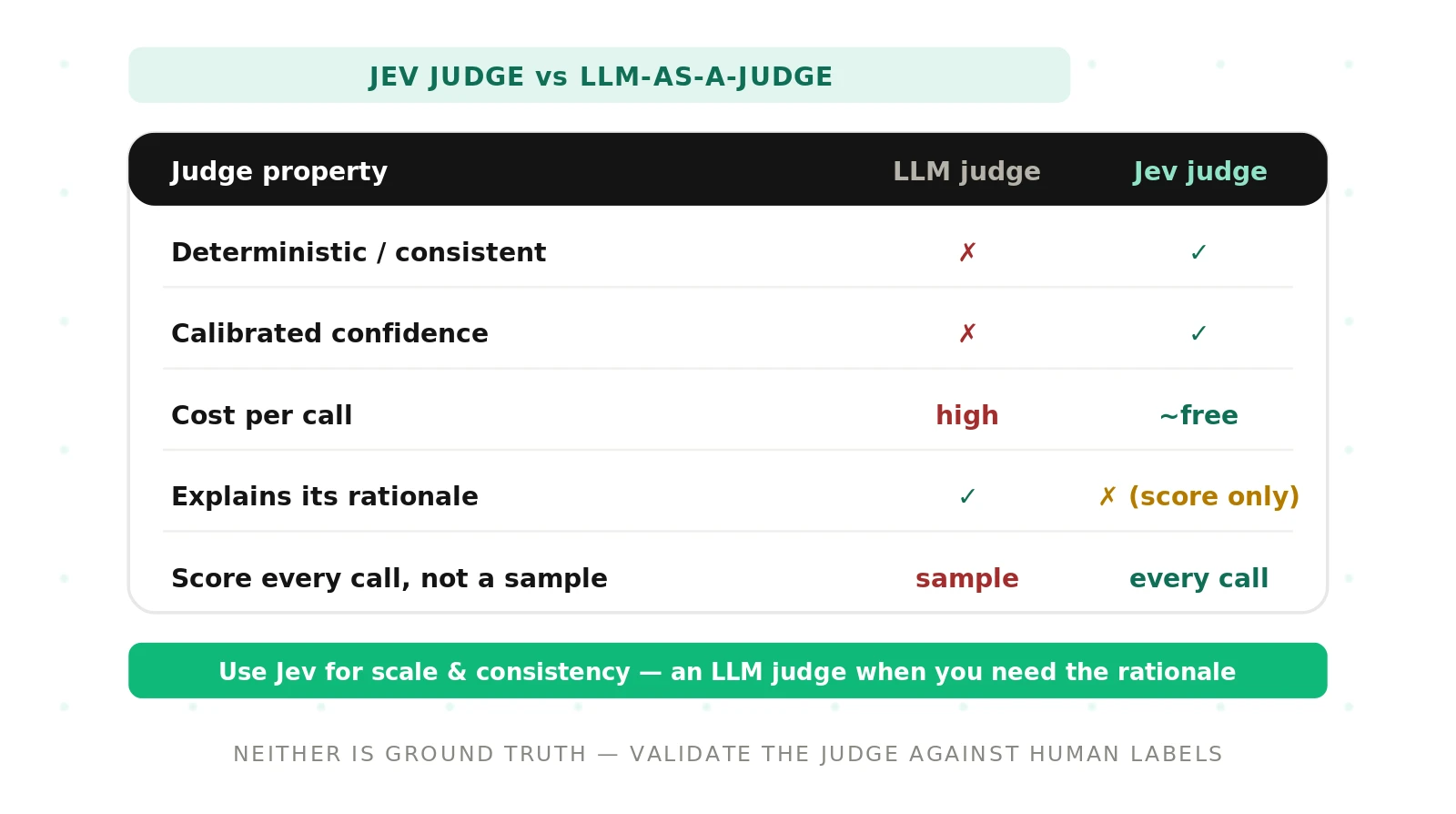
The table below compares the two judges on the properties that matter for a judge. It is not a general model comparison. It is scoped to the judging job.
| Judge property | LLM-as-a-judge | Jev-as-a-judge | Why it matters for a judge |
|---|---|---|---|
| Determinism / consistency | Non-deterministic; scores drift run to run | Deterministic; same state, same score | A judge that reruns to a different verdict is not defensible |
| Calibrated confidence | Rarely calibrated; confidence is prose, not a number | Calibrated confidence per decision | Tells you which verdicts to trust and which to route to people |
| Cost per call | High; sampling is common | $0.042/MTok in, output free; ~400x cheaper | Cheap enough to judge every call, not a thin sample |
| Explanations / rationale | Writes a reason in plain language | No prose; a calibrated number or label only | Rationale is where the LLM judge still wins |
| Coverage / scale | Limited by cost and latency | 70–500ms; ~40–200x faster | Full-population scoring instead of a sample |
| Hallucination risk | Can invent a reason or a category | 0% type errors; schema-constrained | The verdict cannot break the rubric's shape |
The pattern is clear. Jev wins on consistency, cost, and coverage. The LLM judge wins on explanation. That trade drives the design below.
The honest trade-off: no rationale
Here is the caveat that most vendor decks skip. Jev does not explain its reasoning. It gives you a calibrated score or label. It does not write prose. An LLM judge can say "the agent interrupted the caller twice, so I marked empathy low." Jev cannot say that. It returns a number and a confidence.
That matters in specific cases. A disputed call needs a rationale. A new failure mode needs a human explanation. A regulator asking "why did this fail" needs words, not a float.
So the right design is a split. Use Jev for scale and consistency. Judge every call. Then keep an LLM judge, or humans, for the cases that need an explained rationale. The two are not rivals. They cover different needs. Our Jev versus LLM decision guide works through the combined pipeline in more depth.
Two more honest limits. Jev works on transcript or text state, not raw audio. You transcribe first, then judge. And calibrated is not the same as correct on any single call. Calibration is a property across many calls. The judge itself must still be validated against human labels. A confident wrong answer is possible. Calibration just makes it rare.
How to build a Jev judge for voice agents
This is the build path from rubric to production. Follow it in order. Each step de-risks the next.
1. Turn your rubric into Score, Noul, and Choice questions. Map each rubric line to a type. Quality dimensions become Score questions. Pass/fail policy checks become Noul questions. Outcome labels become a Choice question. Keep each question atomic and testable.
2. Calibrate your thresholds on real calls. Run the judge on a labeled set. Pick the confidence level where accuracy meets your bar. Set the score cutoffs that separate pass from fail. Do not guess these. Fit them to data.
3. Check agreement against human labels. Have people label a sample. Compare the judge to those labels. Measure inter-rater reliability between the judge and your graders. If agreement is weak, fix the questions before you scale.
4. Run the judge at scale on every call. Once agreement holds, stop sampling. Score the full population. One call to Jev can answer many questions per transcript. Cost stays low because output is free.
5. Route low-confidence verdicts to humans. Gate on calibrated confidence. High-confidence scores flow straight to your dashboard. Low-confidence scores queue for a person. This is human-in-the-loop review done cheaply and on purpose.
6. Re-validate after any change. Rerun the human-agreement check when your agent, prompt, or rubric changes. A judge tuned on the old agent may drift out of agreement on the new one. Treat validation as ongoing, not one-time.
That loop turns a rubric into a judge you can defend. It scores at scale, flags its own weak spots, and stays honest against human labels.
A Jev judge still isn't ground truth
This is the core thesis. A Jev judge is a fast, consistent estimator. It is not ground truth. A judge you did not validate is just an opinion at scale.
Ground truth comes from humans, from real outcomes, or from a deterministic check on a known fact. The judge approximates that. Calibration tells you how good the approximation is. It does not make the judge correct by itself.
So two rules hold. Validate the judge against human labels before you trust it. Route every low-confidence verdict to a person. Skip either step and you have automated a guess. Our broader voice agent evaluation guide and the testing versus evaluation primer put this judge inside the full measurement stack.
Where Evalgent fits
Evalgent is the independent party that builds and validates the judge on your real calls. We are not selling you a voice agent. We are the neutral evaluator. That separation is the point. A vendor grading its own agent has an incentive problem. An outside auditor does not.
We turn your rubric into Jev questions. We calibrate thresholds on your calls, not on a demo. We measure agreement against human labels and report it plainly. We set the confidence gate and staff the low-confidence review. Then we re-validate when your agent changes.
The result is a judge with evidence behind it. Not a vendor's marketing number. Our note on independent voice AI evaluation explains why third-party status changes what a score is worth. If you want a Jev-based judge you can defend to a buyer or a regulator, book a demo.
Frequently asked questions
What is jev as a judge for voice agents?
Jev as a judge is a System One model used to score voice-agent calls. You send it a transcript state and rubric questions. It returns typed, calibrated verdicts in 70 to 500 milliseconds. It replaces the LLM-as-a-judge pattern for scale and consistency, but it returns a number, not a written explanation.
Is Jev a good LLM-as-a-judge alternative?
Jev is a strong LLM-as-a-judge alternative for scale and consistency. It is deterministic, so scores do not drift between runs. It is calibrated, so you know which verdicts to trust. It is about 400x cheaper on classification, so you judge every call. It trades away the LLM judge's written rationale.
Does a Jev judge explain its reasoning?
No. A Jev judge does not write prose or explanations. It returns a calibrated score, label, or yes/no probability. An LLM judge can describe why it scored a call low. Jev cannot. Keep an LLM judge or humans for disputed calls and new failure modes that need an explained rationale.
Can Jev replace an LLM judge entirely?
Not for every case. Jev replaces the LLM judge where you need consistent, cheap, full-population scoring. It cannot replace it where you need a written rationale. The practical setup is a split: Jev judges every call, and an LLM judge or humans handle the cases that need an explanation.
How do I validate a voice agent judge?
Validate a judge by comparing it to human labels. Have graders label a sample of calls. Measure inter-rater reliability between the judge and the humans. If agreement is weak, revise the rubric questions. Re-run this check after any change to the agent, prompt, or rubric. A judge you did not validate is just an opinion.
Why does determinism matter for a judge?
Determinism means the same call always gets the same score. An LLM judge can score one transcript differently across runs. That drift makes verdicts hard to defend and hard to trend over time. A Jev judge is deterministic, so a score is reproducible. You can rerun it and get the same answer, which is what an audit needs.
How does calibrated confidence help a Jev judge?
Calibrated confidence attaches a trust level to each verdict. Higher confidence tracks higher accuracy across many calls. You gate on it: high-confidence scores pass through automatically, and low-confidence scores route to a human. This lets one judge cover every call cheaply while sending only the uncertain ones to people.
Does a Jev judge work on raw call audio?
No. Jev judges transcript or structured text state, not raw audio. You transcribe the call first, then send the transcript and questions to Jev. Audio-specific issues, like tone or overlap, must be captured in the transcript or scored separately. This is a real limit to plan around when you design the judge.
The bottom line
Jev as a judge gives you deterministic, calibrated verdicts on every voice-agent call at near-zero cost, but it returns a number rather than a rationale. A Jev judge is only as good as its validation, so build it on real calls, check it against human labels, and route low-confidence verdicts to people.
Related Articles
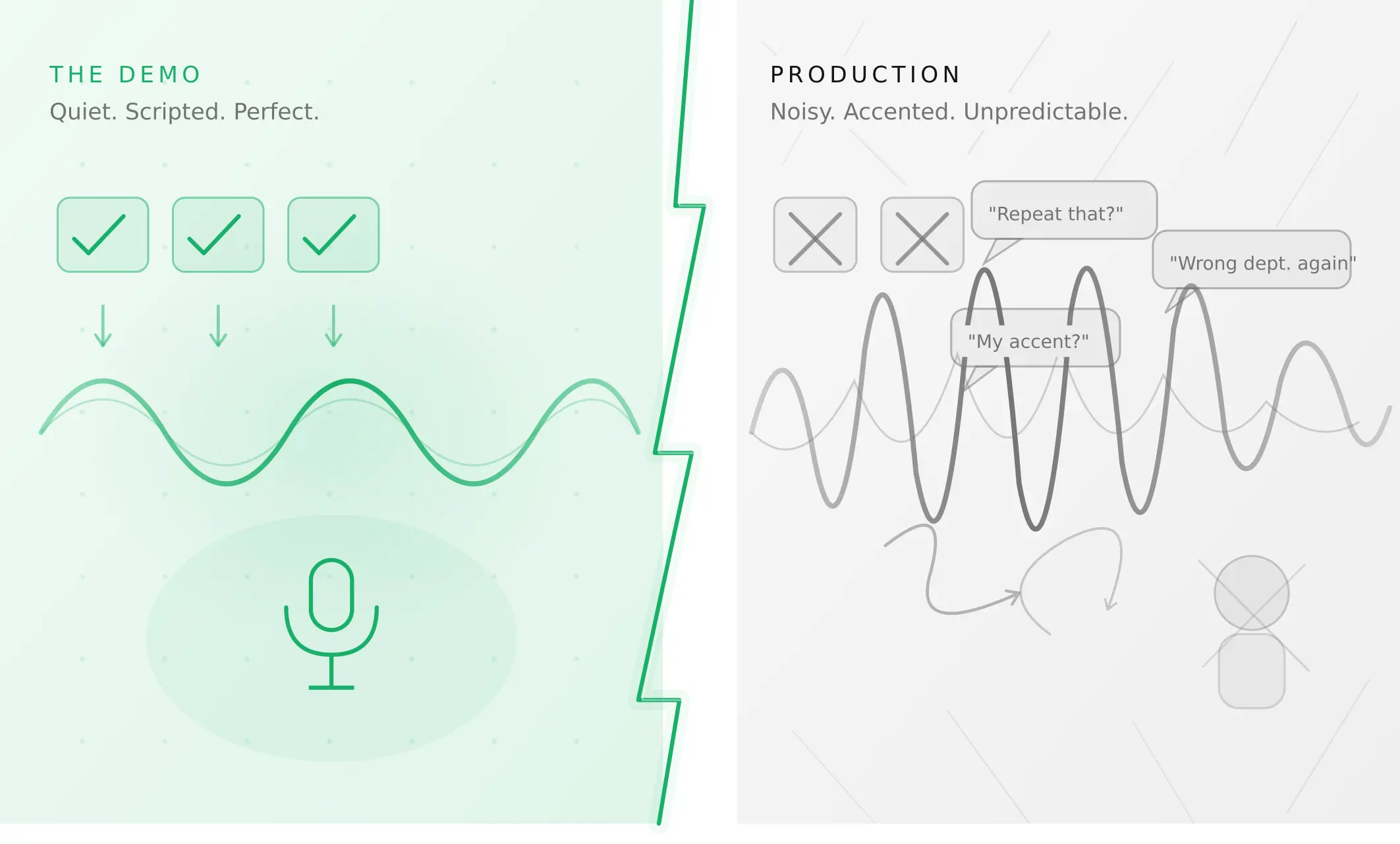
Why AI voice agents fail in production (and how to prevent it)
AI voice agents that ace demos still break in production. Learn the 5 root causes, how to test for each, and what production readiness actually means.
Read more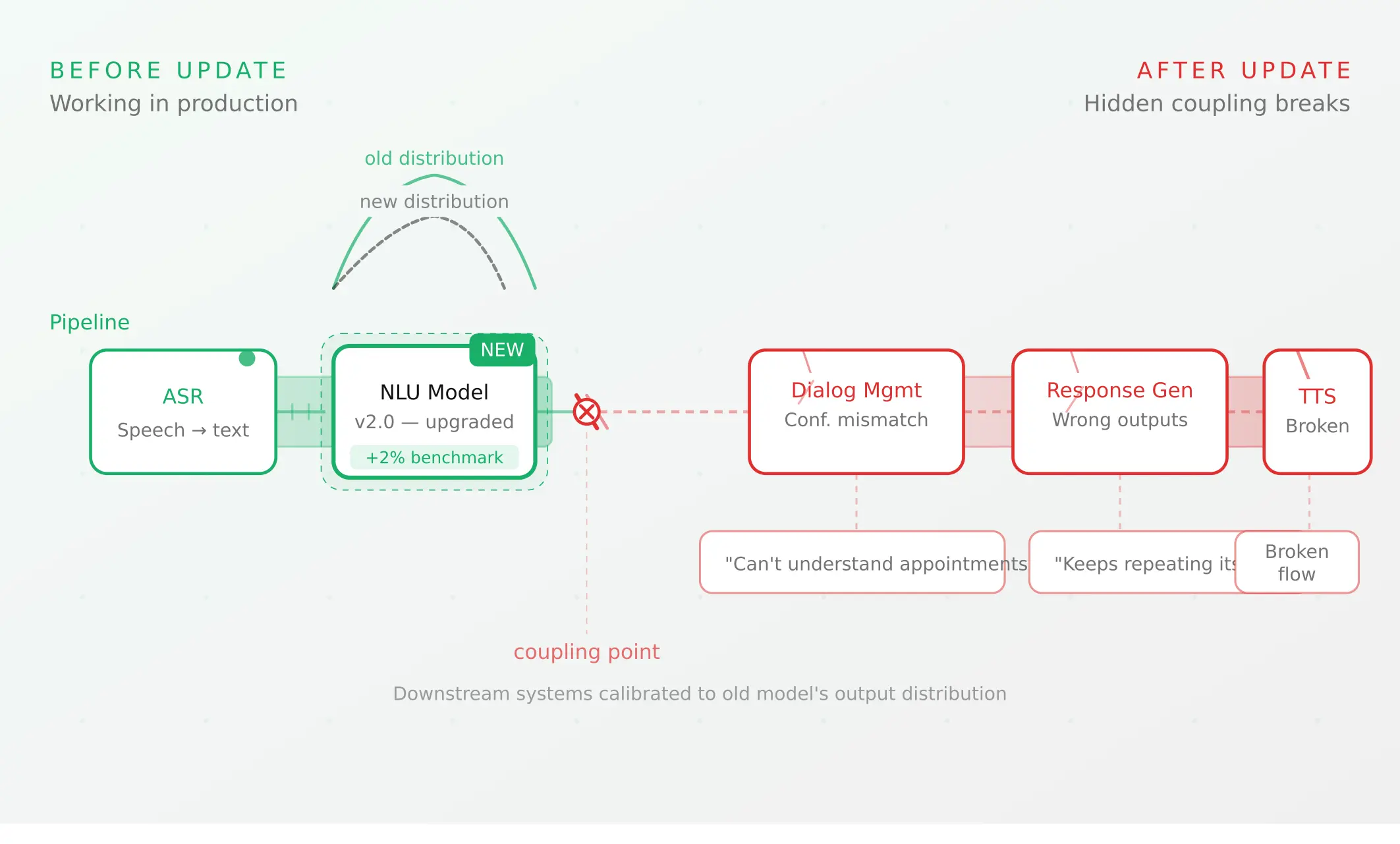
Voice agent regression testing: why LLM updates break production
LLM updates improve benchmarks but break voice agents in 5 predictable ways. How to detect and prevent regressions after every model or prompt change.
Read more